• Win a Free Custom Engraved Brass Coin!!!
    As a way to introduce our brass coins to the community, we will raffle off a free coin during the month of August. Follow link ABOVE for instructions for entering.

Vasa 1628 – engineering a ship

@Waldemar,
This is a very interesting idea. Another researcher who looked at this issue had suggested that the bilge and futtock sweeps were not only arcs of circles, but the same arcs over most of the length with adjustment of the overlap ("haling down"), which I did not find entirely convincing. I like the idea of the outer edge of the floor defined as a logarithmic curve.

How would this accommodate the widening of the hull, most likely by shifting the futtocks outward on the bottom? The ship as built is about 4 feet wider amidships than the specification (17 aln/34 feet/10.098m).

Since I think that the transom shape up to the original wing transom is to the original specification, it might be possible to derive the original shape of the run from your curves.

Always good stuff from you.

Fred
 
.​

Thank you very much, Fred, for your comment and appreciation.

Another researcher who looked at this issue had suggested that the bilge and futtock sweeps were not only arcs of circles, but the same arcs over most of the length with adjustment of the overlap ("haling down"), which I did not find entirely convincing.

I admit that I (also) find it difficult to imagine the consistency or geometric correctness of such a proposal. But maybe I just lack imagination :). Besides, I expect that such a ‘construction’ would have to be quite complicated in practical application (for all regular frames), which in itself should a priori rule it out.


How would this accommodate the widening of the hull, most likely by shifting the futtocks outward on the bottom? The ship as built is about 4 feet wider amidships than the specification (17 aln/34 feet/10.098m).


Yes, of course I will give it a try. I love solving puzzles of this type, and that is probably my main motivation to continue. Specifically, I will start by literally redrawing the contours of the futtock and bilge assembly from the museum plan, and then individually rotating them with the centre of rotation lying on the line of maximum breadth. Then we'll see if anything promising comes of it...

.​
 
.​
@fred.hocker

Fred, I think I have finally found the right solution for this aberrant shape in the aft section of the Vasa's hull. In short: it is not the bottom of the hull at the aft part of the ship that has been widened, but rather the opposite, yet with a similar effect — the line of greatest breadth (physically materialised by the scheerstrook/master ribband) is too narrow (flat) for this area. This is most likely the result of careless workmanship in the style of, nomen omen, intuitive shipbuilding ‘by eye’ instead of strictly following the ship's design. But first things first.

The 3-foot trim on the museum plans seems to be too large, and only after reducing it to 2 feet can the longitudinal design lines be consistently defined as regular geometric curves that also match the shapes of the ship as rendered in the museum plans from 1970/80.

Nevertheless, the original ship design by Hybertsson or Jacobsson must have been for horizontal keel orientation, so working with a longitudinally inclined hull, and at an inappropriate angle, was a particularly troublesome, complicated task. This is more of a piece of information for other potential researchers of the ship based on these plans than a complaint.

I have adopted or determined the following dimensions:

Original dimensions (length/breadth/depth): 153 / 34 / 15.3 (length/breadth ratio = 4.5 : 1, length/depth ratio = „classical” 10 : 1, but for depth measured from the rabbet line, not from the keelson, up to the maximum breadth line, which in turn coincides with the deck line).

Dimensions as modified by Jacobsson (length/breadth/depth): 153 / ~37 (= 34 + 1.5 + 1.5) / 15.3

These latter dimensions match the museum plan particularly well.

Deadrise at the master frame: 1.5 (measured from the rabbet line) or 1 (measured from the upper edge of the keel)

Width of the flat: 24 2/3 (= 2/3 of the breadth)

‘Boeisel’ line at the master frame: as in the diagram (reconstructed according to the specifications of Prins Willem of 1630, i.e. a ship with very similar dimensions).

In the case of the Vasa, I decided to abandon elliptical curves for defining the contours of the frames (as shown before) in favour of parabolic curves, because I realised that the so-called ‘boeisel’ line, which is actually ‘mandatory’ in Dutch designs for large ships, is nothing more than a necessary element for generating parabolic curves that define the contours of the frames. Consequently, I also reconstructed the ‘boeisel’ line for the Vasa 1628.

In practice, parabolic curves can be very well approximated by a simple strip. To verify this, I even conducted a test in the spirit of so-called experimental archaeology, using a wooden strip fixed in a vice. All one have to do is pull the strip vertically (i.e. according to the orientation of the hull) until its curvature coincides with the point determined by the coordinates taken from the ‘boeisel’ line, and voilà, the frame contour is ready (more precisely: the contour of the combination of bilge and futtock sweeps). A fairly effective, quick method with sufficient repeatability, to use an engineering term.

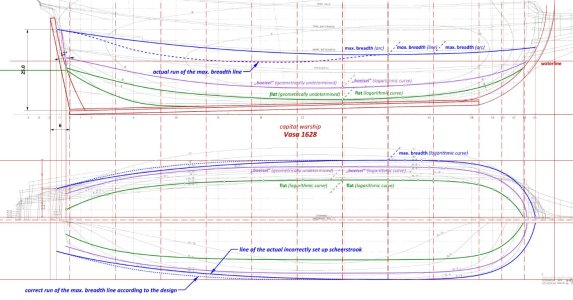
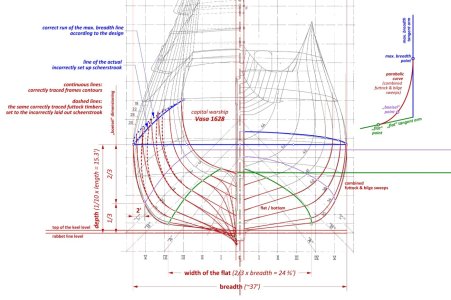
Getting to the heart of the matter, it turns out that in the top view, the maximum breadth line and the ‘boeisel’ line unnaturally converge at the aft section of the ship, which is more likely an assembly failure than a design flaw. In fact, it appears that the contours of the futtock timbers were correctly traced, that is according to the correctly defined maximum breadth line. However, the physically installed scheerstrook during the actual assembly of the hull did not comply with the design in that it turned out to be too flat laterally, which in turn resulted in the incorrect orientation of the installed futtock timbers. I have shown this phenomenon in the attached diagram, where it can be concluded that the curvature of the correctly traced frames corresponds very well with their corresponding contours on the museum plan.

In summary, if the above solution is right, then the Vasa's disaster in 1628 can be attributed most likely to sloppy workmanship, albeit exceptional in this particular case, or, if one prefers, to the intuitive assembly of the scheerstrook ‘by eye’ instead of in accordance with the previously made design of the ship. If the run of the scheerstrook in the aft section had the correct shape, i.e. more convex, in accordance with the design, the ship would have gained (or rather not lost) twice: the actual line of maximum breadth would be in its correct place, i.e. at the appropriate height, benefiting the so-called shape stability, and the volume of the submerged part of the hull would be greater, also benefiting so-called ballast stability (in particular, allowing for an increase in ballast without bringing the gun ports too close to the water).

Would more careful assembly in this respect have prevented the disaster? Appropriate calculations would have to be made, but that is perhaps a task for someone else...
ViewCapture20251204_050439.jpg

ViewCapture20251204_045006.jpg
.​
 
Last edited:
Hey Waldemar,

I'm so curious about your construction report. What research! Great, and what an expert! Amazing!

I'll definitely be following your construction report! :D Thumbsup
 
This extremely odd course of the sheer strook also caught my attention several years ago while studying Dutch construction methods.

The fact that the course of the strook on the Vasa, as it is, is caused by sloppy workmanship and poor judgment, and that they simply left it as is and continued building, seems very strange to me.
 
.​
The fact that the course of the strook on the Vasa, as it is, is caused by sloppy workmanship and poor judgment, and that they simply left it as is and continued building, seems very strange to me.

And yet...

This extremely odd course of the sheer strook also caught my attention several years ago while studying Dutch construction methods.

This reminded me of a certain (true) event. Some time ago, I made a certain discovery or observation. When I presented it publicly, a certain scholar, a doctor, announced more or less in this vein that it was actually his discovery, only future, because he had not yet had time to review the relevant source materials. But he would certainly have noticed it himself, so he considers it his discovery. Brilliant, isn't it...? :)

.​
 
Hi Waldemar,

Very nice work on this topic.
I was wondering that if all futtock wood was already in place before the change of plans of the vessel this could be the reason for the strange run of the scheerstrook.
The lowering and narrowing of the scheerstrook in the stern section allows the shipbuilders to use shorter futtocks allthough in this case a very bad decision and execution.
I can't imagine that the strange running scheerstrook was just sloppyness as you can see even by bear eye it is not running smoothly.
There supplied materials and time strain could have pushed them to this solution.
 
.
Thanks, Maarten. Yes, I realise that it is now possible to look for various reasons for the incorrect course of the scheerstrook, however, without knowing the chronology of events and perhaps some carpentry related details (such as, for example, the amount of allowance during the initial trimming of the timbers), this must remain mere speculation.

Either way, the fact remains that, in one way or another, the design was tampered with, i.e. deviations from the design were made, which could have contributed significantly to the disaster. In my opinion, the scheerstrook was distorted transversely, because both in the top view and the side projection it remains fair throughout, and on the other hand, it is difficult for me to imagine the corrugated or wavy course of the scheerstrook as shown in the side projection as actual line of the resulting breadth (dashed line).

.​
 
.​
The lowering and narrowing of the scheerstrook in the stern section allows the shipbuilders

Oh, and could you please also point to the (primary) source that indicates that the shipwrights deliberately and arbitrarily manipulated the position and course of the scheerstrook during actual construction?

.​
 
No offense intended; my comment was in no way meant to diminish your work or to claim any credit for myself.

Your work and all its conclusions are your achievement, and you deserve all recognition.

If two people recognize a fact, but only one pursues it further and gains insight from it, then naturally only that one deserves the credit.
 
.​
No offense intended; my comment was in no way meant to diminish your work or to claim any credit for myself.
Your work and all its conclusions are your achievement, and you deserve all recognition.
If two people recognize a fact, but only one pursues it further and gains insight from it, then naturally only that one deserves the credit.


Thank you, Bela, for writing that. But let's leave this rude scheerstrook aside for now.

I guess you are quite knowledgeable about, let's call it, drafting and design issues, so I wanted to draw your attention to the hollowing/bottom curves, which I also deliberately included in the diagram above (dashed lines). It turns out that these are also regular geometric curves (specifically parabolas), and what is more, they were all generated unisono, that is in a consistent, uniform geometric manner. Perhaps they were obtained by the original builders of the Vasa using just ribbands or some other carpentry way, but the geometric construction I used is exactly the same as known from later constructions/designs.

That would mean, or rather confirm (at least for me personally), that the ‘flat’, in its entirety, was assembled according to strictly predetermined shapes, and not in some more or less haphazard manner.

.​
 
Last edited:
.​
I can't imagine that the strange running scheerstrook was just sloppyness as you can see even by bear eye it is not running smoothly.


Ah, now I realise that there has been a misunderstanding because you did not understand the diagrams shown above correctly.

Although the descriptions in the diagrams are correct and unambiguous, yet, to be on the safe side, I will add that in the side view (sheer view), the blue solid line indicates both the designed maximum breadth line and the scheerstrook line, which should coincide, and in this case actually did coincide, but only in this projection.

The blue dotted line, on the other hand, marks the actual, resulting breadth of the hull, non-compliant with the design , which is the result of the scheerstrook being too narrow, i.e. in the horizontal plane. This can also be better understood by consulting the longitudinal projection (end view, body plan), also with the correct descriptions, distinguishing between the concept of maximum breadth and scheerstrook.

Judging by the terminology used, it seems to me that Bela also made the same mistake in reading the diagrams shown.

.​
 
.​

Fine, as it is, I believe that the investigation into the Vasa 1628 case has been finally successfully accomplished, both in terms of the general design of the ship and the most probable reason for its aberrant shapes, and both hitherto unknown, and can be considered closed.

As a side note, I would like to add that, having been confronted with various reactions, comments and remarks during this and other investigations, I am beginning to understand better why the ‘belief’ in the construction of Dutch ships ‘by eye’ was so easily created and, on the other hand, so easily and even enthusiastically accepted as a valid ‘religion’.


@fred.hocker

Now, in the context of the next, planned volume of the Vasa 1628 archaeological monograph, which is intended to describe the construction and hopefully conceptual aspects of the ship, I would like to clearly state my name, and even in upper case, since in the latter volume of this official monograph there are recurring spelling mistakes in the name of at least one of the cited persons from my region. This is in case one would wish to use the results of my investigation into the Vasa case, instead of, in particular, continuing to follow the now anachronistic ‘religion’ of constructing ships ‘by eye’, and widely propagated in academic and other works up to now.

Perhaps the very way of presenting the results of the analysis, i.e. via Internet, is not yet considered sufficiently dignified to them being referred to in so-called scholarly publications, fortunately, one can always use a substitute method of reference in the already commonly accepted mode of “personal communication”, whatever that means.


Anyway, good luck and thank you,

WALDEMAR GURGUL

.​
 
.​

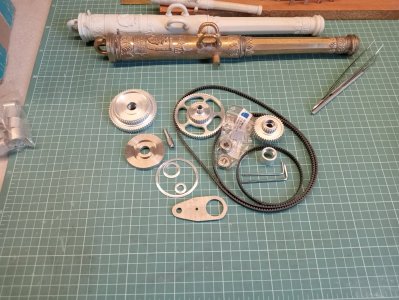
And yet another great video to show. It will be particularly appreciated by users of the Unimat 3 lathe with its original, rather unsuccessful, power transmission system. As can be seen, I converted the whole thing to use toothed belts, instead of smooth belts that slipped and tore quite often. Enjoy!


View attachment 502972
ADMIN.... How do I delete this post, to preserve Waldemar's singular Vasa theme?
Thank you for sharing your Unimat 3 mods.
Did you make the pullies yourself?
Do you think there would be anything to be gained by increasing the mass of the larger one? ie a flywheel
 
Last edited:
.​
Thank you for sharing your Unimat 3 mods.
Did you make the pullies yourself?
Do you think there would be anything to be gained by increasing the mass of the larger one? ie a flywheel

Hi :),

I would be happy to discuss this, as I have even made a few sets to potentially share with other Unimat 3 users, if you are interested. The components are fully machined, but they still need to be assembled, and some drilling and threading is required during assembly. You can see the almost complete set in the attached photo.

But I have a request: please delete your post here and tag me in your thread. What do you say?


IMG20251206133329.jpg
.​
 
.​


Hi :),

I would be happy to discuss this, as I have even made a few sets to potentially share with other Unimat 3 users, if you are interested. The components are fully machined, but they still need to be assembled, and some drilling and threading is required during assembly. You can see the almost complete set in the attached photo.

But I have a request: please delete your post here and tag me in your thread. What do you say?


.​
Thank you, Waldemar. Your kit looks splendid but beyond my budget?

Am happy to delete my post but don't understand ''please delete your post here and tag me in your thread. What do you say?''

PM me please.
 
.​

Fine, as it is, I believe that the investigation into the Vasa 1628 case has been finally successfully accomplished, both in terms of the general design of the ship and the most probable reason for its aberrant shapes, and both hitherto unknown, and can be considered closed.

As a side note, I would like to add that, having been confronted with various reactions, comments and remarks during this and other investigations, I am beginning to understand better why the ‘belief’ in the construction of Dutch ships ‘by eye’ was so easily created and, on the other hand, so easily and even enthusiastically accepted as a valid ‘religion’.


@fred.hocker

Now, in the context of the next, planned volume of the Vasa 1628 archaeological monograph, which is intended to describe the construction and hopefully conceptual aspects of the ship, I would like to clearly state my name, and even in upper case, since in the latter volume of this official monograph there are recurring spelling mistakes in the name of at least one of the cited persons from my region. This is in case one would wish to use the results of my investigation into the Vasa case, instead of, in particular, continuing to follow the now anachronistic ‘religion’ of constructing ships ‘by eye’, and widely propagated in academic and other works up to now.

Perhaps the very way of presenting the results of the analysis, i.e. via Internet, is not yet considered sufficiently dignified to them being referred to in so-called scholarly publications, fortunately, one can always use a substitute method of reference in the already commonly accepted mode of “personal communication”, whatever that means.


Anyway, good luck and thank you,

WALDEMAR GURGUL

.​
 
Back
Top