• Win a Free Custom Engraved Brass Coin!!!
    As a way to introduce our brass coins to the community, we will raffle off a free coin during the month of August. Follow link ABOVE for instructions for entering.
  • SUBSCRIBE TO SHIPS IN SCALE TODAY!

    The beloved Ships in Scale Magazine is back and charting a new course for 2026!
    Discover new skills, new techniques, and new inspirations in every issue.

    NOTE THAT OUR NEXT ISSUE WILL BE MARCH/APRIL 2026

What do you use as a sealer for rigging thread?

In recent years I have been using waxed threads /China, on ALI/Thickness from 0.35-0.8 different colors. I used to pass the threads through a melt of wax with turpentine added to improve impregnation. My models with such impregnation have practically no rigging game for 35 years. It all depends on the depth of impregnation. When restoring old models, you have to use the original material for those times - cotton or linen.
 
Hi, Bob. Will this Shellac work on polyester ropes and knots as good as on cotton ones? Will it seal polyester rope ends to prevent them to flare out?

Well, in the spirit of full disclosure, I've never done a scientific test on it, but I can't see why not. I've never distinguished between the natural and synthetic fibers on that score. It's always worked for me. The early synthetic thread was closer to monofilament fishing line than anything else, but the technology has come a long way. The dies through which the polyester fibers are extruded are incredibly fine and the raw polyester fibers are hard to tell the difference from natural fibers by looking at them with the naked eye. The mechanism of using shellac to fix knots and stiffen and hole coil shapes is the same with synthetics as it is with natural fibers. The dissolved shellac is absorbed by the thread via capillary action, filling the spaces between the fibers. When the alcohol evaporates, it leaves the shellac, hardening as its alcohol solvent dries, to create a matrix with the fibers, be they natural or synthetic.

There shouldn't be any problems using shellac on any kind of thread to glue ends so they will not unravel. The twisting of the thread into scale rope creates residual forces which tend to promote the "rope's" unlaying when cut, but when shellac is applied to the area of the cut and dried (which occurs very quickly) the adhesive property of the dried shellac is more than sufficient to prevent unraveling.
 
Idle curiosity, I looked up linen thread on the internet and it’s still available. A company called Taras sells linen bookbinding thread and another called Hollander sells linen sewing thread. Research is required to figure out thead nomenclature and sizes. Also, some linen threads have little lumps every so often, which would not work for us.

Roger
 
In recent years I have been using waxed threads /China, on ALI/Thickness from 0.35-0.8 different colors. I used to pass the threads through a melt of wax with turpentine added to improve impregnation. My models with such impregnation have practically no rigging game for 35 years. It all depends on the depth of impregnation. When restoring old models, you have to use the original material for those times - cotton or linen.

Excellent points! When restoring models of any antiquity, great pains should be taken wherever possible to preserve the original fabric of the artifact and where that's impossible, replace old material with identical new material. Unfortunately, the delicacy of scale ship model rigging often makes that a very difficult, if not impossible task. Previously, the rigging on many old models (e.g., all but a few of the extant rigged Navy Board models) deteriorated to the point of no return and were, several times in some instances, entirely re-rigged with new material for better or worse. Interestingly, however, present-day professional restorationists and conservators are reporting that application of Paraloid B-72 adhesive resin permits for the first time the "end to end" repair of broken rigging line using newly developed techniques, as well as the stabilization and preservation of intact, but extremely weakened rigging line in older models. As most know, linen, hemp, silk, and even in some cases cotton threads suitable for making scale cordage are in many instances no longer obtainable except perhaps on special order requiring a run of tremendous quantities at exceptional cost. Ship modelers have created a niche market for "new old stock" thread suitable for making scale rope, but obviously this can only be a temporary solution for those fortunate enough to have obtained a supply to sustain future use. (It should not be forgotten, either, that old thread deteriorates at about the same rate on a spool as it does on a model, so the wisdom of re-rigging a 100 year old model with 100 year old thread is questionable.

Surprisingly, even where suitable thread to make scale cordage is available, some major museums have recently actually specified the use of equivalent synthetic threads for making scale cordage to be used in their restoration laboratories. As mentioned as well, the use of B-72 for the conservation and repair of ship models, as well as a myriad of other museum artifacts, has near universally replaced all other similar materials and then some. B-72 has only been in existence for about fifty years and has not been widely marketed to the general public, remaining a product known primarily to the relatively small community of professional scientists, restorationists, and conservators in museums and scientific institution laboratories. If shellac used to be the best material for the job, in nearly every application, it's looking like B-72 is a "better mousetrap." This isn't me talking. I'm just reporting what the scientists have been saying.

If anyone is for whatever reason attached to "waxing" their scale rigging cordage, which I suppose I must admit is a matter of taste, as is "waxing" anywhere else, it is certainly true that any benefit which might obtain from doing so will only be realized by a method of application such as you describe which completely saturates all the thread instead of just rubbing a block of wax over the outside face of the material. (The latter method works for a single thread, but not for a lay-up of twisted threads into three- or four-strand scale rope.) Waxing makes thread stiffer, stronger, and more water repellent. Whether or not any of those enhancements are of any value whatsoever to their use in making scale cordage is entirely up to the modeler. For my own modeling, I don't anticipate any of my models being exposed to water, the strength of the scale rigging material I use exceeds any possible design parameters by orders of magnitude, and if I require stiffness to form shapes or secure knots, I use local application of thin clear shellac and anticipate replacing that with B-72 in the immediate future.

My own two personal concerns with using waxed rigging thread to rig scale ship models are first that the wax imparts a sheen on the waxed rigging material which is unrealistic in appearance. Second, wax is not a particularly "reversable" material, as they say in the restoration and conservation profession. In other words, it's hard to remove from laid scale cordage later on if necessary. If I were asked, I'd say that anyone who desires the benefit of waxed thread for use as ship model cordage would be well advised to avoid the practice of running the thread or worse, laid up scale rope, across a block of bee's wax. This is a messy way to obtain an unnecessarily thick and uneven coating. It's much easier and a far better wax coating is to be had by purchasing any one of the more suitable pre-waxed threads offered by most of the major thread manufacturers.
 
Any diff between using Lineco PVA and using diluted Titebond?
To keep ropes in their 'natural' shape, or secure knots, I use Lineco Neutral pH Adhesive, diluted with water.
View attachment 589658
2 or 3 thin layers will dry transparent, without a glossy surface. Let it dry in the shape you wanted:
Before:
View attachment 589668
After:
View attachment 589659
Use the ‘search option’ of the forum with ‘Lineco’ and you will find lots of positive posts with the use of this PVA.
Regards, Peter
That looks sweet - Gonna order 4 oz of Lineco. Is it more flexible than say, Titebond PVA?
 
Any diff between using Lineco PVA and using diluted Titebond?

That looks sweet - Gonna order 4 oz of Lineco. Is it more flexible than say, Titebond PVA?
Hi Tim. I have no experience with Titebond. Here in the Netherlands I use the Dutch brand Bison. And there PVA gives a little bit of a white film by diluted use and indeed less flexible.
Regards, Peter
 
Idle curiosity, I looked up linen thread on the internet and it’s still available. A company called Taras sells linen bookbinding thread and another called Hollander sells linen sewing thread. Research is required to figure out thread nomenclature and sizes. Also, some linen threads have little lumps every so often, which would not work for us.

Roger
Yes! I've been monitoring this development myself. There's a lot of new products coming on the market, apparently driven by the "environmentally hyper-conscious," for want of a better term. Most of this thread is hemp, although there is some promising looking linen coming on the market as well. It doesn't really matter if it's hemp or linen, since the two fibers are virtually indistinguishable. Hemp is slightly longer fibered than linen, as I recall, which is why it was favored for rope. Linen was a little softer, which is why it was favored for cloth weaving. I've read it takes a scientist and a microscope to tell the two apart.

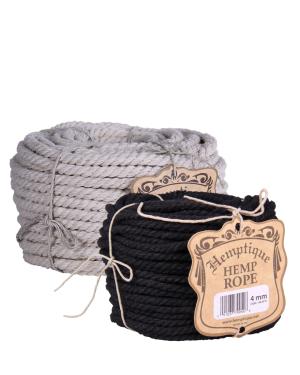
One company offering waxed and unwaxed hemp and linen line (and even rope) is Hemptique. I don't know whether it's of a size and quality we require for ship modeling. If it's suitable, I hope somebody lets us know! A lot of it looks rather "nubby," and I have no idea of their size or color ranges, really. It would be nice to have a source of linen or hemp for restoration work on older models, if nothing else, but as for new construction, it almost seems like we can't put the toothpaste back in the tube when it comes to natural or synthetic materials. The modern polyester threads do seem to have handily triumphed over the natural fiber threads at this point. I certainly have a hard time telling the difference between the two and I'll trust the scientists as to the longevity of each, which is pretty good either way.

See: https://hemptique.com/


1775421089852.png
 
Last edited:
Bob, My wife takes clothes to be altered to a seamstress who does alterations to support her real interest; designing and sewing high quality women’s’ apparel. She’s a kindred soul to our model shipbuilding. There are women my wife included, who prefer to buy clothes made from natural fibers. Her attitude about polyester closely mirrors ours about polyester rigging.

The high end quilters are also kindred souls.

Roger
 
Bob, My wife takes clothes to be altered to a seamstress who does alterations to support her real interest; designing and sewing high quality women’s’ apparel. She’s a kindred soul to our model shipbuilding. There are women my wife included, who prefer to buy clothes made from natural fibers. Her attitude about polyester closely mirrors ours about polyester rigging.

The high end quilters are also kindred souls.

Roger

Definitely. Wives of our generation know a lot about clothing. I'd have to say that most of the quality classic clothing in my wife's closet (and by extension, a lot in my closet, even though I'm known for not being a clothes horse,) are natural fiber material.

The serious fine art quilters surely are our cousins. I've known three of them over the years, one a nationally recognized competitive exhibitor. Archival quality is very important to them, as it should be to scale ship modelers as well, even though not many ship model kit manufacturers seem to have "gotten the memo." I'm due to make a trip to a little specialty store here in town that specializes in all things "quilting." I'm in search of some very finely woven light "handkerchief" material, AKA "ballooner," for a sailing model I'm restoring. I wouldn't normally try putting woven cloth on a model of this scale, but as it's an heirloom restoration job, my mission is to restore it to "intact as built" condition (multiple broken spars and standing rigging.) without changing the builder's work or destroying its 100-year-old age-appropriate "patina." (In this case, the aim isn't to improve the model, but to accomplish undetectable repairs.) Alas, the very thin cloth sails are so deteriorated, mainly from UV exposure, that they tear at the touch and will have to be replicated and replaced anew. I'm pretty sure I can find some suitable material there that quilters use to "back" their quilts.

I find shopping online for materials like this frustrating. I need to get my hands on the stuff to determine if it is really what I am looking for. Online descriptions often don't suffice. Unfortunately, the local independent fabric and sewing stores are mostly long gone and now even the chains like Beverly Fabrics and Joanne's are closing their brick and mortar stores.

I also do a lot of "scrounging," a skill I've always been good at and refines for ship modeling after reading the old "how to" books back in the days when they recommended keeping an eye out for anything that could be used on a model instead of buying it from a hobby shop. (Remember those? ) I've got four old dining room table inserts in my lumber stash, about an inch thick, two of unfigured black walnut and two of unfigured real mahogany, eminently suitable for modeling. This stuff is definitely not be found in a kit at any price and surely imported prior to CITES regulations and the Lacey Act. They cost me nothing at the local dumps. I don't understand the younger generation modelers who won't invest in even basic woodworking tools to mill their own modeling wood but will instead drop four figures on a box of low-grade strip wood that they will have to supplement with additional purchases of "kit upgrade packages" to even begin to approach an appropriate level of materials quality for a decent build. My daughter told me it's called the "IKEA method:" Nobody buys anything to keep for a long time. They just buy cheap new junk and throw it out when it gets shabby. That way everything they own is always "new and in style." Go figure!

At the risk of "thread drift," I'll mention that I am a big proponent of what I call "cross-sourcing." Modelers who limit themselves to retail sources that cater primarily to ship, or even generic, modeling, are often victims of "tunnel vision" as well as predatory marketing practices. The "modeling" catalogs usually have the highest prices for what they are selling anywhere. I often will search online for ship modeling tools and materials in other subject matter areas, such as medical and dental instrument suppliers' catalogs, commercial jewelers supply houses, and, recently, in fly fishing supply retailers. I just got a fly-tying vise and some fly-tying tools for about thirty bucks off TEMU which promise to make my block making and rigging life a whole lot easier. I knew there were such things for fly tying, but until I dug a bit deeper, I had no idea the solutions the fly-tyers had come up with to serve small diameter wire and thread were so directly applicable to ship modeling. The same is true of the archery crowd that has available some wonderfully simple, but highly effective tools for serving fine line. All of those tools would probably cost twice as much if there were the words "ship modeling" anywhere on the box!

I think scale ship modeling is a creative endeavor that demands creative thinking in every aspect of the craft. Anybody who gets into it with a "buy it" rather than a "do it yourself," and I mean really "do it yourself," not just "assemble it yourself," mentality has one arm tied behind their back (and somebody else's hand in their pocket) right out of the gate. That's just my opinion, though. All the usual disclaimers apply. "Your mileage may differ" and all that.
 
Back
Top