• Win a Free Custom Engraved Brass Coin!!!
    As a way to introduce our brass coins to the community, we will raffle off a free coin during the month of August. Follow link ABOVE for instructions for entering.
  • PRE-ORDER SHIPS IN SCALE TODAY!

    The beloved Ships in Scale Magazine is back and charting a new course for 2026!
    Discover new skills, new techniques, and new inspirations in every issue.

    NOTE THAT OUR FIRST ISSUE WILL BE JAN/FEB 2026

ZHL San Felipe 1690

Joined
Jul 25, 2025
Messages
48
Points
78

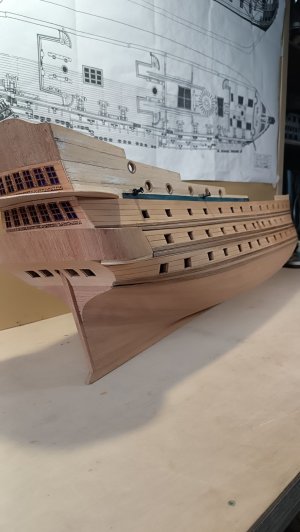
Hello. I'm new to this site. I'm from Russia, so I apologize in advance for my English, but Google Translate is helping me. If anything, I apologize for the mistakes, but this post on this site is a bit unusual for me, especially for the first time.I want to share my build of this rather popular kit from China. I turned 62 in August, and this set was a kind of birthday present from my wife and daughter. In my youth, I was interested in ship modeling, but as I got older, I had less and less time for it. I haven't done this in twenty years, so I decided to try again. I came across this website when I was looking for information about this model. I'm putting it together now, and this is what it looks like. But first things first.
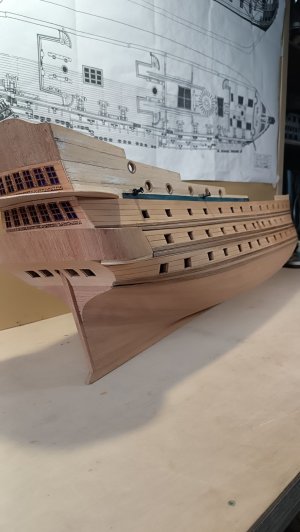
IMG_20251105_134720.jpg

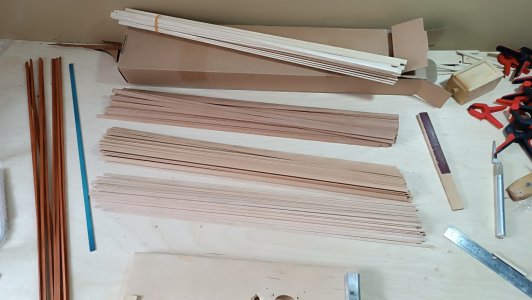
I ordered a kit from China through a Russian marketplace. It cost 185 dollars with delivery at the current exchange rate. They were delivered to our Upper Volga region quite quickly, in a little less than a month. Immediately, I purchased pink pear and sapele boards for the exterior cladding, as well as a white pear for the deck, which cost me another $70.
.trashed-1759048327-IMG_20250829_123141.jpg
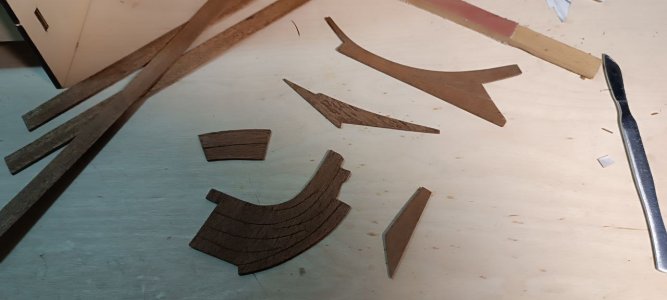
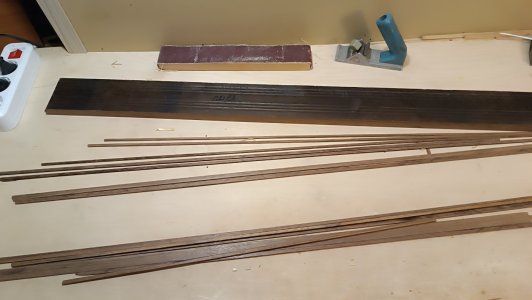
For the barkhouts, I sawed dark walnut planks from my reserves.
IMG_20251106_213515.jpg
I have experience building models from scratch, not from kits. Such instructions turned out to be of little use to me, especially since they were very schematic and in Chinese. The drawing served as a kind of "bible for assembly.And, of course, I had to prepare a new workbench first; I had never built sailboat models of this scale before. The frame was assembled with almost no hitches, but we had to raise the beam line at the stern a little; the Chinese made a small mistake in some details, which greatly affects the design of the stern galleries.
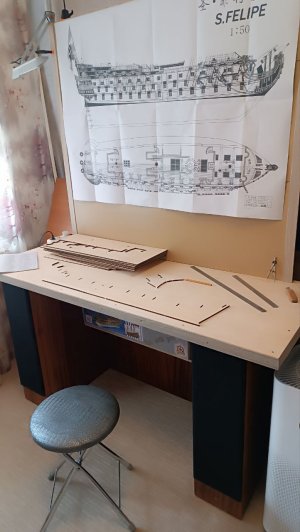
фото_2025-08-21_22-04-00 (4).jpgIMG_20250821_033950.jpg
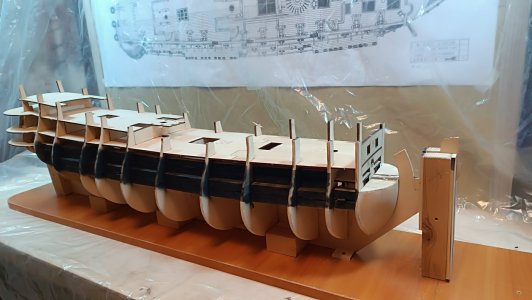
I also made linden bosses for the bow and filled the deck with linden slats for installing half-pillows, and painted everything black.
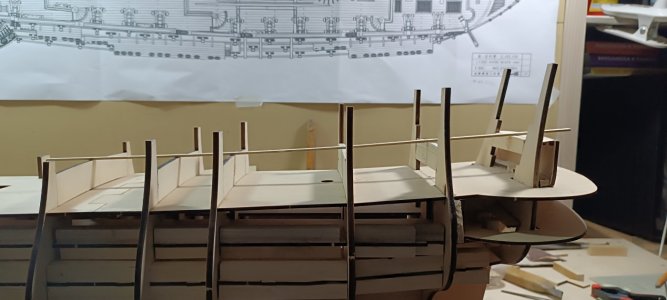
IMG_20250824_000034.jpg

IMG_20250824_211656.jpg
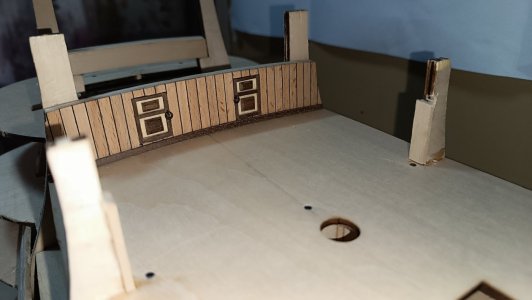
There were no problems with the roughing. However, I still haven't decided on the type of wood. It's a pity that it's not a lime tree, but unlike us, there doesn't seem to be much of it in China. The material that came in the kit is a bit fragile, but it's easy to work with — the main thing is not to sand it to holes.But before proceeding with the black plating, it is necessary to install the finishing trim and doors on both bulkheads. Otherwise, you won't be able to get to them later.
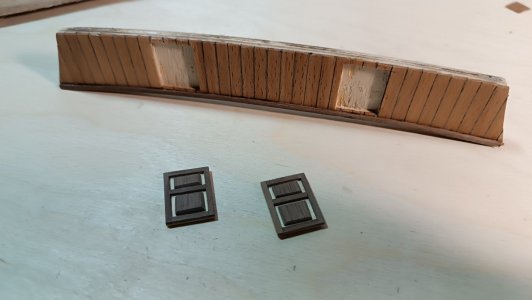
IMG_20250902_213521.jpgIMG_20250904_124418.jpg


.trashed-1758910079-IMG_20250827_220556_обработано.jpg.trashed-1759323440-IMG_20250901_165641_обработано.jpg
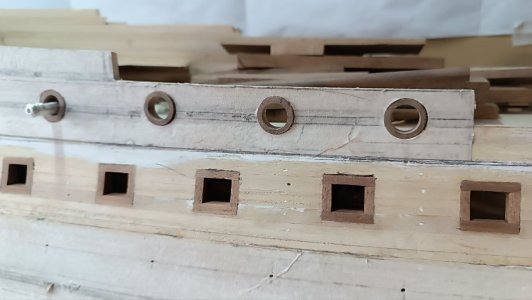
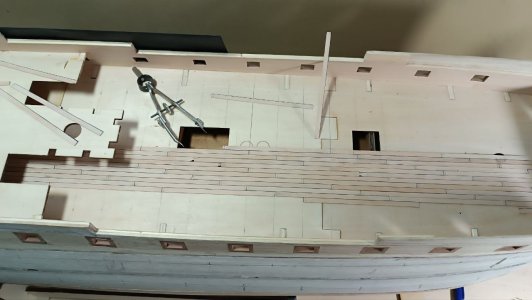
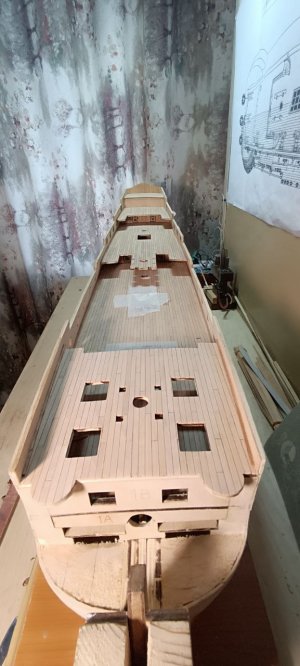
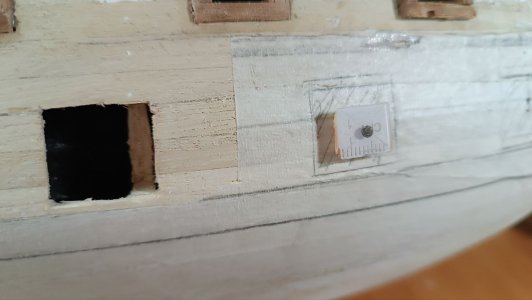
Then I started laying the deck deck, but before that I marked out a place in the hull for gun ports and slats. I took all the dimensions from the drawing; the template from the set was not used, as it slightly does not match the original.
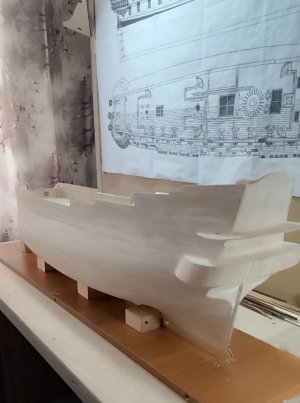
photo_2025-09-14_09-29-28_обработано.jpgIMG_20250911_000931.jpg
I also pre-installed the gun port racks on the upper deck.
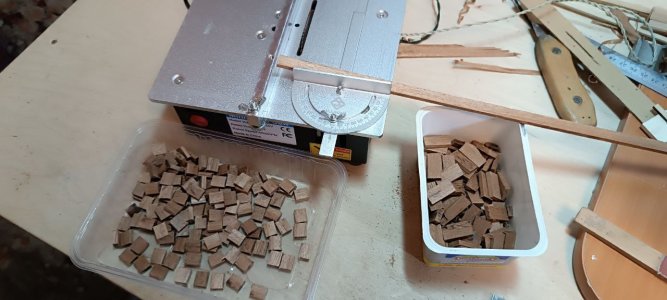
фото_2025-10-12_11-33-33 (3).jpgфото_2025-09-25_01-33-11.jpg


фото_2025-09-25_01-33-09 (2).jpgфото_2025-09-25_01-33-09.jpg
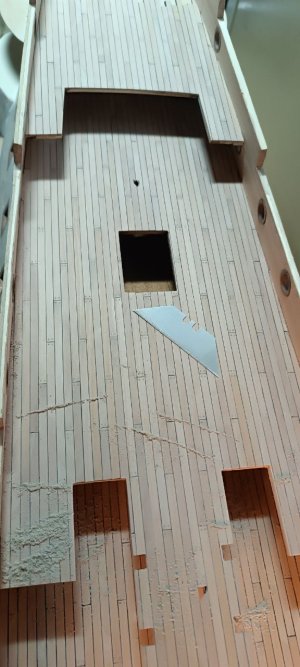
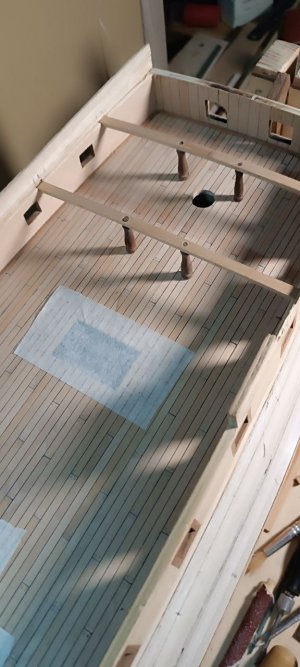
For the flooring, I used light pear planks with a thickness of 1 mm and a length of 4 mm. The length of the board was 100 mm, although 120 mm would be more accurate. I laid them in three boards with a pitch of 25 mm. I pre-modeled the sheets and unpacked the joints, and then laid them. Birch toothpicks were used as dowels, and thin black drawing paper was used for joints.
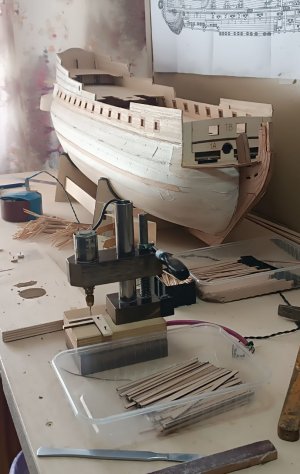
фото_2025-09-25_01-33-10.jpg

фото_2025-10-01_12-44-55.jpgфото_2025-10-08_07-44-01 (2).jpg


фото_2025-10-08_07-44-00 (2).jpgфото_2025-10-08_07-44-00.jpgфото_2025-10-08_07-43-59.jpg


I think that's enough for today. To be continued. If you have any questions, ask, and I'll try to answer them in as much detail as possible.


IMG_20251105_134720.jpg

IMG_20251105_134720.jpg
 
Last edited:
Welcome.

No problem understanding you at all. That's a great looking ship and you seem very skilled and well-equipped.

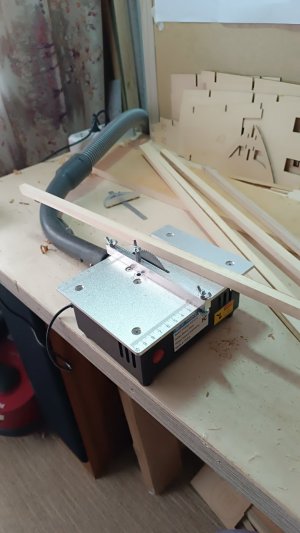
I also love that mini-machinery. May I ask what table saw that is?

Richard
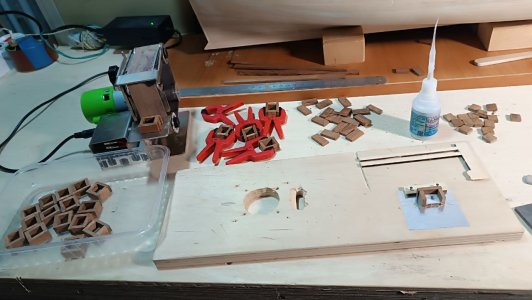
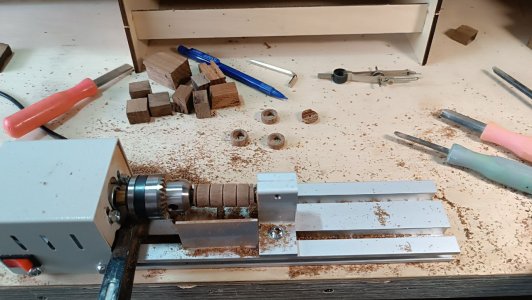
The saw, as well as the lathe, and the grinder are made in China. They are inexpensive, each machine at our rate is about 15-20 dollars. They are quite simple, but they do their job well, but they certainly won't be hindered by some improvements. Specifically for this saw. The collector motor is 95 watts. Transmission from shaft to disc by means of a toothed belt. The set includes several saw blades for wood, plastic and metal, with a diameter of 63 mm. The worktable is adjustable in height. The maximum cutting depth is 14 mm. The kit includes an adjustable power supply unit with a maximum voltage of 24 volts.

The Chinese also include a set of socket wrenches to replace the saw blades. The saw can be disassembled quickly and conveniently . There is a marking in millimeters on the desktop, there is also a feeding guide with a protractor, a groove is milled in the desktop for it. It is convenient to end the slats at any angle. The only drawback is the guide rail, which is mounted with flaps, it probably needs to be improved. But in principle, I'm quite happy with this saw.

IMG_20250820_151335.jpg
 
The saw, as well as the lathe, and the grinder are made in China. They are inexpensive, each machine at our rate is about 15-20 dollars. They are quite simple, but they do their job well, but they certainly won't be hindered by some improvements. Specifically for this saw. The collector motor is 95 watts. Transmission from shaft to disc by means of a toothed belt. The set includes several saw blades for wood, plastic and metal, with a diameter of 63 mm. The worktable is adjustable in height. The maximum cutting depth is 14 mm. The kit includes an adjustable power supply unit with a maximum voltage of 24 volts.

The Chinese also include a set of socket wrenches to replace the saw blades. The saw can be disassembled quickly and conveniently . There is a marking in millimeters on the desktop, there is also a feeding guide with a protractor, a groove is milled in the desktop for it. It is convenient to end the slats at any angle. The only drawback is the guide rail, which is mounted with flaps, it probably needs to be improved. But in principle, I'm quite happy with this saw.

View attachment 555513
Thanks. Looks interesting.
 
I will continue the review on the construction of the "Spaniard". The keel frame itself in the set is made of 5mm plywood, but according to the drawing, the keel, stem, and bottom should be 8mm. I sheathed them with 1.5 mm mahogany plywood, getting the desired result. A 1 mm wide groove was provided for the trim strips.
A 1 mm wide groove was provided for the trim strips.
photo_2025-09-25_01-33-10 (5).jpgphoto_2025-09-25_01-33-10 (4).jpg
photo_2025-09-25_01-33-10 (3).jpg

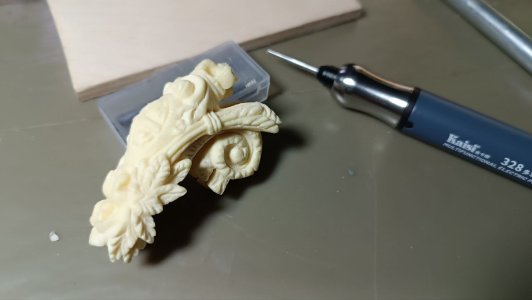
Meanwhile, I worked the nosepiece with a miniengraverandchisels,andtriediton.Ihadtomakeaselection for it on the knavdiged,sincetheseat of the noseornament is 5 mmwide.

photo_2025-10-12_11-32-49 (2).jpg
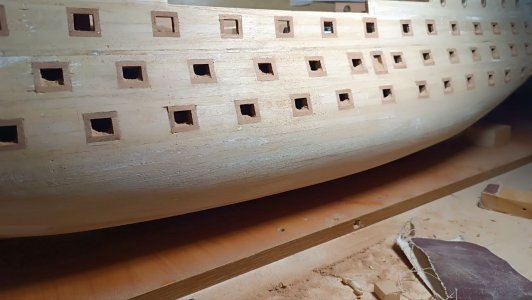
Before starting the finishing work, it is necessary, of course, to install gun ports for all decks.
photo_2025-10-12_11-33-33 (2).jpg
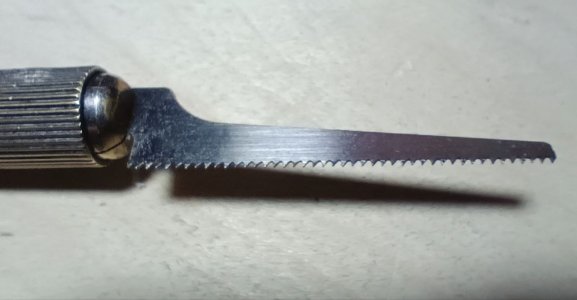
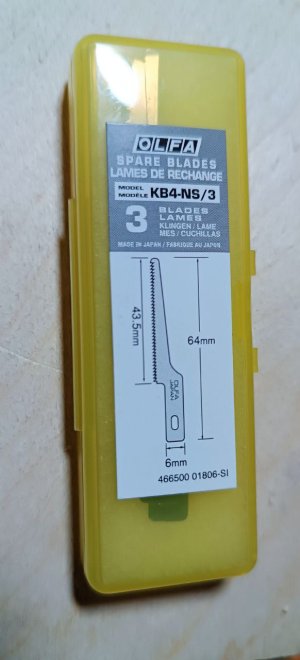
For cutting holes, I recommend these Japanese saws. They are very thin, elastic and flexible at the same time, perfectly sharpened and do not blunt quickly. In a box of three pieces, in oil, on a foam backing. It cost me six dollars.
photo_2025-08-12_22-22-13 (2).jpgphoto_2025-08-12_22-22-13 (4).jpg
Wood dust, there's no getting away from it, I have to work with my asthma in a respirator. which of course causes some inconvenience.
photo_2025-10-20_20-29-31.jpg
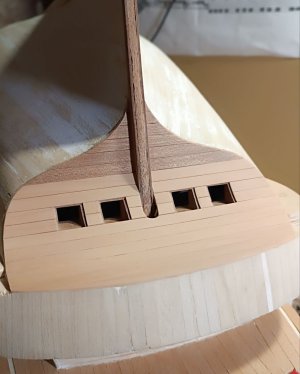
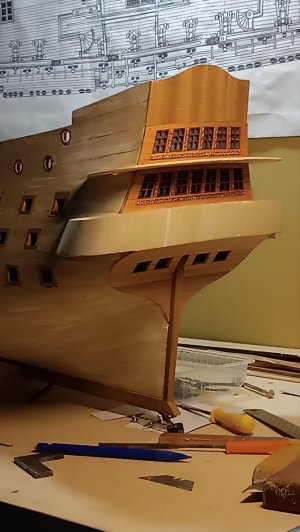
Some work is also needed on the transom of the model and on the aft galleries.photo_2025-10-20_20-29-31 (2).jpg
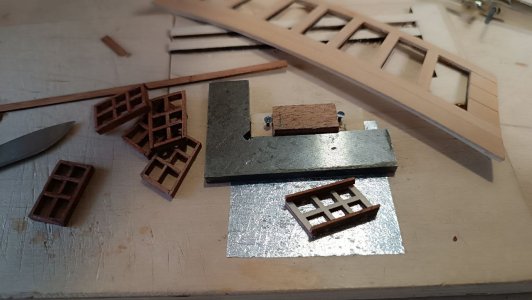
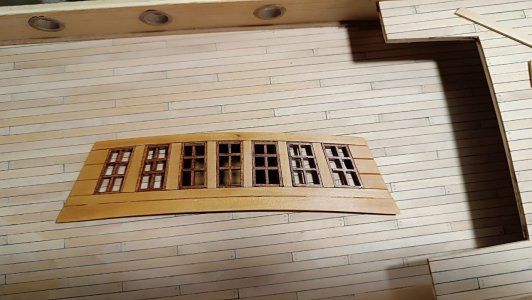
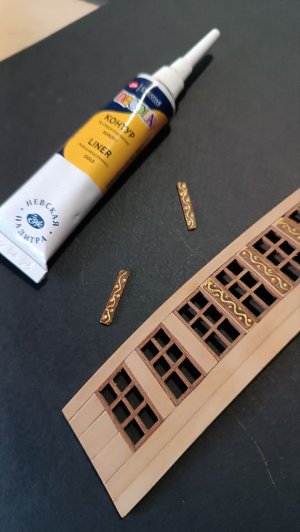
I didn't really like the windows made of thin plywood included in the package, but I used them as conductors for gluing windows made of thin mahogany slats. I glued everything with super glue. A pink pear was used for the bulkhead itsel, coated with tuna oilf, . The decoration between the windows is just my fantasy, but I need to have a steady hand and good eyesight.
photo_2025-10-20_20-29-31 (3).jpgphoto_2025-10-20_20-29-31 (4).jpg
photo_2025-10-20_18-55-17 (2).jpgphoto_2025-10-20_20-41-46.jpgphoto_2025-10-20_20-39-21.jpg
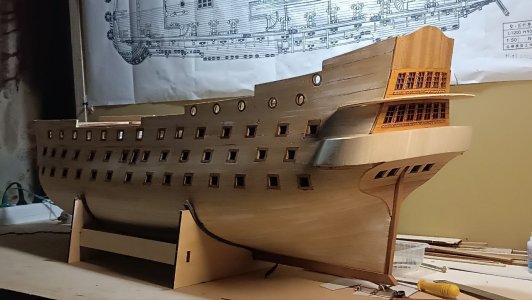
Everything is ready for finishing. Above the waterline it will be a pink pear, below it a mahogany tree (sapel). I haven't decided yet what to trim the foredeck and quarterdeck with, but there are plans for a painted blue hornbeam. I usually don't like to paint the model with acrylic paints, preferring the natural color of wood, with a finish coating with tung oil. But this is already in the next series of construction. That's all for now.

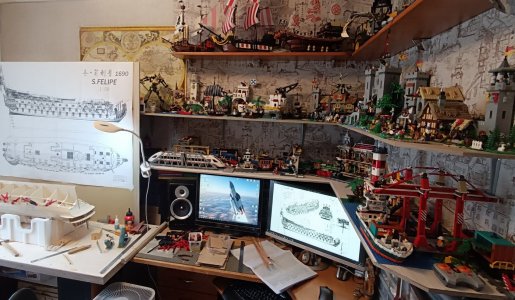
Ps: A little more))) the view of my "den". As you can see, the old tree stump is also fond of Lego, although it was necessary to squeeze out a fairly extensive collection due to the construction of the Spaniard and partially move it to another room, there are old "vintage" sets from the Pirates of the 90s series, such as Fort El Dorado and several more from the same series. Of course, it is necessary to remove all this, inevitably everything is covered with a layer of dust. My grandson is coming to stay for the New Year. So everything needs to be washed and moved to the children's room..trashed-1758954059-IMG_20250828_100324_обработано.jpg

photo_2025-08-21_22-04-03 (4).jpg

photo_2025-09-25_01-33-10 (2).jpg
 
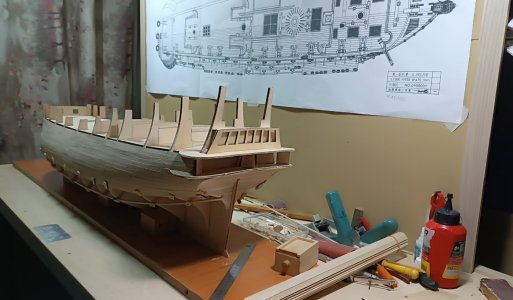
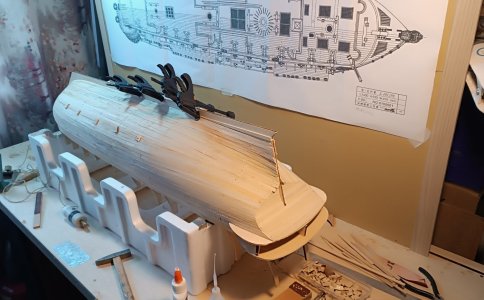
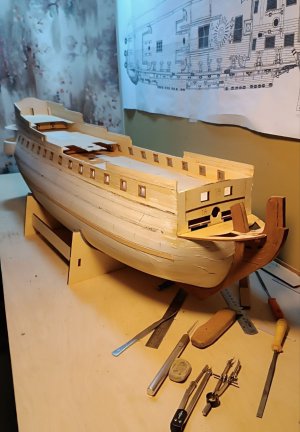
I'll continue. (I'm sorry again if there are errors and unclear places in the text, English is not my native language). As I wrote above, I separately ordered slats of pink pear and mahogany (sapel) with a length of 500 mm, a width of 7 mm and a thickness of 1 mm. But I still haven't decided what to trim the quarterdeck with. There was an idea to use a dyed blue hornbeam and even asked for a sample to see how it would look on the ship. Soaked it in oil, which turned it dark blue. I liked it and I decided to order the slats anyway, but then the manufacturer had some minor problems-a defect with the unpainted hornbeam array. So for now, I postponed this issue for later, and took up the cladding below the quarterdeck. Up to the waterline is a pink pear tree, below it is a mahogany tree. I sawed walnut slats with a width of 4 mm, 6 mm and 7 mm on the barhouts.
IMG_20251025_205004.jpgIMG_20251026_221855.jpgIMG_20251026_221918.jpg
At the rails of the pear tree, I made a small chamfer at the joints, imitating the stitching of the boards. The only difficulty at this stage of work is in the bow of the ship. In order to bend the same walnut slats, I first kept them in boiling water for a few minutes, and then bent the profile with a powerful soldering iron.
IMG_20251027_163654.jpgIMG_20251027_165704.jpg
I also made a small spike for installation on the barkhout, and a groove for it on the stem.
IMG_20251027_171342.jpgIMG_20251027_171633.jpgIMG_20251027_170901.jpg
IMG_20251030_214255.jpg

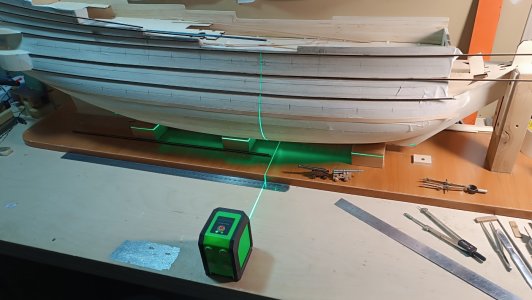
The greatest difficulties and the largest amount of work are, of course, when the hull is below the waterline. There I tried to sheathe using the planking method-calculating the width of the slats in the middle, stern and bow of the ship by the length of the hull. I narrowed them to the required size and inserted them in separate places, I don't know how it is in English, but we call them "losses".
IMG_20251101_194928.jpgIMG_20251101_195111.jpgIMG_20251101_232753.jpg

I also had to bend the nose bars or make them from several parts in very problematic places.The profile was taken directly from the hull along the line of the finished skin.

IMG_20251103_182447.jpgIMG_20251104_164150.jpgIMG_20251103_212618.jpg
IMG_20251103_213952.jpg
With the work in the stern, of course, the work is simpler.

IMG_20251103_034204.jpgIMG_20251105_013853.jpg
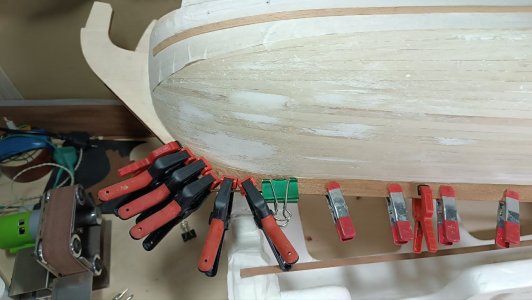
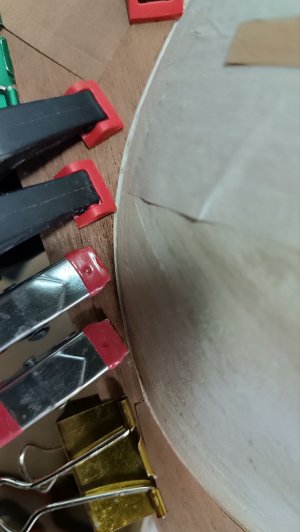
Finally, all the slats are glued, the hull below the waterline is sanded and also brought almost to perfection by cycles. Subsequently, it will be coated with tung oil in three layers.
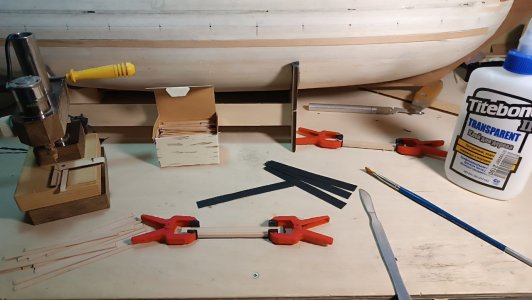
And yes, I highly recommend the glue in the last photo, I use only it for covering the deck and hull slats, one of the best adhesives for ship modelers in my humble opinion-it is reliable and seizes quickly enough, the excess can be immediately removed with a damp cloth, does not leave traces of fringe when pouring wood.
IMG_20251105_134236.jpgIMG_20251105_134329.jpg
IMG_20251105_130200.jpgIMG_20251105_172036.jpg

That's all for now. I am currently working on the other side of the building. I'll continue the review later, if nothing prevents.
 
My kit is for the Chinese market. It contains only two large-format drawings and illustrated copies of instructions from a set of the same Mantua ship. The Chinese actually copied this battleship from them, only enlarging it to a scale of 1:50. The assembly instructions themselves are attached to the CD. I read it on the computer without any problems. The illustrations are in color, the text is in Chinese, but Google Lens translated it without any problems. But unfortunately, this instruction is misleading in some places, even in the specification, the part numbers partially do not match the numbers in the illustrations.
By and large, I don't need instructions, I use them only in some cases. I focus more on the drawings, although they are certainly not in full. My experience of building models not from kits helps out. For the European and American markets, as far as I know, the kit comes in a slightly different configuration, maybe things are better with the tools there and at least they immediately come with an English translation.
IMG_20250806_163856.jpgIMG_20250806_164235.jpg

photo_2025-08-06_19-07-40.jpg
 
Model is built on a Mantua 747 base. Here's the manual.
Thank you, I already have this instruction, even with a Russian translation. Enthusiasts made a translation on one of the Russian forums many years ago.;) Actually, personally, I need it as a general recommendation, no more. What really wouldn't hurt is normal drawings with sections and views of the locations, but I haven't found this anywhere.
 
What really wouldn't hurt is normal drawings with sections and views of the locations, but I haven't found this anywhere.
I doubt you will ever be able to find these kinds of drawings unless you fabricate your own somehow. From what I could find with a quick search on the internet (which means it would be good to do further research :)) ..... The original plans for the San Felipe model ship were created and published in the 1950s by the Departamento de Falange del Mare. These plans, which are considered to be of a largely unhistorical, or a "fantasy" ship (though representative of Spanish warships of the late 17th/early 18th century, not necessarily the real San Felipe 1690), later formed the basis for popular model kits by manufacturers such as the Italian company Mantua/Panart, and subsequently ZHL and OcCre. The Italian historian Vincenzo Lusci is often associated with the model's origins as well, as he published drawings based on this initial Spanish draft.
While Lusci's drawings are praised for their detail, their historical accuracy has been debated. Some sources claim that there is a lack of historical documentation to support Lusci's description of the ship and suggest he may have misinterpreted details about the Real Felipe, a different Spanish galleon from 1732. Despite this, the model is still considered a good representation of a late 17th-century European ship of the line.

If you want to get his book it is available on the internet. I THINK there are an English and Italian versions .

Allan
 
Last edited:
I doubt you will ever be able to find these kinds of drawings unless you fabricate your own somehow. From what I could find with a quick search on the internet (which means it would be good to do further research :)) ..... The original plans for the San Felipe model ship were created and published in the 1950s by the Departamento de Falange del Mare. These plans, which are considered to be of a largely unhistorical, or a "fantasy" ship (though representative of Spanish warships of the late 17th/early 18th century, not necessarily the real San Felipe 1690), later formed the basis for popular model kits by manufacturers such as the Italian company Mantua/Panart, and subsequently ZHL and OcCre. The Italian historian Vincenzo Lusci is often associated with the model's origins as well, as he published drawings based on this initial Spanish draft.
While Lusci's drawings are praised for their detail, their historical accuracy has been debated. Some sources claim that there is a lack of historical documentation to support Lusci's description of the ship and suggest he may have misinterpreted details about the Real Felipe, a different Spanish galleon from 1732. Despite this, the model is still considered a good representation of a late 17th-century European ships of the line.

If you want to get his book it is available on the internet. I THINK there are an English and Italian versions .

Allan
As for the fact that there really was no such sailboat, and the original drawings do not exist in nature, I basically found out when I was still looking through many ship modeling forums in search of information on this Chinese set and a set from Mantua. And by and large, I've come to terms with it. It's just that the Chinese, for example, have the same template with cannon ports slightly incorrect, and there is no template for the bulwark at all, which presents known problems. All the dimensions had to be empirically removed from the drawings that are in the set, but of course they are not enough, since there is no drawing of the frames with markings on the decks, bars, and so on. After all, in my youth, we were taught from school to be guided in our work by theoretical drawings and technical documentation, and then we have to build a model, alas, based on pictures.
 
As for the fact that there really was no such sailboat
From what I could find there were several Spanish ships with the name San Felipe including written records of the 1596 galleon. There seems to be debate on the existence of the San Felipe 1690 including her being sunk by the British in 1705 with a load of gold on board that was lost with the ship.
Allan
 
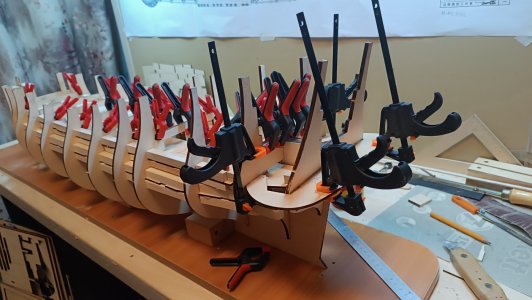
Today I will go back a little bit and describe in more detail the initial work on the building, as the "comrades in misfortune" have questions. The Chinese manufacturer made unforgivable mistakes in the design of the stern, which breaks its entire geometry. I spent a week myself with a ruler, compasses and a calculator, taking measurements from the drawing to get a more or less slender picture in the stern area. It didn't turn out quite perfectly, but nevertheless. There really won't be many photos, I didn't take all the details when I was correcting mistakes, because I was in a very angry mood and cursed more dirty, according to Russian custom, letting off steam))), it wasn't up to the smartphone camera. And that's how I'll start.


Initially, after gluing everythingtogether,Irealizedthat it turned out to becompletenonsenseon the stern, Ihad to tear off everything in thephotobelowandlookforwhat the Chinese were wrong about.

IMG_20250821_033950.jpg
And immediately the first mistake:

Без имени.jpg
photo_2025-08-21_22-03-56 (2).jpg

I had to fix this place later too. When building this model, you need to count on seven steps forward, and not mindlessly work according to the instructions. As the Russians say: Measure seven times, cut once.

IMG_20250821_093350.jpg.trashed-1758910079-IMG_20250827_220556_обработано.jpg
But the main problem was the incorrect height of the beams, as a result of which the deck of the quarterdeck was too low, and the detail of the balcony gallery connected to it under a Polish break.

But the main problem was the incorrect height of the beams, as a result of which the deck of the quarterdeck was too low, and the detail of the balcony gallery connected to it under a Polish break.

IMG_20250824_000237.jpg
IMG_20250824_000219.jpg
IMG_20250824_000034.jpg
IMG_20250824_211656.jpg
They didn't take care of one detail for the upper aft gallery at all, they had to cut out 3mm of the remaining plywood themselves. There is one on the lower gallery, but if you just glue the windows to the transom above, you will get an ugly step in profile.
photo_2025-10-20_18-55-17.jpgIMG_20251115_131803.jpgIMG_20251115_131818.jpg
We also need to refine the details of the captain's cabin a little.
IMG_20251115_130824.jpg
I hope I have explained the problems and their solution more or less clearly. I will add more dimensions of the gunwale, because the manufacturer did not bother to make them. The only thing to keep in mind is that my dimensions are based on the fact that my deck is not lined with thin veneer, but with slats 1 mm thick.
IMG_20251115_131026.jpg
IMG_20251115_131040.jpg
IMG_20251115_131050.jpg

IMG_20251115_131102.jpg

IMG_20251115_131130.jpg
Some more tips and comments.
.trashed-1759238891-IMG_20250830_103724.jpg
.trashed-1760354119-IMG_20250912_012346.jpg
photo_2025-09-25_01-33-10 (7).jpg
By the way, the amount of beech veneer in the kit, which is used for lining the sides, is not enough. Below the waterline, it is proposed to plaster the rough hull and paint it. As I wrote above, I immediately ordered pear and mahogany slats for both the deck and the sides. It is somehow not accepted to paint models among Russian modelers, we usually try to choose shades of natural wood.
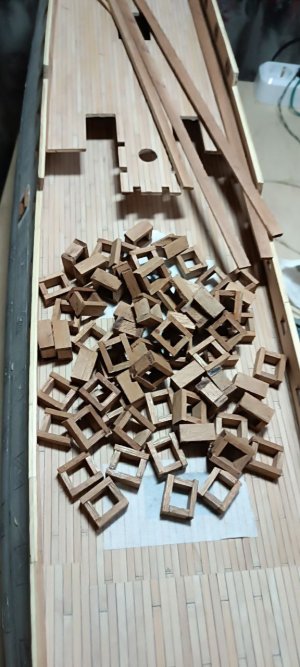
IMG_20251115_131421.jpgMore on the marking of gun ports. The template coming with the set is not entirely correct, because it was made from a direct projection of the side view, not taking into account the considerable bend of the sides. I took all the markings directly from the drawing. By the way, this is why the bosses for the raised pads may not match, so I pasted the decks with linden bars for the entire length. And then painted it black. I did the same thing under the quarterdeck deck.
IMG_20250820_184033.jpg
That seems to be all, I hope I haven't made many mistakes in English and my advice will be useful. Fuuh, I got a little tired doing this post))). Well, a little positive in this life. My wife and I celebrated 38 years of marriage today. The photo is really summer, when my grandson came to visit us from Europe.

photo_2025-11-15_15-45-10.jpg

.trashed-1759721962-IMG_20250906_073832_обработано.jpg
 
Today I will go back a little bit and describe in more detail the initial work on the building, as the "comrades in misfortune" have questions. The Chinese manufacturer made unforgivable mistakes in the design of the stern, which breaks its entire geometry. I spent a week myself with a ruler, compasses and a calculator, taking measurements from the drawing to get a more or less slender picture in the stern area. It didn't turn out quite perfectly, but nevertheless. There really won't be many photos, I didn't take all the details when I was correcting mistakes, because I was in a very angry mood and cursed more dirty, according to Russian custom, letting off steam))), it wasn't up to the smartphone camera. And that's how I'll start.


Initially, after gluing everythingtogether,Irealizedthat it turned out to becompletenonsenseon the stern, Ihad to tear off everything in thephotobelowandlookforwhat the Chinese were wrong about.

View attachment 557050
And immediately the first mistake:

View attachment 557051
View attachment 557052

I had to fix this place later too. When building this model, you need to count on seven steps forward, and not mindlessly work according to the instructions. As the Russians say: Measure seven times, cut once.

View attachment 557053View attachment 557054
But the main problem was the incorrect height of the beams, as a result of which the deck of the quarterdeck was too low, and the detail of the balcony gallery connected to it under a Polish break.

But the main problem was the incorrect height of the beams, as a result of which the deck of the quarterdeck was too low, and the detail of the balcony gallery connected to it under a Polish break.

View attachment 557058
View attachment 557059
View attachment 557060
View attachment 557061
They didn't take care of one detail for the upper aft gallery at all, they had to cut out 3mm of the remaining plywood themselves. There is one on the lower gallery, but if you just glue the windows to the transom above, you will get an ugly step in profile.
View attachment 557063View attachment 557062View attachment 557064
We also need to refine the details of the captain's cabin a little.
View attachment 557065
I hope I have explained the problems and their solution more or less clearly. I will add more dimensions of the gunwale, because the manufacturer did not bother to make them. The only thing to keep in mind is that my dimensions are based on the fact that my deck is not lined with thin veneer, but with slats 1 mm thick.
View attachment 557066
View attachment 557067
View attachment 557068

View attachment 557069

View attachment 557070
Some more tips and comments.
View attachment 557071
View attachment 557073
View attachment 557074
By the way, the amount of beech veneer in the kit, which is used for lining the sides, is not enough. Below the waterline, it is proposed to plaster the rough hull and paint it. As I wrote above, I immediately ordered pear and mahogany slats for both the deck and the sides. It is somehow not accepted to paint models among Russian modelers, we usually try to choose shades of natural wood.
View attachment 557075More on the marking of gun ports. The template coming with the set is not entirely correct, because it was made from a direct projection of the side view, not taking into account the considerable bend of the sides. I took all the markings directly from the drawing. By the way, this is why the bosses for the raised pads may not match, so I pasted the decks with linden bars for the entire length. And then painted it black. I did the same thing under the quarterdeck deck.
View attachment 557076
That seems to be all, I hope I haven't made many mistakes in English and my advice will be useful. Fuuh, I got a little tired doing this post))). Well, a little positive in this life. My wife and I celebrated 38 years of marriage today. The photo is really summer, when my grandson came to visit us from Europe.

View attachment 557078

View attachment 557072
First, congratulations on you marriage.
You have done an excellent job at explaining the problems at the stern and their solutions. I, for one, finally understand how to do this area correctly.
Thank you
Ted
 
Back
Top