
• Win a Free Custom Engraved Brass Coin!!!
    As a way to introduce our brass coins to the community, we will raffle off a free coin during the month of August. Follow link ABOVE for instructions for entering.

BALDER, Vlaardingen Herring Lugger from 1912, scratch build scale 1:50 Plate-On-Frame

Starting with the very eye-catching and crucial components for processing the catch: the 'krebben'. (crabs / bunks ??)
0882 Krebben.jpg
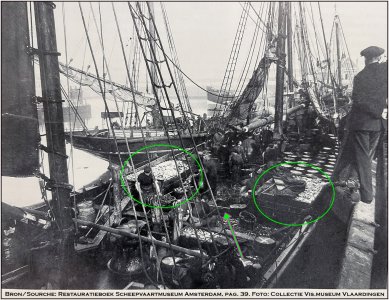
Just a quick look at this photo I posted earlier.
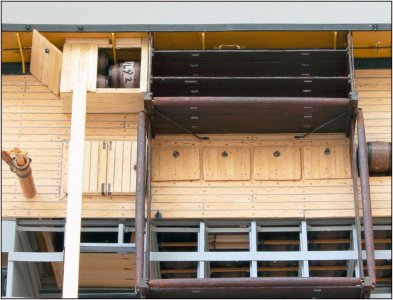
The 'krebben' are in the two colored ovals. When the nets are hauled in, the catch above is shaken out of the nets and collected.
Because they are so visually dominant, I'm going to make both. So also the one on the open construction section.
The reason for this is that additional baffles and rollers can be placed between the two crabs. See the arrow between the two ovals. And some more rollers.

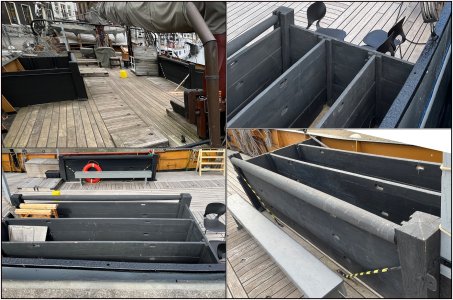
As they are positioned on the Balder:
0883 Krebben.jpg
-Three compartments can be created lengthwise with planks.
-Above the inner baffle, a roller for the nets to roll over.
-Two diagonally placed iron rods lengthwise hold the uprights in place. Otherwise, when the crabs are full, the side baffles will be pushed outward.
-On both side boards, a tie rod is secured to the bulwark plate. This prevents the lengthwise boards from falling inward due to pressure.

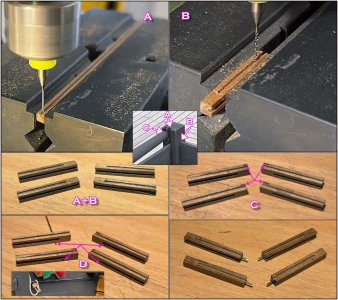
Started with the four 3x3 mm uprights.
0884 Krebben.jpg
A: The continuous groove, 0.7 mm wide and 0.7 mm deep, for the lengthwise planks.
B: The 0.7 mm x 0.7 mm groove for the side boards that doesn't extend all the way.
C: The 0.5 mm wide and 0.5 mm deep groove, where the axle of the removable roller is mounted.
D: The 0.5 mm hole where the tie rod is secured to the bulwark.
Finally, a pin is placed in the bottom to secure it to the deck. Later, some securing strips will be added to the foot.

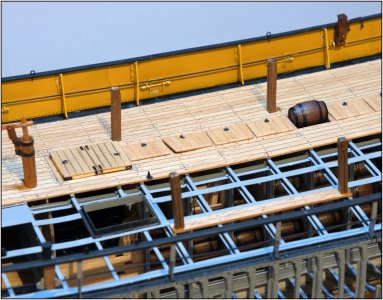
On the deck, I've determined the position of the four uprights:
0885 Krebben.jpg
On the open starboard section, I've made two pieces of deck planking so that the two uprights and the planks between them are at the same height as on the entire port section.

Now I can line the uprights and start measuring and cutting the 30 planks for the bulkheads to size, as well as the supports, rods, brackets, guide strips, etc.
Regards, Peter
 
Last edited:
A total of 34 planks and 8 tie rods were made for both 'krebben'.
Technical details:
0886 Krebben.jpg
-The side panels are secured in the recesses in the two uprights and in a U-profile on the bulwark plate.
-On the outside/top of the side panels are the tie rods that are secured to the bulwark plate. M 0.6 mm nuts were used here as well.
-On the inside of the uprights are the angled tie rods to prevent the side panels from folding outwards when the 'krebben' are full of fish.
-On the inside of the panels are the double slats between which two panels can be placed.
-On the front of the uprights are also double slats to accommodate additional panels.
-On the outside of the uprights, just below the tie rods, is a bracket for hanging an additional roller.

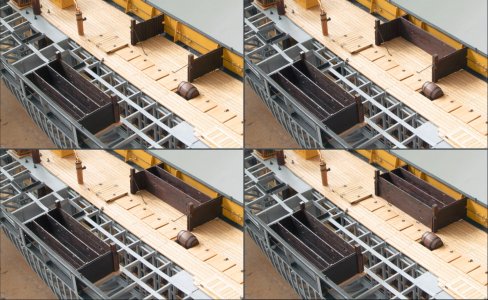
The 4 stages of building the 'krebben':
0887 Krebben.jpg
The two recesses per plank act as handles, allowing you to slide the planks into the recesses without getting your fingers caught.

The additional bulkheads that can be placed between the two 'krebben':
0888 Krebben.jpg
The bottom planks have the deck curve and fit perfectly between the recesses between two hatches.

Finally, another overview picture:
0889 Krebben.jpg
The deck is filling up more and more.
Now, the lathe is back on the table to make the 4 rollers.
Regards, Peter
 
See my comment to Maarten about a build that invokes thoughts of the real thing. Here is another one - a model of authenticity and substance. Chapeau, Peter!
Thank you for this nice complimentary post, Paul.
As Maarten's answer also shows, a model reflects the nature of the builder. This also depends on the (reliable) sources available regarding the original. With scratch building, you can make important choices yourself. With a kit, you're initially dependent on the designers' choices. Kit bashing is the option, where the choice of materials is another factor.
I'm glad I can now have fun with plastic, brass, and wood. And who knows what the rigging can still come up with.
Regards, Peter
 
See my comment to Maarten about a build that invokes thoughts of the real thing. Here is another one - a model of authenticity and substance. Chapeau, Peter!
True story. Peter and Maartens builds are…..I have no superlatives yet again. It must have something to do with the Dutch beer…. Cheers Grant
 
My thoughts exactly- Peter is a master.
True story. Peter and Maartens builds are…..I have no superlatives yet again. It must have something to do with the Dutch beer…. Cheers Grant
Thanks, Grant. And I'm not even a beer lover. We've talked about a delicious glass of Scotch whisky before.:)
And about international beer:
That reminds me on the Monty Python live at the Hollywood Bowl:;)
MP: We find your American beer is a little like making love in a canoe …..
Audience: YEH ….. YEH ……
MP: It’s fucking close to water.ROTF
Although water is the basic element for both beer and whisky, it’s all about the outcome with also here 3 actions, like with your butt pattern planks: patience, patience and patience.
Regards, Peter
 
Last edited:
Always inspiring to see your work Peter! Superb attention to detail.

I have sadly ground to a complete halt with my efforts (too much other stuff to do) - I need some of your dedication to the hobby!
Hi Dom. Thanks for you visit and compliments. Sometimes there are other things in life which put model building to the background. I’ll hope to see you soon back on your Cutty Sark. That’s still my favorite for a fully rigged clipper.
Regards, Peter.
 
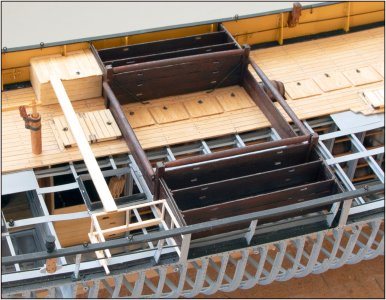
This section of the deck is now also finished:
0890 Krebben.jpg
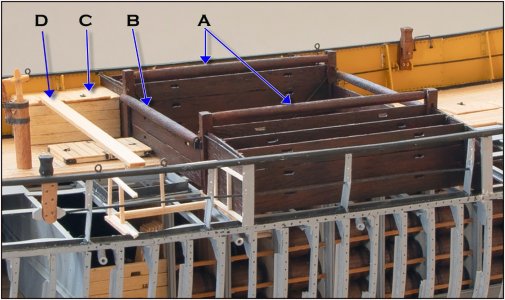
A: The two load rollers in the recesses in the uprights. The nets are pulled over these when hauling in.
B: The cook's roller, suspended in brackets on the side of the uprights. This is so called because the cook stands directly behind it and is responsible for stowing the 'vleet' (the fishing nets) in the two net holds. This are the two holds directly behind the roller with the double hatches.
C: The crate. According to the old specifications: "Suitable for stowing provision barrels and the like, and fitted with a removable lid." The specification drawing reads "Box for 4 barrels."
D: the jawing board. This is where the men who gut the herring sit. The sturdy board is also used as an extra gangway.

Viewed from above:
0891 Krebben.jpg
On the starboard side only the frame of the crate.
It's a multifunctional unit. Various parts can be removed accordingly. Some old photos might clarify this.

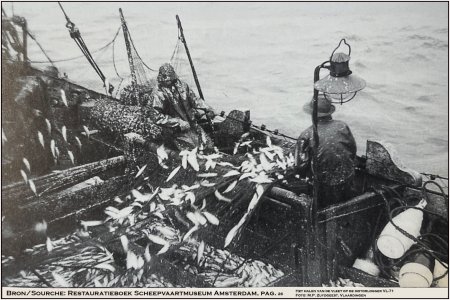
Retrieving the catch:
0894 Krebben.jpg
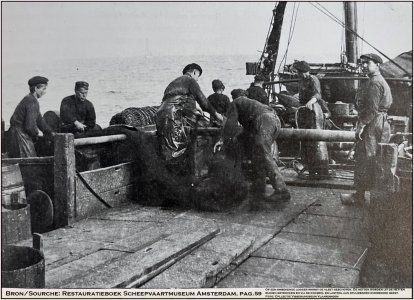
The herring is caught in the 'krebbe' and in the planked area between the 'krebben'. There's also a roller on the bulwark. It's removable and can therefore be used on both sides. I still need to make this. Since I don't have any drawings for it, I'll use old photos and Sybe de Jong's model.

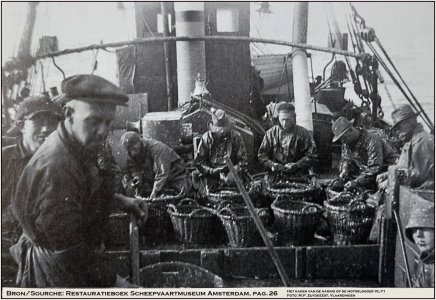
The herring gutters:
0895 Krebben.jpg
They sit next to each other on the 'kaakplank' and throw the gutted herring into the baskets. These are salted there and stored in the barrels.

Several parts were removed during the launching of the 'vleet':
0896 Krebben.jpg
In the photo: "The fleet is being launched on an unknown sailing lugger. The nets are pulled from the net holds and thrown overboard via the cook's roll and the last roll on the starboard side. The breels, which were brought aft from the 'krebbe' on the foredeck for this purpose, are on the starboard side aft."

Another photo with the open crate:
0897 Krebben.jpg
To prevent confusion, the provision barrels were often given a white chalk border with the letters and numbers of the ship in question. Imagine finding a groggy crew member spooning a few scoops of freshly salted herring over the food for the coming days...:(

It's always nice to be able to show historically accurate material.
Regards, Peter
 
Last edited:
So nice to have the old photographs that show all the details you construct, being used! It's fascinating how many fish were caught, cleaned and stored on such ships, with their small crews!

Your log is wonderful to read, because of this "history" and also the incredible accuracy and details you incorporate. Thanks for sharing!!
 
So nice to have the old photographs that show all the details you construct, being used! It's fascinating how many fish were caught, cleaned and stored on such ships, with their small crews!

Your log is wonderful to read, because of this "history" and also the incredible accuracy and details you incorporate. Thanks for sharing!!

Thanks for this nice post and compliments, Brad. This type of fishing vessel has a very efficient layout and equipment. Of course, that's a development based on previous experiences. In terms of photos, I have the advantage that photography was coming up at that time. And there are enthusiasts who have dug them up from archives and presented them in books and online. The black-and-white photos are often true works of art in themselves.
Regards, Peter
 
This section of the deck is now also finished:
View attachment 559515
A: The two load rollers in the recesses in the uprights. The nets are pulled over these when hauling in.
B: The cook's roller, suspended in brackets on the side of the uprights. This is so called because the cook stands directly behind it and is responsible for stowing the 'vleet' (the fishing nets) in the two net holds. This are the two holds directly behind the roller with the double hatches.
C: The crate. According to the old specifications: "Suitable for stowing provision barrels and the like, and fitted with a removable lid." The specification drawing reads "Box for 4 barrels."
D: the jawing board. This is where the men who gut the herring sit. The sturdy board is also used as an extra gangway.

Viewed from above:
View attachment 559516
On the starboard side only the frame of the crate.
It's a multifunctional unit. Various parts can be removed accordingly. Some old photos might clarify this.

Retrieving the catch:
View attachment 559517
The herring is caught in the 'krebbe' and in the planked area between the 'krebben'. There's also a roller on the bulwark. It's removable and can therefore be used on both sides. I still need to make this. Since I don't have any drawings for it, I'll use old photos and Sybe de Jong's model.

The herring gutters:
View attachment 559518
They sit next to each other on the 'kaakplank' and throw the gutted herring into the baskets. These are salted there and stored in the barrels.

Several parts were removed during the launching of the 'vleet':
View attachment 559519
In the photo: "The fleet is being launched on an unknown sailing lugger. The nets are pulled from the net holds and thrown overboard via the cook's roll and the last roll on the starboard side. The breels, which were brought aft from the 'krebbe' on the foredeck for this purpose, are on the starboard side aft."

Another photo with the open crate:
View attachment 559520
To prevent confusion, the provision barrels were often given a white chalk border with the letters and numbers of the ship in question. Imagine finding a groggy crew member spooning a few scoops of freshly salted herring over the food for the coming days...:(

It's always nice to be able to show historically accurate material.
Regards, Peter
Peter my dear friend
yes are doing incredible work!!
 
Back
Top