• Win a Free Custom Engraved Brass Coin!!!
    As a way to introduce our brass coins to the community, we will raffle off a free coin during the month of August. Follow link ABOVE for instructions for entering.

School for Shipmodel Building School for model ship building

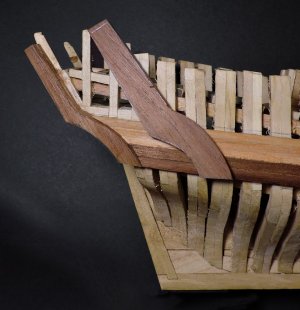
The way i work is to start big and work the piece down to a snug fit on the model. What i am fitting is the front edge to the wale and planking, once the curve is cut in the planking it is now a matter of fitting the molding to the planking.
up work5.jpg

The more you sand and adjust the front edge the more material you're losing at the other edge, so that is why i start big to leave enough material to work both edges
up work6.jpg

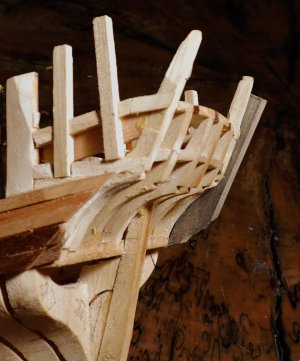
You need an overlap at the stern edge for the stern planking to butt against
up work7.jpg

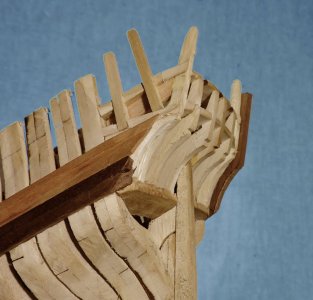
With a lot of shaping and testing the fit to the hull finally the molding is the proper shape and in place and a nice tight fit to the wale and planking.
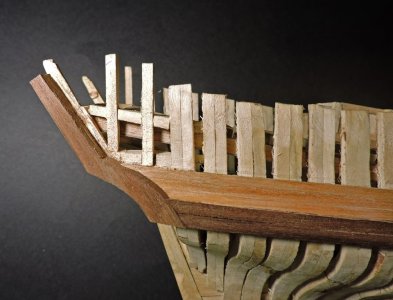
up work8.jpg
 
Last edited:
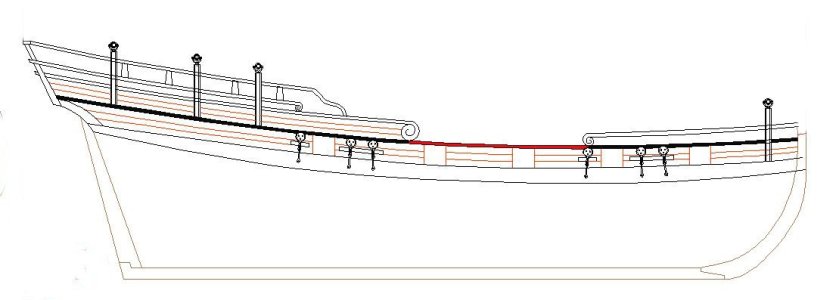
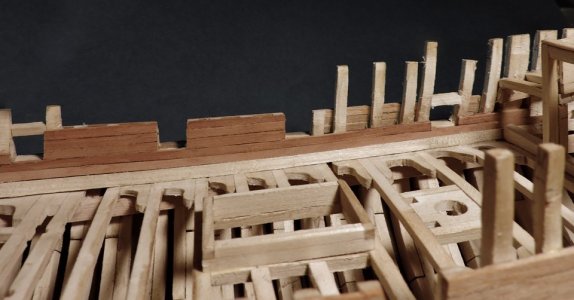
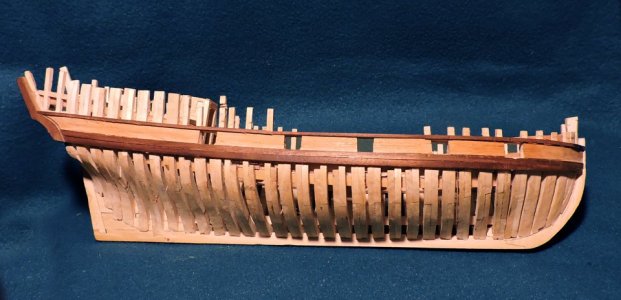
Almost ready to start the upper works but first there is a molding that runs from stem to stern along the top of the bulwark planking. In model ship building it is common for one thing depending on something else and if you are doing thing out of order you find yourself in trouble. The red section of the molding is actually the edge of the cap rail so it has to go in first.

Capture molding.JPG

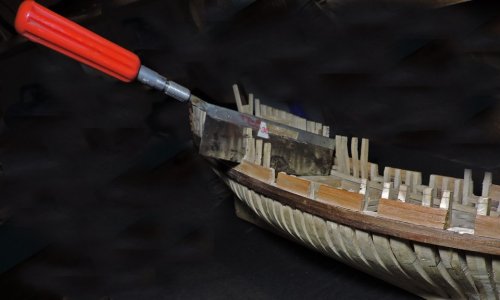
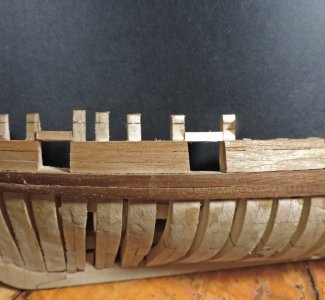
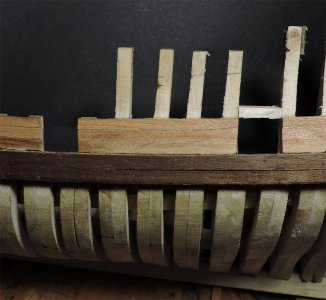
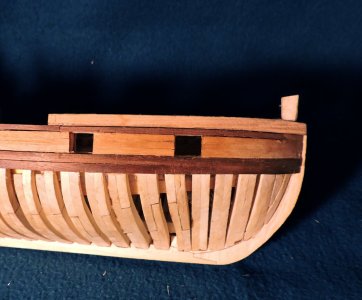
Before the cap rail can go in the gun ports have to be cut in and those are cut with a razor saw
.

up work9.jpg

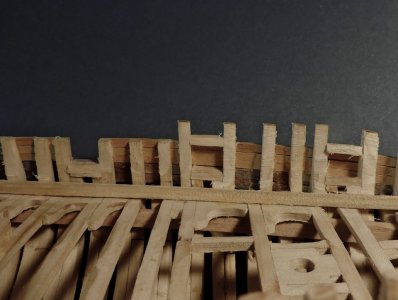
Oops i put the top of the gun ports in before i cut them out, no big deal i just cut through the top of the ports then redid the tops

up work10.jpg

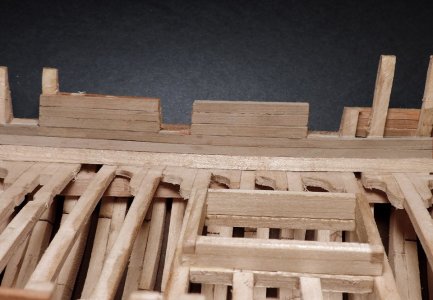
The inside of the bulwarks has to be planked before the cap rail so i will get that done this week

up work11.jpg
 
Last edited:
I left off with an oops! with the gun ports by putting in the top head piece and not cutting out the port first. The problem was an easy fix by ripping out the top timber then cutting out the port and reinstalling the top timber. Now with that fixed i can move on to the bulwark planking

up work12.jpgup work13.jpg


a lesson here is to spend a little time looking at the model and planning your next step so you do not have to back track or rip thing out.
 
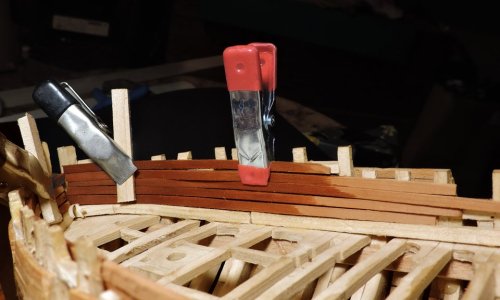
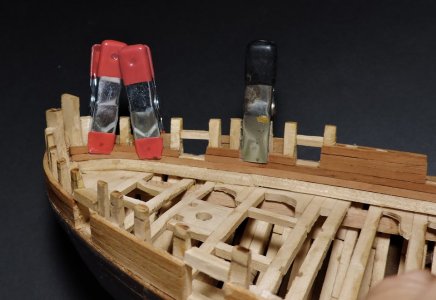
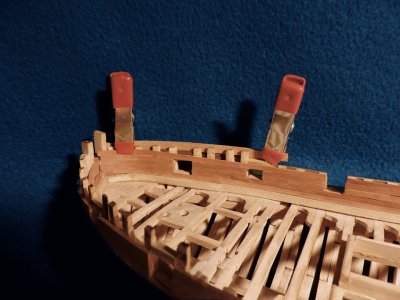
I tried to bend the planking dry but ended up breaking them, the curve is just to tight for a dry bend so i soaked the ends of the planks in hot water for about 20 minutes, they bent with ease. Wet wood is soft so i never use a clamp directly on the plank i always use a piece of scrap between the clamp and the plank. Well except for the red clamp but the planks will be cut at the gun port.

up work14.jpg

I started the inside of the bulwark planking in the center and worked my way to the bow and stern plank by plank.


up work15.jpgup work16.jpg

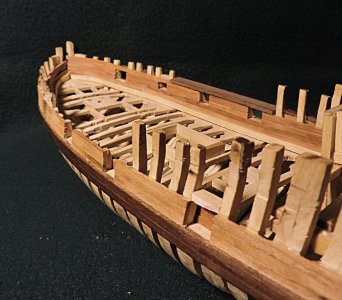
The inside of the bulwarks are finished except for the last upper plank at the bow, i set the cap rail on the center section.

up work17.jpg

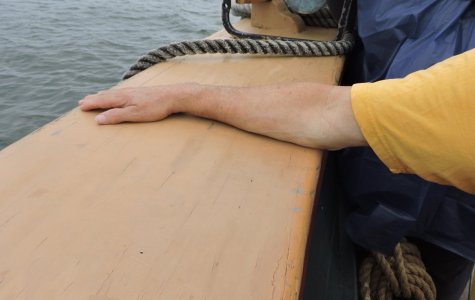
cap rails are a much bigger timbers than expected

DSCN0094.JPGDSCN6878.JPG

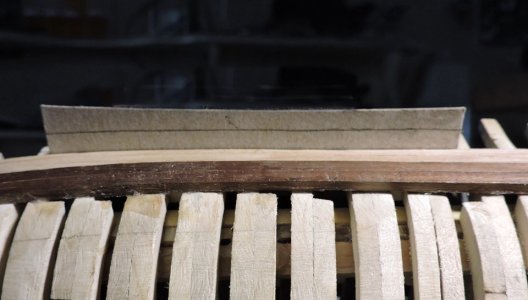
The center cap rail although it looks straight it actually has a slight curve> to get the right shape and fit use a piece of cardboard and trace the bulwark then move you cardboard pattern up to the width of the bulwark and make another line. You have to take into account an overhang so the cap rail meets the outside molding.


DSCN1127.jpg
 
Last edited:
The molding runs along the top of the bulwark planking and meets the cap rail.

up work18.jpg


At the bow the final plank has a taper wide at the stem and tapers back. There will be a cap rail on top and a scroll at the end.

up work19.jpg

What makes planking a kit difficult is the lack of sheet stock or wider planks to make tapered planks both at the bottom of the hull as well as fitting planking at the top. With all the same width planking provided in a kit you can only taper from the width to the smaller end. Very often you need that full width and you need to taper a plank to the wider end.

On the inside of the bulwark at the bow the taper runs opposite of the outside. On the outside the last plank is wider at the stem and tapers back, on the inside the last plank is narrower at the stem and widens as it goes back. The reason for the reverse tapering is because the deck rises as it approaches the bow give less room for the inside planking.

up work20.jpg
 
The molding runs along the top of the bulwark planking and meets the cap rail.

View attachment 563405


At the bow the final plank has a taper wide at the stem and tapers back. There will be a cap rail on top and a scroll at the end.

View attachment 563406

What makes planking a kit difficult is the lack of sheet stock or wider planks to make tapered planks both at the bottom of the hull as well as fitting planking at the top. With all the same width planking provided in a kit you can only taper from the width to the smaller end. Very often you need that full width and you need to taper a plank to the wider end.

On the inside of the bulwark at the bow the taper runs opposite of the outside. On the outside the last plank is wider at the stem and tapers back, on the inside the last plank is narrower at the stem and widens as it goes back. The reason for the reverse tapering is because the deck rises as it approaches the bow give less room for the inside planking.

View attachment 563407
How soon will the “kit”
Be available for sale?
 
@Dave Stevens (Lumberyard), greeting Dave. A thousand thanks for this build tutorial. I am picking up a number of techniques along the way. This is very useful. Believe us, your time and effort are already paying off by providing know-how and sharing your experience with many modelers. Sitting now at 37K view, I'm sure you already helping many, me first. Cheers,
 
@Dave Stevens (Lumberyard), greeting Dave. A thousand thanks for this build tutorial. I am picking up a number of techniques along the way. This is very useful. Believe us, your time and effort are already paying off by providing know-how and sharing your experience with many modelers. Sitting now at 37K view, I'm sure you already helping many, me first. Cheers,

Thank you Loracs it takes about if not more time doing the photography and creating the class as it does building the model itself.
Happly to hear your getting information out od all this
 
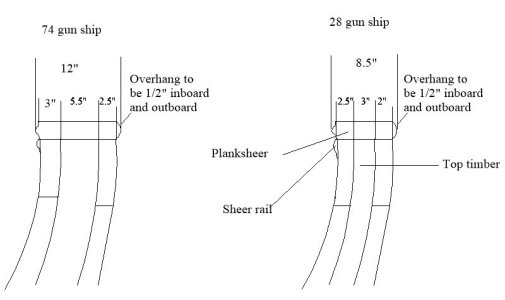
Each ship no doubt varied. Dimensions in the Establishments and Steel are similar. Before and after those dates the dimensions may have been very different. In the contract for HMS Severn 1695 the sizes are not all clearly given but for those I could find they are a bit smaller than for the 28 gun in the second drawing below.
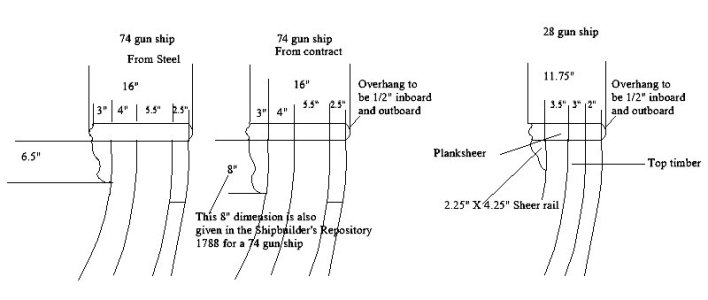
The first drawing is from The Fully Framed Model, Volume II, by David Antscherl. The second is using scantlings from contemporary contracts.
Allan

1765987883598.jpeg

1765987932920.jpeg
 
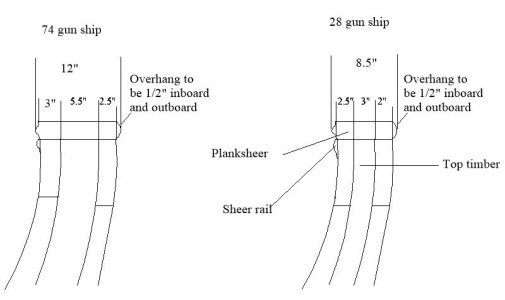
The first drawing is from The Fully Framed Model, Volume II, by David Antscherl.
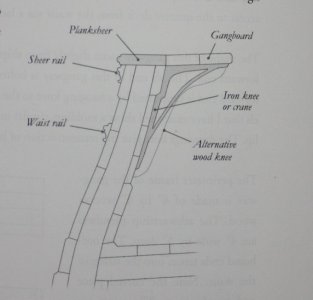
I have been classifying the sheer rail and waist rail as actual full thickness wales. The outside planking butting against below and above. Antscherl has them as superficial decoration.
Here, I have been thinking that they were adding strength to the hull.
 
I have been classifying the sheer rail and waist rail as actual full thickness wales.
Me too. I read further and found on page 155 of volume II in TFFM the following:

As a matter of interest, in naval shipbuilding these rails were applied over the planking, but in merchant yards each rail was usually moulded from a solid plank which was made thicker for the purpose.

Going back to the contracts, on the contract for Elephant (74) 1786:

The Sheer Rail to be 8 inches broad, and 3 ½ inches thick; the Waste Rail 7 inches broad, and 2¾ inches thick; the Rails in the Drift to be 6 inches broad and 2½ inches thick.

SHEER STRAKE From the first Drift forward & aft to work one Strake of 3 inches thick on the Sheer Strake and the upper edge of the Strake under the Plankshire from the Drift aft to be diminished to the thickness of 2½ inches, which is to be dry English Plank.


Note that the sheer strake and sheer rail are two different thicknesses so perhaps it can be assumed two different pieces.

I re-drew the set up after digging up more dimensions. As with most things in this endeavor of ours there are very few things that are constant from ship to ship, era to era, etc. to etc.

Allan

1766002508743.jpeg
 
The Sheer Rail to be 8 inches broad, and 3 ½ inches thick;
I guess it makes the building of it a bit easier.
I will check the scantlings but as far as what I will do is make it as thick as needed to fit under the rail and be at the necessary position.
I am thinking that it will need to be glued to the edge of a plank to have its moulding scraped. Then debonded. Another job for Duco.
 
It is not an O-Gee but there is a shape to be scraped. If the sheer rail is cut to size and then operated on - it will kind of flimsy and difficult to control.
One way would be to cut to size, glue to a temp board support, operate, debond.
Then I remembered the NRG thickness stop jig for a table saw - the product outside the blade instead of between the blade and fence. The curved shape riding the fence would not be reliable in my hands. Shaping the edge of a thick plank and having it out in the wind for the thickness cut - works for me in theory.
It also makes it less painful to scrap an effort and start over.
 
Dave,
It is buried now, so would you restate the various wood species that you are using for which parts?


the keel, framing and deck, coamings and companion way are all built from Soft Maple but there actually is no such type of Maple it is a commercial name meant to differentiate the wood from other types of maple. The wood is also called Red Maple because in the fall the leaves turn a bright red. The wood is not soft it has a hardness and workability as Cherry. When fresh cut the wood looks white but will change to a light reddish brown to a honey color.

companion way paneled sides are Basswood

The hull planking is Cherry sapwood which is off white with a slight tint of red. It is easy to work and bend.

the wales, molding and plank sheer or cap rail are Black Walnut which bends quite well.

inside the bulwarks is steamed pearwood also known as Swiss Pearwood

in the photos color will vary depending where i took the pictures. Some were outside in sun light other pictures were under LED lighting or incandescent lighting
 
the fun part of scratch building is not following someone else's build exactly that 8.5 inch planksheer seems to narrow

1765987932920.jpeg


looking at the gun port it looks wider than 8.5 inches.

there is a top timber of 5 inches planking inside and out of 2 inches a black outside molding of 2.5 inches that is 9.5 inches so a planksheer of 8.5 would not cover the top of the bulwark. I did measure the planksheer and it was 19 inches wide.

DSCN7007.JPG

DSCN7104.JPG

in the drawing it shows the planking thickness the same as the top timber.

width of the planksheer comes down to the final size of the top timber and thickness of the bulwark planking inside and out
 
Back
Top