
• Win a Free Custom Engraved Brass Coin!!!
    As a way to introduce our brass coins to the community, we will raffle off a free coin during the month of August. Follow link ABOVE for instructions for entering.
  • PRE-ORDER SHIPS IN SCALE TODAY!

    The beloved Ships in Scale Magazine is back and charting a new course for 2026!
    Discover new skills, new techniques, and new inspirations in every issue.

    NOTE THAT OUR FIRST ISSUE WILL BE JAN/FEB 2026

Sterling American Scout WWII Cargo Ship

A thought about scale - some say Sterling kit is 1/96 scale, although measuring it the hull is only about 400' long in 1:96 scale. Since the C2 ship is about 460' long, that scales it to about 1:108. The 50" long hull scales to about 360' in HO (1:87) scale.

So how to justify its use in a HO scale? Model railroading is all about "selective compression" - a Google search on that term defines as "the process of selectively reducing the size or complexity of something to fit a smaller space while retaining its key identifying features." While we can reproduce individual items like locomotives to exact scale, there's no way in a reasonable space to reproduce the terrain a train might travel through or even create a scale model of a very large bridge for example. In the case of this ship, selective compression for me means that a ship that's a bit under scale will still be large enough to give the right impression. But scale people will tower over the doors in this kit. There are several options to deal with that, one of which I'll decide on during construction of the ship:

1. Modify the deckhouse to have proper height proportions for HO scale so the doors and people scale the same.
2. Only put scale people in places where they won't be near doors, such as on the fantail manning the 5" gun.
3. Don't put any scale people on the ship and leave the doors as-is.

I plan to build the deckhouse using option #1 - replace all the vertical walls with new taller pieces properly scaled for 1:87. The overall footprint of the deckhouse won't change, but the height of each level would be more appropriate to HO scale people. I think the height of the decks and the doors is really the only thing on the model that would be very obviously out of scale for HO people, so this would correct that.

I edited the plans drawing of the deckhouse to alter the height of each deck to HO scale, this shows the difference. I've added a sailor to each drawing, he's 6' tall in HO scale. He looks too big when placed on the stock height deskhouse, but correct on the HO deckhouse. The doors on the right are scaled to 5 1/2' height, which is a common height for this type of door, but I may make them larger - they still look a little short to me.

DeckhouseHeight.jpg

I taped a printout of the HO scaled deckhouse on the kit plans for another check on how it would look:

DeckhouseHeight.2.jpg

The difference in the heights of the stock vs. HO deckhouses is a little under 1", which I think will look fine on the finished model, especially if there are a few sailors around the deckhouse to give it scale. I've ordered some HO scale sailors, they should arrive Saturday and I'll use them as I'm building the deckhouse to make sure everything looks good.

Sailors.jpg
 
A thought about scale - some say Sterling kit is 1/96 scale, although measuring it the hull is only about 400' long in 1:96 scale. Since the C2 ship is about 460' long, that scales it to about 1:108. The 50" long hull scales to about 360' in HO (1:87) scale.

So how to justify its use in a HO scale? Model railroading is all about "selective compression" - a Google search on that term defines as "the process of selectively reducing the size or complexity of something to fit a smaller space while retaining its key identifying features." While we can reproduce individual items like locomotives to exact scale, there's no way in a reasonable space to reproduce the terrain a train might travel through or even create a scale model of a very large bridge for example. In the case of this ship, selective compression for me means that a ship that's a bit under scale will still be large enough to give the right impression. But scale people will tower over the doors in this kit. There are several options to deal with that, one of which I'll decide on during construction of the ship:

1. Modify the deckhouse to have proper height proportions for HO scale so the doors and people scale the same.
2. Only put scale people in places where they won't be near doors, such as on the fantail manning the 5" gun.
3. Don't put any scale people on the ship and leave the doors as-is.

I plan to build the deckhouse using option #1 - replace all the vertical walls with new taller pieces properly scaled for 1:87. The overall footprint of the deckhouse won't change, but the height of each level would be more appropriate to HO scale people. I think the height of the decks and the doors is really the only thing on the model that would be very obviously out of scale for HO people, so this would correct that.

I edited the plans drawing of the deckhouse to alter the height of each deck to HO scale, this shows the difference. I've added a sailor to each drawing, he's 6' tall in HO scale. He looks too big when placed on the stock height deskhouse, but correct on the HO deckhouse. The doors on the right are scaled to 5 1/2' height, which is a common height for this type of door, but I may make them larger - they still look a little short to me.

View attachment 570443

I taped a printout of the HO scaled deckhouse on the kit plans for another check on how it would look:

View attachment 570444

The difference in the heights of the stock vs. HO deckhouses is a little under 1", which I think will look fine on the finished model, especially if there are a few sailors around the deckhouse to give it scale. I've ordered some HO scale sailors, they should arrive Saturday and I'll use them as I'm building the deckhouse to make sure everything looks good.


View attachment 570442
It looks a little tall and skinny. You’re also changing the size of the cranes.
 
It looks a little tall and skinny. You’re also changing the size of the cranes.
After I get the deckhouse built to the new height, I'll decide if the cranes need to be upsized as well. They should be pretty easy to make taller.
 
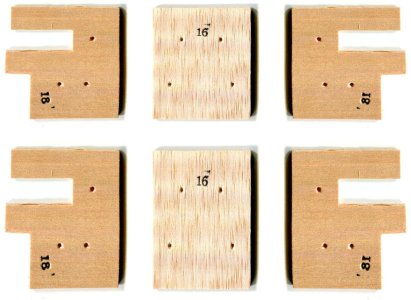
I'm beginning construction of the deckhouse and I'm scaling the height of the decks to an appropriate height for HO scale. Since I figure the model is 1:108 scale and I'm going to 1:87, the height of the walls needs to be increased by a factor of 1.24 (108/87). Most of the wall parts are simple rectangles that are 7/8" tall, so 1.24 x 7/8 = 1.085", or I'll call it 1 1/16" (that's 1.0625", the missing .020" won't matter). Those rectangular parts will be easy to cut from 1/8 balsa stock.

A few of the walls are more complicated shapes and some have portholes at specific heights, so to get them right I'm scanning those parts and pasting the scans into my drawing program. My drawing program allows me to do math on the dimensions of objects, so I multiplied the height of these parts by 1.24 to make patterns for cutting new parts. These parts are the front walls of the deckhouse, the uppers ones are as scanned and the lower ones are resized for HO height.

RescaledParts1.jpg
 
I’m very interested to see how it will look in the end.
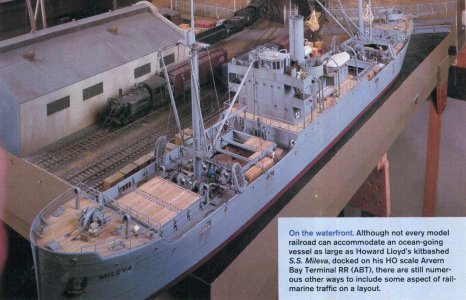
I think if you look at the finished model in the context of a C2 freighter and think "the deckhouse is too tall for a C2", you won't like it. On the other hand, I look at it as a "360' long ship that could be", much like Howard Lloyd's model pictured here which also has a deckhouse the height of which has about the same relationship to the length of the ship that my model will. For my purposes with the HO trains, I'm going for the impression of a cargo ship that "could be", not an exact scale rendering of any particular ship in the same way that Lloyd seems to have done.

Lloyd1.jpg

Lloyd started out with a Dean's Marine "Melanie 2" kit in 1:96 scale, but if you look at the photos it appears that he may have made the deckhouse taller because the HO scale people on the upper part of the deckhouse don't seem out of scale.
 
I think if you look at the finished model in the context of a C2 freighter and think "the deckhouse is too tall for a C2", you won't like it. On the other hand, I look at it as a "360' long ship that could be", much like Howard Lloyd's model pictured here which also has a deckhouse the height of which has about the same relationship to the length of the ship that my model will. For my purposes with the HO trains, I'm going for the impression of a cargo ship that "could be", not an exact scale rendering of any particular ship in the same way that Lloyd seems to have done.

View attachment 571461

Lloyd started out with a Dean's Marine "Melanie 2" kit in 1:96 scale, but if you look at the photos it appears that he may have made the deckhouse taller because the HO scale people on the upper part of the deckhouse don't seem out of scale.
Are you going with the bowed deckhouse as in the kit or a flat one like Lloyd’s model?
 
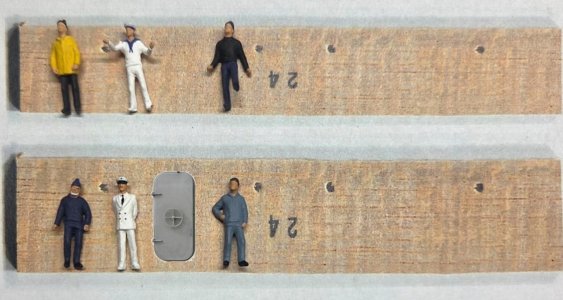
The post office failed to deliver the mail on Saturday because of about a half inch of snow, so my sailors didn't arrive until today. I've been waiting to get them before cutting any new parts for the deckhouse so I can check the height. Shown below are sailors posed against the printout of a kit cabin wall and my taller HO scale wall. I think this will work, although I probably could take 1/16 - 3/32 out of the height of the wall and still be ok.

Also shown against the lower wall is an image of a ship door. I plan to print these on my color printer in heavy cardstock and glue them in place. The thickness of the cardstock will give enough relief to be realistic and the printouts have very nice detail. Haven't decided on the final size of the door yet, I think many real doors are a bit smaller than shown below. Input on door size is very welcome.

WallsWithSailors.jpg
 
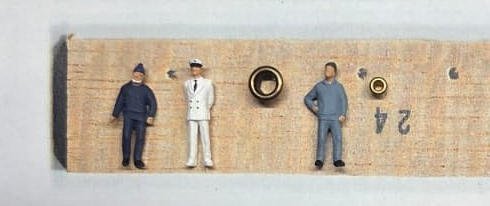
One more thing I'm thinking about - the size of the portholes. The kit comes with a lot of tiny eyelets, which I presume are for the portholes although I haven't found any mention of portholes in the instructions. Maybe I missed something, the text of the instructions is very dense. The eyelet above the 24 in the photo below is one of the ones that comes with the kit and they look small to me even for 1:108 scale. The larger eyelet between the two men is 5/32", and the opening scales to about 14" in 1:87 scale. Seems like a reasonable size to me but I'm not an expert on ship fittings so any input anyone has would be valued. I'm thinking about it now because it seems like it would be easier to install them in the parts of the deckhouse as I'm assembling rather than installing them after assembly of the deckhouse.

PortholeTest.jpg
 
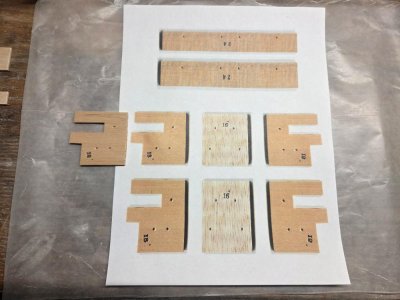
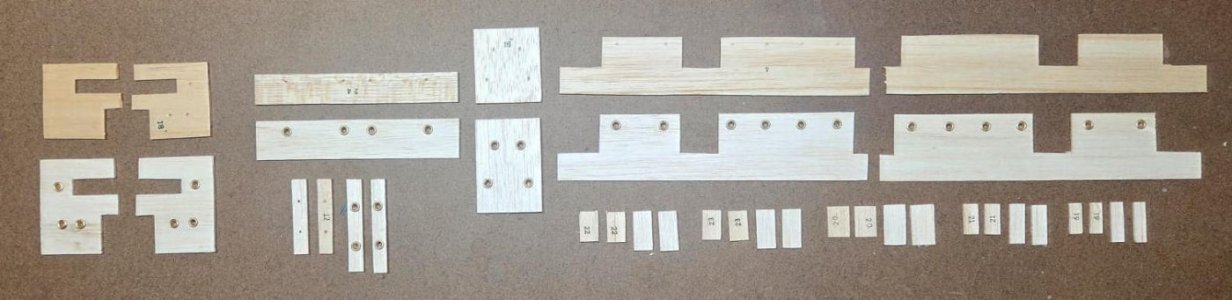
Home renovation projects have kept me away from this project for the last two weeks but today I found some time and made the taller walls for the first level of the deckhouse, they're laid out on the workbench next to the original parts - since I didn't number the new parts this is how I'll use them by number when assembling.

DeckhouseLevel1Parts.jpg

It seemed like it would be easier to make the holes for the portholes before assembly, so I've drilled the holes; the eyelets for the portholes are not glued in place yet, they'll come out when I assemble the deckhouse and be installed after painting.

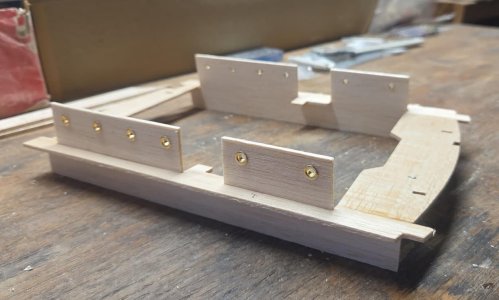
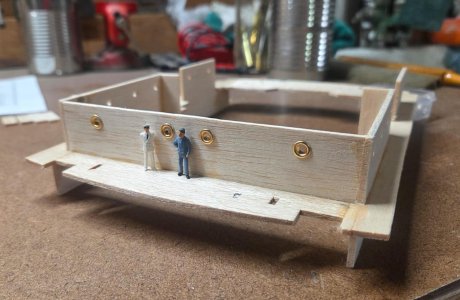
I've begun assembly, more photos to come as I make progress.

DeckhouseLevel1-1.jpg
 
I only used the larger eyelets. Your new walls look great! Can’t wait to see how the entire superstructure will look. Did you check to see how the davits for the boats will fit?
 
You’re doing a careful job building a scenic addition to your model railroad layout. Therefore, allow me to offer a suggestion. Get rid of those brass portholes! Real steel hulled vessels do not have them. What they do have is a brass fitting holding the glass that bolts to the INSIDE of the hull’s shell plating, or in your case the steel plating of the deckhouse. The diameter of the hole cut in the plating is small enough that the brass fitting holding the glass is not visible from the outside.

Roger
 
Are they the kit supplied portals?
The kit-supplied eyelets seemed too small even for 1:108 scale so I used 1/8 eyelets. The glass area scales to roughly 12" diameter in 1:87 (HO scale) and I figure that's just about right for what I'm doing. After I finally install them, I will also install "glass" in them using Micro Kristal Klear. It's commonly used to create panes of glass in model railroading, in case you're not familiar with it: https://www.walthers.com/micro-kristal-klear-1oz-29-6ml

I only used the larger eyelets. Your new walls look great! Can’t wait to see how the entire superstructure will look. Did you check to see how the davits for the boats will fit?
I think they'll be OK but if I have to remake them that's ok.
 
You’re doing a careful job building a scenic addition to your model railroad layout. Therefore, allow me to offer a suggestion. Get rid of those brass portholes! Real steel hulled vessels do not have them. What they do have is a brass fitting holding the glass that bolts to the INSIDE of the hull’s shell plating, or in your case the steel plating of the deckhouse. The diameter of the hole cut in the plating is small enough that the brass fitting holding the glass is not visible from the outside.

Roger
I plan to paint the brass gray. Actually almost everything will be painted gray because I'm modeling this as a WWII cargo ship. The brass won't be visible when I'm done.
 
Back
Top