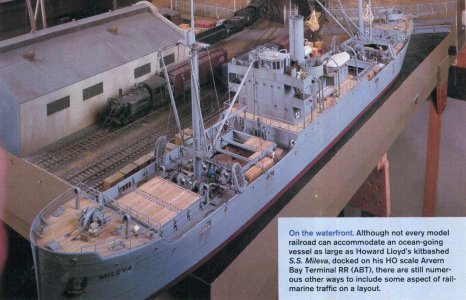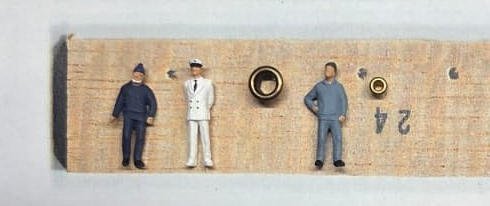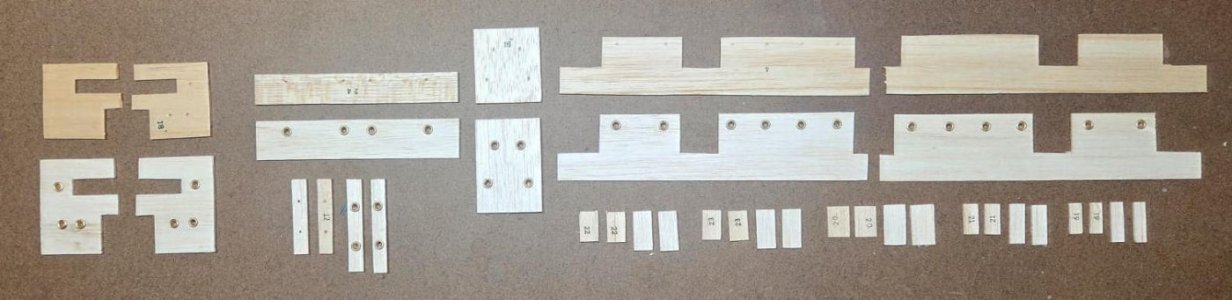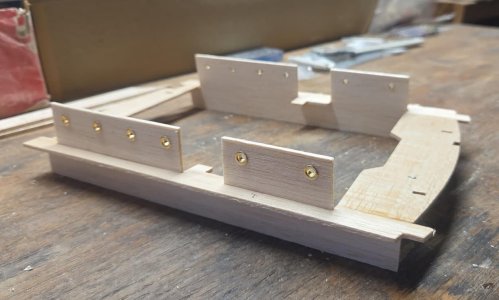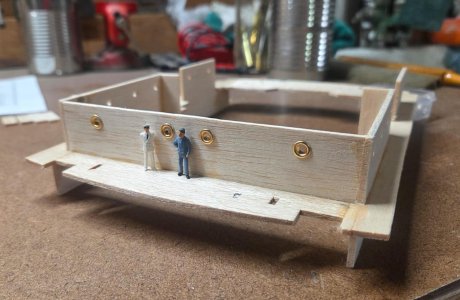


A thought about scale - some say Sterling kit is 1/96 scale, although measuring it the hull is only about 400' long in 1:96 scale. Since the C2 ship is about 460' long, that scales it to about 1:108. The 50" long hull scales to about 360' in HO (1:87) scale.
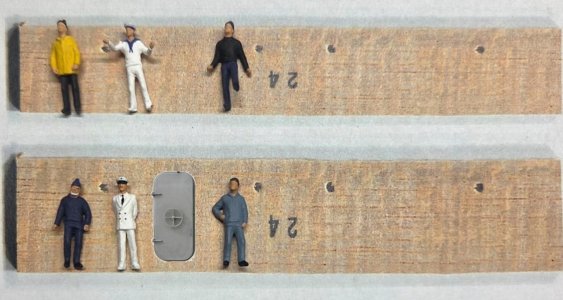
So how to justify its use in a HO scale? Model railroading is all about "selective compression" - a Google search on that term defines as "the process of selectively reducing the size or complexity of something to fit a smaller space while retaining its key identifying features." While we can reproduce individual items like locomotives to exact scale, there's no way in a reasonable space to reproduce the terrain a train might travel through or even create a scale model of a very large bridge for example. In the case of this ship, selective compression for me means that a ship that's a bit under scale will still be large enough to give the right impression. But scale people will tower over the doors in this kit. There are several options to deal with that, one of which I'll decide on during construction of the ship:
1. Modify the deckhouse to have proper height proportions for HO scale so the doors and people scale the same.
2. Only put scale people in places where they won't be near doors, such as on the fantail manning the 5" gun.
3. Don't put any scale people on the ship and leave the doors as-is.
I plan to build the deckhouse using option #1 - replace all the vertical walls with new taller pieces properly scaled for 1:87. The overall footprint of the deckhouse won't change, but the height of each level would be more appropriate to HO scale people. I think the height of the decks and the doors is really the only thing on the model that would be very obviously out of scale for HO people, so this would correct that.
I edited the plans drawing of the deckhouse to alter the height of each deck to HO scale, this shows the difference. I've added a sailor to each drawing, he's 6' tall in HO scale. He looks too big when placed on the stock height deskhouse, but correct on the HO deckhouse. The doors on the right are scaled to 5 1/2' height, which is a common height for this type of door, but I may make them larger - they still look a little short to me.

I taped a printout of the HO scaled deckhouse on the kit plans for another check on how it would look:

The difference in the heights of the stock vs. HO deckhouses is a little under 1", which I think will look fine on the finished model, especially if there are a few sailors around the deckhouse to give it scale. I've ordered some HO scale sailors, they should arrive Saturday and I'll use them as I'm building the deckhouse to make sure everything looks good.

So how to justify its use in a HO scale? Model railroading is all about "selective compression" - a Google search on that term defines as "the process of selectively reducing the size or complexity of something to fit a smaller space while retaining its key identifying features." While we can reproduce individual items like locomotives to exact scale, there's no way in a reasonable space to reproduce the terrain a train might travel through or even create a scale model of a very large bridge for example. In the case of this ship, selective compression for me means that a ship that's a bit under scale will still be large enough to give the right impression. But scale people will tower over the doors in this kit. There are several options to deal with that, one of which I'll decide on during construction of the ship:
1. Modify the deckhouse to have proper height proportions for HO scale so the doors and people scale the same.
2. Only put scale people in places where they won't be near doors, such as on the fantail manning the 5" gun.
3. Don't put any scale people on the ship and leave the doors as-is.
I plan to build the deckhouse using option #1 - replace all the vertical walls with new taller pieces properly scaled for 1:87. The overall footprint of the deckhouse won't change, but the height of each level would be more appropriate to HO scale people. I think the height of the decks and the doors is really the only thing on the model that would be very obviously out of scale for HO people, so this would correct that.
I edited the plans drawing of the deckhouse to alter the height of each deck to HO scale, this shows the difference. I've added a sailor to each drawing, he's 6' tall in HO scale. He looks too big when placed on the stock height deskhouse, but correct on the HO deckhouse. The doors on the right are scaled to 5 1/2' height, which is a common height for this type of door, but I may make them larger - they still look a little short to me.
I taped a printout of the HO scaled deckhouse on the kit plans for another check on how it would look:
The difference in the heights of the stock vs. HO deckhouses is a little under 1", which I think will look fine on the finished model, especially if there are a few sailors around the deckhouse to give it scale. I've ordered some HO scale sailors, they should arrive Saturday and I'll use them as I'm building the deckhouse to make sure everything looks good.