
• Win a Free Custom Engraved Brass Coin!!!
    As a way to introduce our brass coins to the community, we will raffle off a free coin during the month of August. Follow link ABOVE for instructions for entering.
  • PRE-ORDER SHIPS IN SCALE TODAY!

    The beloved Ships in Scale Magazine is back and charting a new course for 2026!
    Discover new skills, new techniques, and new inspirations in every issue.

    NOTE THAT OUR FIRST ISSUE WILL BE JAN/FEB 2026

Sterling American Scout WWII Cargo Ship

On a general cargo ship there will be four spot lights located under the cross tree or upon the cross trees.
They would be aimed at the deck space between the cargo hatch and the ships side.
There are lights in the hold to accommodate lighting requirements below decks.
There are also cage lights along every deck structure ( usually about 10 feet apart) to accommodate night time lighting requirements for manpower moving about the decks.
None of the deck house(s) cage lights would be located in such a way as to shine into the wheelhouses forward facing windows.

And those peaked hatch covers from the magazine article…..
That’s not true to life.
Hatch covers were always flat, covered in heavy tarps, steel strapped and secured to the hatch coming.
A peaked hatch cover would have been impossible to keep watertight.

He probably got the idea by seeing a rain tarp hanging over the open hatch.
Rain tarps were hung to keep cargo dry if it was raining while cargo operations were in progress.
 
Last edited:
On a general cargo ship there will be four spot lights located under the cross tree or upon the cross trees.
They would be aimed at the deck space between the cargo hatch and the ships side.
There are lights in the hold to accommodate lighting requirements below decks.
There are also cage lights along every deck structure ( usually about 10 feet apart) to accommodate night time lighting requirements for manpower moving about the decks.
None of the deck house(s) cage lights would be located in such a way as to shine into the wheelhouses forward facing windows.

And those peaked hatch covers from the magazine article…..
That’s not true to life.
Hatch covers were always flat, covered in heavy tarps, steel strapped and secured to the hatch coming.
A peaked hatch cover would have been impossible to keep watertight.

He probably got the idea by seeing a rain tarp hanging over the open hatch.
Rain tarps were hung to keep cargo dry if it was raining while cargo operations were in progress.
Thanks for the info, very helpful!

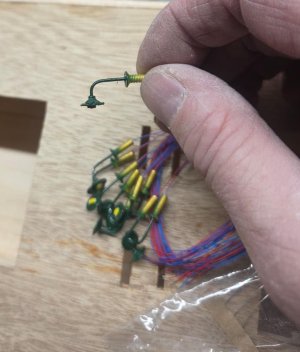
I've got these lights with LEDs that I may use in the few places on the deckhouse where floodlights might be used. I'll have to see if I can find HO scale cage lights, I don't think I've seen any before but maybe they exist. I'll also look for floodlights that might go on the cross trees.

FloodLights1.jpg

I found these spotlights in HO scale from a number of sources, maybe these would be good on the cross trees?

Spotlights.jpg
 
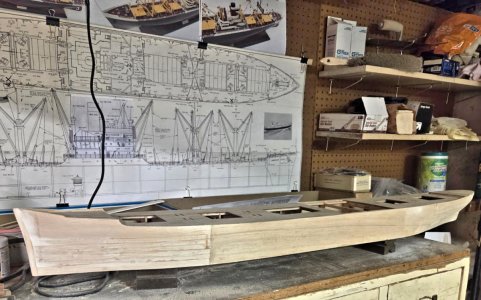
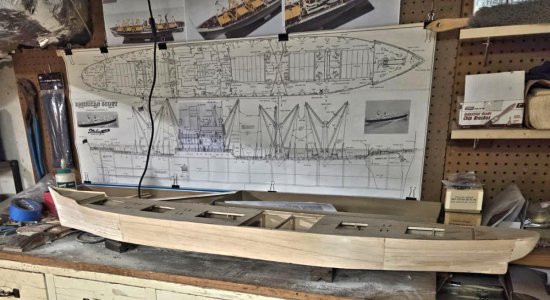
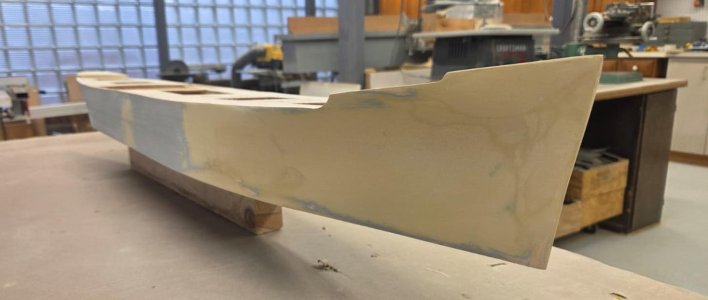
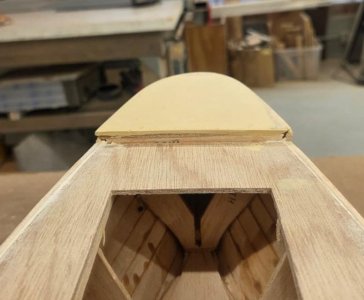
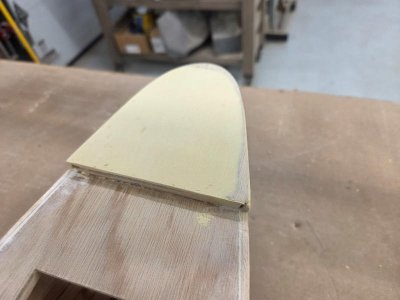
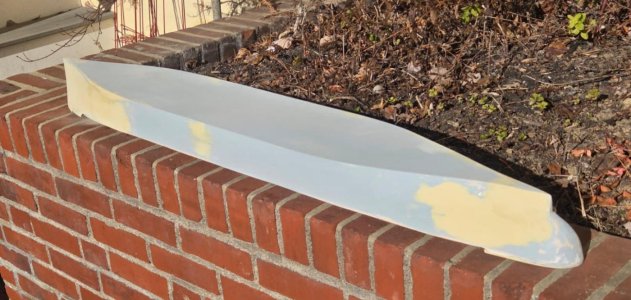
Hull sheathing/planking now done and rough sanded smooth. Probably will do some sort of filler to get everything perfectly smooth. I used some Deluxe Materials Model Lite Balsa Filler near the bow and it works pretty well. I didn't like the design of the bow where the planks from both sides would be glued together, seemed like the point of the bow would be fragile with the soft balsa so I added a stem in front out of pine. More sanding and filler required before I'll call the hull done but I'm happy with how it's coming along.

HullPlanking1.jpg

HullPlanking2.jpg
 
Hull sheathing/planking now done and rough sanded smooth. Probably will do some sort of filler to get everything perfectly smooth. I used some Deluxe Materials Model Lite Balsa Filler near the bow and it works pretty well. I didn't like the design of the bow where the planks from both sides would be glued together, seemed like the point of the bow would be fragile with the soft balsa so I added a stem in front out of pine. More sanding and filler required before I'll call the hull done but I'm happy with how it's coming along.

View attachment 567557

View attachment 567558
Looking smooth so far. I like the idea of a piece of pine at the bow. It will look straighter that way.
 
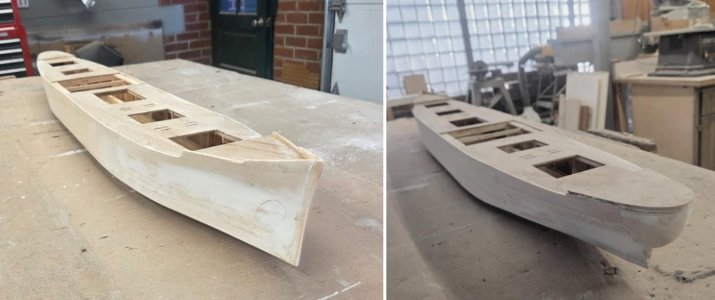
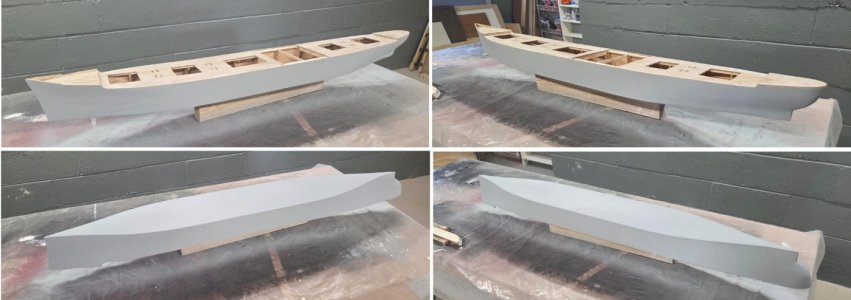
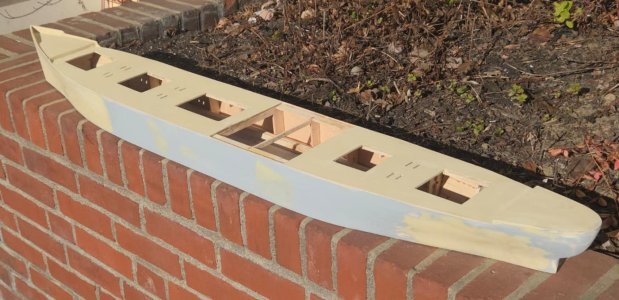
Got back to the project today, the hull is sanded and some filler has been applied to smooth the shape. Next up will be several coats of sanding sealer followed by several coats of high build primer. High build primer is used in automotive body work as a step in perfecting the smoothness of the surface for painting; it goes on fairly thick to fill imperfections and sands easily. Maybe it's not a typical step to finish a model ship hull but I've got lots of experience with it in making molds for fiberglass automotive parts and in putting final paint finishes on the pasts from those molds and I've always gotten excellent results with it.

HullShaped.jpg
 
A nice job building the hull! I particularly like your shaping of the “cruiser” stern.

Roger
Thank you very much! We'll see if I've done a good enough job when I spray it with the primer - having everything one uniform color usually highlights areas that need more refinement. I'm expecting a little more filler work to get everything perfect.
 
Back
Top