

• Win a Free Custom Engraved Brass Coin!!!
    As a way to introduce our brass coins to the community, we will raffle off a free coin during the month of August. Follow link ABOVE for instructions for entering.
  • PRE-ORDER SHIPS IN SCALE TODAY!

    The beloved Ships in Scale Magazine is back and charting a new course for 2026!
    Discover new skills, new techniques, and new inspirations in every issue.

    NOTE THAT OUR FIRST ISSUE WILL BE JAN/FEB 2026

Sail-making

Joined
Jul 12, 2025
Messages
90
Points
68

Hi guys and gals!

I’m a relative novice and I’m learning to make sails. My problem is that I’m trying to get a slight “bowing” of my sails to simulate wind-filled sails on my schooner. I used a roll of a plastic “foam” as a base (as a form then covering it with wax paper and the airbrushing a light application of white acrylic paint on them and let them dry hoping they would stiffen up and achieve the proper curve but after they dried they were still limp and it didn’t work.

I was thinking of applying dilute white PVA glue with a paint brush and letting it dry on the form but I don’t want to mess it up.

Can anyone advice me of a good technique?
 
You can try wetting the sail canvas and blowing hair drier on it till it is dry. Sail must be attached to its yard and bottom clews must be held by the sheet ropes like on real ship to produce proper wind blowing effect. Do it on separate fixture instead of your model.
 
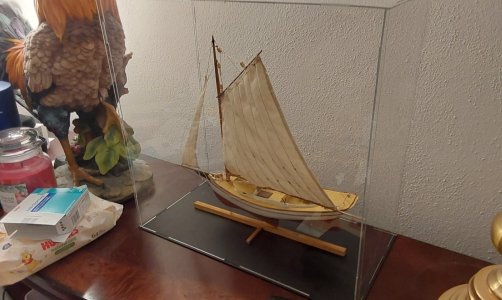
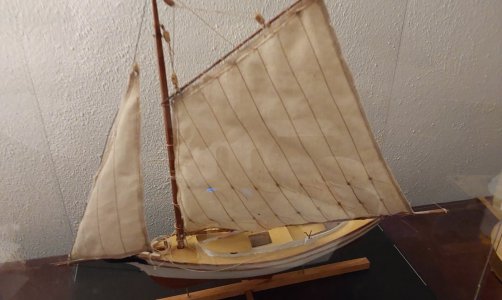
I am rebuilding a Swift pilot schooner, decided to add sails as part of the rebuild. I purchased a product recommended by a guy on utube I think it's called stiffey, he described it as basically watered down white glue it worked well on my lobster smack. I will try to post some photos as soon as I have them mounted. They need sewed onto the booms which tends to take me a while.

20260228_224744.jpg

20260228_224759.jpg
 
Hi guys and gals!

I’m a relative novice and I’m learning to make sails. My problem is that I’m trying to get a slight “bowing” of my sails to simulate wind-filled sails on my schooner. I used a roll of a plastic “foam” as a base (as a form then covering it with wax paper and the airbrushing a light application of white acrylic paint on them and let them dry hoping they would stiffen up and achieve the proper curve but after they dried they were still limp and it didn’t work.

I was thinking of applying dilute white PVA glue with a paint brush and letting it dry on the form but I don’t want to mess it up.

Can anyone advice me of a good technique?

I can help with that since I make 17th century models and the sails of that period were more billowed than the flatter, 19th century sails. You start by selecting the right material. Most fabrics that are weaves have little to no stretchability. Knits have lots of flexibility, mostly in one axis, but are fuzzy and as such don't look much like sail material. T-shirts are made from fine knit material, for example.

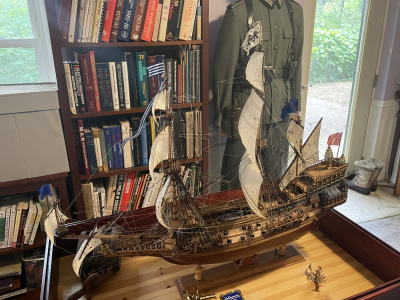
You need a weave that has an elastic material built into it, a good example of which is stretch cotton sateen fabric. I bought some white fabric, the last two yards they had at JoAnn's Fabric store, but decided it was too bright and may not take a stain evenly, leaving bright areas, so I kept hunting for the right material. Sails are NOT white. I found the same sateen fabric on Etsy.com, but in ivory color. Perfect! It has the right amount of tan color to start with. The fabric has the same properties that Olha Batchvarov uses in her sail making techniques video. It has no stretch in one direction, but has a little stretch in the perpendicular direction. The fabric is 97% cotton and 3% spandex, and has a fairly tight weave. With the stretchy direction laid in the horizontal direction, you make your sails. After making the sails on the sewing machine, stitch on the bolt rope and form cringles, the sails need to be stretched on a stretching jig while wet with starch, and allowed to dry in the billowed shape that you want. The feel like stiff parchment and hold their shape. Here are detailed instructions on how I made custom sails: Link

Here is the final result.
1772346143750.png
 
YT, I said that I didn’t like the idea of just setting and blow drying the sails because I feel that they wouldn’t keep their shape but I certainly will try it. Thanks so much for responding and trying to help me out!
 
Darivs Architectvs, thanks for your excellent response! I never thought of using starch my mom and grandma did when ironing shirts etc. I must have brain rot. I certainly will try it. I’ll also try commercial fabric stiffener- I didn’t even know there was such a thing.

Also, thanks for the link to Olha’s sailmaking video. I like the idea of using sugar or other heavy powder or granular stuff in a plastic bag as a weight to achieve the curvature. I used a piece of foam matting and it was ok but of course only worked in one axis.

Btw, the model in your photos looks amazing. Wow!
 
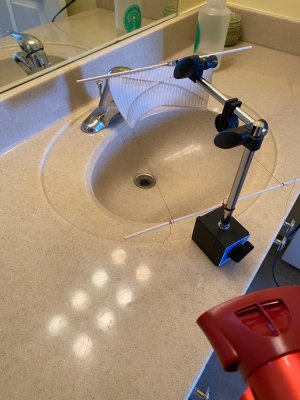
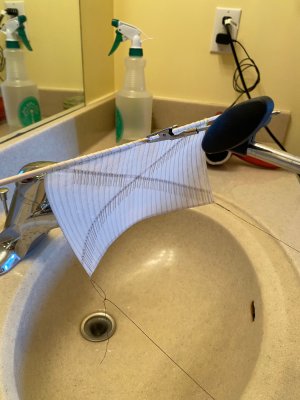
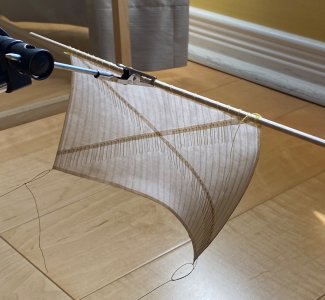
Today is your lucky day, BigBad. I’m just working on sails. This is the result of technique I suggested you to use. I just tried it as we speak.

IMG_1052.jpeg

IMG_1054.jpeg

IMG_1055.jpeg
 
Last edited:
Wow, YT! I’m gonna try it as soon as I get home today. I’ll have to make my own jig though. Guess I’ll use fowels and wood scraps. Where did you get that cool tool?
 
This is just a common magnetic stand to mount machinist dial indicator. This is indispensable tool in ship model rigging - a so called third arm.
 
I will be starting my next build - Billing Boats FD10 Yawl - soon and this will be my first try at making the sails. I don't have a sewing machine and wondered if anyone had some tips for "edging" the sails. Thanks.
 
Darivs Architectvs, thanks for your excellent response! I never thought of using starch my mom and grandma did when ironing shirts etc. I must have brain rot. I certainly will try it. I’ll also try commercial fabric stiffener- I didn’t even know there was such a thing.

Also, thanks for the link to Olha’s sailmaking video. I like the idea of using sugar or other heavy powder or granular stuff in a plastic bag as a weight to achieve the curvature. I used a piece of foam matting and it was ok but of course only worked in one axis.

Btw, the model in your photos looks amazing. Wow!
Commercial fabric stiffener is what I used. Worked great. And the water bag worked a small bit better than a sand bag, but if it leaks, you have a mess! Glad i could help. That's what the forum is for.
 
YT, I said that I didn’t like the idea of just setting and blow drying the sails because I feel that they wouldn’t keep their shape but I certainly will try it. Thanks so much for responding and trying to help me out!
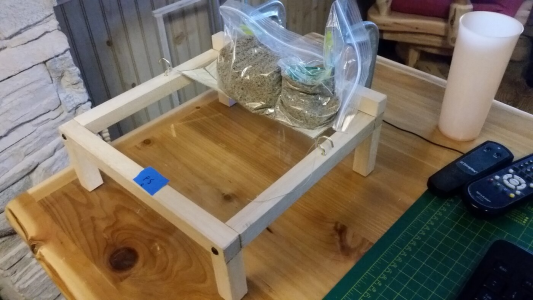
Blow drying the sails in order to shape them is pretty ineffective at stretching the fabric unless you use hurricane force wind. Stretch sateen fabric needs more force to stretch the spandex in it and achieve a deep shape. Positioning the water or sand bag allows you to control where the deepest depression in the fabric is and control the shape. You may blow hot air against the sail to speed things up while it is in the stretching jig, but the sand/water bag draws off a lot of the heat, so it's easier to just let it dry overnight. Be sure to make a "test sail" to to practice attaching the bolt rope and also to test your stain so the sails come out at the color you want. I saved the wooden stretch jig I made for future models. It will get lots of use.

1772396364382.png
 
Last edited:
This is just a common magnetic stand to mount machinist dial indicator. This is indispensable tool in ship model rigging - a so called third arm.
Thank you so much YT and Darivs! I’m gonna try those techniques. I found that tool online and the Harbor Freight right near me apparently stocks them and they’re not expensive. First thing tomorrow morning I’m going to Harbor Freight.
 
Clive, I am also new to sail-making but I’ve made a few sails and a top for my doctor’s buggy which came out pretty good. After cutting the material to size I folded over the edge of the material about 1/8-1/4” and used a piece of a scrap plank to “iron” it so it formed a nice flat crease which maintained its crease pretty good, then used a running stitch (my grandma called it a “basting stitch”) to finish the “hem”. Works well (and I guess it’s like they did sail sewing back in the day so it shoud be kind of authentic considering they didn’t have sewing machines back in the day). Only problem is that it takes much longer than a sewing machine but I got a little faster as I got into it. Takes more time but if you can’t afford a sewing machine it works. But take the advice of experts like YT and Darivs who are a heckuva lot more knowledgable than me. I bought a half-decent sewing machine and have just finished learning how to use it and man, it really saves time! It can’t mimic hand-stitching but comes pretty close :)
 
I noticed in Olga Batcherov’s video that she sewed the bolt rope on the edge of the sail by hand. In the few sails I’ve done I first layed the bolt rope in the crease, then sewed it into the “hem” by sewing around it and making sure it stayed in the crease as I sewed. That’s because I saw it in several videos and books. As a newbie I read that that’s the way they did it back then but of course they must have used different techniques for different applications. I’m currently building the Herreshoff 12 1/2 and interestingly the bolt ropes are outside of the sail edges- the sail edges are “hanked” onto the bolt ropes. New to me but what do I know lol. It’s what is great about our hobby- you keep learning the techniques in boat building that evolved over the ages :)
 
My best advice, get a sewing machine. Get a used one, make sure it's properly cleaned, oiled, and tuned by a local sewing store's service department. A dirty sewing machine that is out of tune (bobbin thread friction and upper thread friction out of calibration) is a source of frustration. It will create loose stitches or hairball knots while you sew. A well tuned machine makes work smooth as butter and FAST FAST FAST! You can sew one sail with all the panel lines in under 15 minutes. You don't need a fancy sewing machine. You can buy an old Singer or even an old 1920's Minnesota and it will work fine, especially if it can make very small, straight stitches. I use my grandmother's portable 1952 Singer sewing machine and it only has two stitches, straight and zig-zag. Old machines are built like tanks and last several generations if cleaned and oiled correctly. The don't have all the fance computerized stitching types, but are reliable. Ask your local fabric store people where you can send your machine for a cleaning/oiling/tuning. Once done, it will last months of continuous use. Then you clean/oil it again.

Hand sewing sucks. It's slow and meticulous work, but sewing bolt ropes and other detail steps in sail making make it necessary. You can machine sew panel lines, edges, and reinforcement panels (lining). The rest is handsewing. On smaller models, gluing the bolt rope onto the edge of the sail is an option to help keep that detail in scale, and it is not necessary to fold the edges on sails for scales smaller than 1:72. The folded edged are typically far too large in size for sails on models smaller than 1:48 scale. You have to decide if you want to sew the bolt ropes or fold sail edges on or use an alternate method.

On ships smaller than 1:85, panel lines on sails are better simulated with pencil lines that stitching. Keeping the details on your model in scale is important in maintaining realism in appearance, especially since there are plenty of details omitted or simplified in models because they are too small to make at scale already. A balance in what details are crafted and which are simplified or omitted needs to be established.
 
Last edited:
Thanks Darivs. My ex-wife and I were just reminiscing about the old Singers our grandmothers used- they had foot pedals instead of electric to operate the machine, so you didn’t need electricity to run them. They had rocker pedals and a pulley system to turn the device and bob the needle up and down. I guess it was Singer’s original design. Boy, they probably cost a lot of money nowadays as antiques lol. Amazing to see the technology that developed. Like shipbuilding!
 
Back
Top