• Win a Free Custom Engraved Brass Coin!!!
    As a way to introduce our brass coins to the community, we will raffle off a free coin during the month of August. Follow link ABOVE for instructions for entering.
  • SUBSCRIBE TO SHIPS IN SCALE TODAY!

    The beloved Ships in Scale Magazine is back and charting a new course for 2026!
    Discover new skills, new techniques, and new inspirations in every issue.

    NOTE THAT OUR NEXT ISSUE WILL BE MARCH/APRIL 2026

Le Saint Philippe 1693 after Jean-Claude Lemineur (Ancre) in scale 1:48

.​
To those of you who know what you are doing...

Excellent! :) (this is why I decided to enter... :))

The heavy construction of this particular deck and in this specific spot seems unnecessary and even harmful. It could be seen as a classic case of overkill on the part of the modern reconstruction designer. Neither the knees nor the ledges are needed here.

.​
 
Those plans are utterly confusing. Have you asked the question on the French forum? Gerard Delacroix may be able to help you here.
 
.​


Excellent! :) (this is why I decided to enter... :))

The heavy construction of this particular deck and in this specific spot seems unnecessary and even harmful. It could be seen as a classic case of overkill on the part of the modern reconstruction designer. Neither the knees nor the ledges are needed here.

.​
Indeed. All of these elements disappear on the quarterdeck (and poop deck).

But if they were to be included (yes, I know...) what is being shown with regard to the horizontal knees vs. the ledges on the drawings?
 
.​

But if they were to be included (yes, I know...) what is being shown with regard to the horizontal knees vs. the ledges on the drawings?

Well, since I see you’re determined to stick to the reconstruction plan after all...

The upper surfaces of the beams and ledges must be flush, so the ledges need to be extended slightly so that they can be mortised a few inches into those wretched lodging knees, which I don’t think were even used in French shipbuilding at that time. One can take some English sample for more detailed guidance :) .

.​
 
Well, since I see you’re determined to stick to the reconstruction plan after all...
I have not come to any conclusions about what I will or will not do here, Waldemar. Without disparaging your expertise in any way - you can't sneeze on this forum without getting yucky stuff on an expert, to that end I prefer to allow the final decision to hang for a bit.

And I thank you very much for your explanation of what is drawn: the ledges are morticed into the upper surface of the knees. In English practice I believe these knees were flush with the top of the beams. Is that correct?
 
.​
In English practice I believe these knees were flush with the top of the beams. Is that correct?

That’s how they’re usually modeled, but in reality it wasn’t really necessary — and perhaps even inadvisable —, and besides, such perfect leveling would require much more work and produce a lot of waste from a component that’s expensive and becoming increasingly difficult to obtain over time.

I’m curious to see what you ultimately decide for your model, and I assure you that I won’t judge your choice.

.​
 
Paul,

Confusing drawings to be sure.

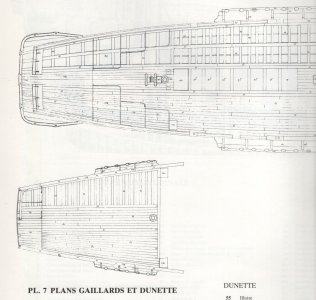
Regarding your first question (why the knees become horizontal at this point): It appears the cannon ports on the deck above, stop. Therefore, no need for beefy vertical knees supporting the heavy weight of cannons. Also, like you said, it keeps them out of what are likely more formal living space?

The horizontal knees appear flush with both top/bottom of the beams, at the outer bulkhead.

The ledges are let into these knees (top photo). Can't explain why this joint is not shown in the bottom photo???? I look forward to how you resolve this apparent discrepancy in the last drawing.
 
.​


That’s how they’re usually modeled, but in reality it wasn’t really necessary — and perhaps even inadvisable —, and besides, such perfect leveling would require much more work and produce a lot of waste from a component that’s expensive and becoming increasingly difficult to obtain over time.

I’m curious to see what you ultimately decide for your model, and I assure you that I won’t judge your choice.

.​
Thank you kindly, Waldemar.
 
One more observation, the plan view shows the ledges being supported by 4 possibly 6 longitudinal short beams between each major (1-6) floor beams. This would be adequate for support of the ledges without any mortise into the horizontal knee if in my opinion these ledges were only to keep the decking stiffer (by keeping the longitudinal deck boards from moving vertically next to each other). Your plans as I see them do not show any mortise into the knees.
 
Paul,

Confusing drawings to be sure.

Regarding your first question (why the knees become horizontal at this point): It appears the cannon ports on the deck above, stop. Therefore, no need for beefy vertical knees supporting the heavy weight of cannons. Also, like you said, it keeps them out of what are likely more formal living space?

The horizontal knees appear flush with both top/bottom of the beams, at the outer bulkhead.

The ledges are let into these knees (top photo). Can't explain why this joint is not shown in the bottom photo???? I look forward to how you resolve this apparent discrepancy in the last drawing.
You have it right, Brad. Mr. Lemineur shows hanging knees forward of this location - there is a whole row of guns running to the bow - but only one gun aft of the mizzen mast.
 
One more observation, the plan view shows the ledges being supported by 4 possibly 6 longitudinal short beams between each major (1-6) floor beams. This would be adequate for support of the ledges without any mortise into the horizontal knee if in my opinion these ledges were only to keep the decking stiffer (by keeping the longitudinal deck boards from moving vertically next to each other). Your plans as I see them do not show any mortise into the knees.
Thanks for your thoughts here, Daniel.
 
.​

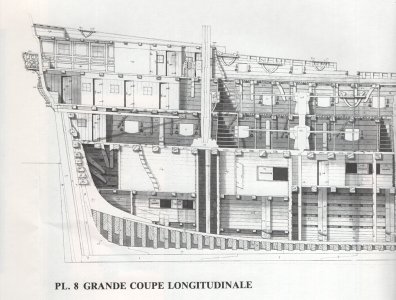
French written sources from the late 17th century clearly indicate that great care was taken to ensure the lightness of the upperworks where it was possible, by using lighter wood and a lighter construction; these sources even include specific lists of scantlings, the number of components, and the types of wood recommended for warships of each type. A good example is a slightly later plan of a structural nature, from the third or fourth decade of the 18th century. The arrangement of the deck elements immediately reveals where the artillery was located and where it was not. For comparison, and other details, such as scantlings, a longitudinal section has been also included below.


002.jpg

003.jpg
.​
 
.​

French written sources from the late 17th century clearly indicate that great care was taken to ensure the lightness of the upperworks where it was possible, by using lighter wood and a lighter construction; these sources even include specific lists of scantlings, the number of components, and the types of wood recommended for warships of each type. A good example is a slightly later plan of a structural nature, from the third or fourth decade of the 18th century. The arrangement of the deck elements immediately reveals where the artillery was located and where it was not. For comparison, and other details, such as scantlings, a longitudinal section has been also included below.


.​
Strangely, I had a similar thought while working out a moment ago. The monograph goes into great detail over the concern for hogging on these big ships (this being the explanation for the morticed frame-pairs and several other features on the SP) - keeping weight down at the rear of the ship would have consistent with other design elements (says the guy who has no right to have an opinion about this matter).
 
.​

Paul, whatever you decide, you have the opportunity to avoid the lodging knees problem altogether by omitting these elements that are clearly superfluous, and such a decision will be in line with the sources. In short, that is essentially the message I wanted to convey to you. The rest is up to you :).

.​
 
Well, Paul, my first impulse was to reference Michele Padoan’s build, but for some reason I am unable to find it.

I read through Waldemar’s contributions to your build log, and I do believe that his interpretation of the drawing is correct; that the ends of the ledges would be let into the horizontal knees.

I also think he is correct to state that these unnecessarily heavy components would likely have been omitted in the superstructure, as the French were, by this time in 1693, keenly aware of overloading with top-hamper.
 
.​

Many thanks, Marc :). Especially your support is a huge psychological boost.

As for the strict requirements regarding the lightness for the upper structures, it would be admittedly rather troublesome now to find and quote specific, very numerous and scattered passages, but if anyone wishes to verify this, they can be found in the work Construction des Vaisseaux du Roy by an anonymous author, published in Havre de Grace in 1691 (and later reprinted in Brest in 1706), that is, almost exactly at the time of the construction of Le Saint Philippe.

.​
 
Last edited:
Back
Top