• Win a Free Custom Engraved Brass Coin!!!
    As a way to introduce our brass coins to the community, we will raffle off a free coin during the month of August. Follow link ABOVE for instructions for entering.
  • SUBSCRIBE TO SHIPS IN SCALE TODAY!

    The beloved Ships in Scale Magazine is back and charting a new course for 2026!
    Discover new skills, new techniques, and new inspirations in every issue.

    NOTE THAT OUR NEXT ISSUE WILL BE MARCH/APRIL 2026

Le Saint Philippe 1693 after Jean-Claude Lemineur (Ancre) in scale 1:48

Well, Paul, my first impulse was to reference Michele Padoan’s build, but for some reason I am unable to find it.

I read through Waldemar’s contributions to your build log, and I do believe that his interpretation of the drawing is correct; that the ends of the ledges would be let into the horizontal knees.

I also think he is correct to state that these unnecessarily heavy components would likely have been omitted in the superstructure, as the French were, by this time in 1693, keenly aware of overloading with top-hamper.
Hmm. A part of Michele's build report is still there but his most recent posts are now missing.


He shows more on the French Forum:


Regardless, Michele's build has been mothballed in favor of another ship model. He was not as far as the third deck so there is nothing there to see anyway.

And I do thank you, Marc, for sharing your thoughts on this puzzling (annoying?) situation.
 
.​

Many thanks, Marc :). Especially your support is a huge psychological boost.

As for the strict requirements regarding the lightness for the upper structures, it would be admittedly rather troublesome now to find and quote specific, very numerous and scattered passages, but if anyone wishes to verify this, they can be found in the work Construction des Vaisseaux du Roy by an anonymous author, published in Havre de Grace in 1691 (and later reprinted in Brest in 1706), that is, almost exactly at the time of the construction of Le Saint Philippe.

.​
I am a great admirer of your work, Waldemar, precisely because you have dug deep into primary sources. Your scholarship is truly impressive. I like to think of you as a kind of “Key Master,” unlocking possibilities previously unexplored.
 
Hmm. A part of Michele's build report is still there but his most recent posts are now missing.


He shows more on the French Forum:


Regardless, Michele's build has been mothballed in favor of another ship model. He was not as far as the third deck so there is nothing there to see anyway.

And I do thank you, Marc, for sharing your thoughts on this puzzling (annoying?) situation.

Interesting. If I remember, he is building the prototype for a collaboration with his friend, who developed a monograph of the Queen Charlotte.
 
Just for you guys :) - here are the freshly installed knees:

View attachment 583442

As you can see, the knees on the second deck have decorative ends:

View attachment 583443

Including on the vertical elements:

View attachment 583444

View attachment 583445

View attachment 583446

Carlings and ledges will follow...

Thanks for stopping by!
It's pretty amazing what you can accomplish with a set of diamond files and a mini saw. Great looking pics too. Congratulations
 
.​
I am a great admirer of your work, Waldemar, precisely because you have dug deep into primary sources. Your scholarship is truly impressive. I like to think of you as a kind of “Key Master,” unlocking possibilities previously unexplored.


Many thanks, Marc :). Although, I must say, it’s largely down to chance; I’m simply an oddball who happens to be interested in these conceptual issues, which for almost everyone else are, at best, a necessary evil, and hardly anyone bothers with them. This situation has its pros and cons. On the one hand, that is precisely why I’ve had the chance to make discoveries in this heavily neglected field; on the other hand, hardly anyone cares about their historical significance :).

.​
 
To those of you who know what you are doing...

I already asked this question of someone via DM - but as I wait for his reply, I'll ask the same question here in the hopes that someone who knows how to read these drawings can help me sort something out:

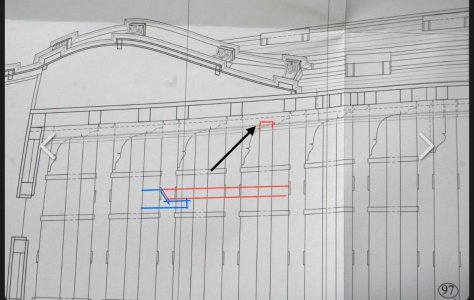
Here are drawings of the 3rd deck on the SP. There are vertical knees (per normal) along the length of the ship. But as we approach the stern these knees become horizontal (I assume to keep them out of living spaces, or???).

Anyway, on the side drawings it appears as if these horizontal knees are UNDER the ledges - but on the above-view drawings it appears that these horizontal knees sit OVER the ledges.

What's going on here? None of my other monographs (or the 74-gun series) have this third deck so I have run out of resources.

Yellow are full-sized beams. Orange are ledges. Blue are knees.

View attachment 584426

View attachment 584427

View attachment 584428

View attachment 584429

IF the knees are UNDER the ledges the top two drawings make them look to be below the top of the beams rather than flush with the top of the beams. This is unexpected. Or maybe I'm not seeing things correctly...

I would be most grateful for help!
Hi, I'm wondering: are the drawings any good, or ............................... .Frank
 
Hi, I'm wondering: are the drawings any good, or ............................... .Frank
Unfortunately, I have been having these same thoughts for quite a while now. Of course, I am not really qualified to judge the plans on how well they capture period-correct French naval architecture. But I have now identified quite a number of inconsistencies from plate to plate. I'm certain some of these can be explained by my confusion over what is being shown - but other times there are clearly differences that cannot be reconciled.

I cannot imagine how difficult it must be to create plans like these. But the reviews of this monograph across several forums has certainly doomed this model from being built very often. Personally, I am only aware of two completed POF (full ship) models - and both of these were built in conjunction with the development of the monograph itself. Two others have been started by expert modelers and they will likely be completed one day - but each of them has been discontinued at the present time in favor of other projects. There are several POB models in existence (or under construction right now) - but that approach avoids some of the inconsistencies I have encountered.

Since I really only build for my personal enjoyment this stern section model will continue without regret over mistakes (all while I genuinely try to get it right).
 
French written sources from the late 17th century clearly indicate that great care was taken to ensure the lightness of the upperworks where it was possible, by using lighter wood and a lighter construction; these sources even include specific lists of scantlings, the number of components, and the types of wood recommended for warships of each type. A good example is a slightly later plan of a structural nature, from the third or fourth decade of the 18th century. The arrangement of the deck elements immediately reveals where the artillery was located and where it was not. For comparison, and other details, such as scantlings, a longitudinal section has been also included below.


[]
002.jpg


003.jpg
[/]


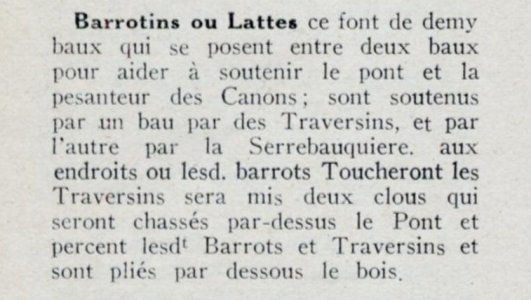
In addition to all the other sources, I have still today consulted the so-called J355 manuscript on shipbuilding on this specific point, which – importantly – was written and contains information from the years 1680–1701, that is, during the construction of Le Saint Philippe in 1693, and what's more, most probably (at least in large part) by the builder of the ship himself. In the sub-section ‘Connaissance de toutes les pièces qui entrent dans la construction d’un vaisseau […]’, I found a passage that appears to corroborate the previously shown fragment of a later plan from the second quarter of the 18th century, specifically the absence of carlings and ledges for the section of the deck devoid of artillery.


French transcription:

Pages from Construction et proportions de plusieurs vaisseaux - manuskrypt J355 - 1690-1701 - ...jpg


Translation:

Ledges are half-beams [in terms of their thickness] placed between two beams to help support the deck and the weight of the cannons; they are supported by beams via carlings, and also by the beam-shelf. At the spots where the said ledges touch the carlings, two nails shall be placed, which shall be driven over the deck and pierce the said ledges and carlings, and shall be bent beneath the wood.


Admittedly, I’m not sure whether this will make your final choice easier or harder, but at least you now have, I think, all the possible options to consider :).

.​
 
The discussion of the horizontal (lodging) knees aft of the mizzen mast on the third deck of the Saint Philippe has taken an unfortunate turn. As part of an exchange with one of our members, I posted what was intended to be a message of thanks and appreciation. Sadly, the sincerity of my post was summarily rejected, and I was accused of being dishonest, misleading, upset with people who dared offer guidance, and unprepared to receive anything but blind flattery. Indeed, I was characterized as creating a circle of mutual, narcissistic adoration. Oh, and those of you who post encouraging things on this build report are sycophants per my current detractor.

I've been here before which is why I was reluctant to even continue as a member of SOS. It would seem I am like a flame that draws moths.

Well, this current episode hits me at a time when walking away feels less appropriate. I am genuinely sad for our fellow member who is seemingly incapable of receiving a sincere message of gratitude (sincere being a trigger word for my detractor).


Onward we go. You might remember that the genesis of this discussion was several drawings that I was incapable of reconciling. Thanks to our friends Waldemar and Tobias (who is my intermediary with Gerard Delacroix on the French forum [Gerard is a naval archaeologist, author of several monographs, and a specialist in 17th and 18th French ships]) we have learned the following with regard to the relationship of the lodging knees and the ledges:

IMG_0218.jpeg

OK, I can do this.

But then a question was raised about how Mr. Lemineur has reconstructed this portion of the third deck. There is no heavy artillery in this location... should there even be knees here? If so, should they be horizontal? Should they be vertical? As long as we are at it: should there even be ledges here?

After taking in quite a lot of information... I can now report that the preponderance of the evidence shows there is not a preponderance of evidence. Indeed, it is possible to defend several solutions...

To that end I can think of no reason to depart from the plans as shown. In support of this I find myself motivated by something written by Blaise Ollivier. Mr. Ollivier wrote a treatise on French ship construction that was published in 1735 (about 40 years after the SP was build):

"THIRD DECK CURVES
These are wooden curves that connect the beams of the third deck for first-rate vessels to the gunwale. There is a curve at each end of the third deck beams, positioned and attached like the second deck curves, except from the mizzenmast to the stern where some builders run the third deck curves horizontally to allow more space in the cabins..."

This is exactly what Mr. Lemineur shows on his plans and may even be WHY he made the decision to reconstruct the SP the way he has (a decision, by the way, he does not bother to comment on in his monograph).

Thanks for playing along.
 
Here’s my sage advise… ignore the detractors! As I’m sure you know there will always be those whose opinion is the only one that matters and the rest of us minions are illiterate fools. To those detractors I send a heart felt raspberry! (well maybe, a couple of more heartfelt 4 letter words as well… ) :rolleyes:;)
Carry on, my friend!
 
Як хтось сказав на змаганнях по судомоделізму: "Чтобы не было жу-жу, делай все по чертежу"
As someone said at a ship modeling competition: "To avoid any noise, do everything according to the blueprint"
 
The discussion of the horizontal (lodging) knees aft of the mizzen mast on the third deck of the Saint Philippe has taken an unfortunate turn. As part of an exchange with one of our members, I posted what was intended to be a message of thanks and appreciation. Sadly, the sincerity of my post was summarily rejected, and I was accused of being dishonest, misleading, upset with people who dared offer guidance, and unprepared to receive anything but blind flattery. Indeed, I was characterized as creating a circle of mutual, narcissistic adoration. Oh, and those of you who post encouraging things on this build report are sycophants per my current detractor.

I've been here before which is why I was reluctant to even continue as a member of SOS. It would seem I am like a flame that draws moths.

Well, this current episode hits me at a time when walking away feels less appropriate. I am genuinely sad for our fellow member who is seemingly incapable of receiving a sincere message of gratitude (sincere being a trigger word for my detractor).

Serious? Puhhhh ... could it be a language matter? Anyway staying on SOS is the right decision I need time to find some flaws :-D

Dirk
 
The discussion of the horizontal (lodging) knees aft of the mizzen mast on the third deck of the Saint Philippe has taken an unfortunate turn. As part of an exchange with one of our members, I posted what was intended to be a message of thanks and appreciation. Sadly, the sincerity of my post was summarily rejected, and I was accused of being dishonest, misleading, upset with people who dared offer guidance, and unprepared to receive anything but blind flattery. Indeed, I was characterized as creating a circle of mutual, narcissistic adoration. Oh, and those of you who post encouraging things on this build report are sycophants per my current detractor.

I've been here before which is why I was reluctant to even continue as a member of SOS. It would seem I am like a flame that draws moths.

Well, this current episode hits me at a time when walking away feels less appropriate. I am genuinely sad for our fellow member who is seemingly incapable of receiving a sincere message of gratitude (sincere being a trigger word for my detractor).
Hi. Paul. Here a reply of one of those ‘sycophants, kneeling before you in admiration’.
Here in the Netherlands, we have the expression "That is unfilmable." Sometimes someone's ego is bigger than the person themselves. An ego like that doesn't get captured on celluloid. No idea how that works in this digital age .... :rolleyes:
Then sometimes you just have to 'count to 10' ....... maybe even continue to 100 .......... and then make the wise decision to ignore this person and keep posting your contributions here on the SoS.
Onward we go. You might remember that the genesis of this discussion was several drawings that I was incapable of reconciling. Thanks to our friends Waldemar and Tobias (who is my intermediary with Gerard Delacroix on the French forum [Gerard is a naval archaeologist, author of several monographs, and a specialist in 17th and 18th French ships]) we have learned the following with regard to the relationship of the lodging knees and the ledges:

View attachment 585176

OK, I can do this.

But then a question was raised about how Mr. Lemineur has reconstructed this portion of the third deck. There is no heavy artillery in this location... should there even be knees here? If so, should they be horizontal? Should they be vertical? As long as we are at it: should there even be ledges here?

After taking in quite a lot of information... I can now report that the preponderance of the evidence shows there is not a preponderance of evidence. Indeed, it is possible to defend several solutions...

To that end I can think of no reason to depart from the plans as shown. In support of this I find myself motivated by something written by Blaise Ollivier. Mr. Ollivier wrote a treatise on French ship construction that was published in 1735 (about 40 years after the SP was build):

"THIRD DECK CURVES
These are wooden curves that connect the beams of the third deck for first-rate vessels to the gunwale. There is a curve at each end of the third deck beams, positioned and attached like the second deck curves, except from the mizzenmast to the stern where some builders run the third deck curves horizontally to allow more space in the cabins..."

This is exactly what Mr. Lemineur shows on his plans and may even be WHY he made the decision to reconstruct the SP the way he has (a decision, by the way, he does not bother to comment on in his monograph).

Thanks for playing along.
Thanks for this step and keep on posting!
Regards, Peter
 
Last edited:
Back
Top