Continuation: Main Tacks an Sheets - Les amures et les écoutes de grande voile
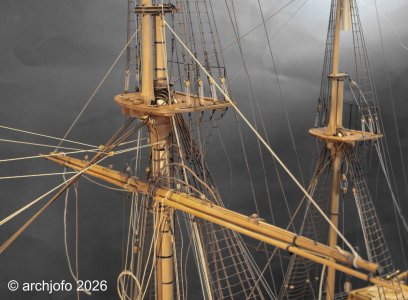
In principle, the work steps now repeat those used when mounting the foreyard. In this context, I would like to address a fundamental aspect of my model‑building philosophy.
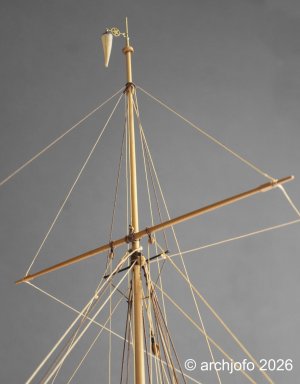
The running rigging of the yards is mostly pulled upward. Since the model, unlike the original, lacks the real weight of the yard, it is often difficult to give the lines the correct mechanical tension. Some model builders therefore use a small brass pin to invisibly fix the yard to the mast – a solution that makes rigging considerably easier.
I deliberately avoid this, even though it does not make the work any easier. By adjusting the clewlines in combination with sheets and tacks, I can control the necessary settings quite well. This corresponds to my own philosophy: I try not to create additional fixed points in the rig so that the entire system remains more elastic. The materials react to climatic changes such as humidity and temperature. A more flexible system can absorb such changes and compensate for tensions better than a rigidly fixed one.
Whether this actually matters on a model – who knows?
For me, this approach simply feels right. Accordingly, I turned to the sheets and tacks of the main yard before continuing with the truss pendant and hanger.
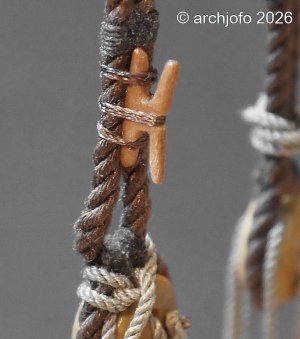
The main sheets and tacks on La Créole had a diameter of 32 mm and 30 mm respectively, which corresponds to 0.67 mm and 0.63 mm in scale. As with the fore sheets and tacks, I decided to make them as so‑called Grelins (French term for cables less than 12 French inches circumference).
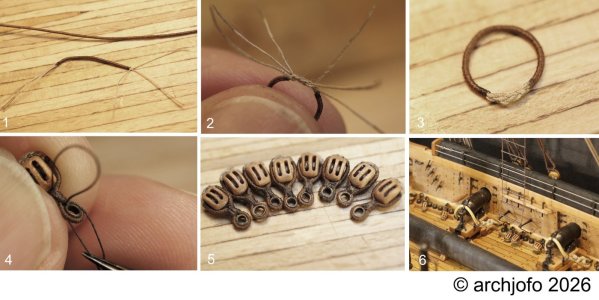
To give an impression of how this looks on my ropewalk, here are two photos:
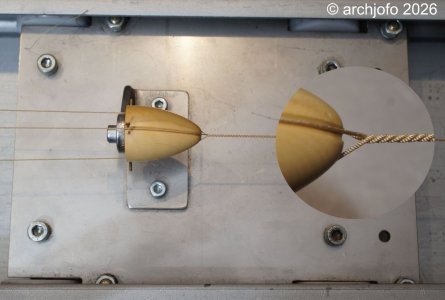
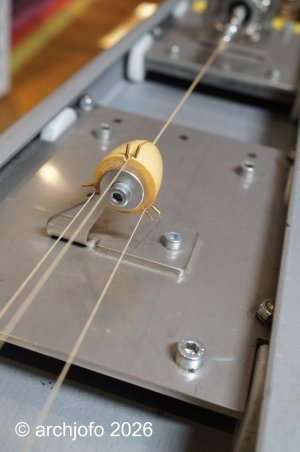
They clearly show how three right‑laid ropes are twisted into a cable. Since the final diameter depends on the starting yarn, certain compromises are unavoidable.
As already explained for the fore sheets and tacks, the standing parts were partially served. For this I relied in particular on a depiction from the Atlas du Génie Maritime, shown below:
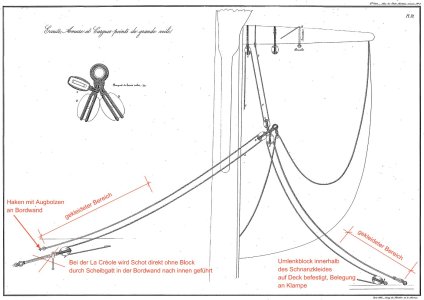
Source: Atlas du Génie Maritime, Pl. 31
This illustration also shows that the main tacks are fitted and led inside the bulwarks. This arrangement is also found on contemporary models from the early 19th century in the Musée national de la Marine. On the original model of La Créole, neither tacks nor sheets are present; not even the corresponding belaying cleats exist.
In the rigging plan of Jean Boudriot’s monograph on La Créole, the standing parts of the main tacks are drawn as being fastened outside the hull, with the running parts passing over the hammock stowage into the interior – a solution that I personally do not consider practical, as can be seen from the belaying cleat (marked in red on the right).
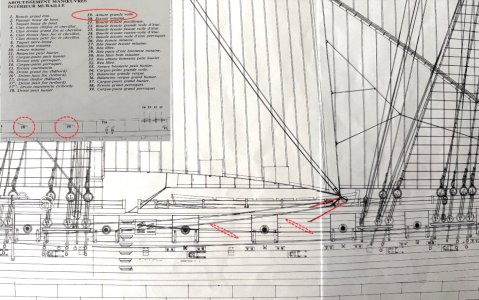
This arrangement is found neither in contemporary literature nor on contemporary models.
On this question, I found a clear description in the period manual Manuel de Gréement by F. A. Coste (1829), starting on page 164. Both variants of main tacks are described there – the external and the internal arrangement. However, especially on warships, the internal variant was preferred. M. Verdier (Nouveau manuel complet de marine, Part 1: Gréement, 1837) discusses only the internal arrangement, as also shown on a depiction of a brig from 1839 in the Atlas du Génie Maritime.
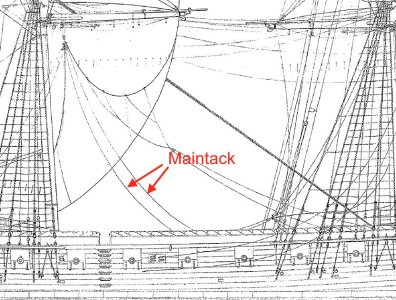
Source: Atlas du Génie Maritime, Brig 1839, Pl. 209
La Bergère (French corvette of 1832), an important reference model in the monograph on La Créole, also shows the main tacks consistently led inside.
Thus it became clear to me how I would represent the main tacks on my model.
Accordingly, it was necessary to determine the attachment points for the standing parts and the turning blocks of the main tacks on the deck of La Créole. For this I analysed examples from contemporary models:
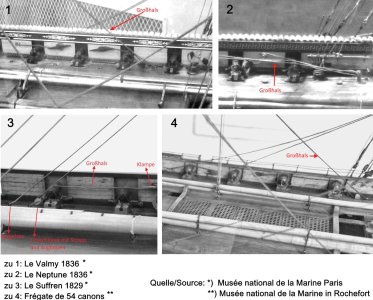
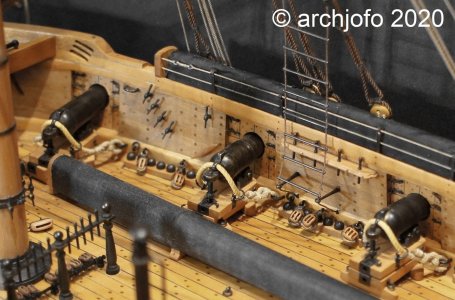
It is striking that leading the running parts of the main tacks even across guns apparently posed no problem. Contact with hammock stowage and their supports also seems to have been uncritical – the numerous examples suggest this. For a professional assessment I lack practical experience in sail handling, so I simply accept this as given.
For the reconstruction on my model, only one variant is feasible due to the structural conditions, as shown below:
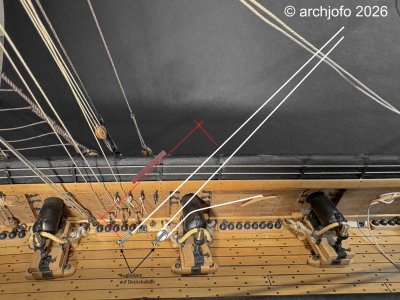
I will report on the further implementation on the model in due course.
To be continued …