• Win a Free Custom Engraved Brass Coin!!!
    As a way to introduce our brass coins to the community, we will raffle off a free coin during the month of August. Follow link ABOVE for instructions for entering.

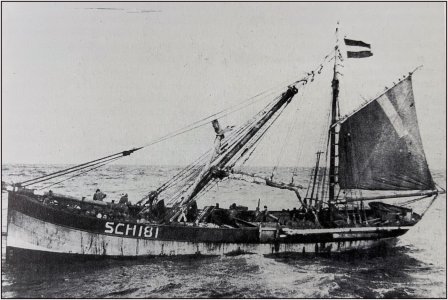
BALDER, Vlaardingen Herring Lugger from 1912, scratch build scale 1:50 Plate-On-Frame

Hi Peter, impressive as usual.
Do you paint or chemically blacken the metal parts?
Thanks, Herman. I give the last parts a Ballistol blackening as a basic layer. And then paint them black because on the Balder all the parts are also painted. My experience now is that this as a primer, makes the paint adhere better to the brass.
So, a bit out ‘off the box’ …….
Regards, Peter
 
Thanks, Herman. I give the last parts a Ballistol blackening as a basic layer. And then paint them black because on the Balder all the parts are also painted. My experience now is that this as a primer, makes the paint adhere better to the brass.
So, a bit out ‘off the box’ …….
Regards, Peter
It looks really well! Thank you.
 
No detail has been omitted. Impressive work, Peter!
Thanks, Paul. It's in the details and against the limits.;)
Hi Peter,
Suprized to see there is only an anchor at the SB side?
I think they could also manually turn it to port once it's out. But I also have a question for them, including whether they still use a chain for the anchor. I haven't seen one during my visits yet.
The Amsterdam restoration book does mention it:
"It was unknown exactly how many meters of anchor chain the Balder had on board. The stock anchor was raised with the steam spindle, using a hawser attached to the chain and then wrapped around the spindle several times."
So, still a lot of questions on my next visit for the Balder crew.
Regards, Peter
 
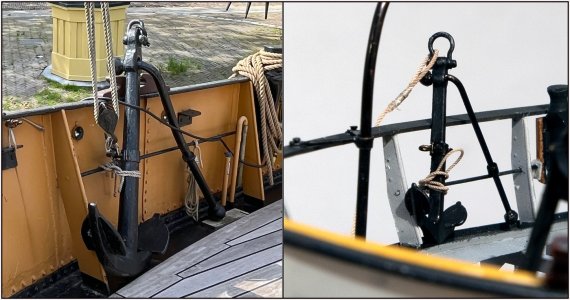
Got a little more work done on the slightly to long anchor:
0920 Anker David.jpg
It was a printed version with a fixed stock.
-Shortened the main beam a bit;
-Made a clamp with an eye about halfway down, where the hook block will later be hooked;
-Cut off the printed stock and made a new one that can hinge.
-Secured it to the lashing rail.
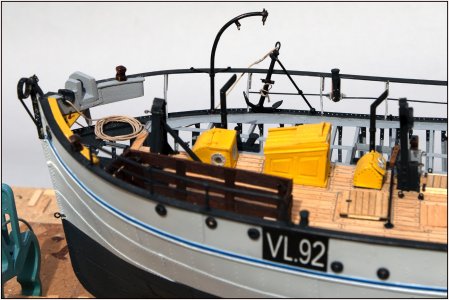
0921 Anker David.jpg
With an overview of the increasingly crowded foredeck.

The question of whether they use an anchor chain or rope has also been resolved:
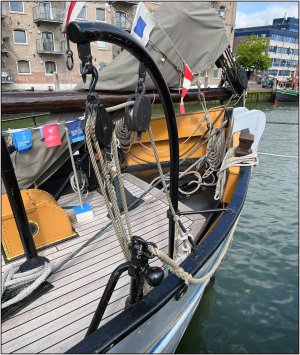
0922 Anker Kabel.jpg
According to regulations, the ship must have complied with all safety regulations when it is operational. That is also a ready-to-use anchor. Here they have an anchor rope with an eye splice attached to the anchor with the shackle.
Therefore, the anchor is fitted with an anchor rope:
0923 Anker Kabel.jpg
I also tried to make an original eye splice. But the rope was probably heat-treated, preventing the strands from being twisted open to thread the three strands through and through. So, a tied-off eye was used instead.

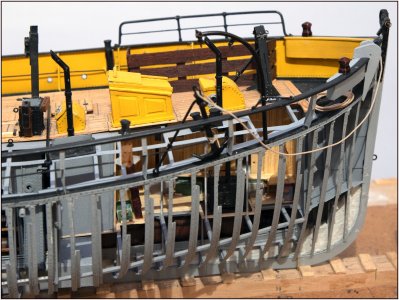
On to the aft ship: the cover plate above the opening to the hold where the Donkey boiler is located. This plate is secured with numerous bolts.
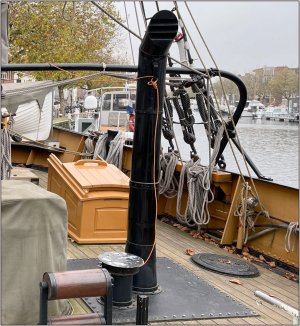
0924 Donkey ventilatie.jpg
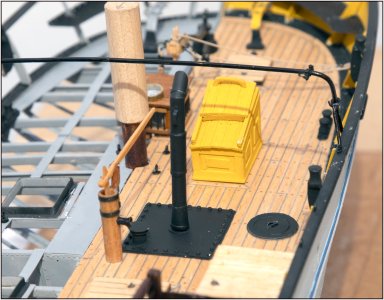
On the left forward corner is a ventilation shaft, and in the middle the Donkey boiler's funnel. Between this plate and the bulwark, the heavy metal cover can be seen on the chute to the coal hold.
0925 Donkey ventilatie.jpg
Attached to the aft deck. 32 M0.6 mm hexagonal heads were used for the plate.
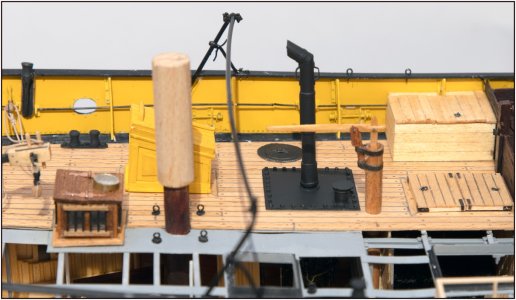
0926 Donkey ventilatie.jpg
With an overview of the increasingly full aft deck.
Regards, Peter

 
I also tried to make an original eye splice. But the rope was probably heat-treated, preventing the strands from being twisted open to thread the three strands through and through
Heat is good, I think the rope is twisten too tight. I got the same problem with the reef tackles of the mizzen. Need to experience with new rope with a twist that’s not so tight. Less weight on the bok or let the cone move easier.
How thick is that rope? I can send you an example when ready.
 
Heat is good, I think the rope is twisten too tight. I got the same problem with the reef tackles of the mizzen. Need to experience with new rope with a twist that’s not so tight. Less weight on the bok or let the cone move easier.
How thick is that rope? I can send you an example when ready.
Thanks for the info, Stephan. I will send you a PM.
Regards, Peter
 
Back
Top