


• Win a Free Custom Engraved Brass Coin!!!
    As a way to introduce our brass coins to the community, we will raffle off a free coin during the month of August. Follow link ABOVE for instructions for entering.
  • SUBSCRIBE TO SHIPS IN SCALE TODAY!

    The beloved Ships in Scale Magazine is back and charting a new course for 2026!
    Discover new skills, new techniques, and new inspirations in every issue.

    NOTE THAT OUR NEXT ISSUE WILL BE MARCH/APRIL 2026

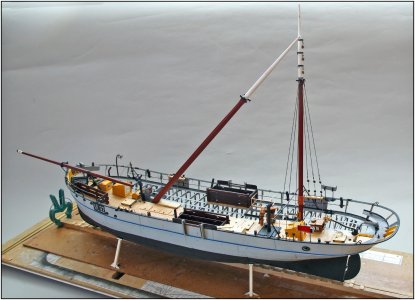
BALDER, Vlaardingen Herring Lugger from 1912, scratch build scale 1:50 Plate-On-Frame

I study this indeed. I looked into Steel, Anderson, Lees, Yk, Witsen and blunt. Because I also was interested in the subject. What I found was that it where not big ropes, they didn't have to carry a lot of weight (the sailers in that time doesn't look like me) and a small rope will be keep better in place on a big shroud line. This is wat I found:
Ratlines are in most cases made of 1.5-inch circumference rope (See Lees and Steel). The diameter would be a little less then a half inch. This was for almost every yard in history common use. Ratlines on scale 1/50 to 1/75 will be somewhere between 0,2 and 0,15 mm. in diameter.
On the model it will look better to go for the smallest rope you can find. So 0,15 looks better then 0,2
The distance between ratlines is between 13 and 15 inch (same Lees and Steel). In cm. between 33 and 38 cm. on scale 1/50 to 1/75 between ~7-4 mm.

I hope this answer helps in this case.
ratlines.jpg
 
I study this indeed. I looked into Steel, Anderson, Lees, Yk, Witsen and blunt. Because I also was interested in the subject. What I found was that it where not big ropes, they didn't have to carry a lot of weight (the sailers in that time doesn't look like me) and a small rope will be keep better in place on a big shroud line. This is wat I found:
Ratlines are in most cases made of 1.5-inch circumference rope (See Lees and Steel). The diameter would be a little less then a half inch. This was for almost every yard in history common use. Ratlines on scale 1/50 to 1/75 will be somewhere between 0,2 and 0,15 mm. in diameter.
On the model it will look better to go for the smallest rope you can find. So 0,15 looks better then 0,2
The distance between ratlines is between 13 and 15 inch (same Lees and Steel). In cm. between 33 and 38 cm. on scale 1/50 to 1/75 between ~7-4 mm.

I hope this answer helps in this case.

View attachment 593513
Thanks for the quick reply, Stephan.
The question related more to the 'international nautical' designation of rope measurements in circumference. Which can cause confusion if the diameter is 'sometimes' mentioned. Do they also refer to 'circumference' in the old Dutch documents?
Regards, Peter
 
Do they also refer to 'circumference' in the old Dutch documents
In Yk, for example, he sometimes refers to the circumference and sometimes to the diameter. He also mentions the thickness around the round or the thickness at the cross, referring to the circumference in the first case and the diameter in the second.

Screenshot 2026-04-20 at 11-23-28 De nederlandsche scheeps-bouw-konst open gestelt vertoonende...png

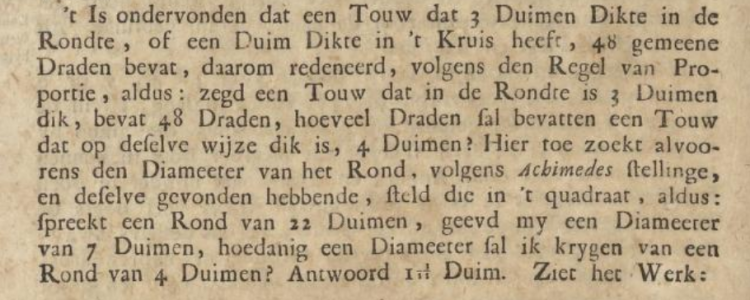
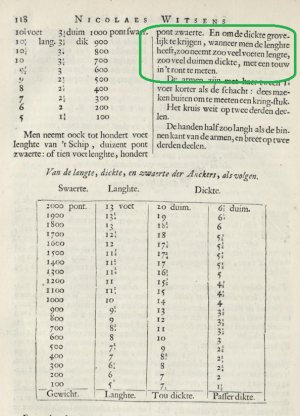
Witsen is talking about the thickness around (circumference) when he mentioning rope thickness

witsen.png
 
In Yk, for example, he sometimes refers to the circumference and sometimes to the diameter. He also mentions the thickness around the round or the thickness at the cross, referring to the circumference in the first case and the diameter in the second.

View attachment 593518

Witsen is talking about the thickness around (circumference) when he mentioning rope thickness

View attachment 593521
Thanks, Stephan. In any case, it is clear that they not only state the size number but also whether it is circumference or diameter.
Regards, Peter
 
Thank you Peter and Stephan. I guess there is no real standard way of specifying line. If it is not explicitly spelled out as cir or dia in the text, you just have to use your common sense and realize that they would never use, for example, 1.5" diameter line for ratlines. ROTF

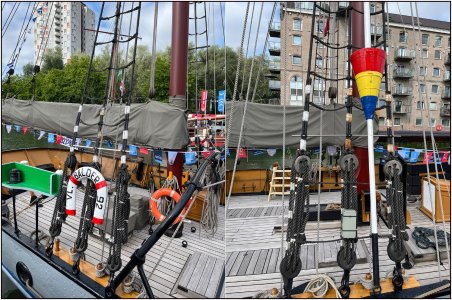
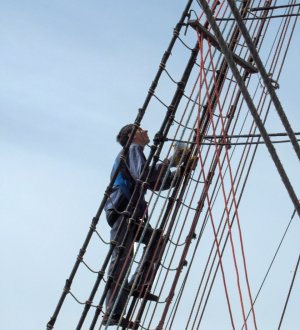
As a side note, the photo that Stephan posted above has answered some questions I had about ratlines - thank you Stephan. I had always wondered what was done with the free end of the ratline at the outermost shroud and how they kept the inner clove hitches from sliding down the shroud with the weight of the sailor. I see from the photo that the free ends are pulled up and seized to the shroud and that there are seizings on each innermost shroud just below the hitch to keep it from sliding. So, for those of you who REALLY want to model to true scale ... ROTF
 
I had always wondered what was done with the free end of the ratline at the outermost shroud and how they kept the inner clove hitches from sliding down the shroud with the weight of the sailor.
Now you gonna hate me :)

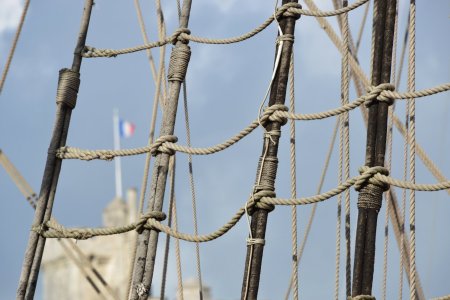
La_frégate_Shtandart_(113).JPG

The first picture was the Dutch method, and above picture the English and French method with an eye on the end of the ratline.
 
Thank you Peter and Stephan. I guess there is no real standard way of specifying line. If it is not explicitly spelled out as cir or dia in the text, you just have to use your common sense and realize that they would never use, for example, 1.5" diameter line for ratlines. ROTF

As a side note, the photo that Stephan posted above has answered some questions I had about ratlines - thank you Stephan. I had always wondered what was done with the free end of the ratline at the outermost shroud and how they kept the inner clove hitches from sliding down the shroud with the weight of the sailor. I see from the photo that the free ends are pulled up and seized to the shroud and that there are seizings on each innermost shroud just below the hitch to keep it from sliding. So, for those of you who REALLY want to model to true scale ... ROTF
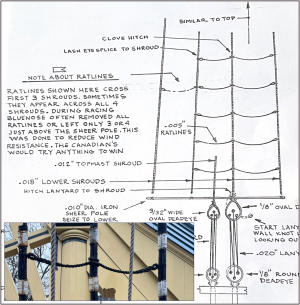
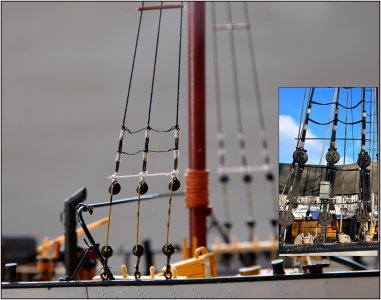
And on the Bluenose and Balder they used the same methode as Stephan posted above:
1776703870660.png
The drawing is about the Bluenose and the insert picture is from the Balder.
It's depending of the scale you are building is this is possible to make.
But Johann @archjofo showed it here in --> this post of his build of La Créole in1:48. <--
Regards, Peter
 
Now you gonna hate me :)

View attachment 593588

The first picture was the Dutch method, and above picture the English and French method with an eye on the end of the ratline.

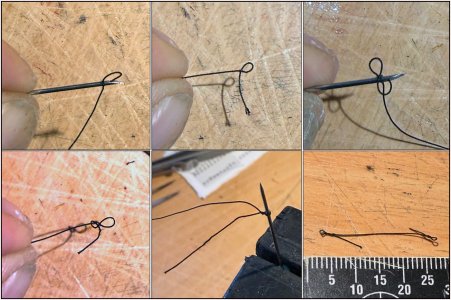
Eye-splicing 0,15mm line? Piece of cake! ;) The hard part will be finding the correct scale size for the small stuff used to lash the splice to the shroud! ROTF
Seriously Stephan, thanks for posting these - and thanks Peter for indulging us on your log.
 
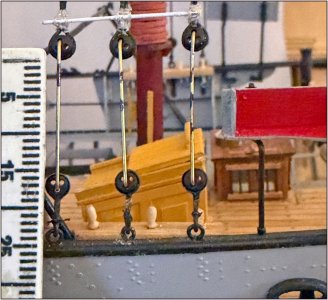
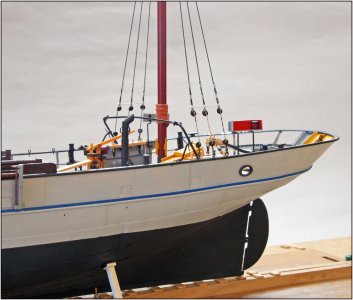
The starboard side done as well:
1053 Speilat.jpg
That took a bit more time. It does need to be at the same height and alignment as the port side.

Total picture so far:
1054 Speilat.jpg
The starboard rigging is not yet divisible. When attaching the ratlines and spreader bars, I am going to integrate the small magnets. At least ..... that is the idea.;)
Regards, Peter
 
She’s coming along pretty fine. And I don’t think everybody appreciates how small the model actually is. From all te details I’d made a mind picture of something table sized. And was surprised when I saw her ‘live’ in Amsterdam.
 
She’s coming along pretty fine. And I don’t think everybody appreciates how small the model actually is. From all te details I’d made a mind picture of something table sized. And was surprised when I saw her ‘live’ in Amsterdam.
I agree. How Peter manages such fine detail at this scale is legendary. Cheers Grant
 
Back
Top