
-

SUBSCRIBE TO SHIPS IN SCALE TODAY!
The beloved Ships in Scale Magazine is back and charting a new course for 2026!
Discover new skills, new techniques, and new inspirations in every issue.
NOTE THAT OUR NEXT ISSUE WILL BE July/August 2026 -

Win a Free Custom Engraved Brass Coin!!!
As a way to introduce our brass coins to the community, we will raffle off a free coin during the month of August. Follow link ABOVE for instructions for entering.


You are using an out of date browser. It may not display this or other websites correctly.
You should upgrade or use an alternative browser.
You should upgrade or use an alternative browser.
Bluenose Schooner 1921 - Model Shipways 1:64 by TexBilly
- Thread starter TexBilly
- Start date
- Watchers 29
-
- Tags
- bluenose model shipways



Dancing around pesky work obligations, I've been painting fake stanchions and waterways. I'm using Model Shipways primer and paints. Now, I consider myself a decently capable painter but…why is white paint so hard???
Thick paint/brushstrokes, poor color transitions, lots of obvious touch-ups. I gradually developed a method that works for me - especially with white paint.
Unfortunately, the starboard side of the quarter deck was where I had started and it suffered through the aforementioned education. I scraped off most or all of the paint twice, which also led to rough surfaces, misshapen stanchions, etc. Poor quality I just couldn't accept.
- Use quality brushes
- Pick the right brush type/size
- Dampen the bristles before loading paint
- Pause and clean the brush often
- Lots of thin coats.
I sat down yesterday, took a deep breath and decided to start over. Hey, once you tear off the first piece it's easy!Once that band-aid was ripped off, I decided to use this as an opportunity built around pre-painting.
After some clean up and a bit of filler, I masked off the waterway and gave it two coats of medium gray paint. I knew I was starting with no stanchions for support so I gradually tacked the 1/16" thick bottom waist plank (pre-painted on the inside) to the top hull plank/deck surface in 6-8 spots using super glue and finally wood-glued the end onto the filler block at the transom. I followed the same method for the 1/32" top waist plank, keeping it flush with the inside of the bottom waist plank as much as possible. I had some minor paint touch up along the joint.
I had also pre-painted a strip of 1/8" square stock for the replacement stanchions and left one side unfinished, which will attach to the sides. I'll scrape a small area of the waterway and side at each location and probably use only spots of super glue. My hope is only light touchup will be needed. The stanchions shown in the photo are dry fit and I hope to complete this section of the deck in the next couple days.
This approach is a whole lot cleaner and neater and I'm pretty pleased. But now there is a real danger I'll want to do the same for the rest of the deck.In fact, I'm already 99% sure I'll do the same on the port side of the quarter deck, for continuity. We'll see about the fore deck!
View attachment 610091View attachment 610092View attachment 610093View attachment 610094View attachment 610095

Hats off for going back to fix something you weren’t happy with. I’ve learned that if you think about fixing something on a model, you probably should. And, as you say, ungluing isn’t that hard. One question - did you thin the paint? I found with the Model Expo warm white I had to dilute it about 60:40 paint to water to get it to flow properly with my airbrush, and a little less than that for brush painting.Dancing around pesky work obligations, I've been painting fake stanchions and waterways. I'm using Model Shipways primer and paints. Now, I consider myself a decently capable painter but…why is white paint so hard???
Thick paint/brushstrokes, poor color transitions, lots of obvious touch-ups. I gradually developed a method that works for me - especially with white paint.
Unfortunately, the starboard side of the quarter deck was where I had started and it suffered through the aforementioned education. I scraped off most or all of the paint twice, which also led to rough surfaces, misshapen stanchions, etc. Poor quality I just couldn't accept.
- Use quality brushes
- Pick the right brush type/size
- Dampen the bristles before loading paint
- Pause and clean the brush often
- Lots of thin coats.
I sat down yesterday, took a deep breath and decided to start over. Hey, once you tear off the first piece it's easy!
After some clean up and a bit of filler, I masked off the waterway and gave it two coats of medium gray paint. I knew I was starting with no stanchions for support so I gradually tacked the 1/16" thick bottom waist plank (pre-painted on the inside) to the top hull plank/deck surface in 6-8 spots using super glue and finally wood-glued the end onto the filler block at the transom. I followed the same method for the 1/32" top waist plank, keeping it flush with the inside of the bottom waist plank as much as possible. I had some minor paint touch up along the joint.
I had also pre-painted a strip of 1/8" square stock for the replacement stanchions and left one side unfinished, which will attach to the sides. I'll scrape a small area of the waterway and side at each location and probably use only spots of super glue. My hope is only light touchup will be needed. The stanchions shown in the photo are dry fit and I hope to complete this section of the deck in the next couple days.
This approach is a whole lot cleaner and neater and I'm pretty pleased. But now there is a real danger I'll want to do the same for the rest of the deck.
View attachment 610091View attachment 610092View attachment 610093View attachment 610094View attachment 610095View attachment 610096View attachment 610097View attachment 610098View attachment 610099View attachment 610100


Hi Tom, thanks so much and I completely agree on following your instincts but my standards do sometimes get in the way!Hats off for going back to fix something you weren’t happy with. I’ve learned that if you think about fixing something on a model, you probably should. And, as you say, ungluing isn’t that hard. One question - did you thin the paint? I found with the Model Expo warm white I had to dilute it about 60:40 paint to water to get it to flow properly with my airbrush, and a little less than that for brush painting.

I didn’t thin the paint ahead of time but instead on the fly with my damp brush or briefly dipping the loaded brush into water - this made the paint more milky and led to those multiple coats. I agree on the relative thickness of ME paints and I’m afraid that contributed to my early quality challenges. If I had to guess, I’d say I thinned it to 60:40 on average. I’ve since bought some generic acrylics as well as a Golden starter set to play with but I have a lot of ME paints so I’m motivated!
Last edited:
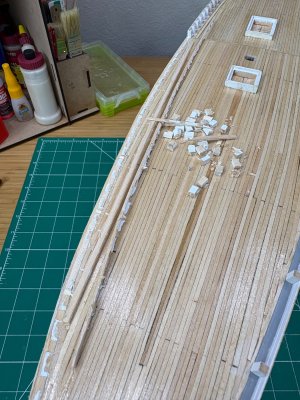
Yeah, it’s happening over on the port side…

Hi Allan and thanks. That photo was shared by our fellow SOS member @bradjensen, who is also building the same kit. He might even see this post and provide an answer!Billy
Thanks for sharing a nicely detailed build log with explanations.
In the photo in post #31 is the white stipe on the hull paint, pinstripe tape, or something else?
Thanks
Allan
Thanks. Pin striping can be a pain in the neck but it looks fantastic. For painting a stripe, If it is right it looks spectacular, if not,,,,,,,,paint over it.Hi Allan and thanks. That photo was shared by our fellow SOS member @bradjensen, who is also building the same kit. He might even see this post and provide an answer!

Allan
Last edited:
Progress! Very glad I took that big step.
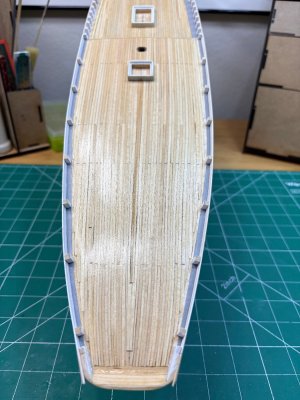
Last edited:
That second bandaid had some strong adhesive but I ripped it off nonetheless and rebuilt the fore deck. Absolutely no regrets as I’m happy with the much neater and orderly appearance from pre-painting. Now, time to move on!
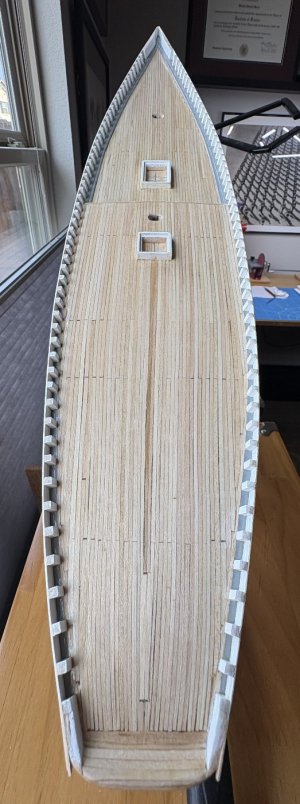
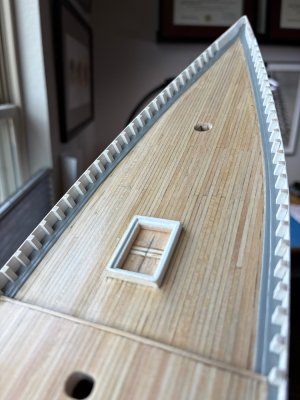
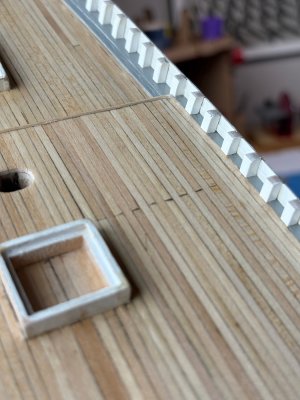

You made the right decision, Bill. This is looking so much better!That second bandaid had some strong adhesive but I ripped it off nonetheless and rebuilt the fore deck. Absolutely no regrets as I’m happy with the much neater and orderly appearance from pre-painting. Now, time to move on!
View attachment 613663View attachment 613662View attachment 613664
Regards, Peter
Thanks, Peter - as soon as I began re-assembling the first quarter deck section I knew this was the way to go to make things much more crisp. I'll definitely use this method wherever I can in the future!You made the right decision, Bill. This is looking so much better!
Regards, Peter
I think my next major move is painting the hull but I'm first reviewing what details make sense to complete beforehand. I started with one of the hawse pipe holes. I hand drilled the basic hole using three progressive drill diameters, then reamed/filed/sanded to enlarge the hole, especially on the outside. I then test fit the cast hawse pipe lip. Getting the hole angle right was a little nervy but I was soon able to breathe normally. 
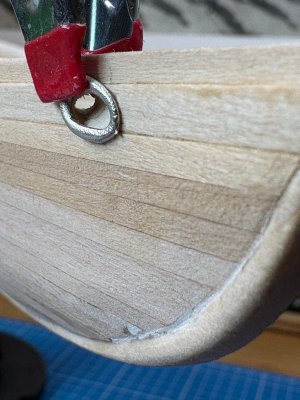

Good morning Bill. Great redo- I agree definitely better. You are owning this BN. Cheers Grant
Chafe blocks added with the required amount of chafing
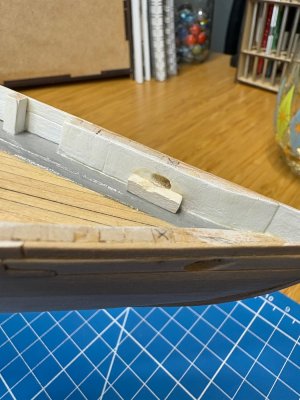

A nice looking model.

I struggled with the “fashion pieces” too, but am glad I added them. It might be too late for your build, but take a look at my log, post 60 where I added them. You can see them in later posts up to post 128 where the hull gets painted. Again, I don’t know what they do (other than cause a lot of thinking).Planking the quarter deck
The obvious challenge on the quarter deck is the tapering of the planks going aft. I hand cut the first six planks - two down the centerline then the four notched planks ending at the transom's cross planks (I had preinstalled those after shaping the filler blocks, more on the transom later).
For the rest of the tapered planks, I used my mini block plane and started the tapers about 6" from the end, then gradually planed closer and closer to the aft end (about 4-5 total strokes). Not every taper ended the same width but the general stack up turned out ok. I found this easier and more consistent than cutting with a knife, with no sanding required. I cut shorter planks after tapering, where required to fit my planking pattern.
Similar to the fore deck, I did have to custom fit four planks to fill in the converging angles (highlighted in yellow and blue). Not exactly text book but they did the job.
Despite my apprehension going into it, the quarter deck was much simpler than the fore deck (which was self-induced I'm sure LOL).
View attachment 606933View attachment 606935View attachment 606934
Waist planks
I experimented adding scuppers using a small diameter gouge and did install one waist plank with them. I soon decided my method wasn't consistent enough and was not to scale. I removed the plank and reinstalled without scuppers. I recall one of the scale modeling rules of "can you see it at scale?" (in this case 1/64" x 3/64" slots) and decided that was good enough for me!
I guess I wasn't paying attention when I installed the waist planks because I did leave some small gaps between the planks (I probably should have wet shaped them). Nothing a bit of filler won't hide but it was a miss on my part.
Transom
Back at the framing stage, I installed the filler blocks without much trouble. I roughed the shape in the garage using small hand saws, then got closer with my oscillating spindle sander. After gluing them in, I hand sanded as close to the plan profiles as I could. Once I started on the stern blocks and transom framing/planking, I fine tuned the filler block profiles.
Now for the biggest rework I've created so far. Soon after hull planking was done, I absentmindedly trimmed the planks flush to the filler blocks, ignoring how to transition with the transom planks! Only when I started work on the transom did I realize this. Also notice where I had sanded a few planks down to the filler block!I later carved fake plank joints and brushed on some primer. Big lesson learned, especially when I build a natural finish hull.
View attachment 606936
I played with shaping a curved filler piece to serve as a joint between the hull and transom planks but abandoned that idea. I then decided to go big and carve out the filler blocks to allow transom planks to butt up against the now exposed hull planks. This took some time but with the help of my carving knives, I was able to get it pretty smooth. Yeah, I effectively shortened the stern but I'm good with it and the profile seems to look ok.
Starting at the bottom, I then shaped and installed six thin planks and was able to tuck them in reasonably well so the hull planks overlap. Instead of installing the support pieces called out on the plan, I decided to shape and install a wider strip near the top, which will also support the planking on the deck side. I'll likely carve out some fake joints across the wide strip. I'll continue sanding/filling soon but given the wrong turn I took earlier, I'm happy with the fix. Oh yeah, I started to shape "fashion pieces" called out at the transom, in case I can make heads or tails on how they fit! So far, I haven't found an example!
View attachment 606941View attachment 606938View attachment 606951
I then shaped and installed transition blocks between the last fake stanchions and that wide strip. I then installed the interior planks and shaped everything to resemble the profile on the plan.
View attachment 606939
Back at the bow, I installed my interpretation of the hawse timbers and knighthead using using 1/8" stock. I still need to install the chafe block.
View attachment 606940
Fake stanchions
I forgot to mention these. Like others, I thought I'd be able to utilize the bulkhead extensions but once I installed the first fake stanchons, it was obvious they would not do! Oddly shaped, varying thicknesses - just battered LOL. They definitely served a purpose during the install and I cut them off along the way. After all of the stanchions were in place, I went back and sliced a bit off most of the fronts so they fell even with the waterways - especially on the quarter deck. This way the painted stanchions will be even with the waterway (likely painted as well) and not the main deck planks.
Ok, I think I hit the major areas so it's time to move forward!
Thanks, Hugh! Not too late at all! It’s interesting how we all interpret the plans. You mounted your fashion pieces on the sides and I had read the (yes, vague) plans as attaching them on the transom. Who knows! By the way, your BN looks great and I’ll certainly tag along!I struggled with the “fashion pieces” too, but am glad I added them. It might be too late for your build, but take a look at my log, post 60 where I added them. You can see them in later posts up to post 128 where the hull gets painted. Again, I don’t know what they do (other than cause a lot of thinking).
OK, some progress as I inch closer to painting the hull before switching to the many projects awaiting me on deck.
I have to admit, I paused a good long time before taking my paint brush to the hull as I'm a fan of that smoothly planed and sanded planking, even if it is lower quality wood. Alas, the BN is painted!
I hand painted the first coat of primer and it did its job to expose what turned out to be light filling and sanding. Probably due to me wanting a bit smoother finish on the second coat, requiring long strokes while also battling fast drying primer, my second coat didn't flow (or cover) very well. Nothing horrible and I would have gotten there eventually - but decided instead to switch to spraying with a rattle can.
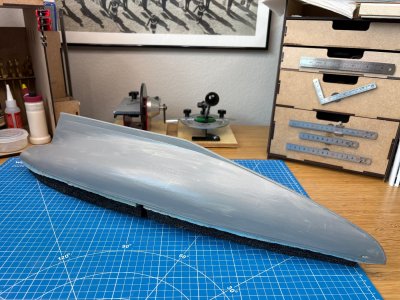
Much better! Hey, she looks pretty nice in gray! I'll let the paint cure for a day and set my sights on the waterline.
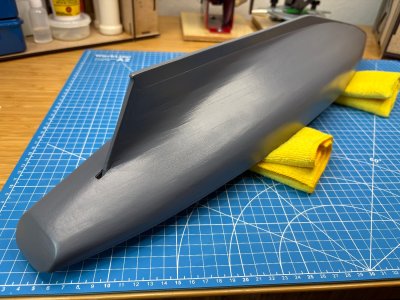
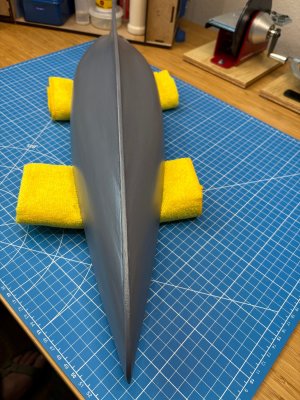
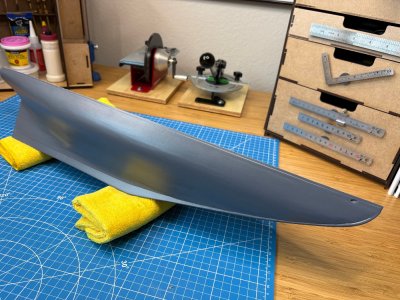
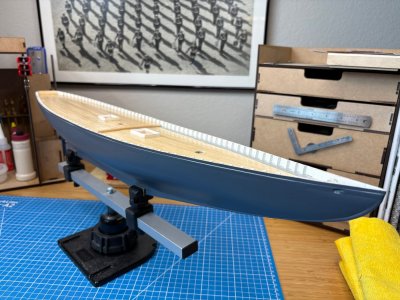
I have to admit, I paused a good long time before taking my paint brush to the hull as I'm a fan of that smoothly planed and sanded planking, even if it is lower quality wood. Alas, the BN is painted!
I hand painted the first coat of primer and it did its job to expose what turned out to be light filling and sanding. Probably due to me wanting a bit smoother finish on the second coat, requiring long strokes while also battling fast drying primer, my second coat didn't flow (or cover) very well. Nothing horrible and I would have gotten there eventually - but decided instead to switch to spraying with a rattle can.
Much better! Hey, she looks pretty nice in gray!
I'll let the paint cure for a day and set my sights on the waterline.
Last edited:
Speaking of hull colors, I picked up two candidates. It's hard to tell in the photo but the "Payne's Gray" is a "blueish black" which I've read mentioned as one of the original colors.
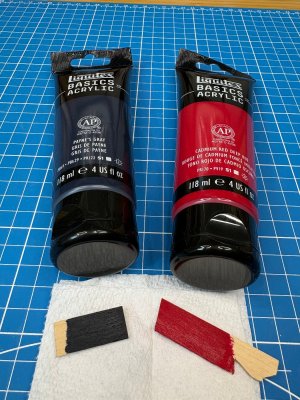
She looks really good. Amazing job on the hull! Are you going to brush or airbrush?Speaking of hull colors, I picked up two candidates. It's hard to tell in the photo but the "Payne's Gray" is a "blueish black" which I've read mentioned as one of the original colors.
View attachment 615643