• SUBSCRIBE TO SHIPS IN SCALE TODAY!

    The beloved Ships in Scale Magazine is back and charting a new course for 2026!
    Discover new skills, new techniques, and new inspirations in every issue.

    NOTE THAT OUR NEXT ISSUE WILL BE July/August 2026
  • Win a Free Custom Engraved Brass Coin!!!
    As a way to introduce our brass coins to the community, we will raffle off a free coin during the month of August. Follow link ABOVE for instructions for entering.

Bluenose Schooner 1921 - Model Shipways 1:64 by TexBilly

She looks really good. Amazing job on the hull! Are you going to brush or airbrush?
Tom, thanks so much! Not sure which way I’ll go but I’ll probably test a brushed sample first. I do need to eventually get my airbrush going so maybe this hull will be my motivation. :)
 
OK, some progress as I inch closer to painting the hull before switching to the many projects awaiting me on deck.

I have to admit, I paused a good long time before taking my paint brush to the hull as I'm a fan of that smoothly planed and sanded planking, even if it is lower quality wood. Alas, the BN is painted!

I hand painted the first coat of primer and it did its job to expose what turned out to be light filling and sanding. Probably due to me wanting a bit smoother finish on the second coat, requiring long strokes while also battling fast drying primer, my second coat didn't flow (or cover) very well. Nothing horrible and I would have gotten there eventually - but decided instead to switch to spraying with a rattle can.

View attachment 615633

Much better! Hey, she looks pretty nice in gray! :cool: I'll let the paint cure for a day and set my sights on the waterline.

View attachment 615638View attachment 615636

View attachment 615637
View attachment 615639
She shows her lines with the painted base very nice.
Speaking of hull colors, I picked up two candidates. It's hard to tell in the photo but the "Payne's Gray" is a "blueish black" which I've read mentioned as one of the original colors.

View attachment 615643
I would guess that this will be a nice color combination, Bill. Looking forward to the outcome!
Regares, Peter
 
Speaking of hull colors, I picked up two candidates. It's hard to tell in the photo but the "Payne's Gray" is a "blueish black" which I've read mentioned as one of the original colors.

View attachment 615643
i like your hull color selection The Paynes gray is interesting. I have heard the Bluenose at some point had a very dark blue color. Do you intend to airbrush these? I will definitely airbrush mine. The ones you have would definitely require a lot of thinning to be airbrushed and it is possible that the pigment particles themselves are too big for airbrushing.

I am also wondering if you had a large amount of decking planks left? Finishing up decking I have plenty of spare planks. I also had a lot of spare hull planks left over. I know others have complained that they had just enough.

Rob
 
i like your hull color selection The Paynes gray is interesting. I have heard the Bluenose at some point had a very dark blue color. Do you intend to airbrush these? I will definitely airbrush mine. The ones you have would definitely require a lot of thinning to be airbrushed and it is possible that the pigment particles themselves are too big for airbrushing.

I am also wondering if you had a large amount of decking planks left? Finishing up decking I have plenty of spare planks. I also had a lot of spare hull planks left over. I know others have complained that they had just enough.

Rob
Hi Rob, yes, I was wondering myself just how much that type of paint would have to be thinned. I hope to play around with a few methods this weekend. I do like the look of the dark dark blue and hope I can make it work.

I had some leftover 1/8" wide planks but ran out of the 3/32" wide planks (and borrowed a few from another kit). I probably used more than some due to my hull and deck patterns/cuts. I also used a lot of narrow planks on the hull to fill spaces too narrow for multiple wider planks, while trying to maintain the planking "bands". I also reworked a few small areas on the deck so that consumed a bit more. If I had used full-length planks where possible, I'd say the kit has just enough.
 
Last edited:
Hi Rob, yes, I was wondering myself just how much that type of paint would have to be thinned. I hope to play around with a few methods this weekend. I do like the look of the dark dark blue and hope I can make it work.

I had some leftover 1/8" wide planks but ran out of the 3/32" wide planks (and borrowed a few from another kit). I probably used more than some due to my hull and deck patterns/cuts. I also used a lot of narrow planks on the hull to fill spaces too narrow for multiple wider planks, while trying to maintain the planking "bands". I also reworked a few small areas on the deck so that consumed a bit more. If I had used full-length planks where possible, I'd say the kit has just enough.
I am what I like to call parsimonious, (the Admiral calls me cheap) so i made sure to be as economical with the planking as possible.
I did not use the band method when planking the hull, that probably saved some planks. The kit I have is second hand and probably old. They may have included more planking material.

Rob
 
Hi Bill,
Your Bluenose is looking great. When I built my Benjamin Latham I painted the hull with artist acrylics. I brushed it and the color laid down very well. I would think brushing or airbrushing would be determined by how much wood grain you want to see.

Bill
 
Hi Bill,
Your Bluenose is looking great. When I built my Benjamin Latham I painted the hull with artist acrylics. I brushed it and the color laid down very well. I would think brushing or airbrushing would be determined by how much wood grain you want to see.

Bill
Thanks, Bill! I'm actually a fan of letting the wood grain/seams show through so I look forward to testing it out. I now automatically thin my acrylic paints (sometimes I mix, sometimes I wet the brush) but for a large area like the hull, I'm curious how much you thinned your acrylics? Did put on multiple (perhaps thin) coats?
 
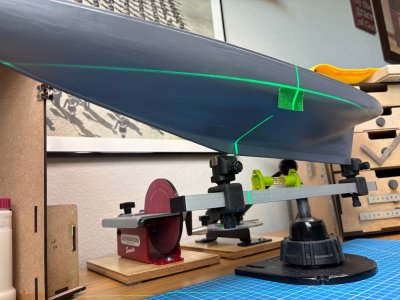
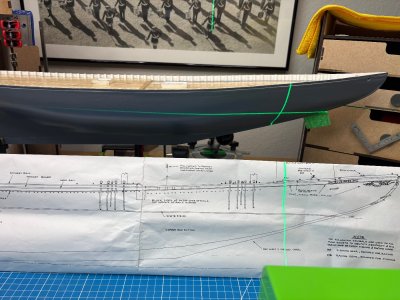
It's waterline time, which means it's an opportunity to play with toys! Isn't that why we buy so many of them? :cool: Well, I played a bit with the traditional horizontal pencil trick by using a table saw blade height jig I have but then had another thought -my laser level.

But first, some setup is required, regardless of the method.

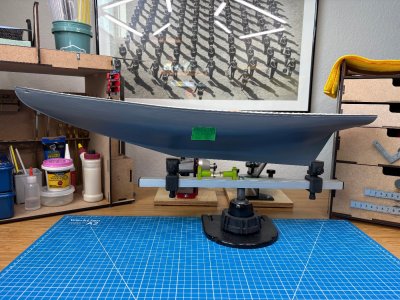
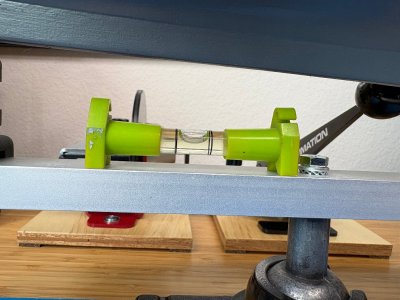
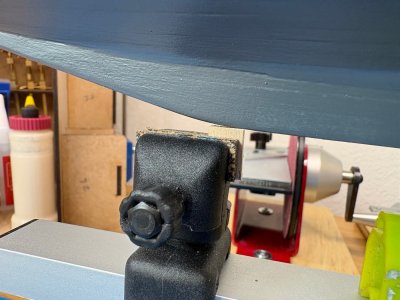
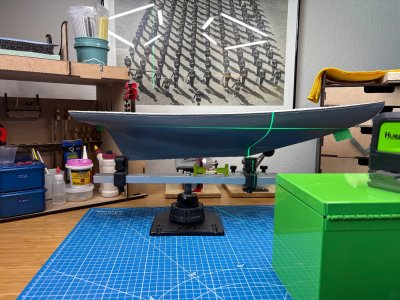
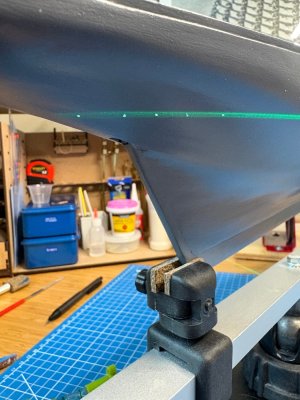
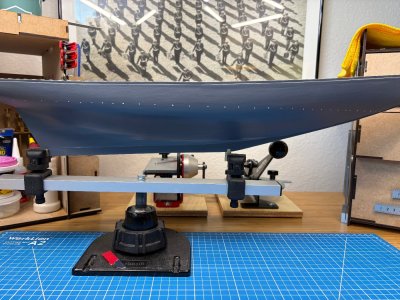
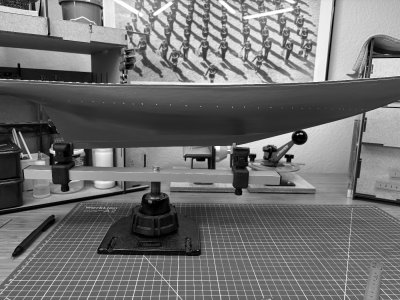
I first leveled the vise in two directions as accurately as possible. Next, the plan's "baseline" aligns with the bottom of the sternpost so I called that y=0". Since the keel doesn't rest on the baseline due to the position of the boat in the water, I needed a solid measuring point to approximate the keel's rise. I chose the upward turn of the keel toward the bow and from the plan measured a rise of y=0.5". I then set the hull into my vise with the sternpost resting on the bottom of its clamp (y=0), then clamped a 0.5" high scrap of stock in the other clamp. Since the 0.5" rise falls above the clamp, I carefully rested the keel on top of the wood and tightened the other clamp. Plenty stable for this purpose.

IMG_1229.jpegIMG_1230.jpegIMG_1232.jpeg

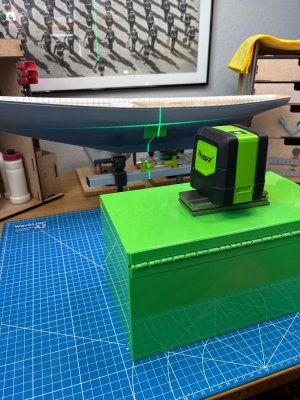
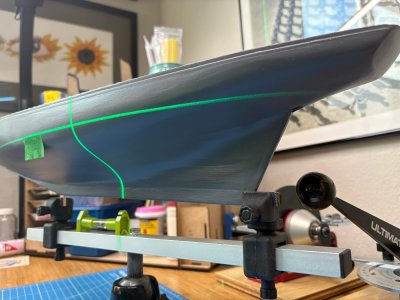
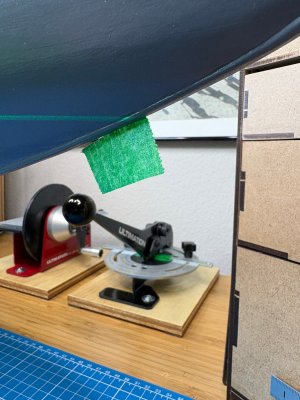
Now for the practice run. From the plan and at Bulkhead H (at the great beam) I measured from the top of the stanchions down to the waterline and attached a piece of tape for reference. I chose this relatively center position since the hull is fairly vertical. I then stacked whatever was around to raise my level line to that same elevation. I used the level's "self-leveling" mode so I didn't have to fuss with squaring everything.

IMG_1233.jpegIMG_1235.jpegIMG_1236.jpeg

I left the laser where it was and turned the boat around to starboard and the landing points were very close to those on the port side so I I guess I did a reasonable job squaring the hull and vise.

IMG_1238.jpegIMG_1239.jpeg

I'm pretty happy with the results and think it passes the eye test. I'll play a little more to dial it in but the waterline seems to fall as designed (or close) and at least as good as doing it by hand. Once I'm done practicing, I plan to mark the laser line with a series of pencil marks or pointed pieces of tape, then connect the marks with masking tape. What could go wrong? :rolleyes: ROTF

Overkill? Maybe. Did it save some fiddling and set up? Yes! Opportunity to play with toys? Absolutely!!

IMG_1241.jpeg
 
It's waterline time, which means it's an opportunity to play with toys! Isn't that why we buy so many of them? :cool: Well, I played a bit with the traditional horizontal pencil trick by using a table saw blade height jig I have but then had another thought -my laser level.

But first, some setup is required, regardless of the method.

I first leveled the vise in two directions as accurately as possible. Next, the plan's "baseline" aligns with the bottom of the sternpost so I called that y=0". Since the keel doesn't rest on the baseline due to the position of the boat in the water, I needed a solid measuring point to approximate the keel's rise. I chose the upward turn of the keel toward the bow and from the plan measured a rise of y=0.5". I then set the hull into my vise with the sternpost resting on the bottom of its clamp (y=0), then clamped a 0.5" high scrap of stock in the other clamp. Since the 0.5" rise falls above the clamp, I carefully rested the keel on top of the wood and tightened the other clamp. Plenty stable for this purpose.

View attachment 616131View attachment 616132View attachment 616133

Now for the practice run. From the plan and at Bulkhead H (at the great beam) I measured from the top of the stanchions down to the waterline and attached a piece of tape for reference. I chose this relatively center position since the hull is fairly vertical. I then stacked whatever was around to raise my level line to that same elevation. I used the level's "self-leveling" mode so I didn't have to fuss with squaring everything.

View attachment 616134View attachment 616136View attachment 616137

I left the laser where it was and turned the boat around to starboard and the landing points were very close to those on the port side so I I guess I did a reasonable job squaring the hull and vise.

View attachment 616139View attachment 616140

I'm pretty happy with the results and think it passes the eye test. I'll play a little more to dial it in but the waterline seems to fall as designed (or close) and at least as good as doing it by hand. Once I'm done practicing, I plan to mark the laser line with a series of pencil marks or pointed pieces of tape, then connect the marks with masking tape. What could go wrong? :rolleyes: ROTF

Overkill? Maybe. Did it save some fiddling and set up? Yes! Opportunity to play with toys? Absolutely!!

View attachment 616142

Playing with toys is always fun, Bill. You have now a leveled waterline.
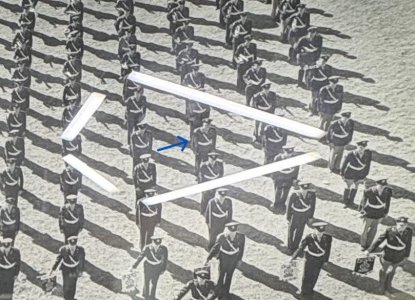
And I see a nice photo of the Fightin’ Texas Aggie Band behind your BN. I saw a lot of videos of them. It’s on my list to see them ones in real. I also played in a marching band myself. Later in a Brass-Band.
Regards, Peter
 
Playing with toys is always fun, Bill. You have now a leveled waterline.
And I see a nice photo of the Fightin’ Texas Aggie Band behind your BN. I saw a lot of videos of them. It’s on my list to see them ones in real. I also played in a marching band myself. Later in a Brass-Band.
Regards, Peter
Thanks, Peter, this great hobby provides countless learning experiences and it's always fun to find another "ah ha!" moment.

As for the Fightin' Texas Aggie Band, it means a lot to me that you not only know of them but also correctly addressed them by their official name! As a graduate of Texas A & M, I've expereinced their precision marching many, many times but still watch their videos. As you probably know, halftime at A & M football games is not a time to take a break - Aggies make sure to stay so we don't miss a minute of their great performances. The band stirs up a lot of emotion for me as it takes me back to my years on campus but more importantly because that photo is from 1951 and my late father was a junior clarinet player in the band. There he is below. I chose not to join the Aggie band but I also played (trumpet) in marching and brass bands and orchestras throughout my youth. Thank you, Peter!

Dad in Aggie Band.jpeg
 
Hello fellow modelers, looks like that a lot of you like to build the famous Canadian schooner the Bluenose. I am a professional model maker and I live in Canada. I was on the Bluenose last year when I was in vacation in Nova Scotia. I can tell you that the Bluenose that many kit manufactures are selling is the schooner that sunk in 1946 and the one that is in the water at the present time is completely different. The schooner was rebuilt in 1963 with the name changed to Bluenose II. In 2009 a major renovation work was started on the schooner and was finished in 2016. To make the model of the latest one is very difficult because there are no drawings available. I was commissioned in 2024 to build the Bluenose II from scratch, it took me 13 months to finish. The process involved to contact the Maretime museum in Lunemburg which gave me a ton of informations on the present Bluenose II regarding rigging, which was done with a roping machine, cowl vents, done in 3d, colour scheme etc.
Keep up the good work fellow modelers.
Massimo

IMG_0593 - Copy.JPG

IMG_0594.JPG

IMG_0595.JPG

IMG_0596.JPG

IMG_0597.JPG

IMG_0599.JPG
 
Hello fellow modelers, looks like that a lot of you like to build the famous Canadian schooner the Bluenose. I am a professional model maker and I live in Canada. I was on the Bluenose last year when I was in vacation in Nova Scotia. I can tell you that the Bluenose that many kit manufactures are selling is the schooner that sunk in 1946 and the one that is in the water at the present time is completely different. The schooner was rebuilt in 1963 with the name changed to Bluenose II. In 2009 a major renovation work was started on the schooner and was finished in 2016. To make the model of the latest one is very difficult because there are no drawings available. I was commissioned in 2024 to build the Bluenose II from scratch, it took me 13 months to finish. The process involved to contact the Maretime museum in Lunemburg which gave me a ton of informations on the present Bluenose II regarding rigging, which was done with a roping machine, cowl vents, done in 3d, colour scheme etc.
Keep up the good work fellow modelers.
Massimo

View attachment 616370

View attachment 616371

View attachment 616372

View attachment 616373

View attachment 616374

View attachment 616375
Dear Mr. M. Tocco. Although you made a post in the build-log of Bill, I take the liberty to make this reply.
I am not a moderator and I am not going to respond of this 'repeated' post of you of a BN-II model in a build-log of a 'original 1912' BN model.
But I have made an invitation for you --> here <--.
Regards, Peter
 
Last edited:
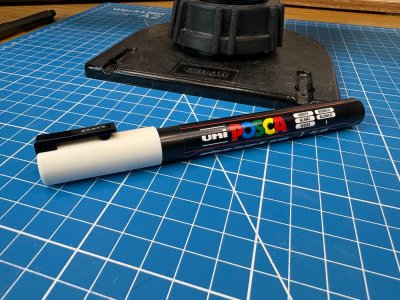
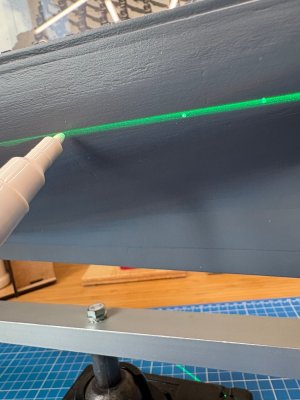
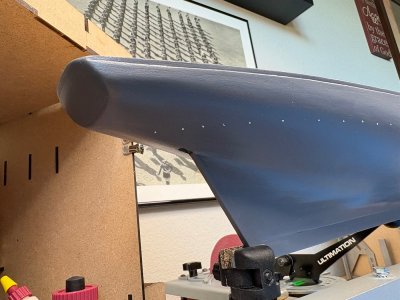
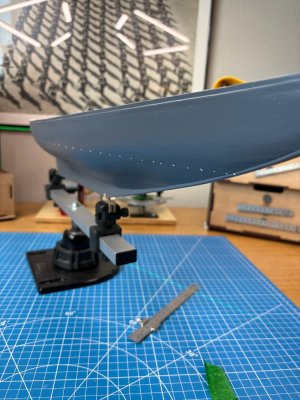
OK, let's mark a waterline! Rather than tape or pencil, I decided to use my white marker, which made the job easy and fast (though the extra coffee this morning almost made me run a white streak across the hull :rolleyes: ROTF).

IMG_1256.jpegIMG_1257.jpegIMG_1246.jpeg

Overall, I'm really happy with the result. I plan to spray the white first so once I'm ready to paint the red and blue, I might need to repeat this in order to define the final boundaries of the white stripe (since the waterline is supposed to be the bottom edge of the stripe). But now I have a repeatable process.

IMG_1247.jpegIMG_1254.jpegIMG_1248.jpegIMG_1258.jpeg
 
OK, let's mark a waterline! Rather than tape or pencil, I decided to use my white marker, which made the job easy and fast (though the extra coffee this morning almost made me run a white streak across the hull :rolleyes: ROTF).

View attachment 616525View attachment 616520View attachment 616521

Overall, I'm really happy with the result. I plan to spray the white first so once I'm ready to paint the red and blue, I might need to repeat this in order to define the final boundaries of the white stripe (since the waterline is supposed to be the bottom edge of the stripe). But now I have a repeatable process.

View attachment 616522View attachment 616524View attachment 616523View attachment 616527
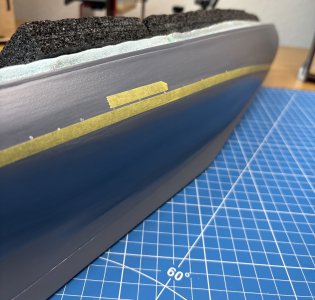
You are literally and figuratively ‘Spot On’ ……. Or is it ‘Dot On’ … ;). It is a option to make the waterline with thin masking tape. It’s one spray action less. But with ‘spraying skills’ a painted white waterline shows the best.
Regards, Peter
 
You are literally and figuratively ‘Spot On’ ……. Or is it ‘Dot On’ … ;). It is a option to make the waterline with thin masking tape. It’s one spray action less. But with ‘spraying skills’ a painted white waterline shows the best.
Regards, Peter
ROTF Spots and dots!

Yep, I've read some modelers go the tape way and I've given it a thought but to your point, I fear the tape and paint wouldn't show as well. We'll see how it goes soon!
 
Last edited:
ROTF Spots and dots!

Yep, I've read some modelers go the tape way and I've given it a thought but to your point, I fear the tape and paint wouldn't show as well. We'll see how it goes soon!
I have been thinking of using pin striping tape for the while line on my Bluenose. The tape is very flexible,, thin and comes in different diameters and is easy to apply and adjust if need be.

I used it in the past to represent bands around the mast of the Constitution cross section and it worked out well.

Rob
 
Back
Top