• Win a Free Custom Engraved Brass Coin!!!
    As a way to introduce our brass coins to the community, we will raffle off a free coin during the month of August. Follow link ABOVE for instructions for entering.

CAF Granado 1/48 PoF Bomb Vessel by Signet

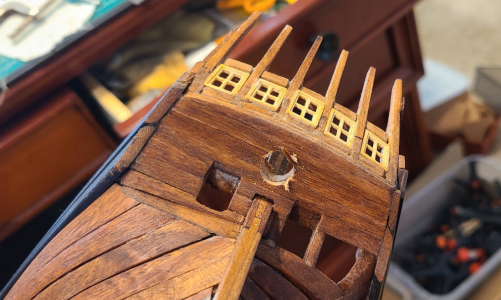
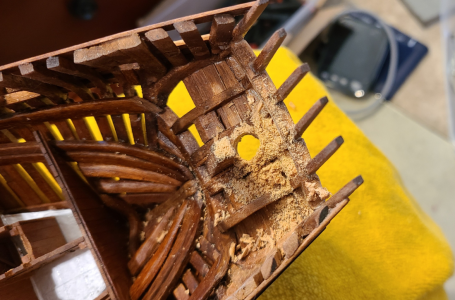
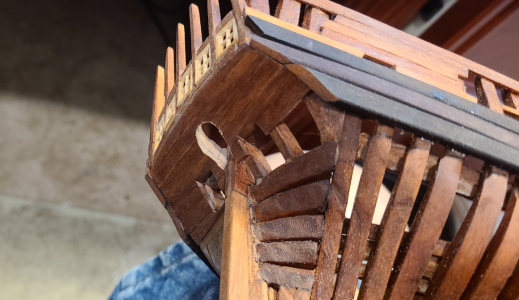
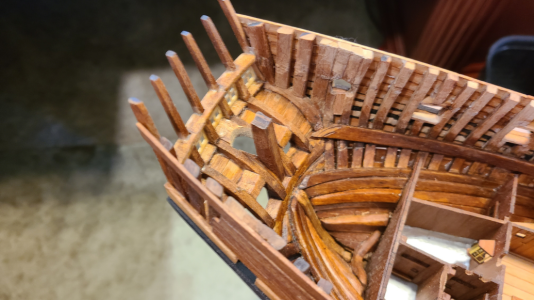
Very innovative and exciting way to modify the kit, to provide views of the interior, as well as the riders for the mortars!

Thanks for sharing your awesome modifications...we look forward to seeing how it progresses, as you tidy up the rough openings!!
 
Very innovative and exciting way to modify the kit, to provide views of the interior, as well as the riders for the mortars!

Thanks for sharing your awesome modifications...we look forward to seeing how it progresses, as you tidy up the rough openings!!
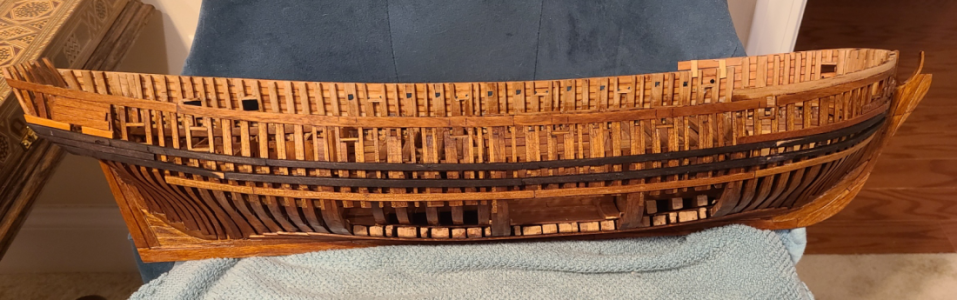
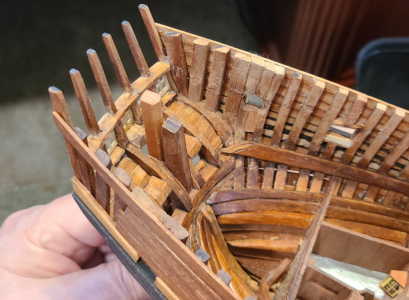
Thanks. I've cleaned it up some, and put a fresh coat of Danish Oil on it (sanding and handling really dulls the finish):
1724723633803.png
I haven't yet touched up the black wales; I'll wait until later for that.
1724723650458.png
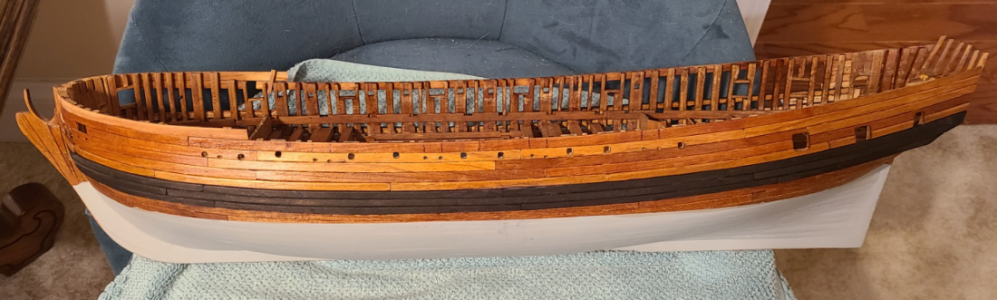
The lower hull color is shown more accurately here, although I will be coming up with a better color for "white stuff" later on.

Hopefully the most messy/dusty portion is done, and I can get back to adding some inside detail. I feel good about the openings and hope they will provide a good view of the internals.
 
Very good result - Bravo !!!
This is maybe more dangerous than my cut - I like the idea and way of execution
 
Thanks. I've cleaned it up some, and put a fresh coat of Danish Oil on it (sanding and handling really dulls the finish):
View attachment 467618
I haven't yet touched up the black wales; I'll wait until later for that.
View attachment 467619
The lower hull color is shown more accurately here, although I will be coming up with a better color for "white stuff" later on.

Hopefully the most messy/dusty portion is done, and I can get back to adding some inside detail. I feel good about the openings and hope they will provide a good view of the internals.
Good morning. Way to go! Now we will some of the detail inside. Very brave and pulled off really well. Kudos. Cheers Grant
 
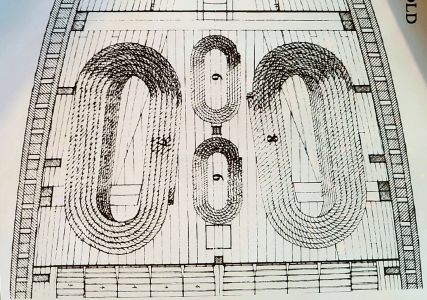
I'm planning my inside details, and one of the things I want to show is the anchor ropes in the hold. They were 13" in circumference, 120 fathoms long, and of course were left-hand laid cables. For my model, that is 2.2mm diameter and a length of 15 actual feet each.

Based on drawings I've seen like this:
1724849615134.png
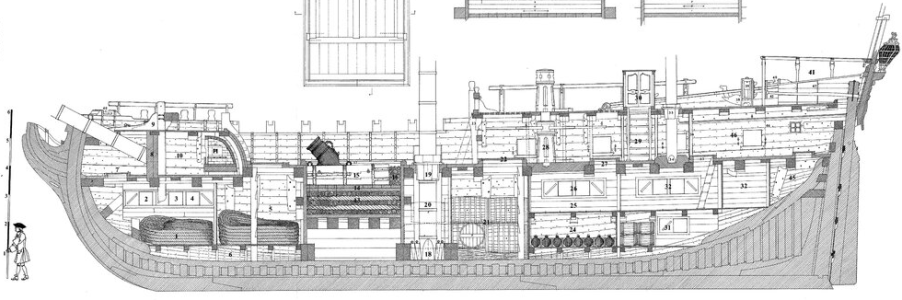
and this:
1724849725521.png
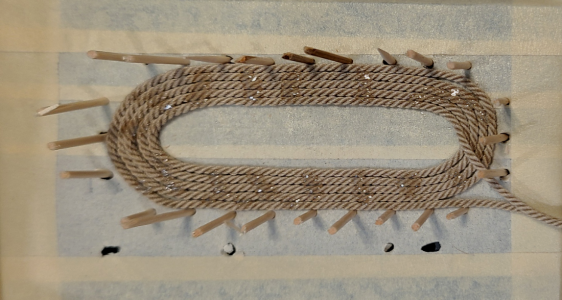
I thought that I wanted it to be really "neat" in its storage, so made a jig to use in creating it:
1724849766714.png
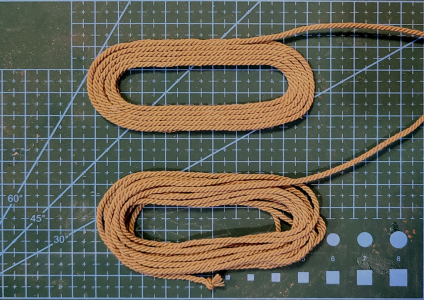
The idea was to put down one layer of cable, add some super glue to hold it in place, then add the next. Four layers in height, with five rows per layer, uses the entire 15' (scale 120 fathoms). Doing four layers was difficult/impossible for me, so I did two separate ones with 2 layers. While I thought it looked pretty good, I took another piece of rope and wrapped it around my hand, then placed it. Here's a comparison:
1724849837502.png
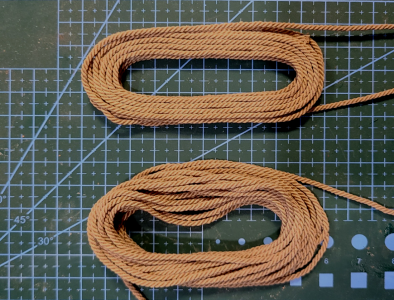
I then placed the two double layers atop each other, and also wrapped the entire 15' around my hand, giving this:
1724849870755.png
Unexpectedly, I'm leaning toward the more random coil, and not the neat one. It seems more realistic, and closer to the photos Uwe posted, although not so much the drawing. But then the drawing shows right-hand laid rope/cable, not the correct left-hand. ;-) Especially if I neaten it up just a bit, I think it should be good.

I plan on laying these two anchor ropes on either side in the main hold between the mortar shell rooms. Maybe put a couple barrels inside the loops, as space is so limited on this ship.
 
Your coils look awesome and show a huge level of patience and attention to detail!!

Careful putting anything inside the loops. First rule of deck seamanship: Don't put any part of your body inside a bight (loop) if you want to keep it.

As that anchor rope feeds out, anything inside the loop has a high potential of being snagged and drug through the hawse holes (body parts or EVEN a cannon which wouldn't turn out well for the hawse hole).

You're absolutely right, space is a premium. I'm thinking, the only way to minimize space is to make the coils smaller and pile them higher.
 
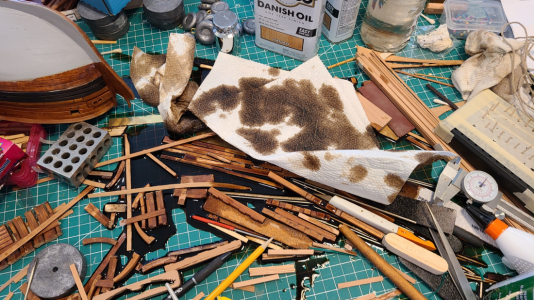
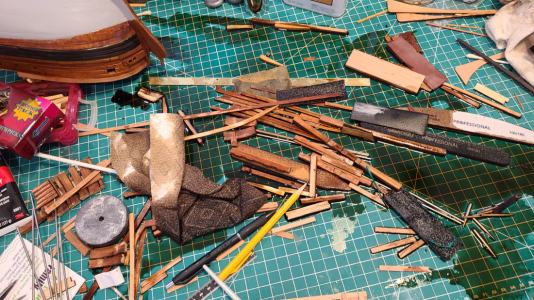
Okay, mess cleaned up (although the "messy" seems to be omnipresent with me), so I'm trying to do other messy jobs, things that create sanding or cutting dust, which goes everywhere, before doing any more to the inside of the model.

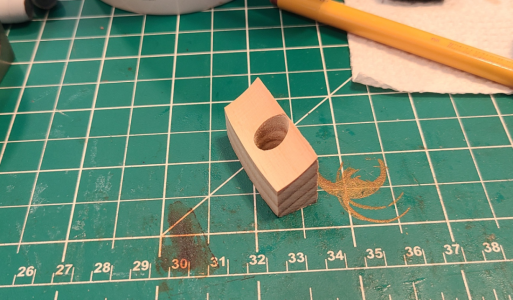
To be honest, I'd planned on cutting the rudder into at least 2 pieces, instead of making the hole in the stern for it to go through. I reasoned that with the leather seal, no one would see it. But I was unsure what, if anything, would cover that hole in the captain's cabin, so decided to make a hole instead. I laid out the rudder post and angle it would swing, and felt that a 3/8" hole would create most of the opening, requiring only filing to complete. To help keep the drill bit in the right location, I made a little guide to help position it:
1725547046722.png
Which then positioned in place to drill the hole:
1725547074372.png
Drilling went okay, with the hole mostly where it should be:
1725547110942.png
1725547125867.png
Yeah, that's what I mean about messy. Hard to do finish construction when you're going to make a mess like this later.

Afterwards, the hole was shaped to the rudder a little better:
1725547188941.png
1725547203268.png
And the rudder does fit, although the hole is probably a bit oversize towards the rear:
1725547237634.png

Next - on to the Barrels for the hold. In Goodwin's book he states that the stores for the similar ship Thunder included 7 Puncheons, 50 Hogshead and 22 Half Hogsheads of water, and 35 Puncheons of beer, so it is logical that this ship had as many barrels as it could fit. While it is true that the accompanying tender would also supply a lot of it, I can't see the sailors letting another ship keep all its beer.

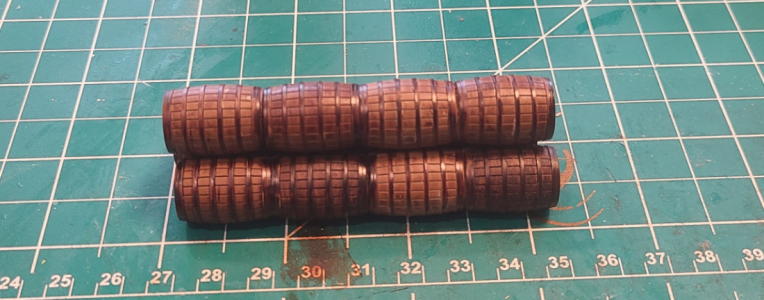
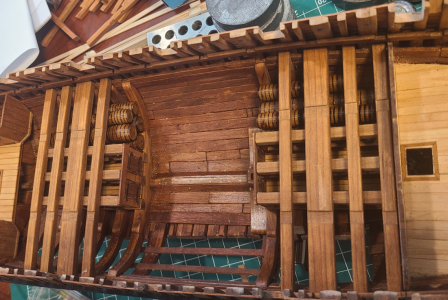
Most of the barrels listed are Hogsheads, about 37" high and 28" in diameter, so I designed 3d models in Fusion 360, and my son made a bunch for me. (The kit came with some nice wood & brass barrels, but they weren't quite the right size and I know from my Bonhomme Richard model that I didn't do a great job on them, so that's why the 3d ones.) Since anchor rope would take up so much of the hold, I felt the area to the sides of the mortar supports was the best location. Those areas could fit 4 Hogsheads end-to-end or 5 Half-Hogsheads, so I glued the barrels end-to-end to keep them in place:
1725547923982.png
I went ahead and placed about as many barrels as possible in those two sizes one the side of the ship which is closed in:
1725547989303.png
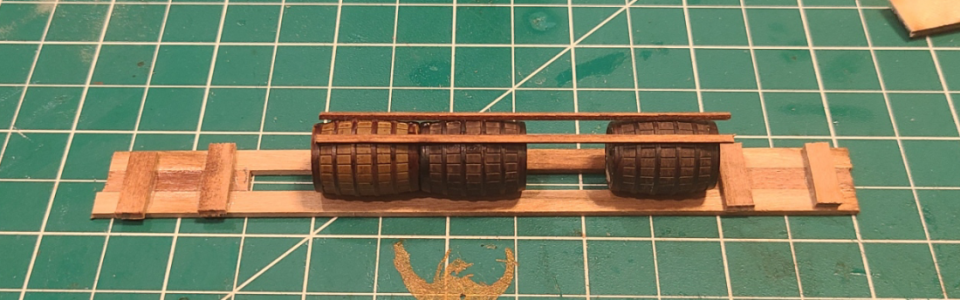
They will probably not really be visible there, but I still felt the need to locate them. I don't want to put many/any barrels in this location on the open starboard side, as they would block visibility of the mortar magazine, one of the most important features of the ship. For that area, I wanted to show a minimum of barrels, to provide better visibility but indicate that the area would be used for storage, so mounted just a couple barrels on barrel support strips:
1725548135284.png
1725548146570.png
1725548163271.png
I'd like to mount them now, but they will be very fragile, so may wait a bit. As you can see, I've left off some of the cross members to allow better access to mount all of these barrels. Here the barrels adjacent to the mortar magazines have been placed on the port side:
1725548376170.png
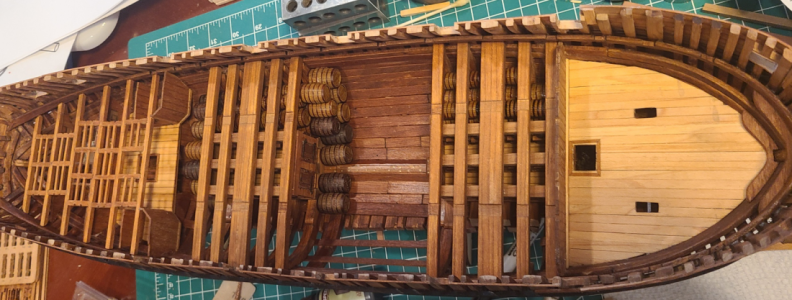
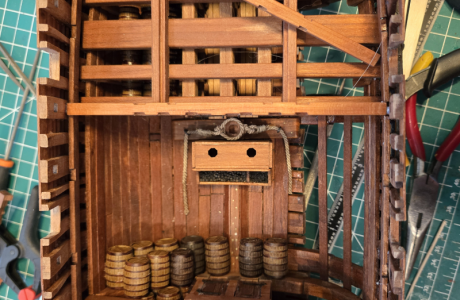
I also reasoned that larger Puncheon barrels would be placed in the small aft hold, as well as a portion of the main hold not occupied by anchor ropes, so added them as well as a few Hogsheads:
1725548491209.png
Naturally, I had to keep barrels from blocking the access doors to the mortar magazine, so that limited placement in the main hold.

The aft hold didn't have that restriction, but space for sailor access had to be allowed for:
1725548584136.png
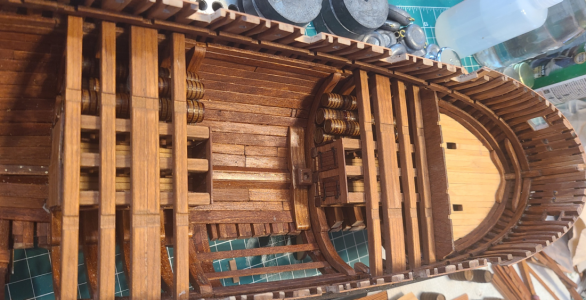
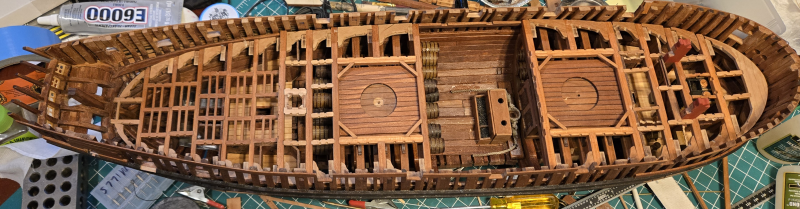
Thus, we have the hull up to this point:
1725548614596.png
You may have noticed that I completed cutting of the cannon ports; I'd delayed that, thinking it might weaken the structure and allow the top of the structure to move, but it didn't seem to.

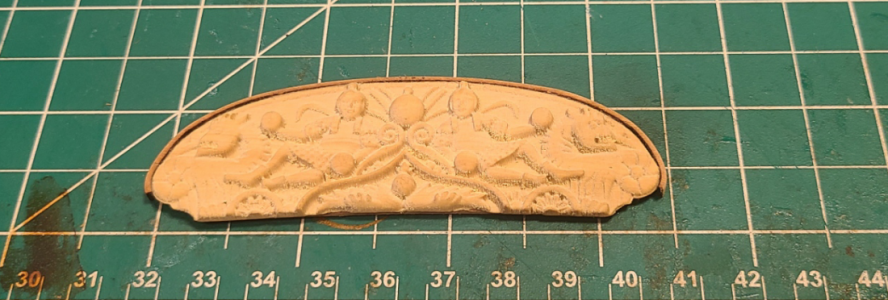
Jumping around in the construction, I wanted to have a good idea of how the stern decoration would fit. The instructions show the backing strip to be applied first, then the decoration over it, but being not sure how I was going to finish the decoration, I decided to glue these pieces together first and finish off the ship:
1725548807179.png
I tried to apply a slight curve to match the stern during gluing, but it didn't really "take". I'll have to force it a bit. I also went ahead and added the extremely fragile edge molding to the assembly, measuring to determine how much overhang was required:
1725549087990.png
In looking at the carving with my 3 diopter reading/modeling glasses, I thought it didn't need any cleanup. I see from the photo that I was wrong:
1725548929205.png
I'm not certainly how to clean this up. I think I will be gilding this panel, so paint will help fill in some problem areas, but I definitely have some cleanup to do.

Until next time -- Thanks for the comments and suggestions, they really help!
 
My friend -> very good work - and many thanks for showing your thoughts and ideas - it is helping to make own decisions
Be only careful with the barrels close to the mizzen mast - there have to be still some pumps installed
 
Sorry about the long delay between posting. I ended last year trying various hammock techniques, finally got one I liked and realized none of the lower cabins were big enough to hold a hammock - and it wouldn't be visible anyhow.

Then I decided to put some 3D printed furniture in those same cabins, long delay designing them and having them made, then found I wouldn't see them anyhow and gave up, for the most part.

Then health problems, and well, just got away from it. But I'm back, and hope to continue on a regular basis.

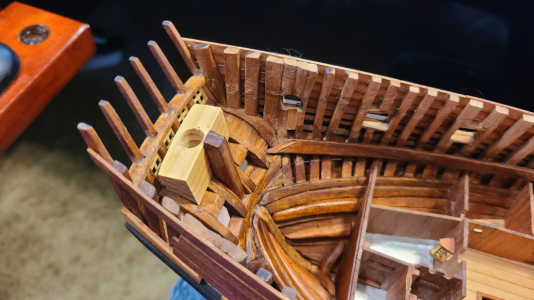
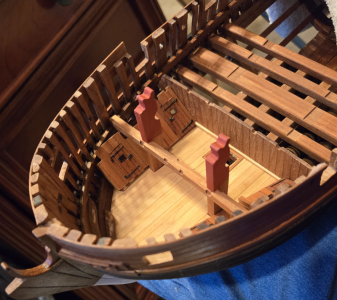
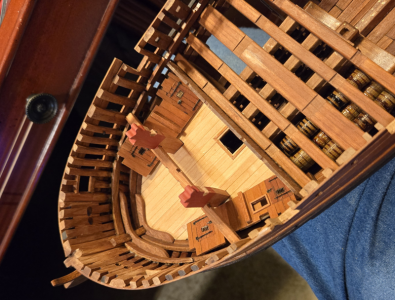
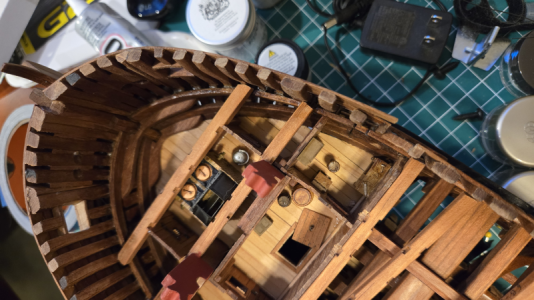
Picking up where I left off, time to permanently position the cabin walls in the fore of the ship, working around the windlass mounting:
1763779299770.png
Wall sections need to be loosely placed prior to fixing windlass structure with cross beam.
1763779344199.png

Walls are now in place, waiting for more cross beams. Stove is also in place:
1763779423469.png
I gave the ship's carpenter a small desk with stool, worktable and storage cabinet, which I'll show later. But of course you can't really see it later.

Starting to put the cross beams over the mortar structure, the beams weren't touching in some areas, so I made small shims to reinforce them.
1763779551135.png
I lived to regret that, as it became more difficult to put the mortar floor in later.

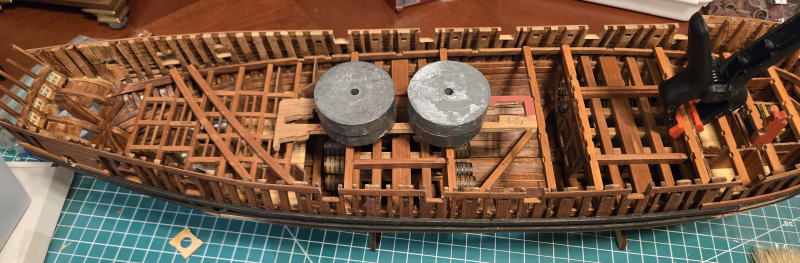
This is in-process of adding some of the remaining beams.
1763779925903.png

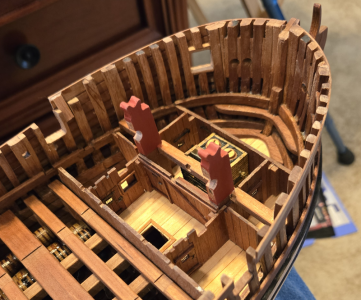
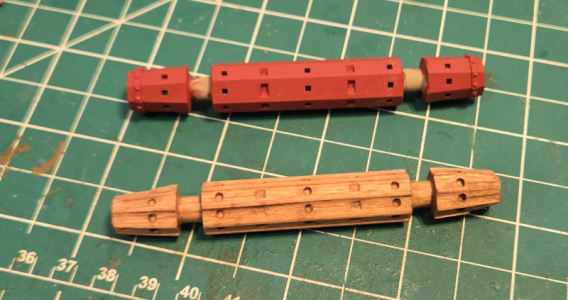
I somehow got it into my head that the drum on the windlass had wear strips on its corners, so tried to saw/cut/carve/sand something in the wood drum to resemble them, but kinda trashed it. And also realized it shouldn't have them. So I designed a new one which my son 3D printed for me (the one at the top and painted red, obviously):
1763779979568.png

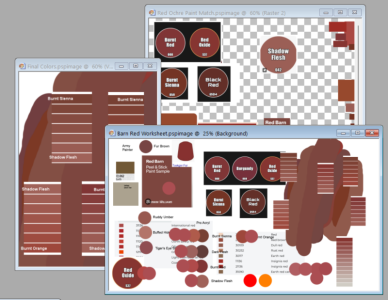
I researched the proper red color, looking at research done previously for Red Ochre, English Red, etc., tried to match colors, bought a dozen red samples, mixed them up trying to match what I thought I wanted. Spent a month on and off doing that, as evidenced by some color match screens:
1763780272640.png
In the end, the colors I thought might be the most authentic ended up with insufficient contrast in color to some of the medium stain applied to the model. I ended up using Red Oxide, which didn't match anything I thought was perfect, but has a pleasing, and I think/hope historic look on the model. The windlass drum painted above looks more orange than it really is. The windlass supports look closer to the resulting paint.

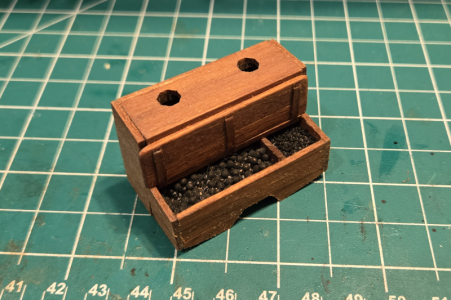
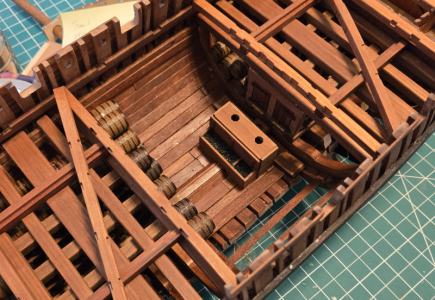
The pump well, which surrounds the pumps just aft of the mainmast, is included with the kit. Goodwin describes the shot locker's location and size just aft of the pump well, so I attached one I made, leaving the lid open, and adding scale 4-pound and half-pound shot to it:
1763781097665.png

This shot shows the combination pump well and shot locker in place:
1763781129662.png
It's a little surprising to me that Goodwin describes the size and location of the shot locker, but doesn't not show it on his plans. I think this adds a nice bit of detail to the model.

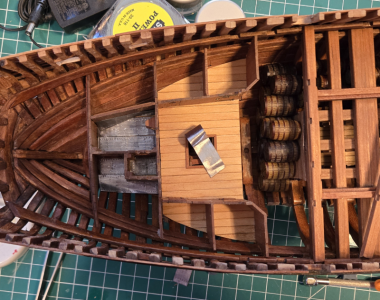
I didn't much like the job I dead in the loading room for the lead sheet flooring. I'd used dull aluminum foil, and it wasn't awful, but as I had some real lead sheet coils, I redid it with that material. The roll (1/2" wide) is shown for comparison:
1763781287610.png

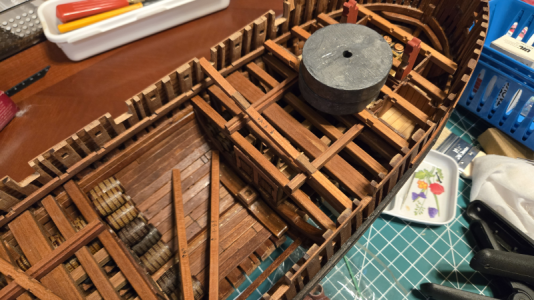
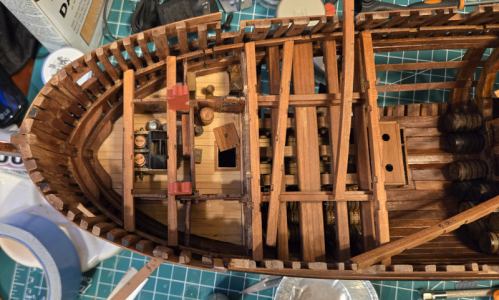
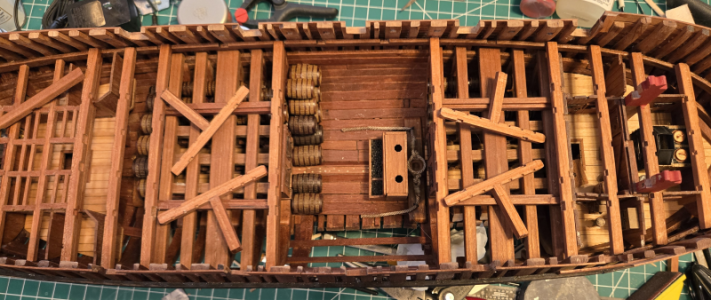
Here's a view of the fore area without most of the cross beams, showing the added furniture and details added to that area. It'll be pretty well impossible to see later, but I still wanted to put it in:
1763781489263.png
1763781520560.png

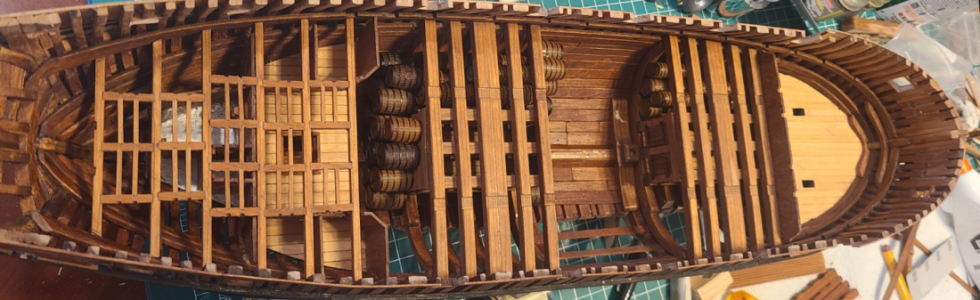
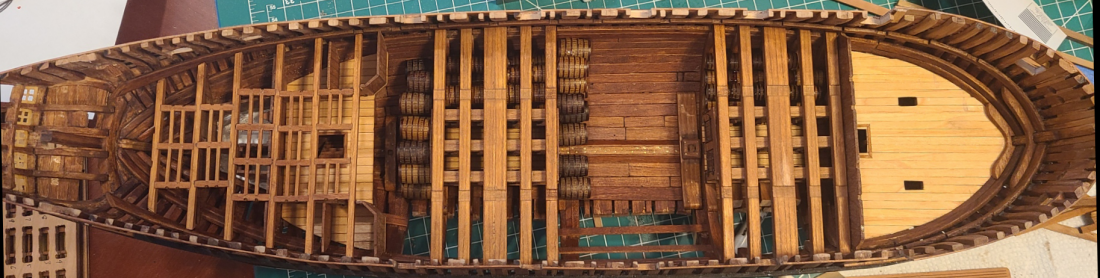
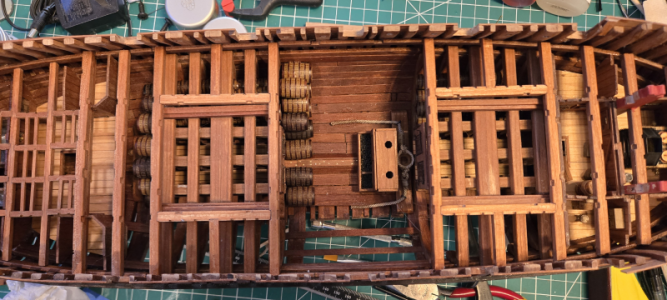
Adding more of the cross beams and other structure:
1763781559619.png
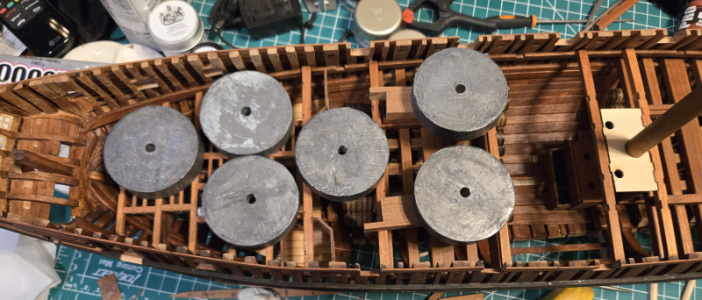
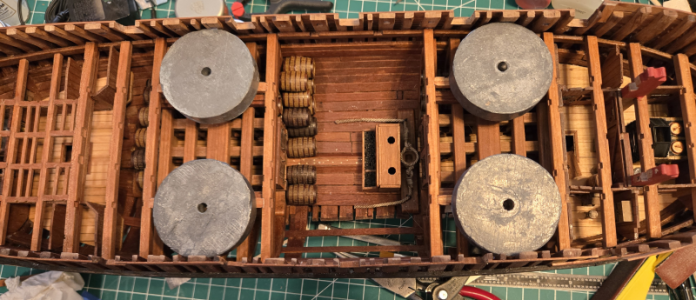
I love me my lead clock weights (1 pound each)! :-)

I've done this work over the last week or so, but that's enough for this episode.
 
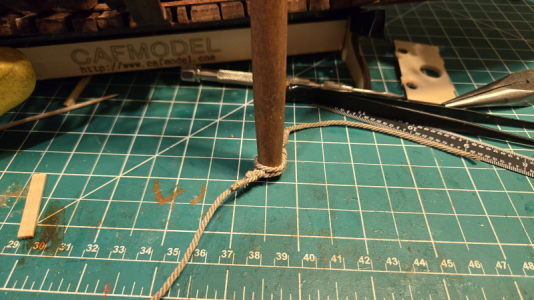
I have read that bower anchor cables were often attached to the nearest mast base, in case the full length of cable were be used, to prevent its loss. I plan to add cables in the center of the ship, but I'm not yet sure how I will do this. So, I attached stubs of cable attached to the mainmast, the ends of which will be covered by cables to be added later. I started by tying the cable in knots around the mainmast, wrapped with serving:
1763782117271.png

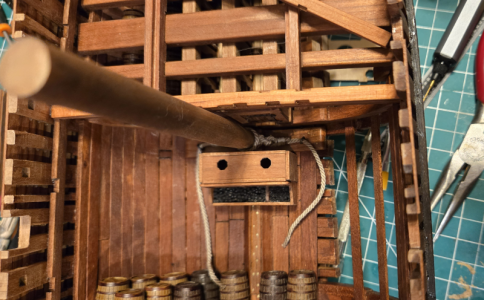
It will be impossible (for me) to add these later, and yet I had to be able to remove the mainmast until later. I used substantial CA glue to stiffen the ropes, adhere them to each other, and hold them in place. They were then glued to the mast base (but not the mast):
1763782233490.png
In this case, I felt rings would have been added to prevent the pull of the cables from straightening against the pump well and damaging it, so I've added them to either side.

Here the cable stubs are glued to the hull ceiling, awaiting cable coils to go on top of them later.
1763782354172.png
 
CAF instructions are generally very good, but like most things, it's best to read ahead. I've done many things waaaay out of order from the instructions, because I felt it would be easier or better that way. In general, that has worked out well. Sometimes, I've missed what I think would have been the best way.

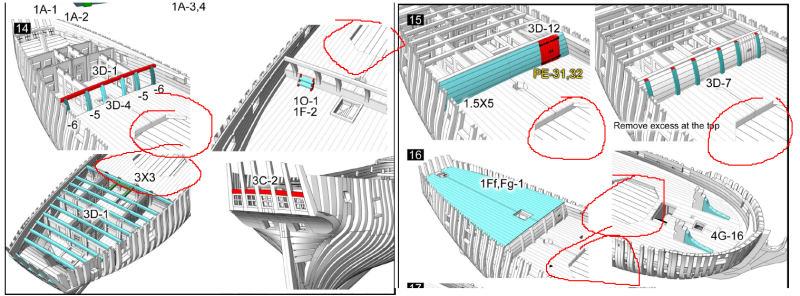
In the case of the mortar beds, the instructions appear to show the entire lower structure completed, along with main deck planking, before the mortar beds (not supports) are installed:
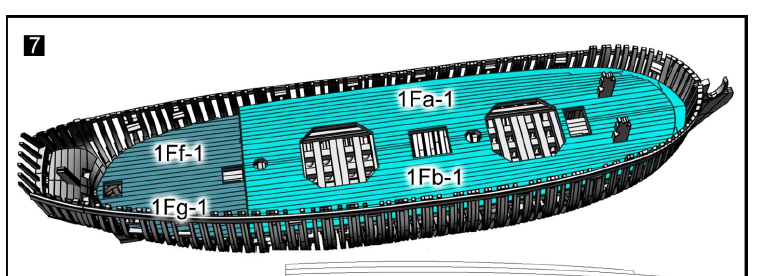
1763783148887.png
I was pretty sure that wouldn't work, and in any case, don't intend to do planking until later.

Then, later, the mortar beds are in place:
1763783481819.png
Both layers of the mortar beds are basically rectangular, and I could see no way to get them into place after the planking is positioned. Here the installation is described in the instructions:
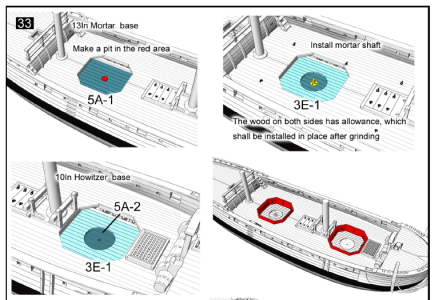
1763783585238.png
Again, I see no way of doing this. The first layer is 5mm rectangular area, cut into loosely connected planks, while the first layer is the same in 3mm. To install it this way, I think, would require separating all the planks (they do fall apart all the time, though), and slide each plank into place individually. VERY difficult to do, and I think, due to clearances and such, actually impossible.

I decided to do mine differently. I wanted to make up the double layer mortar beds complete, and place them before any planking was done. It turned out even that is difficult due to the tight fit between the upper cross beams above and on either end of the mortar beds and the longitudinal and L-shaped pieces that support the beds. The problem is, it's difficult to determine exactly where everything should be, how the beds should be trimmed and centered, etc. when done this way.

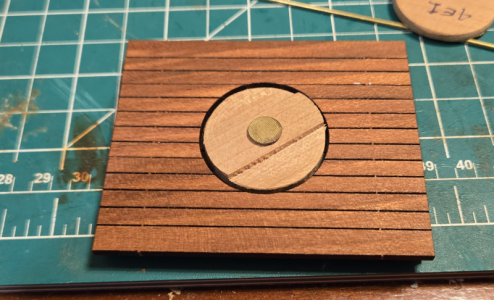
So, first I made up the bed sandwiches of the 5 and 3 mm thick parts. Each of these are formed is a rectangular part, with the individual planks cut. Surprisingly, to me at least, the planks are cut all the way through the material, except for tiny "tabs" holding them together. I see no reason for this. Handling them results in the 3mm part constantly breaking. The 5mm is not much better. And I see NO reason to have them separate, unless you want to try the impossible individual plank procedure I described above. Why not make all four parts securely 1 piece, with only scoring for the planks (deep if desired). Anyhow, I couldn't even handle the 3mm part with it falling apart, so started by trying to glue it together on the back:
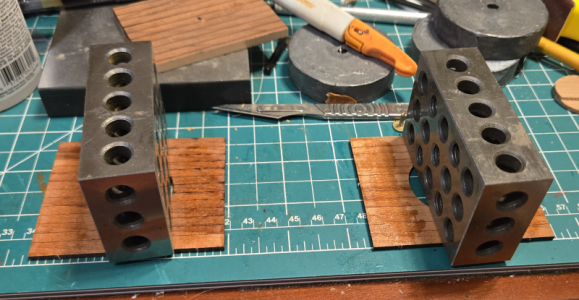
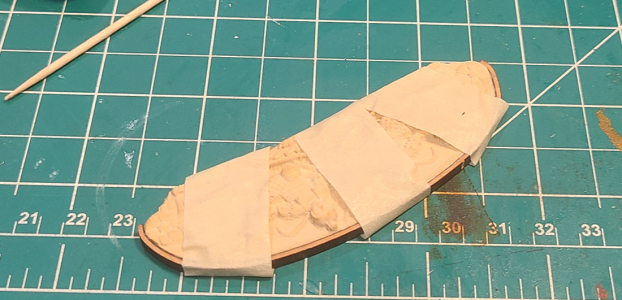
1763784249637.png
I would have preferred to use white glue here, but have had experience with it warping thinner materials, so used CA. I even sandwiched a 0.5mm thick piece of veneer to the bottom to help hold the 5mm piece securely together. I'd end up regretting that, but it didn't hurt too much.

Anyhow, I centered the 5mm and 3mm pieces properly on each other, using the cut out circles in the 3mm pieces and centers marked in the 5mm. I glued up this sandwich with CA, again to prevent future or immediate warping:
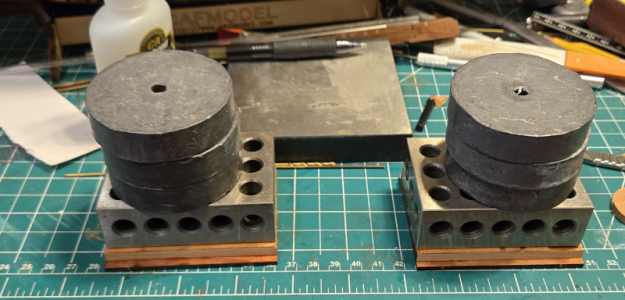
1763784441401.png

Each sandwich, before any fitting or trimming, looked like this (with the pivot installed to insure centering):
1763784484943.png

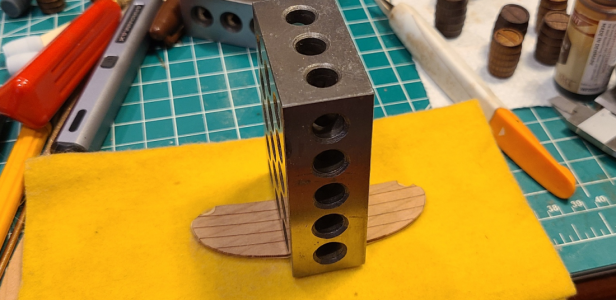
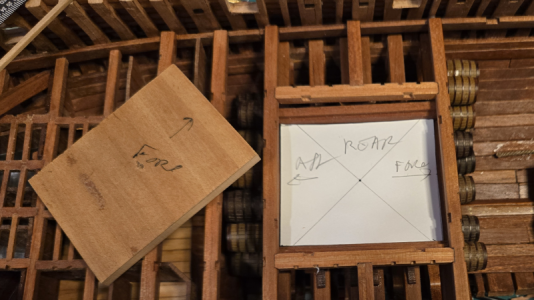
I then needed to determine the exact size of each sandwich. To do that, I needed to determine each pad's exact location in the structure, so as to have the center of the pad and pivot exactly centered with the surrounding structure of each opening. First, I made a stiff paper template, using vernier calipers to determine the size and centers, since my structure varied a bit:
1763784635262.png
As the above photo shows, I'm a bit wrong on the sequence. I took the lower 5mm portion of the sandwich, with the veneer on the bottom, and fitted it separately to determine its center. After that was sized and done, the upper 3mm portion was added, centered, glued and trimmed to size.

In addition to this method, I measured horizontally and vertically between each outer support to determine the center on the wood support structure. I also ran diagonals from all four corner to confirm that location. When I felt all was in alignment, I pin-pricked the template center and drilled a center hole in the lower structure. In this way, I could remove and replace the beds and insure they went back into the right place.
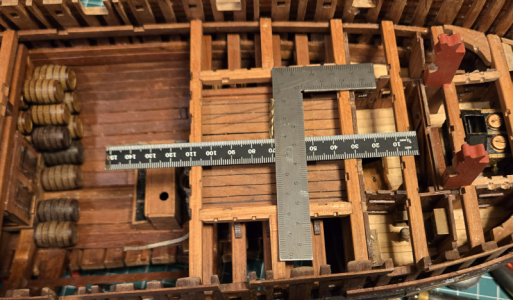
1763784866110.png

This shows the rear mortar bed in place and centered using a piece of wire though all the centers:
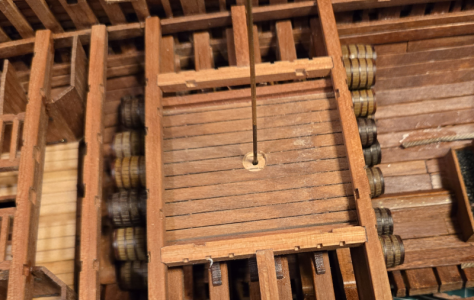
1763784928816.png
BTW, I used a brad point drill to countersink the hold for the center pivot.

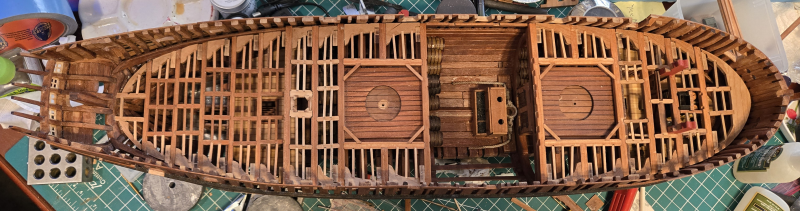
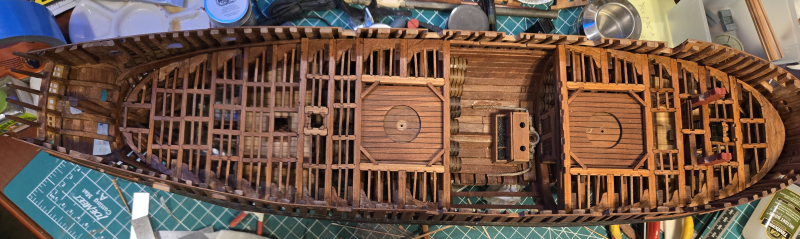
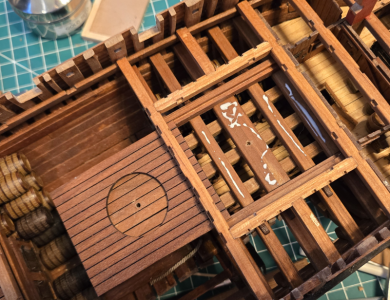
This photo shows the difficulty in installing the mortar beds, even without all the beams and any of the planking:
1763785068645.png
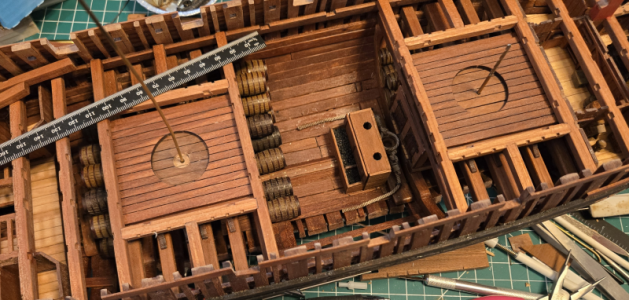
The bed structure has to be slid in from the side. It cannot be done from above, with the mortar beams in place, and those same beams have to locate the bed. Lucky for me, my cross beams didn't all touch the L-shaped members, so were able to slip into place - but only after some trimming, fitting and experimentation. I cannot image installing this per the instructions. Or maybe I should say that I really don't understand the instructions so had to come up with this method.

The advantage of the precisely measured and located holes through all materials becomes evident when sliding the beds into their correct location.
1763785270460.png
Lucky for me, I had left the center hold beams off for my future anchor cables; if I had installed them, I don't know how I'd have done this.

 
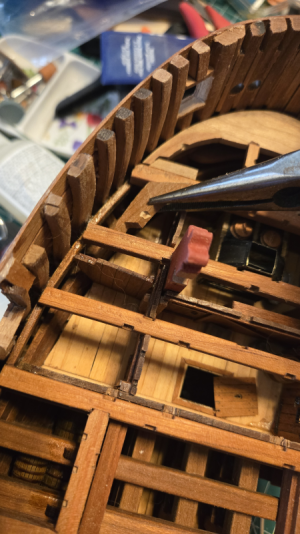
The next portion I wanted to work on was all the bracing between the inside of the hull and the cross members. (Sorry, I don't remember the terms for these pieces, and don't want to take time to look them up right now.) These pieces are fairly large, yet many are inserted into tight areas. Holding on to them to determine what needs trimmed, checking the trim, and positioning and fixing the part in place is difficult due to the close clearances, as shown here:
1763785778865.png
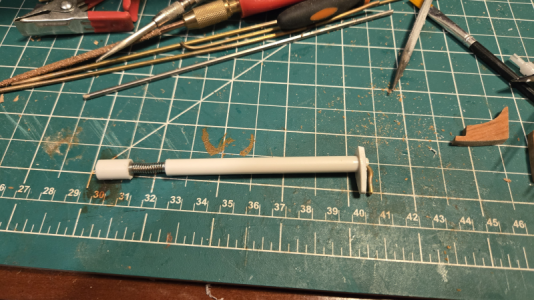
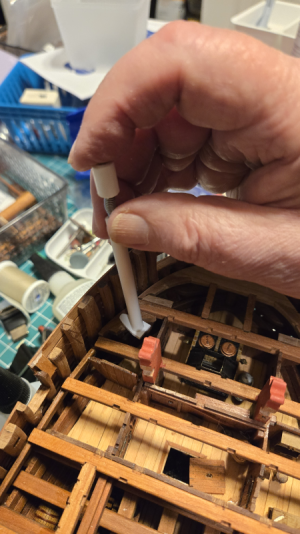
I posted here to get ideas from others to work with areas like this. You can read it here if you like. Members here, as always, had many good ideas, but I wanted something that would work well with my limited talents (and a propensity of dropping every piece on the ship at least once, which explains errant cat fur throught the build). What I ended up with, cobbled up with scrap materials, was this:
1763785896647.png
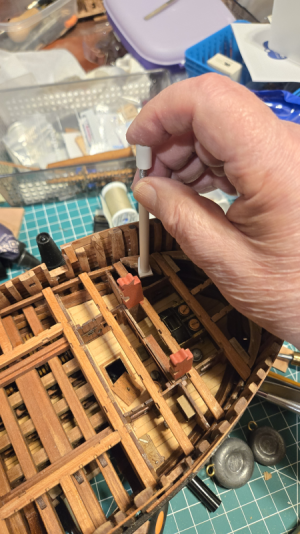
This tool allows me to securely hold many different sizes pieces, keeping the tool vertical and the part horizontal, to do everything I needed to do. It works quite well for me:
1763785971293.png 1763785985157.png
Using this tool, I was able to add all of these pieces fairly easily:
1763786201348.png

Then, continuing on with the 2x2 carlings (I think):
1763786225061.png

And a coat of Medium Danish Oil give me:
1763786241271.png
And before anyone mentions it, I've made tests with glued pieces finished previously with Watco Danish Oil (actually an oil varnish) and found adhesion sufficient most uses.

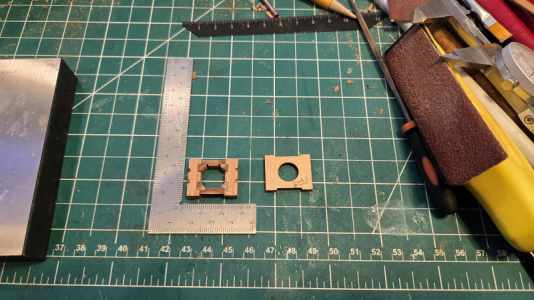
I made the mizzen mast support structure at the main deck separately, and the put it into place:
1763786484115.png
I really love the CAF kit and appreciate their precisely milled and laser cut parts. But I don't think they take full advantage of this. While some parts (certainly deck and hull planks) need to be longer than required, small precise parts should be able to be made to the exact size. CAF seems to allow about 0.5mm extra total width on some parts, 0.5mm on each edge with others. The vertically planked cabins is a good example: They simulate 4mm planks, but you can't just take off the char and glue them together, or the assembly will be several mm too wide when done. Each plank must have that 0.5mm trimmed off, usually not precisely or evenly (by me) to make the parts. And I don't know about you, but I have one heck of a time holding these 4mmx4mm pieces to sand them. And it's worse if you use any kind of tool to do it. These laser cuts seem consistent within less than 0.1mm! Why should I have to modify them? Make them the finished size in the first place.

I mention that which also concerns the above simple assembly. Those little 4mm wedges? They start out closer to 4mm, and must be sanded to size. What size? No one knows. Same for the other pieces, which are oversize. If you use the pieces as-made, it won't fit into the structure. So I used the template piece to determine what to modify, and by how much. Sometimes it's more work to modify a tiny piece than make one from scratch (like the cabin planks mentioned above). Not a big deal, I guess, but with the incredible precision that these pieces are made, I don't understand why CAF does not take full advantage of them and make things to-size in the first place. Char removal changes almost nothing.

Oh, the same with all of the notches on the beams where other beams fit into them. If it's 4mm material, make the notch for it 4mm. Either every notch must be widened (difficult for me to do, and hard to do well) or beams must be notched, tapered or otherwise altered to fit. There should be no need for this with such precise work.

Sorry - end of (long) rant. Still, a wonderful kit, and I'm not saying that CAF does this any differently than others.

That's kind of where I am to date. Hopefully my mistakes, and once in a while my ideas, will help someone else building this or other kits.
 
Back
Top