• Win a Free Custom Engraved Brass Coin!!!
    As a way to introduce our brass coins to the community, we will raffle off a free coin during the month of August. Follow link ABOVE for instructions for entering.

DE 7 PROVINCIËN (1665) 1:50

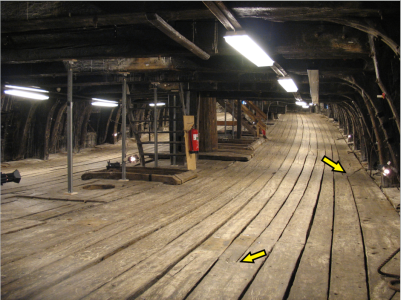
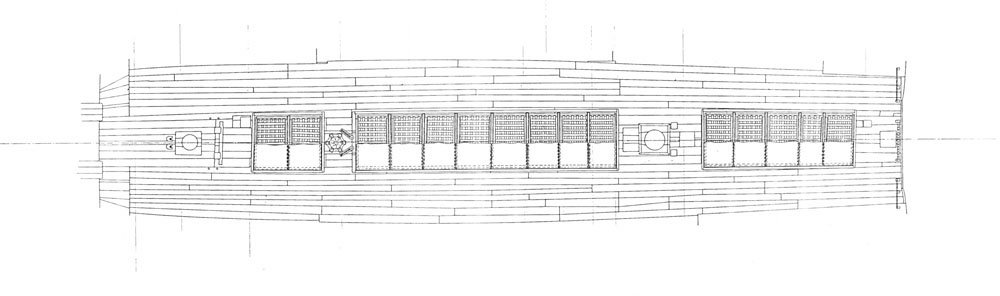
Deck planking may have been laid in accordance with whatever lumber was available, but the largest structural elements were set with precision, despite some asymmetry. What this allows is for leeway for us model builders when it comes to making perfectly symmetrical hull planking strakes and deck planking of varying widths and lengths. For many of us, the mistakes we make in these areas can often be actually historically accurate as a result. We may end up with an additional drop plank or stealer on one side off the hull, or one extra strake of planking on one side. Look at the pictures of Vasa's lower gun deck for how the deck planks appear as an example.

Unconventional deck joints made to get the most use out of available timbers on Vasa's lower gun deck:
1765822908079.png

Vasa's deck planking pattern was opportunistic based on available wood, not set to a strictly followed pattern:
1765822740135.png
 
Hi Paul,

In 17th century building let go this idea of perfect symmetry, it is just not the case. If you create perfect symmetry you create an unrealistic model.
This is not the case for 17th Dutch ships only but for all.
This means it is perfect to have it unsymmetrical 8-)
Darn it Maarten, I read this after I fixed my unsymmetrical stern!! It would have saved a lot of work, since apparently, I had it "perfect"!:D!:D
 
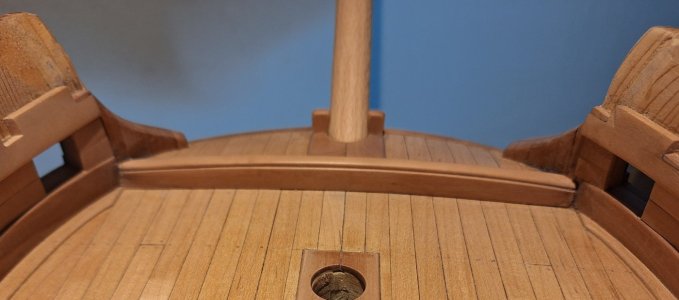
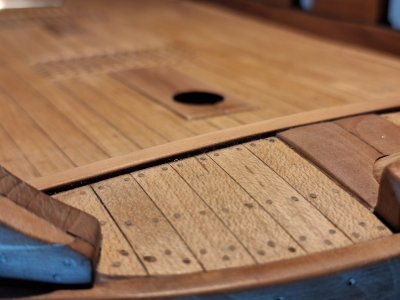
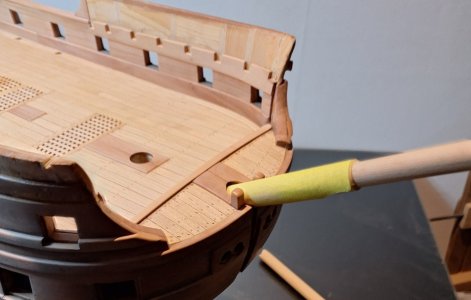
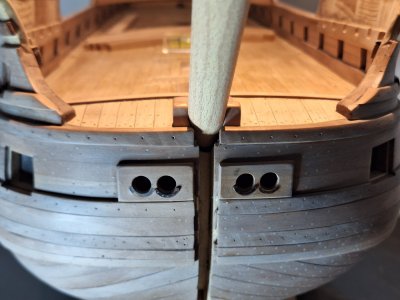
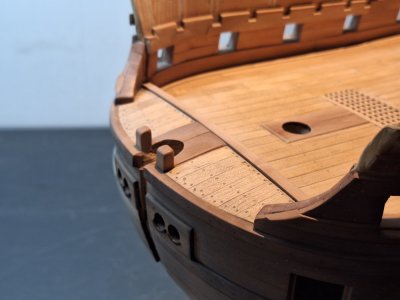
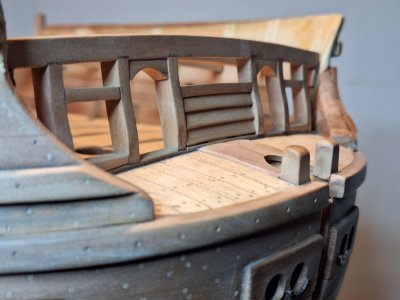
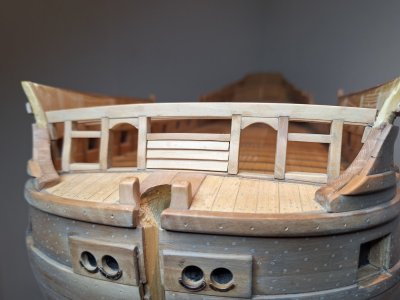
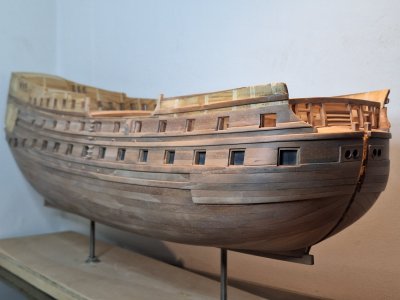
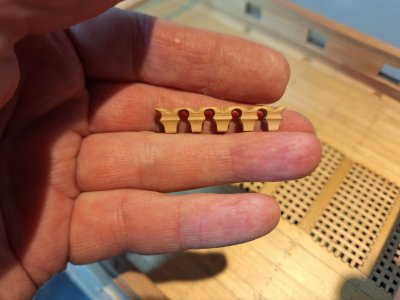
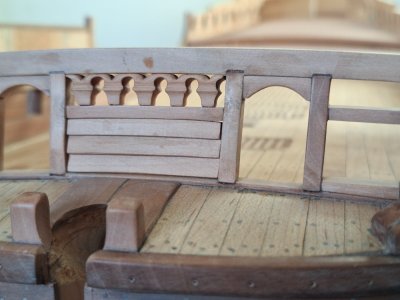
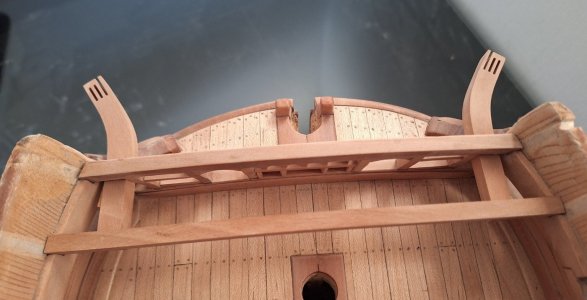
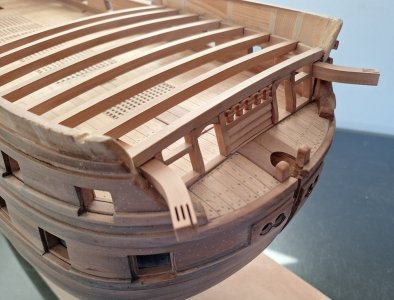
I did some extra work on the forecastle.
I enclosed the back of the forecastle by a beam, with on top an extra threshold. I also added an extra line of nails and finally made the knightheads for securing the bowsprit.
To ensure a good tight fit for the bowsprit I used the thinner piece of wood (reserved for the mizzen mast), wrapped it in sandpaper and sanded the whole until the bowsprit could pass through.
20251215_191536_resized.jpg20251215_191340_resized.jpg
20251215_191042_resized.jpg20251215_191307_resized.jpg
20251215_191836_resized.jpg
 
Also
Deck planking may have been laid in accordance with whatever lumber was available, but the largest structural elements were set with precision, despite some asymmetry. What this allows is for leeway for us model builders when it comes to making perfectly symmetrical hull planking strakes and deck planking of varying widths and lengths. For many of us, the mistakes we make in these areas can often be actually historically accurate as a result. We may end up with an additional drop plank or stealer on one side off the hull, or one extra strake of planking on one side. Look at the pictures of Vasa's lower gun deck for how the deck planks appear as an example.

Unconventional deck joints made to get the most use out of available timbers on Vasa's lower gun deck:
View attachment 563908

Vasa's deck planking pattern was opportunistic based on available wood, not set to a strictly followed pattern:
View attachment 563907

Also the hull is unsymmetric, one side of the bow has more buoyency than tge other side.
Gun port ps and sb side are also unsymmetrical. Even the number of frame timbers.
 
I did some extra work on the forecastle.
I enclosed the back of the forecastle by a beam, with on top an extra threshold. I also added an extra line of nails and finally made the knightheads for securing the bowsprit.
To ensure a good tight fit for the bowsprit I used the thinner piece of wood (reserved for the mizzen mast), wrapped it in sandpaper and sanded the whole until the bowsprit could pass through.
View attachment 564061View attachment 564060
View attachment 564058View attachment 564059
View attachment 564062
I love your fine craftsmanship.
 
Back
Top