



• Win a Free Custom Engraved Brass Coin!!!
    As a way to introduce our brass coins to the community, we will raffle off a free coin during the month of August. Follow link ABOVE for instructions for entering.
  • SUBSCRIBE TO SHIPS IN SCALE TODAY!

    The beloved Ships in Scale Magazine is back and charting a new course for 2026!
    Discover new skills, new techniques, and new inspirations in every issue.

    NOTE THAT OUR NEXT ISSUE WILL BE MARCH/APRIL 2026

ENDURANCE (Occre kit)

Joined
May 13, 2020
Messages
2,552
Points
553

Hi all

Yes, here I am again with another build log. You can't get rid of me :-) .

After my USS BONHOMME RICHARD cross section built, I was planing to start the GRANADO cross section but life have it ways to change your plans. A few months ago, our oldest son call me. He is in MA and we relocated to FL, so we can't see each other frequently. The call was to tell me that he saw a film about the ENDURANCE and he was now reading a book about that ship. He was so enthusiastic with the ENDURANCE story that he decided to order the OCCRE kit and it will be arriving in a few days, followed by "DAD it will be nice if you build it". You can guess my answer : YES !! But without mast/rigging :-) (I hate the rigging part of this hobby, unless it is really very very very easy).

I call him yesterday with the news that I was starting the build. Of course he tried to convince me to do the ship rigging. And of course I said.... "no way".

Nevertheless, within you guys and me, I will decided if I do the mast/rigging when that time comes.

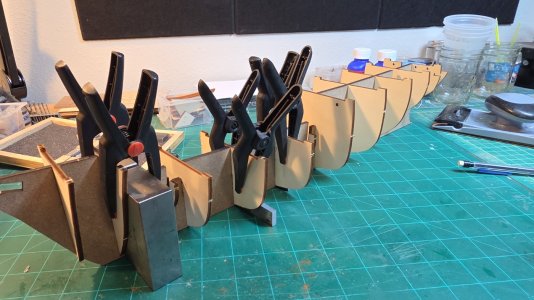
After that nice family story, this log built start : "with these classical images of a POB kit start"
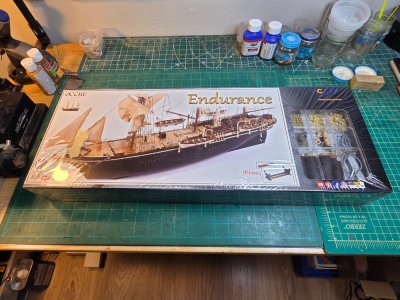
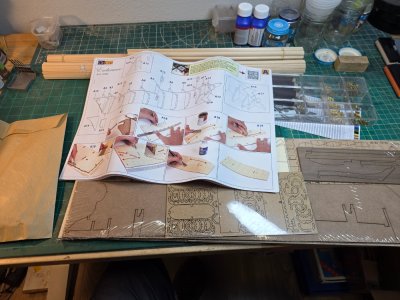
20260403_171629.jpg20260403_172819.jpgIMG-20260404-WA0001.jpeg

Stay tuned.... CHEERS !!! Daniel
 
Last edited:
I'm sorry to do this Daniel... but I'm going to take your son's side on this one. This particular model needs to be fully rigged (well, at least a nod toward full rigging) - the images of its final days with broken masts and ropes hanging everywhere are too iconic to display this ship without these elements intact. Happy rigging! :)

1775394776027.png
 
Last edited:
I'm sorry to do this Daniel... but I'm going to take you son's side on this one. This particular model needs to be fully rigged (well, at least a nod toward full rigging) - the images of its final days with broken masts and ropes hanging everywhere are too iconic to display this ship without these elements intact. Happy rigging! :)

View attachment 589930
I have the feeling that you will be pressing me to do it. Don't ask why I have that feeling :-) .

Thank you for stopping by.... and YES ...."Could be" ... (the door is open :-) )
 
I’m inclined to side with your son and Paul on rigging the model, and here’s why. In our modeling world, you often hear the term admiralty-style” model. That’s where the ship is shown primarily as a framing structure, with either no planking or only one side planked. In those cases, rigging is kept to a minimum, typically just the stub masts.
However, if you’re planning a fully planked hull (and I’m quite sure you are), leaving it unrigged can make the model feel a bit incomplete, IMHO. The rigging is what brings the whole vessel to life.

But… at the end of the day, you are the captain, and the helm is firmly in your hands. I will support the decision you'll make. ;)
 
I’m inclined to side with your son and Paul on rigging the model, and here’s why. In our modeling world, you often hear the term admiralty-style” model. That’s where the ship is shown primarily as a framing structure, with either no planking or only one side planked. In those cases, rigging is kept to a minimum, typically just the stub masts.
However, if you’re planning a fully planked hull (and I’m quite sure you are), leaving it unrigged can make the model feel a bit incomplete, IMHO. The rigging is what brings the whole vessel to life.

But… at the end of the day, you are the captain, and the helm is firmly in your hands. I will support the decision you'll make. ;)

Oh my Gosh... the pressure is increasing .... like the ICE against the ENDURANCE..... HAHAHA :-)
 
Guys.... let chat about the ENDURANCE hull.

Here is an interesting inage of the ENDURANCE hull.

Screenshot_20260404_092549_Chrome.jpg

Posted and discussed here:

Thread 'Endurance hull work' https://shipsofscale.com/sosforums/threads/endurance-hull-work.16692/

Do you think I can try to replicate that hull building ?

The hull will be painted all black. So details (mistakes on planking) will be hidden using putty and sanding. Being said this, I can try to add another layer of planks and copper in the keel

Am I wrong ?
 
…The advantage of double planking is that the first layer serves as a foundation for the final planking. This base allows you to establish smooth, continuous curves. At this stage, you can use any methods and materials at your disposal to achieve a perfect surface. The final planking, even if it will be painted, should still read as individual boards—so fillers are best avoided on the outer layer.
 
…The advantage of double planking is that the first layer serves as a foundation for the final planking. This base allows you to establish smooth, continuous curves. At this stage, you can use any methods and materials at your disposal to achieve a perfect surface. The final planking, even if it will be painted, should still read as individual boards—so fillers are best avoided on the outer layer.
Good advice!!!
 
This is my idea:

The hull of this kit will have the first planking that will be shaped using putting and sanding. Classical techniques. As Jimsky explained.

Then, I have the idea to add another layer of planks, in the lower section of the hull , as the real ship image. This layer will be also shaped with putting and sanding. I hope that this will replicate the lower hull section of the endurance as seen in the posted image.

On top of "all the hull" will go the second planking. Those will be only sanded. These planks are only 0.5 mm thick. After a soft sanding to smooth this second planking, the hull will be painted black. At the end, any visual plank shapes will be gone. See my Marmara built (links below)


Post in thread 'Marmara Trade Boat, 1:48 , SC brand [COMPLETED BUILD]' https://shipsofscale.com/sosforums/...-48-sc-brand-completed-build.5645/post-121633

Post in thread 'Marmara Trade Boat, 1:48 , SC brand [COMPLETED BUILD]' https://shipsofscale.com/sosforums/...-48-sc-brand-completed-build.5645/post-122015

Let see how this evolves. For now that is my idea to achieve the visual effect of the ENDURANCE real hull with 2 thicknesses.

Next steps : I need to build the decks.

Cheers
Daniel
 
Or, on a second thought, I will probably do a more "soft paint" allowing the planks to be seen, like in the below build log, and as suggested by Jimsky.

Also, chatting about this topic with my friend Mike Shanks, he suggested too that the planks need to be "seen" like in the painted image he sent me of the USRC BEAR, that is an Ice Breaker too, and he is building it from scratch.

Post in thread 'Build Log: ENDURANCE by OcCre [COMPLETED BUILD]' https://shipsofscale.com/sosforums/...nce-by-occre-completed-build.8181/post-195471

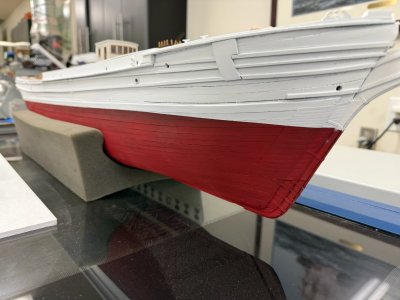
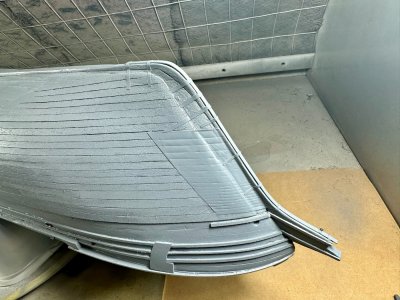
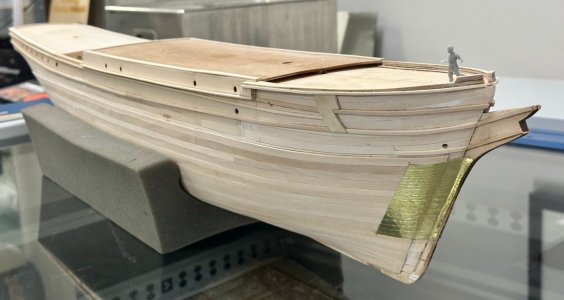
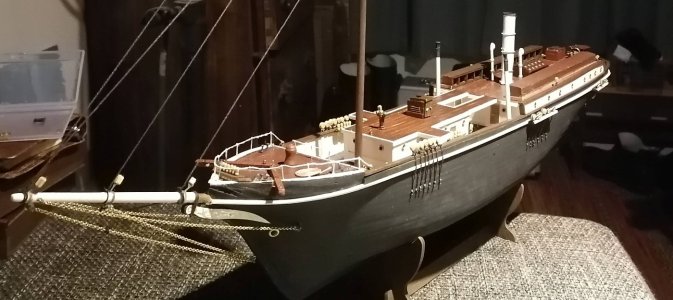
If you zoom the image, you can see the reinforced hull and the metal plates at the keel.
IMG_4525.jpg

IMG_3967.jpgIMG_3940.jpg

Screenshot_20260404_092549_Chrome.jpg

Let's see if I can replicate those builts.

Cheers
Daniel
 
I'm sorry to do this Daniel... but I'm going to take your son's side on this one. This particular model needs to be fully rigged (well, at least a nod toward full rigging) - the images of its final days with broken masts and ropes hanging everywhere are too iconic to display this ship without these elements intact. Happy rigging! :)

View attachment 589930
True story and ditto
 
tip: I built the Endurance, and used blackboard (school) paint for the hull. It is.. well.. eh.. black, but also extremely dull, which hides imperfections in the planking quite nicely, while keeping the individual strakes visible. Good luck with the build, it is a beautiful ship..and what a story!IMG_20240110_190843.jpg
 
Last edited:
The final planking, even if it will be painted, should still read as individual boards—so fillers are best avoided on the outer layer.
I'm curious: why is it that individual planks are so visible in the Endurance in White photo above? I would think that if planks were all tight with each other, then painted, it would be difficult to see the individual ones on an actual ship, yet they are so visible. Are they caulked or chinked into gaps that would make them visible?

On the other hand, on my models, even though individual planks are really visible when applied, after shaping and sanding they no longer are (beneath paint), at least in most areas. Putting a slight bevel on the planks before installation doesn't work that well (for me) because a varying amount of plank, and therefore bevel, being sanded off. So the appearance of planking varies. For me, anyhow.

I'd be interested in learning how to plank in such a way that the plank separation lines are all visible, evenly. Maybe that's just beyond me.
 
I'm curious: why is it that individual planks are so visible in the Endurance in White photo above? I would think that if planks were all tight with each other, then painted, it would be difficult to see the individual ones on an actual ship, yet they are so visible. Are they caulked or chinked into gaps that would make them visible?
The individual planks are visible because the seams between them are caulked with materials like tarred fiber, which remain slightly recessed and absorb paint differently, creating subtle dark lines. In addition, wooden planks are never perfectly flush and tend to expand, shrink, and wear over time, causing slight variations that show through the paint. Since traditional marine paint is relatively thin and follows the surface rather than hiding it, these natural differences, enhanced by lighting, make the plank lines clearly visible even on a fully painted hull.

On the other hand, on my models, even though individual planks are really visible when applied, after shaping and sanding they no longer are (beneath paint), at least in most areas. Putting a slight bevel on the planks before installation doesn't work that well (for me) because a varying amount of plank, and therefore bevel, being sanded off. So the appearance of planking varies. For me, anyhow.
Well..., as you can guess, on a real ship, plank seams might be several millimeters wide/deep and remain visible even after paint. But at model scale: say, 1:50 (48) or 1:100, those seams scale down to fractions of a millimeter.

At model scale, sanding and painting effectively eliminate true plank seams, so what you’re seeing is normal. So even if your planking is accurate, it becomes “optically invisible” at scale. To recreate the look of a real ship, you often need to artificially suggest the planking rather than rely purely on physical structure.

Here is the method I use to recreate plank lines. It is the same as laying down the deck planks: Pencil method (most controllable). I use a hard pencil (H or 2H), lightly draw along plank seams using your existing layout as a guide. Keep pressure very light, break the line occasionally (don’t make it continuous like a cartoon)

Hope this helps.
 
The individual planks are visible because the seams between them are caulked with materials like tarred fiber, which remain slightly recessed and absorb paint differently, creating subtle dark lines. In addition, wooden planks are never perfectly flush and tend to expand, shrink, and wear over time, causing slight variations that show through the paint. Since traditional marine paint is relatively thin and follows the surface rather than hiding it, these natural differences, enhanced by lighting, make the plank lines clearly visible even on a fully painted hull.
That's kind of what I was thinking. But I assumed during construction the planking would be placed as tightly as possible, leaving little area for caulking in some areas, more in others. I wonder if they beveled the planks to have a better fit? If not, that would create an automatic gap for caulking along the ships curves.
Here is the method I use to recreate plank lines. It is the same as laying down the deck planks: Pencil method (most controllable). I use a hard pencil (H or 2H), lightly draw along plank seams using your existing layout as a guide. Keep pressure very light, break the line occasionally (don’t make it continuous like a cartoon)
Are you using the pencil as a gouge to kind of create a groove? I know about using pencil lead on planking to simulate caulk, but if the hull is to be painted that wouldn't work. A groove would be visible, though, but I wouldn't have thought a pencil would groove hardwood that much.
 
Are you using the pencil as a gouge to kind of create a groove? I know about using pencil lead on planking to simulate caulk, but if the hull is to be painted that wouldn't work. A groove would be visible, though, but I wouldn't have thought a pencil would groove hardwood that much.
Ah…you are correct. On a painted hull (if it is not white), the planking gap would generally remain hidden. However, on a white-painted hull, it tends to appear more as subtle shading rather than distinct lines.
The pencil is not making a groove; it is just making a black shadow.
 
Back
Top