• Win a Free Custom Engraved Brass Coin!!!
    As a way to introduce our brass coins to the community, we will raffle off a free coin during the month of August. Follow link ABOVE for instructions for entering.
  • PRE-ORDER SHIPS IN SCALE TODAY!

    The beloved Ships in Scale Magazine is back and charting a new course for 2026!
    Discover new skills, new techniques, and new inspirations in every issue.

    NOTE THAT OUR FIRST ISSUE WILL BE JAN/FEB 2026

H.M.S. Surprise by Artesania Latina - Build log

I jettisoned the "kite sting/yarn" that was supplied with the kit. The black ropes were purchased from "Ropes of Scape", and I've learned to make small diameter ropes in the tan colour (0.15mm, 0.25mm and 0.5mm ropes) with acceptable results. I'm fortunate to have a 22 foot countertop in my kitchen, and I live alone - so no one around to scream about my kitchen use for the ropewalk. LOL!

I also purchased some medium brown ropes and thread from Ropes of Scale which I have plans to use for some of the stays. I'm not a "purist" when it comes to colour selection. To be honest, I am disappointed in the black shrouds. The fact that I served these is almost impossible to see because the black colour hides it so well. My next ship will not be using black rope at all. Live and learn.
Would dark brown offer better contrast so your parcelling or serving can be visible?
 
Would dark brown offer better contrast so your parcelling or serving can be visible?
Possibly. I have made several hundred feet of dark brown rope at 0.8mm diameter. I have not served any of it yet. I was thinking of using the dark brown rope as a core and serving it with medium brown thread. Not sure if it will make any difference, but I do know that the medium brown shows the serving much better than the black does.
 
Last edited:
Possibly. I have made several hundred feet of dark brown rope at 8mm diameter. I have not served any of it yet. I was thinking of using the dark brown rope as a core and serving it with medium brown thread. Not sure if it will make any difference, but I do know that the medium brown shows the serving much better than the black does.
I was going to suggest that also, as long as the contrast isn’t too great between the two threads.
 
I have been working with a single semi-functioning hand. My physiotherapist thinks this hobby would be good for the recovery and sensitivity of my fingers. I told her that my fingers were never very sensitive.

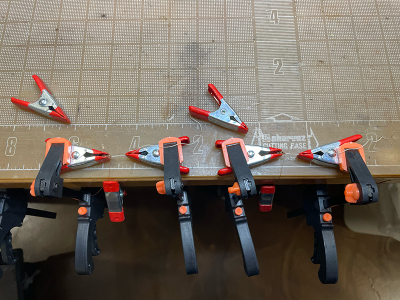
So I rigged a few blocks. But to do them as well as I hoped required some clamping action...
1-Handed Setup.png

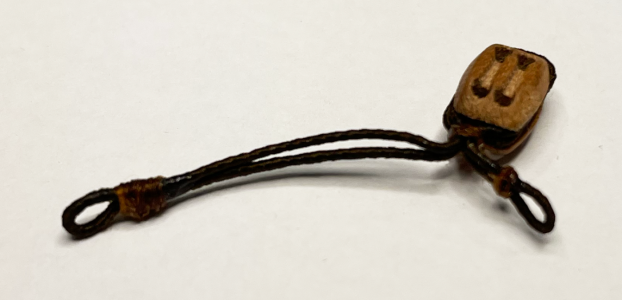
Made the Main Topsail Yard Tye. This took me awhile - sorry about the focus... my camera skill is questionable.
Main Topsail Yard Tye.png
So I learned a number of things when I created this assembly:
1. Serving small diameter (0.35mm) rope is a 1766618472695.pngchallenge.
2. Making a served rope perform a loop without the serving "spreading" on the turn is, ummm, difficult.
3. A one-armed idiot should not attempt this type of delicate construction.


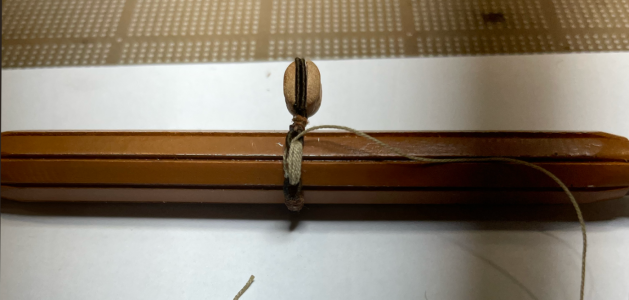
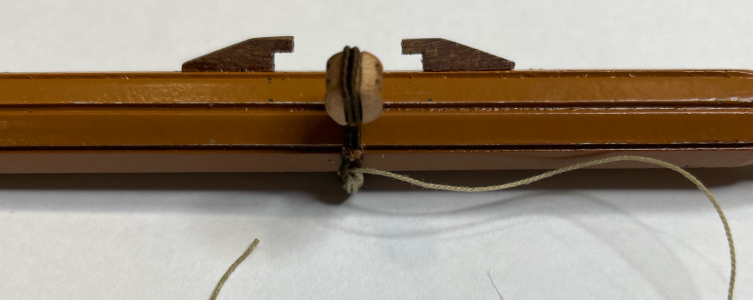
I was really proud of my lashing on the tye, until I discovered that I had the rig reversed, and had to disassemble it and apply it to the other side of the yard.
Yard Tye Installed Backward.png
Tye backwards.png

I plan to continue rigging the yards until my hands are functioning better. These items can be redone without much difficulty. Once my hands are reliable, then I'll get back to stays and ratlines.

Wishing all a Merry Christmas!

1766618334130.png
 
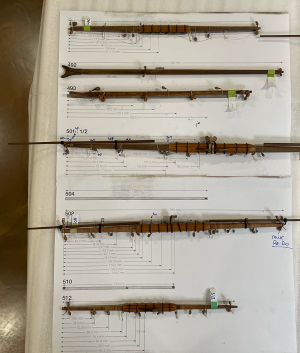
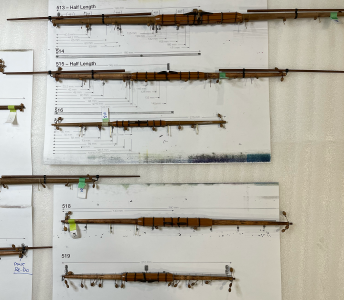
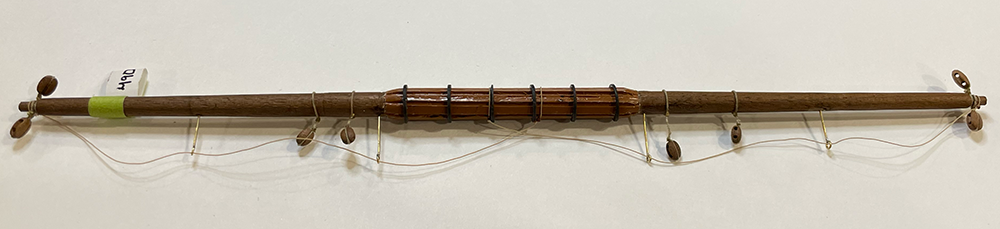
I've been working on the yards, and have them completed except for the footropes. I haven't determined exactly how I'll get these to hang correctly, but I've got some ideas.

409-512 yards.png
513-520 yards.png
SpritSailYard-footrope.png

Took a "short" break from rigging and went back to completing the anchor details:

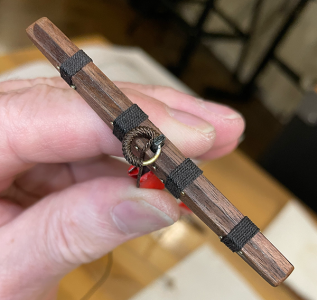
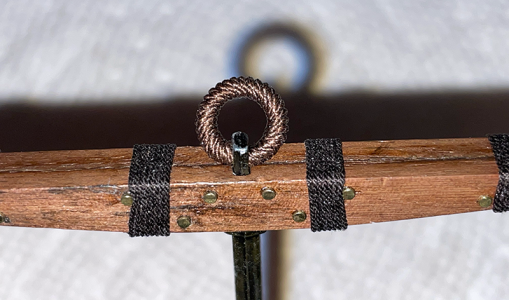
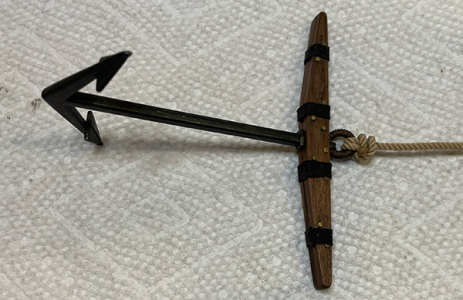
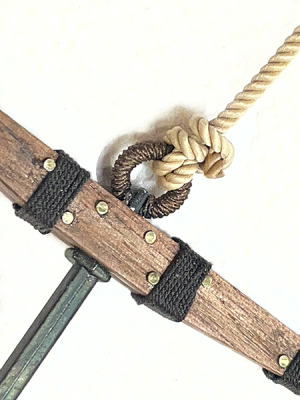
The reference I have indicates that the anchor ring should be "served". I tried several diameters of rope and finally settled with a rope that is clearly not the correct diameter, but my feable fingers were able to serve it correctly:
AnchorRingSansWrap.png
AnchorRingWrapInProg.png
Anchor Ring Wrap.png

During this process I discovered that the serving looks more realistic if it is wound in a clockwise direction around the ring. If served counter-clockwise the rope looks twisted (as shown above). Oh darn. I did not re-do the rings that I already completed though. Yup, lazy bugger!

Anchor Completed.png
Anchor Rig Close.png

I used the "modern day" anchor bendknot for the attachment of the rope to the ring as it looks very neat. I made some cable rope, but was unhappy with the look. So I went with my usual rope for this, which I like the look of better.
 
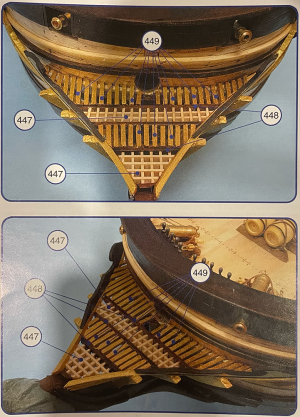
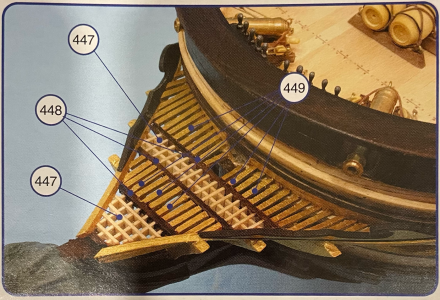
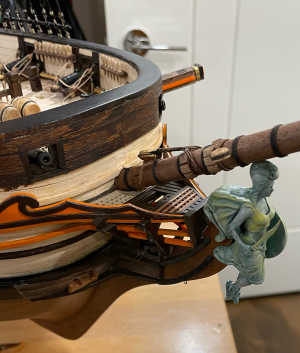
After completing the anchor details, I went back and worked on the ship's head. As I've mentioned previously, I'm less than proficient with grates, and the ships' head uses a number of them. The following pictures are from the A.L build manual.

ShipsHead-Kit-01.png
ShipsHead-Kit-02.png

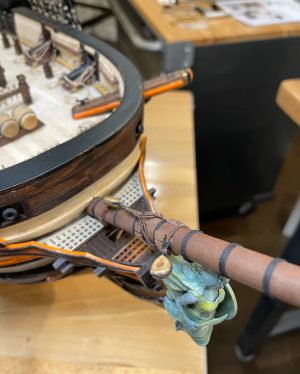
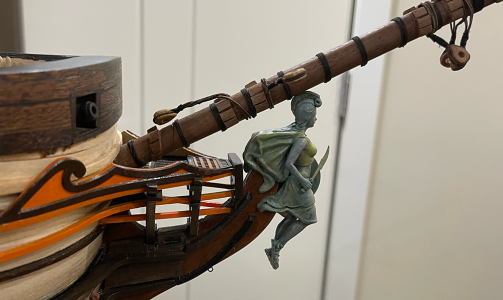
You probably cannot hear me gag when I look at these. So, in an attempt to make my ship look like it has a decent head, I made my own grates from scratch. Bad idea? Probably... I'm crap at this stuff.

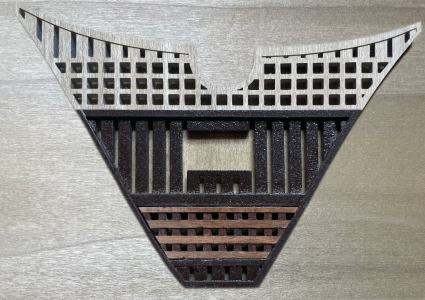
I made several "accurate" templates using empty cereal box cardboard and built the grates in stages and test fit each to the ship before final assembly.

Here's what the head looked like before final installation:
Ships Head-PreInstall.png

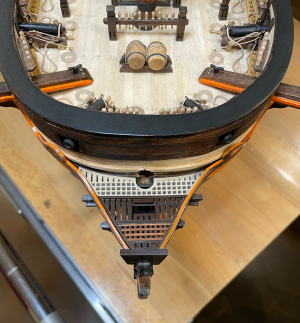
And here are a few shots of the assembly in place:
Ships Head VerticalD01.png
ShipsHead+Bowsprit Angled.png
ShipsHeadSideBSprit.png

Was it another error not to crop the figurehead boobs out of the photo? Well, I'll claim I left it uncropped to inspire a good look at the ship's head.
Yeah, right.

A final look. Yes, the bowsprit is "resting" on the figurehead. That is only temporary and will lift up about 1ft above her when the stays are rigged.
ShipsHeadFmStartBSprit.png

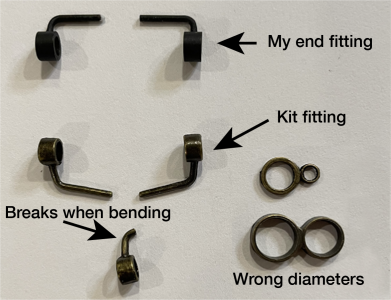
For those who may be following my build, and have the same kit in drydock, note that the supplied yard boom fittings are unusable and I made my own. The yard-end brass fittings have a significant angle to them rather than a 90º angle. I tried to bend these to the correct angle and the brass is very brittle and breaks. Even with a heat treatment... And the figure 8 rings are not the correct diameter as specified for the various yard tapers.

Kit Yard fittings+Mine.png
 
Hi Reg
The puddening on the ring looks terrific. :)

Is there a reason you used rope around the stock instead of metal hoops? I can't find any contemporary based information that shows rope instead of metal in any second half 18th to early19th centuries English ships. Sutherland's Shipbuilding Unveiled , Science Museum pics, etc. all show metal hoops. I am guessing the hoops varied in size but Lavery shows a drawing of a 39CWT anchor with hoops that were 2 1/2" wide by 5/8" thick which gives a little indication of the hoop size.
Thanks
Allan
 
Is there a reason you used rope around the stock instead of metal hoops?
Hi Allan,
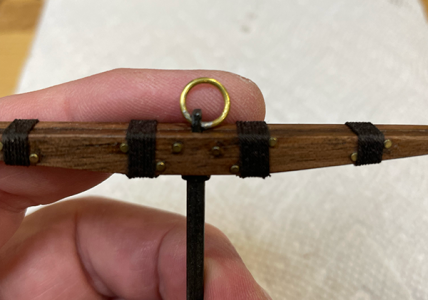
I'm still learning the nomenclature for some of these ship parts, but I'm not sure what you mean when you say "stock" - I'm guessing that is the wooden crossbeam on the anchors.. As this is my first attempt at constructing a wooden ship, I'm mostly just following A.L.'s kit plans. So where you see rope on my ship, and anchors, that is what the plans called for. However, I did not use rope when I secured the reinforcement battens to the yards - for those I made my own metal hoops (the kits plans called for rope here too). Shrug. Clearly I'm making all the typical newbie mistakes, but I'm trying not too. Thank you for pointing this detail out. If I build another model, then I'll do the anchors correctly.
 
Last edited:
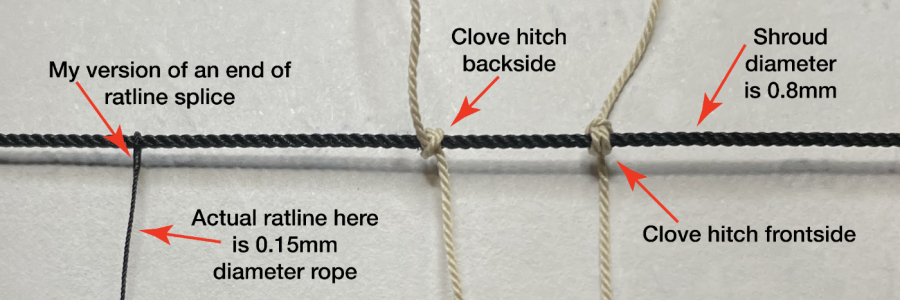
In preparation for having serviceable fingers on both hands, I have tried a couple of samples of the hitch knots that I'll be using for the ratlines. Fortunately I have been tying hitch knots for many years. In doing so, I find that one side is "prettier" than the other. In the image below I show a closeup of what I mean:

Clove Hitch + splice.png

So I prefer the clove hitch frontside view, as it looks very tidy. I haven't done any research to determine which side of this knot should be outboard or inboard on the shrouds, but as my model will always be viewed from outboard, the clove hitch frontside view is what I'd like on the outboard. If this is a gross error, please correct me. As a Monty Python skit quote said, "a spanking may be called for...." But, as I haven't really started on the ratlines, a correction now is better than later.

 
In preparation for having serviceable fingers on both hands, I have tried a couple of samples of the hitch knots that I'll be using for the ratlines. Fortunately I have been tying hitch knots for many years. In doing so, I find that one side is "prettier" than the other. In the image below I show a closeup of what I mean:

View attachment 571067

So I prefer the clove hitch frontside view, as it looks very tidy. I haven't done any research to determine which side of this knot should be outboard or inboard on the shrouds, but as my model will always be viewed from outboard, the clove hitch frontside view is what I'd like on the outboard. If this is a gross error, please correct me. As a Monty Python skit quote said, "a spanking may be called for...." But, as I haven't really started on the ratlines, a correction now is better than later.

A spanking...a spanking !!!!
ROFL My favorite movie (I know, that explains a lot).
 
I'm not sure what you mean when you say "stock"
Yes the stock is the two pieces of wood. :)

I love your version of the ratlines. They look perfectly scaled,


for those I made my own metal hoops (the kits plans called for rope here too).
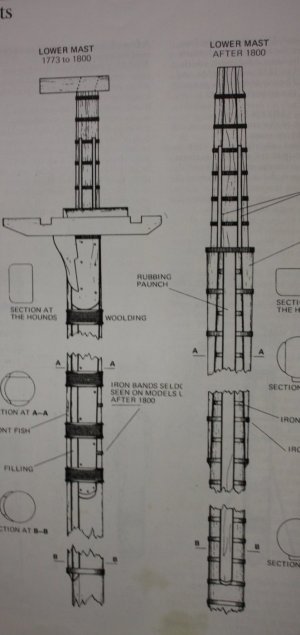
Are you speaking about the rope wooldings and the thin wooden rings on the top and bottom of the wooldings? Some kits do not provide for the rings.

From James Lees' The Masting and Rigging of English Ships of War.

1768691781186.jpeg
 
A.L. did not include the wooden rings for the masts,
That is no "surprise" :)

As you wrote, for down the road, there is a post in the Tricks of the Trade topic here at SoS that shows an easy way to make wooden rings and hoops that may be helpful.

Yes, I saw this reference in that book
As you have a copy of Lees' book when it comes to masting and rigging you have a huge advantage over those that do not.

Allan
 
Back
Top