
-

SUBSCRIBE TO SHIPS IN SCALE TODAY!
The beloved Ships in Scale Magazine is back and charting a new course for 2026!
Discover new skills, new techniques, and new inspirations in every issue.
NOTE THAT OUR NEXT ISSUE WILL BE July/August 2026 -

Win a Free Custom Engraved Brass Coin!!!
As a way to introduce our brass coins to the community, we will raffle off a free coin during the month of August. Follow link ABOVE for instructions for entering.


- Home
- Forums
- Ships of Scale Group Builds and Projects
- HMS Alert 1777 1:48 PoF Group Build
- HMS Alert 1777 1:48 Group Build Logs
You are using an out of date browser. It may not display this or other websites correctly.
You should upgrade or use an alternative browser.
You should upgrade or use an alternative browser.
HMS Alert [1777] 1:48 POF by serikoff. (Two hulls: skeleton and fully rigged)



Nailing and Bolting.
I've already done all of this on the second hull, so I won't repeat myself. I'll just add a few new techniques and a couple of life hacks.
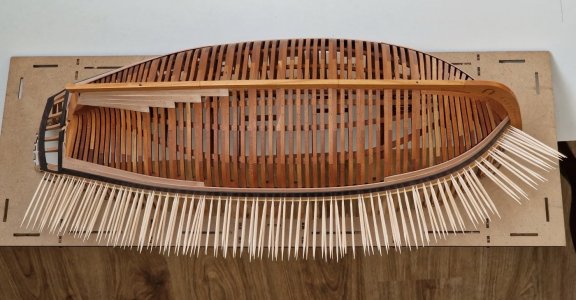
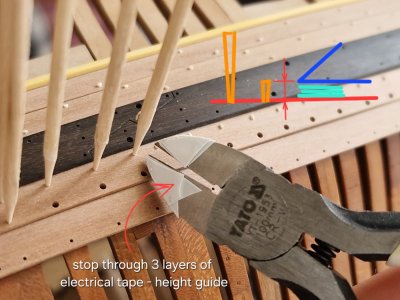
To always cut the toothpicks at the same level, I glued 3 layers of electrical tape to the inside of the nippers.
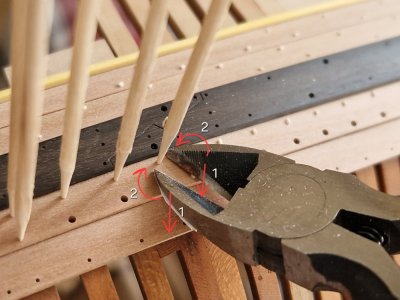
I'm always looking for new ways to speed up and improve the process, so here's another method for making bolts.
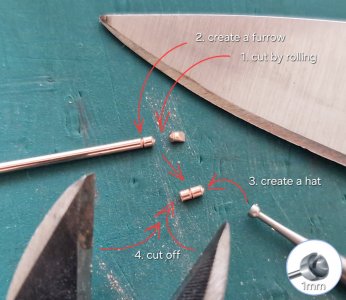
1. I use a knife to cut off the tip, forming the head.
2. Then I make a circular groove to better secure the bolt in the hole.
3. I shape the head by hand with a bowl drill.
4. I cut it to length with nippers.
5. Then I insert the finished bolt into the hole and hammer it in.
As a result, no modifications are required after fastening, and there is no risk of damaging the housing.
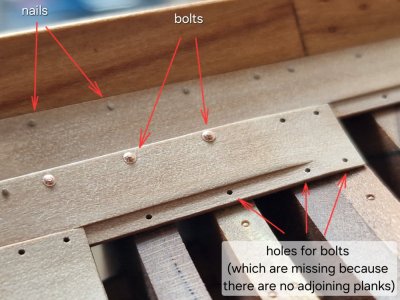
The finished result is: Nails (0.5 mm), Bolts (1 mm) and empty holes (0.5 mm) where the bolts should have been.
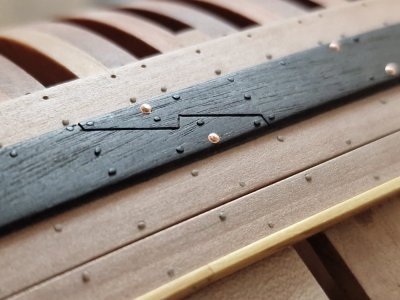
Scuppers.
I also slightly modified the way they were made.
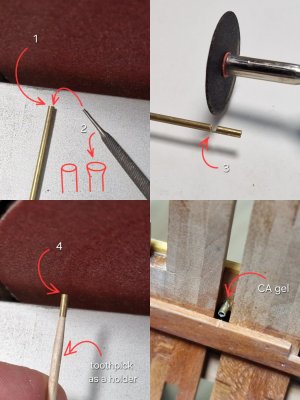
1. First, I smooth and sand the edge.
2. Then I stretch the diameter slightly on one side (this is necessary so that the tube will wedge into the hole).
3. I cut off the excess (I previously did this on-site).
4. I secure a section of the tube with a toothpick and sand the other end.
5. I insert the tube from the outside so that it wedge slightly and protrude from the surface by a few tens of millimeters. Then, I fill the inside with CA gel to secure it. And here's the result:
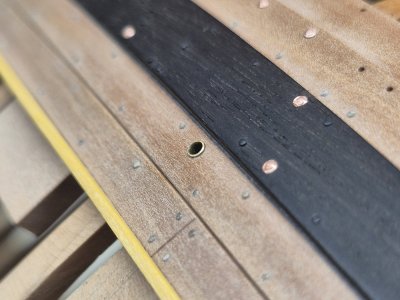
For those who are building or will be building based on my review, here are the exact positions of the scuppers, as neither the anatomy nor the kit provides this information! (The numbers indicate the frames.)
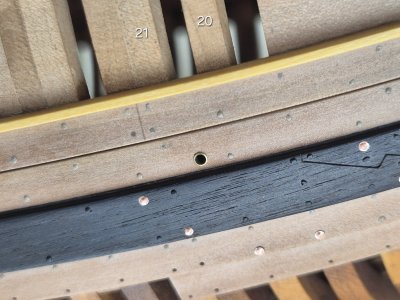
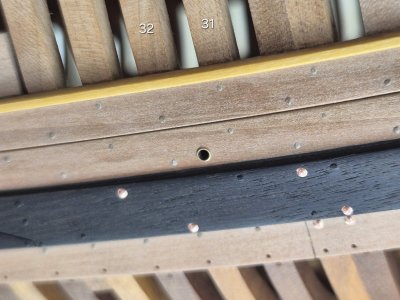
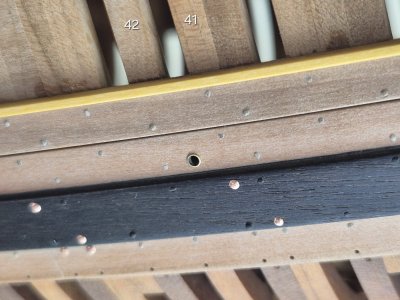
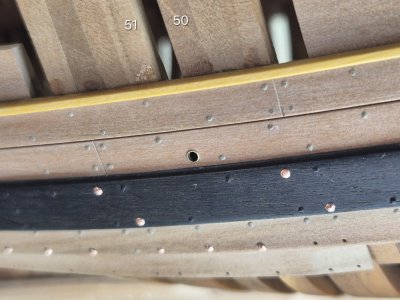
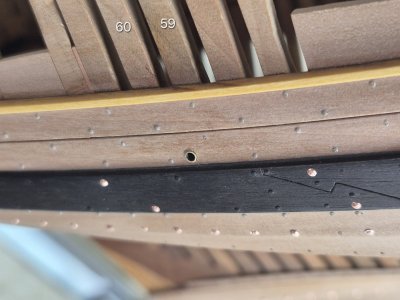
Let me remind you that the scuppers are installed between the frames and they should not fall on the beams.
*As always, I take photos in the evening, and the quality is appropriate. Also, don't pay attention to any glue drips—these areas will be further refined or trimmed.
** @GIG1810 Thank you, friend, for the high rating, don't disappear for long.
I've already done all of this on the second hull, so I won't repeat myself. I'll just add a few new techniques and a couple of life hacks.
To always cut the toothpicks at the same level, I glued 3 layers of electrical tape to the inside of the nippers.
I'm always looking for new ways to speed up and improve the process, so here's another method for making bolts.
1. I use a knife to cut off the tip, forming the head.
2. Then I make a circular groove to better secure the bolt in the hole.
3. I shape the head by hand with a bowl drill.
4. I cut it to length with nippers.
5. Then I insert the finished bolt into the hole and hammer it in.
As a result, no modifications are required after fastening, and there is no risk of damaging the housing.
The finished result is: Nails (0.5 mm), Bolts (1 mm) and empty holes (0.5 mm) where the bolts should have been.
Scuppers.
I also slightly modified the way they were made.
1. First, I smooth and sand the edge.
2. Then I stretch the diameter slightly on one side (this is necessary so that the tube will wedge into the hole).
3. I cut off the excess (I previously did this on-site).
4. I secure a section of the tube with a toothpick and sand the other end.
5. I insert the tube from the outside so that it wedge slightly and protrude from the surface by a few tens of millimeters. Then, I fill the inside with CA gel to secure it. And here's the result:
For those who are building or will be building based on my review, here are the exact positions of the scuppers, as neither the anatomy nor the kit provides this information! (The numbers indicate the frames.)
Let me remind you that the scuppers are installed between the frames and they should not fall on the beams.
*As always, I take photos in the evening, and the quality is appropriate. Also, don't pay attention to any glue drips—these areas will be further refined or trimmed.
** @GIG1810 Thank you, friend, for the high rating, don't disappear for long.


Nicely detailed metalwork, Sergey. I love the bolts and scuppers!Nailing and Bolting.
I've already done all of this on the second hull, so I won't repeat myself. I'll just add a few new techniques and a couple of life hacks.
View attachment 610386
To always cut the toothpicks at the same level, I glued 3 layers of electrical tape to the inside of the nippers.
View attachment 610387
View attachment 610388
View attachment 610389
I'm always looking for new ways to speed up and improve the process, so here's another method for making bolts.
View attachment 610390
1. I use a knife to cut off the tip, forming the head.
2. Then I make a circular groove to better secure the bolt in the hole.
3. I shape the head by hand with a bowl drill.
4. I cut it to length with nippers.
5. Then I insert the finished bolt into the hole and hammer it in.
As a result, no modifications are required after fastening, and there is no risk of damaging the housing.
View attachment 610391
The finished result is: Nails (0.5 mm), Bolts (1 mm) and empty holes (0.5 mm) where the bolts should have been.
View attachment 610392
Scuppers.
I also slightly modified the way they were made.
View attachment 610393
1. First, I smooth and sand the edge.
2. Then I stretch the diameter slightly on one side (this is necessary so that the tube will wedge into the hole).
3. I cut off the excess (I previously did this on-site).
4. I secure a section of the tube with a toothpick and sand the other end.
5. I insert the tube from the outside so that it wedge slightly and protrude from the surface by a few tens of millimeters. Then, I fill the inside with CA gel to secure it. And here's the result:
View attachment 610394
For those who are building or will be building based on my review, here are the exact positions of the scuppers, as neither the anatomy nor the kit provides this information! (The numbers indicate the frames.)
View attachment 610395
View attachment 610396
View attachment 610397
View attachment 610398
View attachment 610399
Let me remind you that the scuppers are installed between the frames and they should not fall on the beams.
*As always, I take photos in the evening, and the quality is appropriate. Also, don't pay attention to any glue drips—these areas will be further refined or trimmed.
** @GIG1810 Thank you, friend, for the high rating, don't disappear for long.
Regards, Peter


Eine wunderbare und wundervolle Arbeit. Ein fantastisches Werk. Die Darstellung ist grandios.Nageln und Verschrauben.
Ich habe das alles schon beim zweiten Rumpf gemacht, also wiederhole ich mich nicht. Ich werde nur ein paar neue Techniken und ein paar praktische Tipps hinzufügen.
View attachment 610386
Um die Zahnstocher immer auf gleicher Höhe abzuschneiden, habe ich drei Lagen Isolierband an die Innenseite der Zange geklebt.
View attachment 610387
View attachment 610388
View attachment 610389
Ich bin immer auf der Suche nach neuen Wegen, den Prozess zu beschleunigen und zu verbessern, daher hier eine weitere Methode zur Herstellung von Bolzen.
View attachment 610390
1. Ich schneide mit einem Messer die Spitze ab und forme so den Kopf.
2. Dann fertige ich eine kreisförmige Nut an, um den Bolzen besser im Loch zu fixieren.
3. Ich forme den Kopf von Hand mit einem Kugelbohrer.
4. Ich habe es mit einer Gartenschere auf die richtige Länge zugeschnitten.
5. Dann setze ich den fertigen Bolzen in das Loch ein und schlage ihn mit dem Hammer fest.
Daher sind nach der Befestigung keine Änderungen mehr erforderlich, und es besteht keine Gefahr, das Gehäuse zu beschädigen.
View attachment 610391
Das Endergebnis ist: Nägel (0,5 mm), Bolzen (1 mm) und leere Löcher (0,5 mm), wo die Bolzen hätten sein sollen.
View attachment 610392
Speigatten.
Ich habe auch die Herstellungsweise leicht verändert.
View attachment 610393
1. Zuerst glätte und schleife ich die Kante.
2. Dann dehne ich den Durchmesser auf einer Seite leicht aus (dies ist notwendig, damit sich das Rohr in das Loch einklemmen kann).
3. Ich habe den Überschuss abgeschnitten (das habe ich zuvor vor Ort gemacht).
4. Ich fixiere ein Teilstück des Rohrs mit einem Zahnstocher und schleife das andere Ende ab.
5. Ich führe das Röhrchen von außen ein, sodass es sich leicht verkeilt und einige zehn Millimeter aus der Oberfläche herausragt. Anschließend fülle ich das Innere mit Sekundenklebergel, um es zu fixieren. Und hier ist das Ergebnis:
View attachment 610394
Für alle, die nach meiner Rezension bauen oder bauen werden, hier die genauen Positionen der Lenzöffnungen, da weder die Anatomie noch der Bausatz diese Information liefern! (Die Zahlen geben die Spanten an.)
View attachment 610395
View attachment 610396
View attachment 610397
View attachment 610398
View attachment 610399
Zur Erinnerung: Die Wasserspeier sind zwischen den Rahmen montiert und dürfen nicht auf die Balken fallen.
Wie immer mache ich die Fotos abends, die Qualität ist angemessen. Bitte beachten Sie keine Klebereste – diese Stellen werden später noch nachbearbeitet oder beschnitten.
** @GIG1810 Vielen Dank, Freund, für die hohe Bewertung. Verschwinde nicht für lange Zeit.


Nicely detailed metalwork, Sergey. I love the bolts and scuppers!
Regards, Peter
Eine wunderbare und wundervolle Arbeit. Ein fantastisches Werk. Die Darstellung ist grandios.
Thank you, friends, for your high praise. We will continue.The level of crafmanship is quite insane...thank you for showing that!

Sills of gun ports.
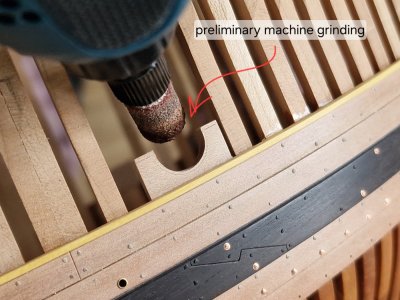
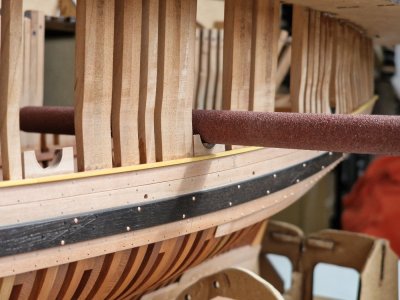
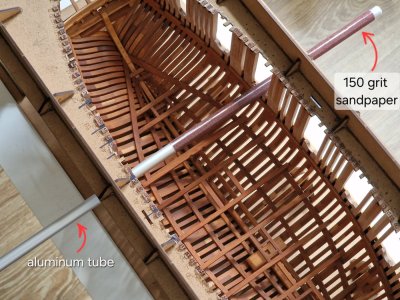
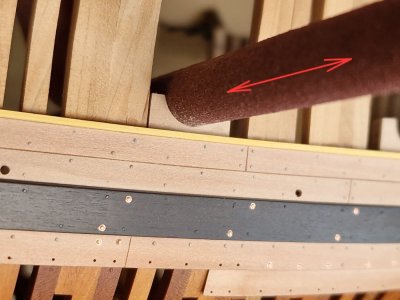
The most important thing in making them is parallelism. First, I make markings by scratching, trimming off the excess, and then I refine the radius with sandpaper glued to an aluminum tube. Finally, I polish the parts using the same method, but with a lower grit.
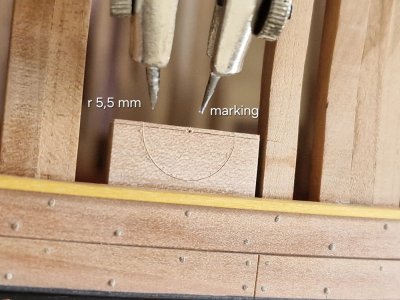
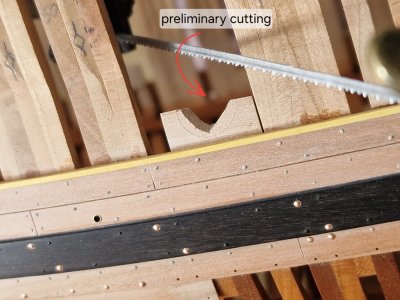
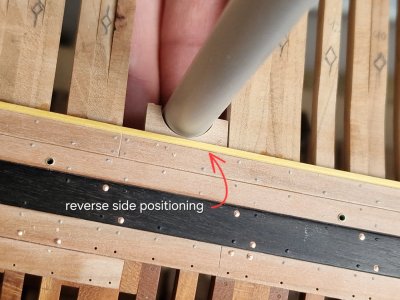
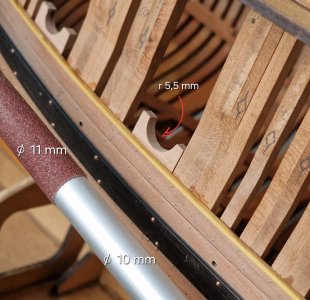
Railing posts.
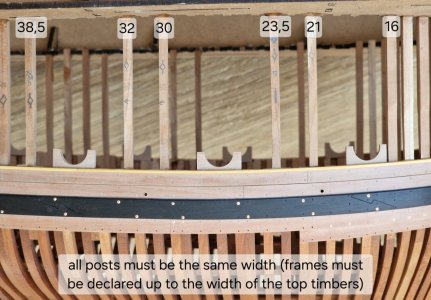
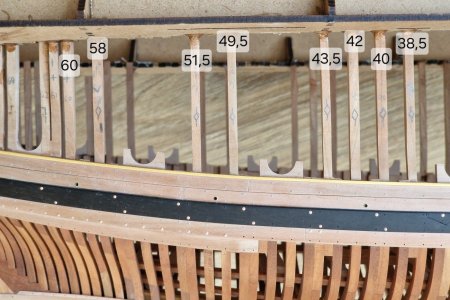
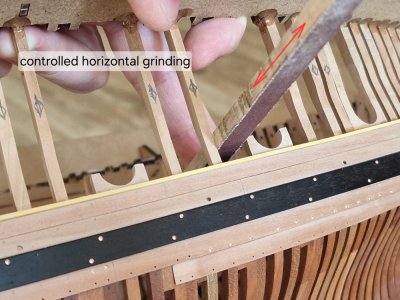
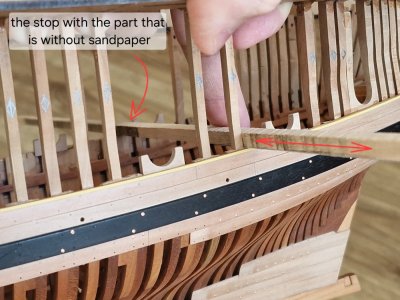
The railing posts are either frames or top timbers. Frames are wider and therefore need to be tapered to the thickness of the top timbers to ensure a uniform appearance. Secondly, I offset frames 30 and 32 backwards (making them look like top timbers) to create a symmetrical arrangement with equal spacing between all the elements. I sanded the yellow railing flush with the plank using a similar method, but I glued the sandpaper to the plank. I cut the frames with a saw blade, protecting the railing with a piece of the blade to avoid damaging it.
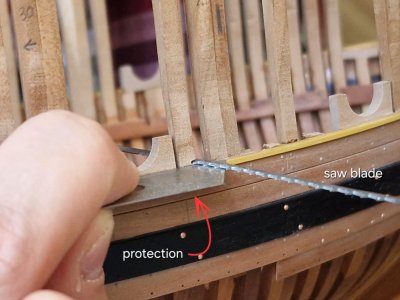
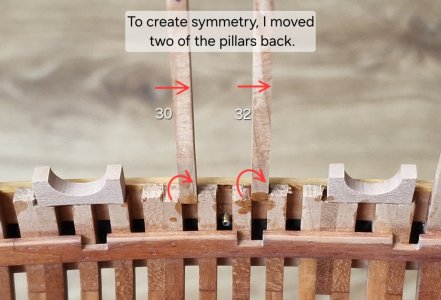
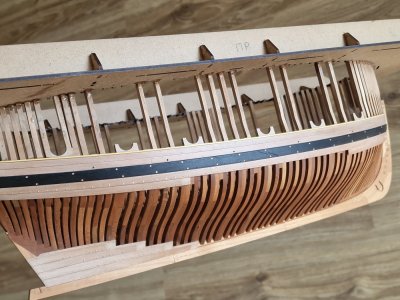
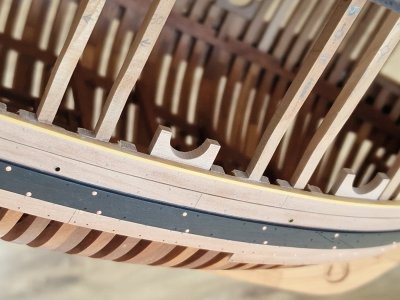
Next, the top (black) part of the railing will be secured. This is a complex and time-consuming procedure.
The most important thing in making them is parallelism. First, I make markings by scratching, trimming off the excess, and then I refine the radius with sandpaper glued to an aluminum tube. Finally, I polish the parts using the same method, but with a lower grit.
Railing posts.
The railing posts are either frames or top timbers. Frames are wider and therefore need to be tapered to the thickness of the top timbers to ensure a uniform appearance. Secondly, I offset frames 30 and 32 backwards (making them look like top timbers) to create a symmetrical arrangement with equal spacing between all the elements. I sanded the yellow railing flush with the plank using a similar method, but I glued the sandpaper to the plank. I cut the frames with a saw blade, protecting the railing with a piece of the blade to avoid damaging it.
Next, the top (black) part of the railing will be secured. This is a complex and time-consuming procedure.

I guess that will be fine, Sergey. You'll just have to settle once again for perfection.
Nice detailed and precise work, Sergey.Sills of gun ports.
The most important thing in making them is parallelism. First, I make markings by scratching, trimming off the excess, and then I refine the radius with sandpaper glued to an aluminum tube. Finally, I polish the parts using the same method, but with a lower grit.
View attachment 610914
View attachment 610915
View attachment 610916
View attachment 610917
View attachment 610918
View attachment 610919
View attachment 610920
View attachment 610921
Railing posts.
The railing posts are either frames or top timbers. Frames are wider and therefore need to be tapered to the thickness of the top timbers to ensure a uniform appearance. Secondly, I offset frames 30 and 32 backwards (making them look like top timbers) to create a symmetrical arrangement with equal spacing between all the elements. I sanded the yellow railing flush with the plank using a similar method, but I glued the sandpaper to the plank. I cut the frames with a saw blade, protecting the railing with a piece of the blade to avoid damaging it.
View attachment 610922
View attachment 610923
View attachment 610924
View attachment 610925
View attachment 610926
View attachment 610927
View attachment 610928
View attachment 610929
Next, the top (black) part of the railing will be secured. This is a complex and time-consuming procedure.
Regards, Peter
Ahaha, very well said.I guess that will be fine, Sergey. You'll just have to settle once again for perfection.
 It's a shame it's still a long way off, but thanks anyway!
 Thank you, friend, for your continued interest in my work.Nice detailed and precise work, Sergey.
Regards, Peter

Sehr schöne Ausführung.Präzise durchgeführt. Tolle Detailarbeiten. Du hast ein feines Gespür für die Umsetzung von Details.Schwellen der Geschützpfforten.
Das Wichtigste bei der Herstellung ist die Parallelität. Zuerst markiere ich die Kanten durch Einritzen, entferne den Überschuss und verfeinere dann den Radius mit Schleifpapier, das auf ein Aluminiumrohr geklebt ist. Abschließend poliere ich die Teile mit der gleichen Methode, jedoch mit einer größeren Körnung.
View attachment 610914
View attachment 610915
View attachment 610916
View attachment 610917
View attachment 610918
View attachment 610919
View attachment 610920
View attachment 610921
Geländerpfosten.
Die Geländepfosten sind entweder Rahmen oder Oberhölzer. Rahmen sind breiter und müssen daher auf die Dicke der Oberhölzer verjüngt werden, um ein einheitliches Erscheinungsbild zu gewährleisten. Anschließend habe ich die Rahmen 30 und 32 nach hinten versetzt (sodass sie wie Oberhölzer aussehen), um eine symmetrische Anordnung mit gleichmäßigem Abstand zwischen allen Elementen zu erzielen. Das gelbe Geländer habe ich mit einer ähnlichen Methode bündig mit der Diele geschliffen, wobei ich das Schleifpapier auf die Diele geklebt habe. Der Rahmen habe ich mit einem Sägeblatt zugeschnitten und das Geländer dabei mit einem Stück des Sägeblatts geschützt, um Beschädigungen zu vermeiden.
View attachment 610922
View attachment 610923
View attachment 610924
View attachment 610925
View attachment 610926
View attachment 610927
View attachment 610928
View attachment 610929
Anschließend wird der obere (schwarze) Teil des Geländers befestigt. Dies ist ein komplexer und zeitaufwändiger Vorgang.
Deine Schleiffstäbe > stellst Du die selbst her?


Your explanations are wonderful and simple to use with outstanding results !
Thank you so much !
Thank you so much !
Your explanations are wonderful and simple to use with outstanding results !
Thank you so much !
Thank you, friends, for your feedback.Sehr schöne Ausführung.Präzise durchgeführt. Tolle Detailarbeiten. Du hast ein feines Gespür für die Umsetzung von Details.
Deine Schleiffstäbe > stellst Du die selbst her?
Yes, I make all my grinding tools myself. They turn out very accurately when I'm working on an aluminum tube, but I think wood would work just as well, as long as the cylinder is perfect.

- Joined
- Oct 12, 2022
- Messages
- 87
- Points
- 113

Sills of gun ports.
The most important thing in making them is parallelism. First, I make markings by scratching, trimming off the excess, and then I refine the radius with sandpaper glued to an aluminum tube. Finally, I polish the parts using the same method, but with a lower grit.
View attachment 610914
View attachment 610915
View attachment 610916
View attachment 610917
View attachment 610918
View attachment 610919
View attachment 610920
View attachment 610921
Railing posts.
The railing posts are either frames or top timbers. Frames are wider and therefore need to be tapered to the thickness of the top timbers to ensure a uniform appearance. Secondly, I offset frames 30 and 32 backwards (making them look like top timbers) to create a symmetrical arrangement with equal spacing between all the elements. I sanded the yellow railing flush with the plank using a similar method, but I glued the sandpaper to the plank. I cut the frames with a saw blade, protecting the railing with a piece of the blade to avoid damaging it.
View attachment 610922
View attachment 610923
View attachment 610924
View attachment 610925
View attachment 610926
View attachment 610927
View attachment 610928
View attachment 610929
Next, the top (black) part of the railing will be secured. This is a complex and time-consuming procedure.
Learn new techniques from each of your updates
Friends, I present to you my second version of the electroplating machine 2.0
My wife called it the Bomb. Ahahahaha, there's something about that.
Also, one post earlier in this thread, I showed the result after blackening... there's some interesting information there too!
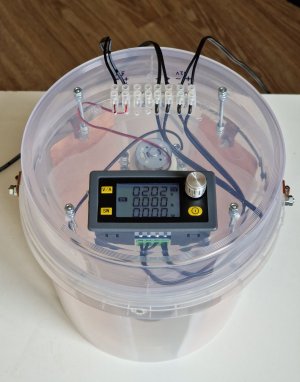
My wife called it the Bomb. Ahahahaha, there's something about that.
Also, one post earlier in this thread, I showed the result after blackening... there's some interesting information there too!
Metalworking. Electroplating (Electroforming), Copper Plating, Soldering, Blackening. Making: cannons anchors rims hinges by serikoff
In this video he let the object turn around for better results. Maybe a solution for you instead of the magnetic stirror. Thanks. Yeah, I thought about that, but there's one downside: one motor = one detal... I still want to make more than just one at a time. And such a mechanism isn't that...
shipsofscale.com
Beeindruckend deine Kreativität und die dazugehörende Ausführung.Freunde, ich präsentiere euch meine zweite Version der Galvanisiermaschine 2.0
Meine Frau nannte es die Bombe. Ahahaha, da wurde getrunken.
Außerdem habe ich in einem früheren Beitrag in diesem Thread das Ergebnis nach dem Schwärzen gezeigt... da gibt es auch einige interessante Informationen!
Metalworking. Electroplating (Electroforming), Copper Plating, Soldering, Blackening. Making: cannons anchors rims hinges by serikoff
In this video he let the object turn around for better results. Maybe a solution for you instead of the magnetic stirror. Thanks. Yeah, I thought about that, but there's one downside: one motor = one detal... I still want to make more than just one at a time. And such a mechanism isn't that...shipsofscale.com
View attachment 612011
And again the wealth of clear photographs is a joy to see. Thanks again for sharing with us. What are you using for a camera, and is it on a tripod? Can you take a photo of a typical camera setup for us? THANKS Sergey!!!
Allan
Allan
Last edited:
Danke Charlie für deine freundlichen Worte.Beeindruckend deine Kreativität und die dazugehörende Ausführung.
Thank you very much. I use a Samsung Galaxy 22 Ultra 90% of the time, but you could definitely get a newer one. But I only shoot with a 3x zoom, meaning not the main lens (which distorts perspective up close, creating a lens distortion), but with a 3x zoom. If I need to take something serious, I have a Fujifilm XT-4, ideally an XF 80mm macro, but I don't have one yet, so I have an XF 16-55mm f2.8.And again the wealth of clear photographs is a joy to see. Thanks again for sharing with us. What are you using for a camera, and is it on a tripod? Can you take a photo of a typical camera setup for us? THANKS Sergey!!!
Allan
And now we learn that you know more about photography than most of us. KUDOS!!!  I have an old Canon camera with various settings that is OK and I would hate to start learning a new hobby so will do as I can for now. Thanks again Sergey

I have an old Canon camera with various settings that is OK and I would hate to start learning a new hobby so will do as I can for now. Thanks again Sergey
Last edited:
For those who love to read and reflect.
Many will understand that at a certain point, you start wondering what you'd like to build next (and many get so carried away that they don't even finish their current projects). Naturally, I won't start a new one until I finish my current project, but I still can't resist dreaming.
I've had a monograph on the brig Le Cygne 1806 for many years. I really like this ship and have wanted to build one for a long time, even before Victory and Alert. Here, by the way, is a visual representation of the difference in size between a cutter and a brig in 1/48th scale. The size difference isn't that big, but the brig is much larger.
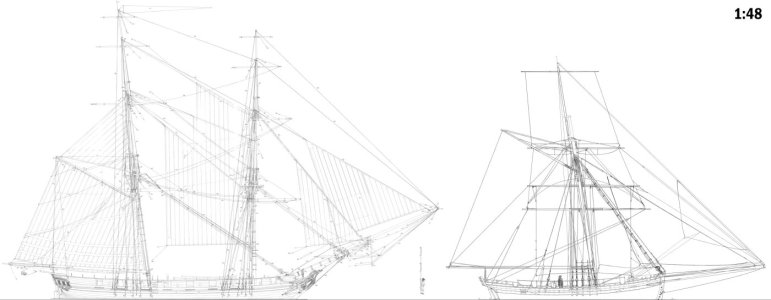
I also like large three-masted ships, but the size... They're difficult to make in a small scale (1:100), as I experienced on the Victory, and in 1:48 they're so huge you wouldn't fit through a door. I wanted to do something in 1:48, and the cutter was the perfect solution. But I always wanted something in between. It had to be small, not huge, but also have a complex design, both in the hull and the rigging. And the brig Le Cygne was the perfect candidate, but!
Two factors have been holding me back all this time... The first is the carronades. I didn't like them until recently, but! I've researched the subject, learned the history, thoroughly studied the mechanics and all the advantages... and I really like them now. The second factor is the Duck... The Swan's figurehead is just a real disappointment. So I started digging through monographs. It turns out that about 60 brigs similar to this one were built by the French, 20 of them were complete copies.
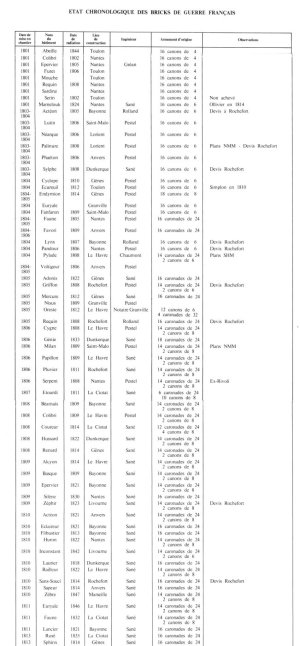
So I decided to find out which of my sister ships could accommodate the figurehead I wanted. It had to be a brig with a female name and carry carronades (some had either fully armed or partially mounted cannons). Working with Artificial Intelligence, we decided that Le Faune 1805 would be such a brig. This brig could carry a female figurehead, a nymph, so I decided to generate in Gemini my vision of the ideal figurehead for this brig. I gave it drawings of the forward section without the figurehead and a photo of a brig model with a different figurehead, so it would take just the model and insert a female figurehead, which I described in words. I described in great detail what she looked like, her pose, where her arms and legs were, where she was looking, and to add a few branches and leaves, because she was a forest nymph... and I was simply shocked by the result!!! Here's what I got:
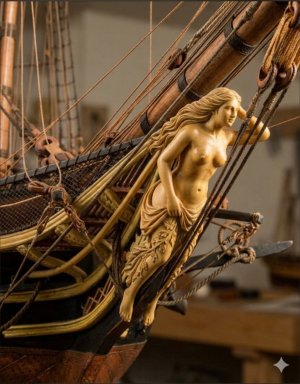
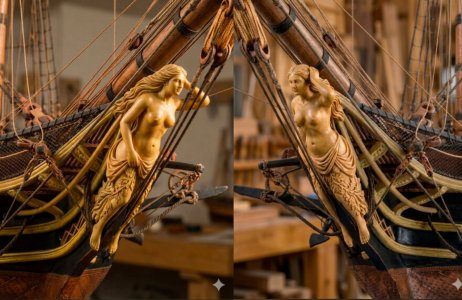
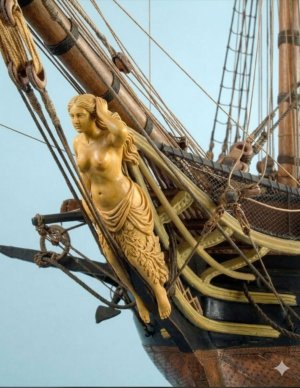
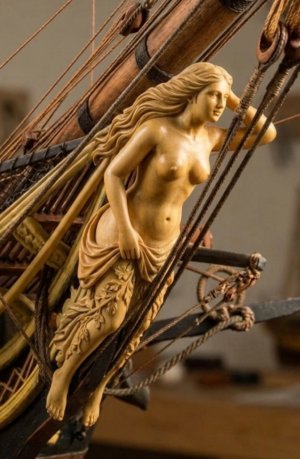
To be honest, I didn't have the slightest faith that it would work, but this was exactly the result I wanted to see... I made absolutely no changes, and I realized that if you describe exactly what you want, Gemini will do wonders.
The idea of replacing the figurehead was indirectly inspired by @Kortes , who is building a similar brig based on these plans, but named Le Favori. Hi Sasha, here's a working diagram for you on how to design a figurehead for your model.
So, if I ever build anything else (if I have the time and opportunity), naturally after finishing my current projects, it will be the Le Faune 1805 brig (based on Le Cygne's monograph) with a figurehead like this...
...if I only knew how to make it))) but that's another story.
Many will understand that at a certain point, you start wondering what you'd like to build next (and many get so carried away that they don't even finish their current projects). Naturally, I won't start a new one until I finish my current project, but I still can't resist dreaming.
I've had a monograph on the brig Le Cygne 1806 for many years. I really like this ship and have wanted to build one for a long time, even before Victory and Alert. Here, by the way, is a visual representation of the difference in size between a cutter and a brig in 1/48th scale. The size difference isn't that big, but the brig is much larger.
I also like large three-masted ships, but the size... They're difficult to make in a small scale (1:100), as I experienced on the Victory, and in 1:48 they're so huge you wouldn't fit through a door. I wanted to do something in 1:48, and the cutter was the perfect solution. But I always wanted something in between. It had to be small, not huge, but also have a complex design, both in the hull and the rigging. And the brig Le Cygne was the perfect candidate, but!
Two factors have been holding me back all this time... The first is the carronades. I didn't like them until recently, but! I've researched the subject, learned the history, thoroughly studied the mechanics and all the advantages... and I really like them now. The second factor is the Duck... The Swan's figurehead is just a real disappointment. So I started digging through monographs. It turns out that about 60 brigs similar to this one were built by the French, 20 of them were complete copies.
So I decided to find out which of my sister ships could accommodate the figurehead I wanted. It had to be a brig with a female name and carry carronades (some had either fully armed or partially mounted cannons). Working with Artificial Intelligence, we decided that Le Faune 1805 would be such a brig. This brig could carry a female figurehead, a nymph, so I decided to generate in Gemini my vision of the ideal figurehead for this brig. I gave it drawings of the forward section without the figurehead and a photo of a brig model with a different figurehead, so it would take just the model and insert a female figurehead, which I described in words. I described in great detail what she looked like, her pose, where her arms and legs were, where she was looking, and to add a few branches and leaves, because she was a forest nymph... and I was simply shocked by the result!!! Here's what I got:
To be honest, I didn't have the slightest faith that it would work, but this was exactly the result I wanted to see... I made absolutely no changes, and I realized that if you describe exactly what you want, Gemini will do wonders.
The idea of replacing the figurehead was indirectly inspired by @Kortes , who is building a similar brig based on these plans, but named Le Favori. Hi Sasha, here's a working diagram for you on how to design a figurehead for your model.
So, if I ever build anything else (if I have the time and opportunity), naturally after finishing my current projects, it will be the Le Faune 1805 brig (based on Le Cygne's monograph) with a figurehead like this...
...if I only knew how to make it))) but that's another story.