




Metalworking. Galvanizing.
Rudder Hinges.
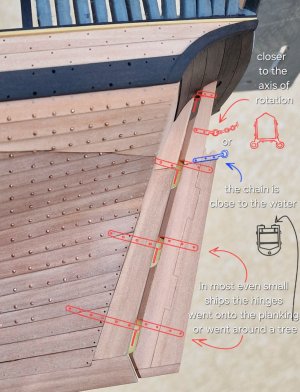
As I mentioned earlier, I'll be making extended loops that extend onto the boards to strengthen the connection. The top loop will also wrap around the handlebars, and there will be another piece to hold the chain in place for an emergency turn if the main steering mechanism is damaged (the red version, not the blue one).
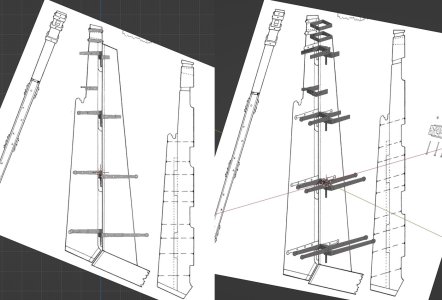
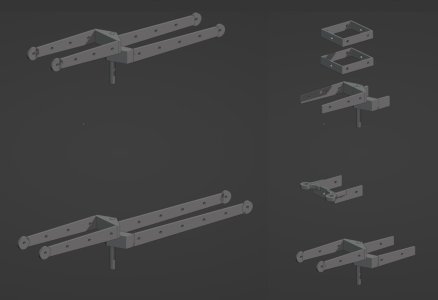
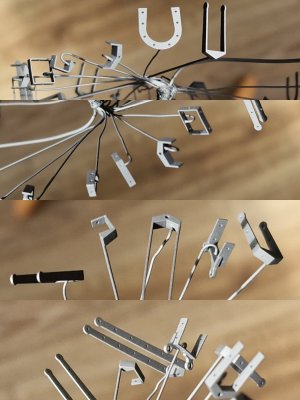
I've previously shown that I modeled these hinges in Blender 3D and 3D printed them. This is in the relevant section.
After printing, I lightly sanded them with 400-grit sandpaper and matched them to the wood. The final fit will be after copper plating.
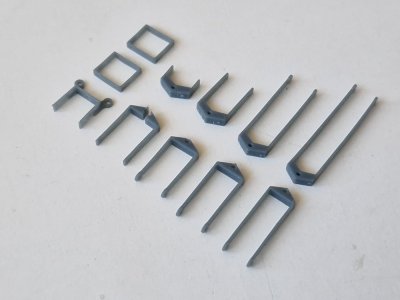
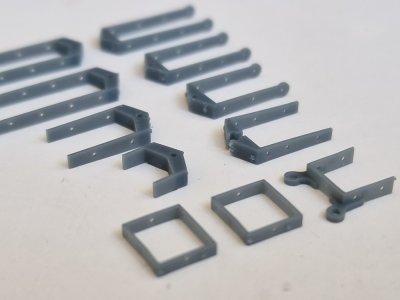
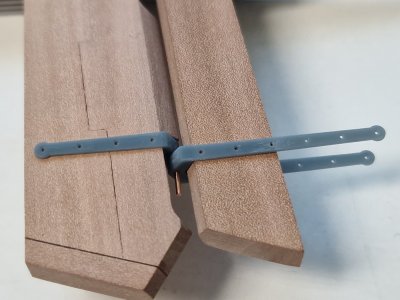
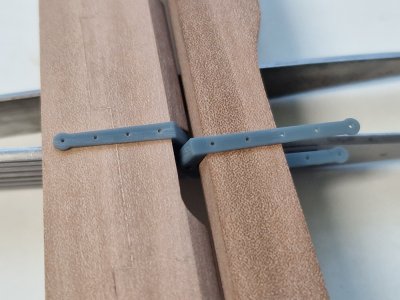
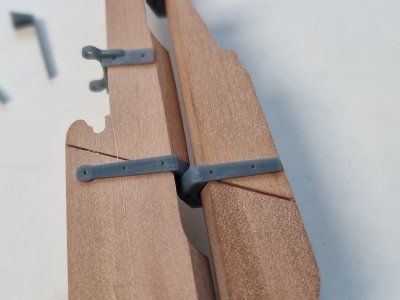
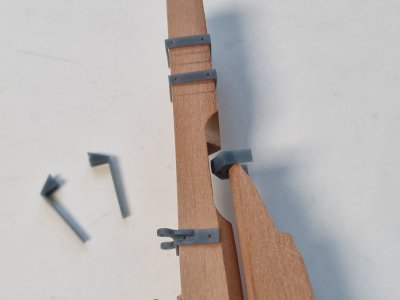
The holes are more like marker holes, as after copper plating, they'll need to be drilled to the correct size for the bolts.
The top hinge will be disassembled, as it's curved and impossible to install without separating. However, the seam will be inside, deep and invisible.
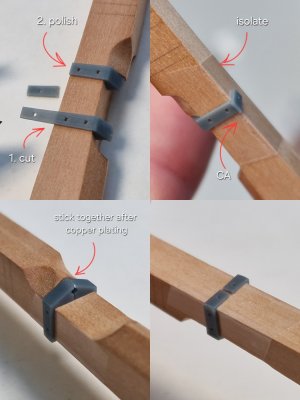
When everything was ready, I glued the leg holders to the parts. (I mostly use 0.5 mm brass wire, since I have a lot of it. But in the places where the axis will be on the hinge, I use 0.6 mm copper!!! And this holder will serve as the axis. In the rest of the places, I glued the holders inside the surfaces.)
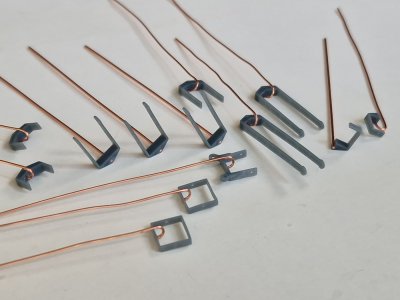
Then I connected all the holders into the wood and covered it all with Graphite Varnish.
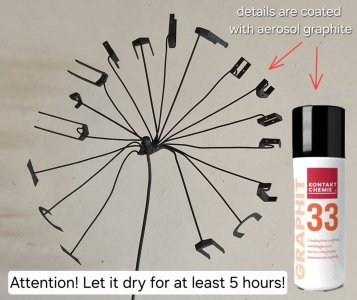
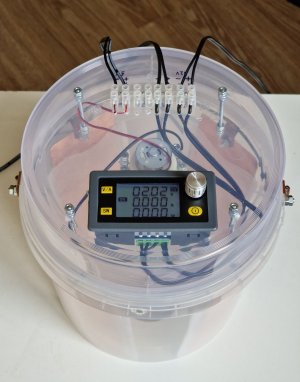
The next day I put the first batch into a special copper plating machine for galvanization (I talk about this in detail here).
Looking ahead, I want to clarify that I conducted a lot of testing and experimentation to achieve the best result. This batch was quite good, but there were a couple of defects, and I fixed them when I made the second batch with two more sets of hinges. So, in fact, I now have three sets for my two hulls and one custom-made for a friend. I compared my hinges with the ones in the kit and realized that the latter wouldn't fit on the model and would have to remake the rudder and sternpost for the first hull (although I thought I'd use them like the hinges from the kit, but changed my mind).
I'll describe all the details of the galvanic process and all the parameters in the dedicated thread, but here I'll show the results of the first batch.
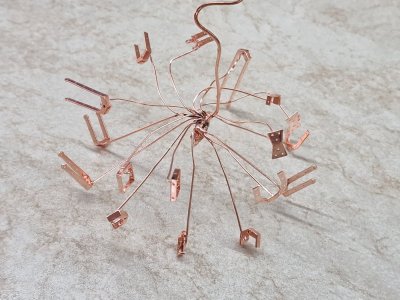
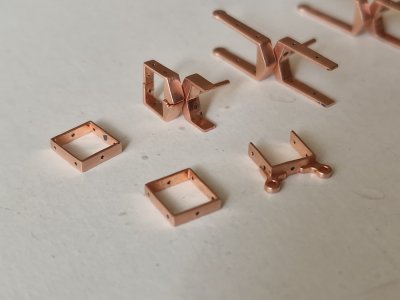
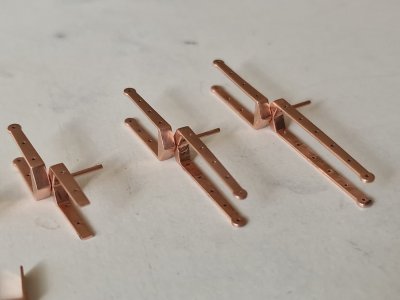
The copper layer on the plastic is over 60 microns thick, up to 100, so it's more than enough to sand and polish the copper (I'll detail the failures in the Galvanic section). Two parts were damaged, but I've already repaired them (more on that later).
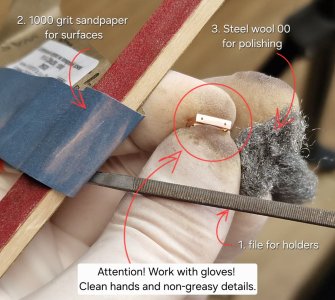
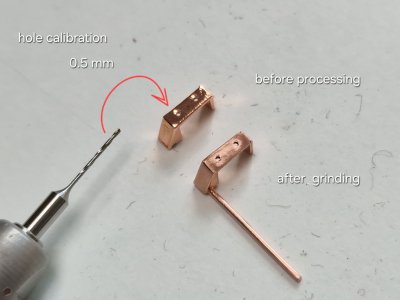
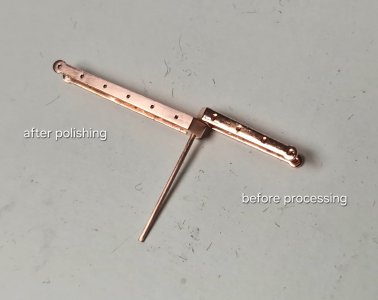
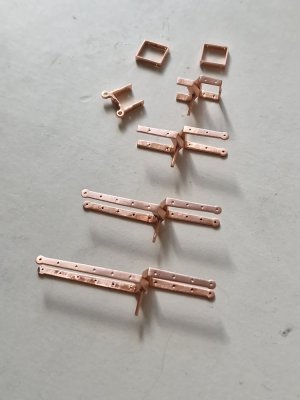
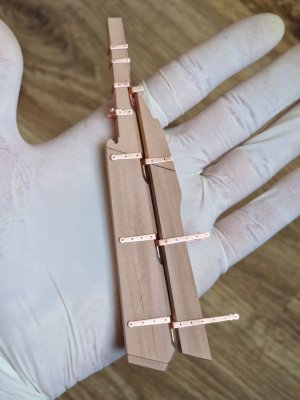
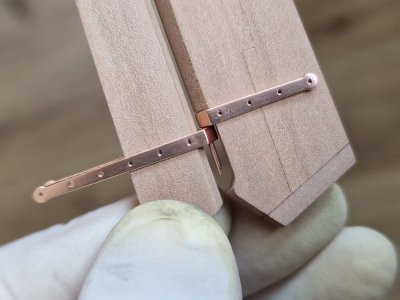
First, I cut the holder with wire cutters, then sanded it with a file, then went over the surface with 600-1000-grit sandpaper to smooth it out. Then I drilled the holes for the bolts and finally polished it (not too hard, just superficially) with 00 or 000-grit steel wool. Just to remove the sandpaper scratches. Don't polish too much (especially with 0000+ steel wool), as the blackening will adhere less well. I was quite happy with the result, but I felt I could do better and made two more sets. More on that later. For now, here's the result of my first attempt:
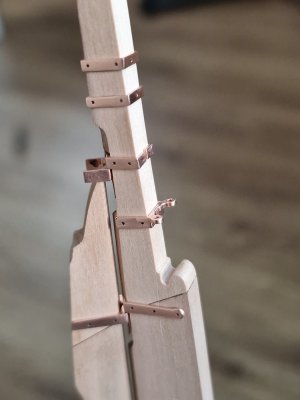
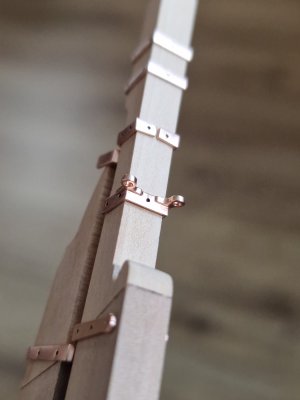
Tomorrow I'll try to post something on the Electroplating Tests thread, detailing what I did the first time and the second time... and it looks like I'm finally close to the ideal electroplating method... but I'm not sure... I'm still in the process.
Rudder Hinges.
As I mentioned earlier, I'll be making extended loops that extend onto the boards to strengthen the connection. The top loop will also wrap around the handlebars, and there will be another piece to hold the chain in place for an emergency turn if the main steering mechanism is damaged (the red version, not the blue one).
I've previously shown that I modeled these hinges in Blender 3D and 3D printed them. This is in the relevant section.
After printing, I lightly sanded them with 400-grit sandpaper and matched them to the wood. The final fit will be after copper plating.
The holes are more like marker holes, as after copper plating, they'll need to be drilled to the correct size for the bolts.
The top hinge will be disassembled, as it's curved and impossible to install without separating. However, the seam will be inside, deep and invisible.
When everything was ready, I glued the leg holders to the parts. (I mostly use 0.5 mm brass wire, since I have a lot of it. But in the places where the axis will be on the hinge, I use 0.6 mm copper!!! And this holder will serve as the axis. In the rest of the places, I glued the holders inside the surfaces.)
Then I connected all the holders into the wood and covered it all with Graphite Varnish.
The next day I put the first batch into a special copper plating machine for galvanization (I talk about this in detail here).
Looking ahead, I want to clarify that I conducted a lot of testing and experimentation to achieve the best result. This batch was quite good, but there were a couple of defects, and I fixed them when I made the second batch with two more sets of hinges. So, in fact, I now have three sets for my two hulls and one custom-made for a friend. I compared my hinges with the ones in the kit and realized that the latter wouldn't fit on the model and would have to remake the rudder and sternpost for the first hull (although I thought I'd use them like the hinges from the kit, but changed my mind).
I'll describe all the details of the galvanic process and all the parameters in the dedicated thread, but here I'll show the results of the first batch.
The copper layer on the plastic is over 60 microns thick, up to 100, so it's more than enough to sand and polish the copper (I'll detail the failures in the Galvanic section). Two parts were damaged, but I've already repaired them (more on that later).
First, I cut the holder with wire cutters, then sanded it with a file, then went over the surface with 600-1000-grit sandpaper to smooth it out. Then I drilled the holes for the bolts and finally polished it (not too hard, just superficially) with 00 or 000-grit steel wool. Just to remove the sandpaper scratches. Don't polish too much (especially with 0000+ steel wool), as the blackening will adhere less well. I was quite happy with the result, but I felt I could do better and made two more sets. More on that later. For now, here's the result of my first attempt:
Tomorrow I'll try to post something on the Electroplating Tests thread, detailing what I did the first time and the second time... and it looks like I'm finally close to the ideal electroplating method... but I'm not sure... I'm still in the process.
Last edited: