
• SUBSCRIBE TO SHIPS IN SCALE TODAY!

    The beloved Ships in Scale Magazine is back and charting a new course for 2026!
    Discover new skills, new techniques, and new inspirations in every issue.

    NOTE THAT OUR NEXT ISSUE WILL BE July/August 2026
  • Win a Free Custom Engraved Brass Coin!!!
    As a way to introduce our brass coins to the community, we will raffle off a free coin during the month of August. Follow link ABOVE for instructions for entering.

HMS ONTARIO - A MARISSTELLA WOODEN SHIP KIT

Thank you for your question. In the historical construction of the actual ship, planks were typically secured using treenails (wooden pegs). However, please note that this model kit does not include or require treenails for assembly. The included instructions will guide you on the appropriate assembly method for the model.

Let us know if you have any other questions.
Good morning,
Thanks for your reply.

Question 2 is answered:
Treenails and not iron nails, which matchs my expectations, since nails would rust away compromising integrity.

As for question 1:
Instructions mention scarphed joints in the spirketing planks and wale planks (main wale and top wale);
My question is if that applies also to other external hull planks (e.g.: the thin stuff, or the turn of the bilge planks, garboard, and broad strake)

Thanks for your help.

Best regards
Catela
 
Last edited:
Answer:


Thank you for your detailed question.


Regarding your query about the application of scarphed joints: according to the kit's specifications, scarphed joints are used only in the spirketing planks, the main wale, and the top wale.


For all other exterior hull planking—including the thin stuff, turn of the bilge planks, garboard strakes, and broad strakes—the joints are straight, butt‑to‑butt connections and do not feature scarfing.


Let us know if you need further clarification or help during assembly.
 
Answer:


Thank you for your detailed question.


Regarding your query about the application of scarphed joints: according to the kit's specifications, scarphed joints are used only in the spirketing planks, the main wale, and the top wale.


For all other exterior hull planking—including the thin stuff, turn of the bilge planks, garboard strakes, and broad strakes—the joints are straight, butt‑to‑butt connections and do not feature scarfing.


Let us know if you need further clarification or help during assembly.
Thank you very much!
Now it's clear, and also less difficult to build!;)
Catela
 
Hi there,
I've been busy with my hull planking.
It's coming along, but not without some self complaints.
The flow of the planks is not as good as I would have liked it to be, as can be seen in the last picture of this post.

The main wales (which will get a second planking layer) are installed. These strakes were not tapered.
20260408_222342.jpg20260408_222520.jpg


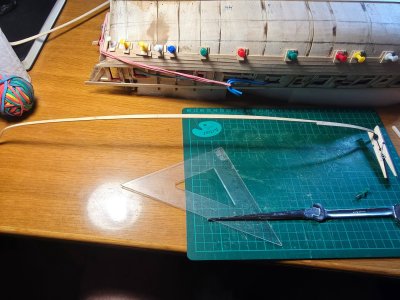
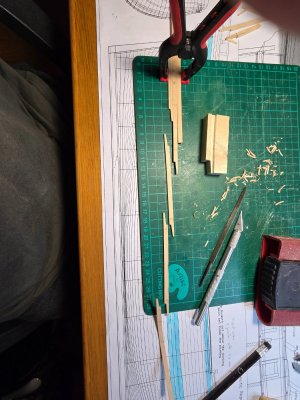
The other planks wer tapered. I do it two by two, by sanding them down to desired width.

20260509_171225.jpg

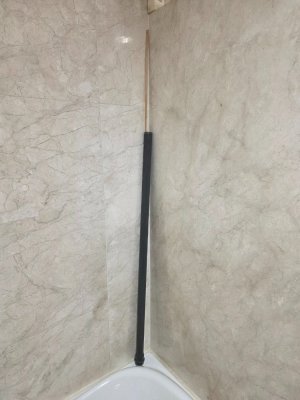
To bend the strakes to the hull shape, I soak them in water (I use a PVC pipe filled with water for this purpose) and leave them to dry attached to the model.
20260509_173312.jpg20260509_165054.jpg20260505_215503.jpg

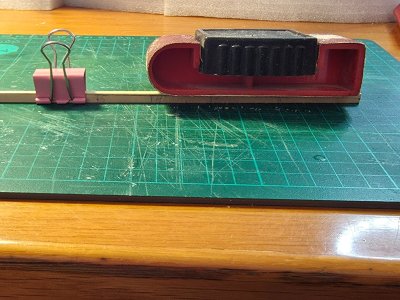
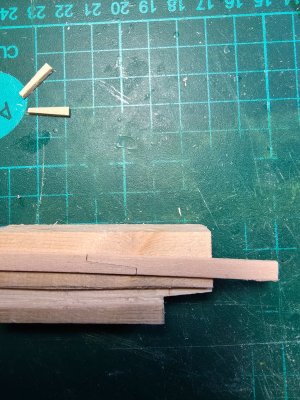
According to Marisstella, some plank strakes should have scarffed joints, instead of butt joints.
My maine issue with these joints is how to guarantee uniform dimensions and look for all joints.
So, I made a small jig to facilitate the cut of the joint.
The jig, and the resulting scarffed strake before being glued one plank to another and the set being glued to the hull.

20260420_232722.jpg20260424_230957.jpg

Planking as of today:

20260513_192308.jpg
Best regards,
Catela
 
Last edited:
Hi there,
I've been busy with my hull planking.
It's coming along, but not without some self complaints.
The flow of the planks is not as good as I would have liked it to be, as can be seen in the last picture of this post.

The main wales (which will get a second planking layer) are installed. These strakes were not tapered.
View attachment 602773View attachment 602774


The other planks wer tapered. I do it two by two, by sanding them down to desired width.

View attachment 602777

To bend the strakes to the hull shape, I soak them in water (I use a PVC pipe filled with water for this purpose) and leave them to dry attached to the model.
View attachment 602778View attachment 602776View attachment 602775

According to Marisstella, some plank strakes should have scarffed joints, instead of butt joints.
My maine issue with these joints is how to guarantee uniform dimensions and look for all joints.
So, I made a small jig to facilitate the cut of the joint.
The jig, and the resulting scarffed strake before being glued one plank to another and the set being glued to the hull.

View attachment 602779View attachment 602780

Planking as of today:

View attachment 602781
Best regards,
Catela
Good morning Catela. I like the scarf joint- nice. Planking looking good so far. Cheers Grant
 
Hi,
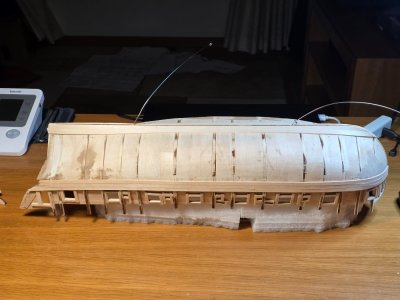
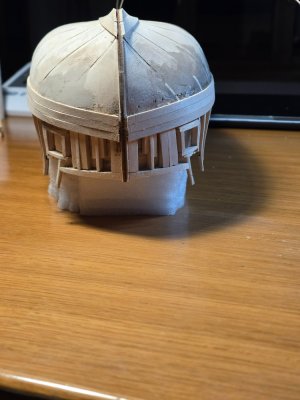
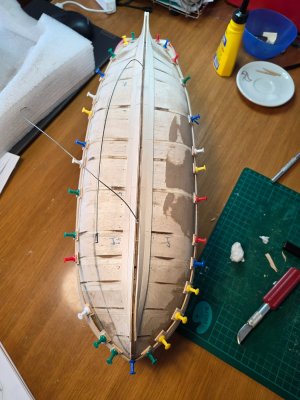
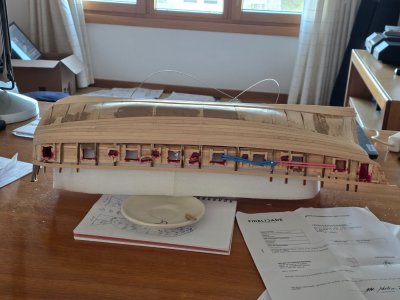
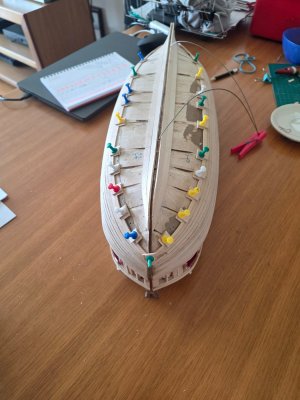
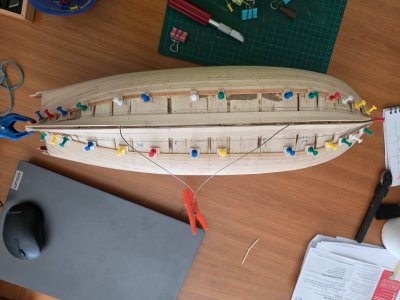
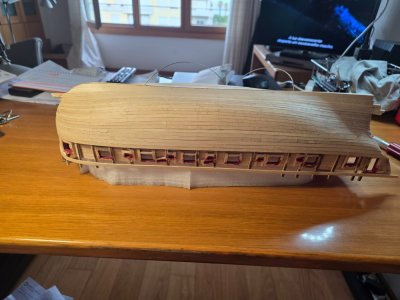
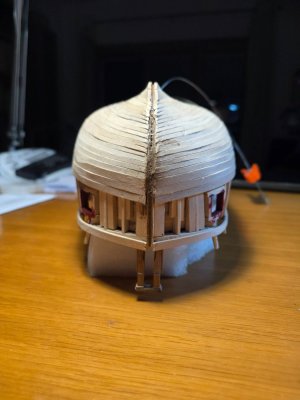
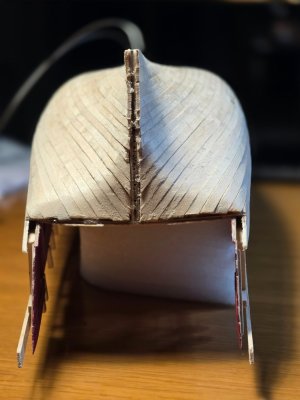
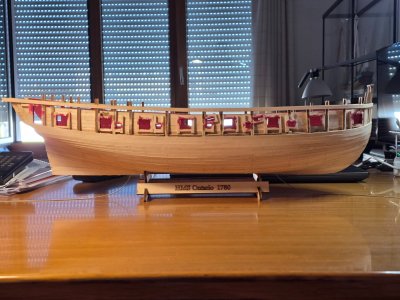
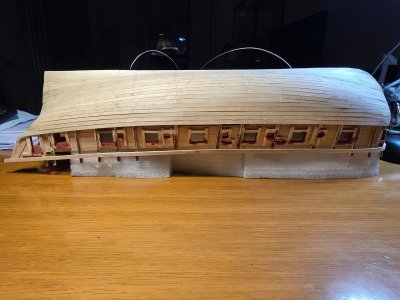
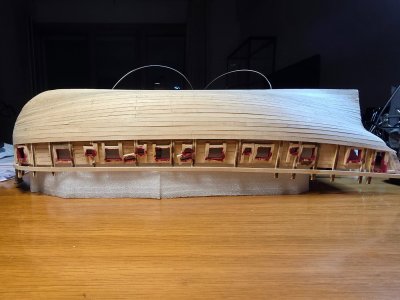
In the month and a half since my last post I've been planking the hull below the main wales of my Ontario.
No sanding was was done yet, so everything seems a rough at this point.
Some of the pictures also have shadows that exacerbate the uneven look of the planking (stern and bow photos). It is not that bad in reality and I hope it all goes smooth after a proper sanding.
I've decided to sand the hull only after completing the upper side (above the main wales, cannon ports, etc), so it will still take some time until it gets a better look.
I already know, though, that some wood filler will have to be used here and there between planks, which is not good. Fortunately all the model is to be painted (no bare wood). I hope that will cover my mistakes.
20260604_120923.jpg20260613_101112.jpg20260621_195207.jpg20260625_230730.jpg20260625_230747.jpg20260628_180004.jpg
Following Maristtella's instructions, I already installed the upper wale. The one which has scarfed joints.

Measuring the distance between the main wales and this upper wale, I found 7 plank strips will not be enough to cover the hight on the central part of the hull by ~2 mm. 7 plank rows are not enough; 8 plank rows require extensive sanding to reduce plank width.

This is annoying!

Decided to install a very narrow strip just above the main wales to correct this. I believe it will be more or less easy to disguise, as the main wales will get a second layer of planks.
Of course to the stern or to the bow this is not a problem, for the this hight between wales gets lower.

Best regards

Catela

20260625_230652.jpg

20260625_230715.jpg
 
Back
Top