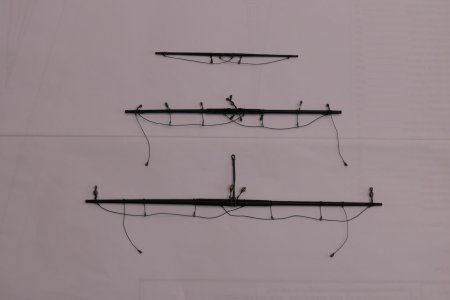
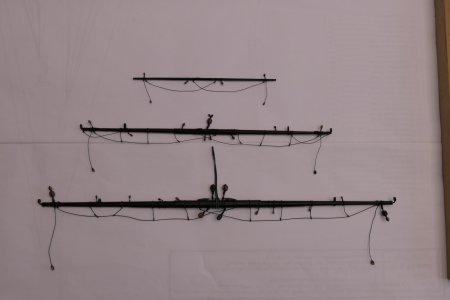
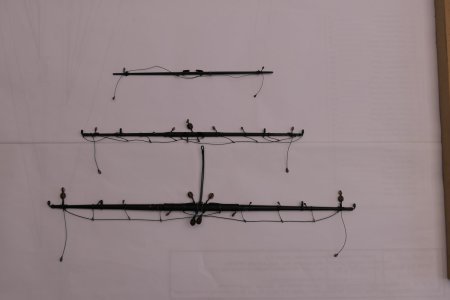
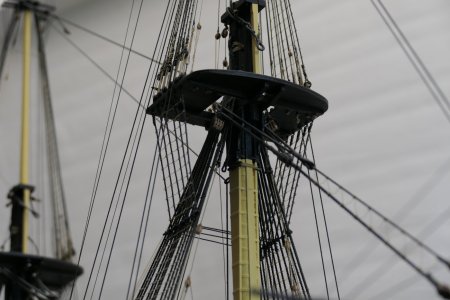
41 The Standing Rigging, the Test
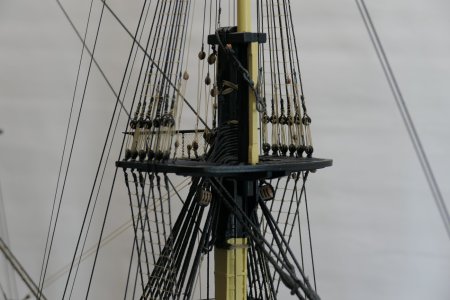
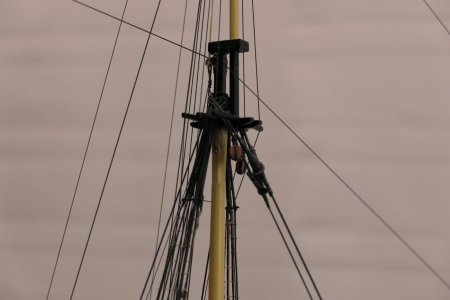
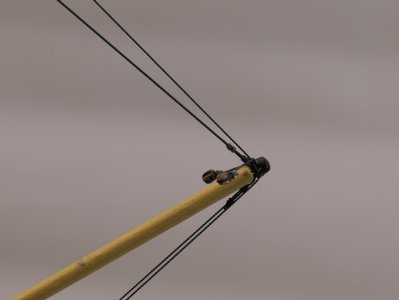
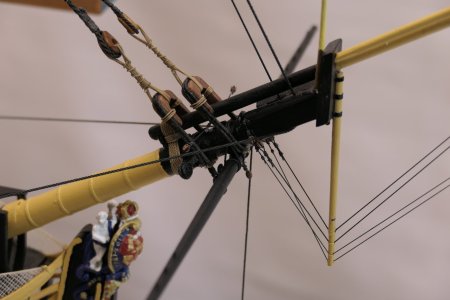
After the gammoning around the bowsprit, it was time for the “standing rigging,” starting with the lower sections of the three masts. The middle and top sections are currently in storage.
Projects 2, 3, and 4 consist of the pendants for the tackles, the shrouds, the ratlines, the futtock staves, the catharpin legs, and the futtock shrouds. I began with the mizzenmast, followed by the mainmast and the foremast. The various ropes were also installed in this order.
I had already laid and tarred all the corresponding ropes for each project — a beautiful variety of thicknesses and colors.
To get an idea of the dimensions of the shrouds, I made two cardboard templates, mirrored: one for port and one for starboard.
Using the guard rails I installed on my slipway, I drew a reference line on both templates, perfectly horizontal and at the same height on both sides. This after carefully adjusting the height of the rails.
I then glued graph paper onto both templates, with the horizontal lines matching the real horizontal orientation in the model. These lines later served as the reference for the ratlines, which are spaced 6 mm apart — roughly 45 cm in full scale.
In the model it looks like this:
I then marked the shroud ropes at the centers of the lower deadeyes and the area where the shrouds will wrap around the mast. I also marked the centerline for the upper deadeyes and the location of the futtock staves.
Finally, I drew in the ratlines. With a loose template like this, fitting and measuring is easy and very clear. In the model it appears as shown in the photo below. I fixed the templates at the top with a red thread, which I can remove later.
In the last photo you can clearly see that I already installed the cap on the mast. When hanging the shrouds later, it will become clear whether this is obstructive and whether the loops will become too large. Otherwise, the caps will have to be removed. We shall see.
I explained how I prepared for my first rigging task: the standing rigging on the mizzenmast.
Until Stephan pointed out that I should first make a test piece. And it’s a good thing he did.
To compare with the situation on my actual model later, I first built a small mock-up of the mizzenmast setup, essentially the same configuration but more manageable.
First challenge: making an eye splice, for the pendants where the tackles will later be attached. First, I wrapped a small section of rope and bent it around a brass hook. Then I twisted the two outgoing lines together. See photos:
My first rigging task after the bowsprit is now a fact, but I can tell I still need more practice.
On to the shrouds. The foremost shroud must be completely parcelled. The upper sections of the other shrouds must be wrapped as well. To highlight the differences, I wrapped everything , including the pendant, with red thread. Installed on the model, it looks like this:
For the rope diameters I tried to match the dimensions listed in McKay’s table as closely as possible. For the seizings that gather the shrouds near the mast top, I used rope that turned out to be too thick. They are bulky and interfere with each other.
Then I installed the ratlines using thin beige thread. This was manageable thanks to the graph paper in the background providing alignment. Lastly, I added the futtock stave. The result so far:
When I removed the graph paper to get an impression of the final look, I was somewhat shocked, especially after placing black paper in the background.
The actual appearance of the ratlines had not fully registered with me before that moment, and it wasn’t pretty.
Tying ratlines is not difficult in itself, but achieving a consistent look, with ratlines that sag slightly instead of being too tight, is a whole different story.
Short summary of the materials used for the mizzenmast test
• Burton pendants: z-laid 3×3, 0.55 mm
• Shrouds: s-laid 3×9, 0.90 mm. I used s-lay rope to visually match the other, thicker shrouds made from s-laid cables.
• Futtock stave: brass rod 0.7 mm wrapped with thread
• Ratlines: z-laid 3×1 beige, 0.2 mm
• All ropes except the wrapping thread were hand-laid.
There is still a lot to improve before I can be truly satisfied. So I will make another test piece on this mock-up, incorporating the following lessons learned:
Points for improvement
• I tend to tie knots and seizings too tightly. This makes corrections nearly impossible, so I must work looser.
• I pulled the seizings on the shrouds as high as possible. This isn’t necessary. They can sit lower, creating a better distribution.
• The eye splice of the pendant is too bulky. Maybe a larger hole or another method. To be tested.
• Graph paper as a background for ratlines is unsuitable, too little contrast. Black paper is much better.
• Much more focus on tying the ratlines: far more precise, and especially avoid tightening intermediate knots too much so they can be adjusted.
• Fix each ratline knot immediately with a tiny drop of CA glue.
• I still don’t know which knot or seizing should attach the futtock stave to the shrouds.
Second test piece
Over the past week and a half, I created a new test based on the lessons learned.
I rebuilt the same mock-up, including the woodwork, so that I could compare before and after side by side.
The situation around the mast top has clearly improved, although I’m still not entirely satisfied with the seizings.
For this test I again used different colored threads for the wrapping and seizings. This makes every flaw stand out, with black, it will be far less noticeable.
After installing the shrouds, I could begin tying the ratlines. Using pencil marks on the black background made the alignment much easier and much calmer to work with.
When you remove the black background, you get a view much closer to how it will appear on the model. Since the ratlines are only 0.2 mm thick, they are barely visible like this.
To compare results properly, I again placed a black sheet behind them for visibility:
All in all, I am satisfied with the progress, let’s call it a successful test.
The next step is to apply all these lessons to the actual model.