
-

"2026 Annual SOS Donation Drive Underway"
Please consider making a Donation to SOS to support our continuing growth and developement. It is greatly appreciated !!!
*** Read More - - Click Here ***
https://www.paypal.me/DonateSOS

-

SUBSCRIBE TO SHIPS IN SCALE TODAY!
The beloved Ships in Scale Magazine is back and charting a new course for 2026!
Discover new skills, new techniques, and new inspirations in every issue.
NOTE THAT OUR NEXT ISSUE WILL BE MARCH/APRIL 2026 -

Win a Free Custom Engraved Brass Coin!!!
As a way to introduce our brass coins to the community, we will raffle off a free coin during the month of August. Follow link ABOVE for instructions for entering.
You are using an out of date browser. It may not display this or other websites correctly.
You should upgrade or use an alternative browser.
You should upgrade or use an alternative browser.
La Belle 1680 - 1/36 - ANCRE monograf - POB prototype by kuba91nt





- Joined
- Jun 29, 2024
- Messages
- 1,802
- Points
- 488

Waldemar, Thanks for the drawings of the Atlantic Merchant Barks that you posted above. I could believe that Le Griffon might have been similar to one of these vessels.
I enjoy reading archeology reports but sometimes it seems like what they really understand are Mast Steps. All else is inferred.
Roger
I enjoy reading archeology reports but sometimes it seems like what they really understand are Mast Steps. All else is inferred.
Roger

Witaj. Biorę przykład od Ciebie Mirku, cały okręt będzie w jednym odcieniu szelaku lub szelaku orange.Witaj
Piękne dekory ,powodzenia. Pozdrawiam Mirek
Zastosowałeś świetne rozwiazanie z podkałdem akrylowym. Dziękuję!
I'm taking your example, Mirek. The entire ship will be one shade of shellac or shellac orange.
You used a great solution with the acrylic primer. Thank you!
It's difficult to determine reality of a unit based on a few writings or boards. Each report is different, it's important to take goal and try to obtain the best information possible. There's a wealth of information about La Belle, but much of it is incorrect despite vast archaeological evidence.Waldemar, Thanks for the drawings of the Atlantic Merchant Barks that you posted above. I could believe that Le Griffon might have been similar to one of these vessels.
I enjoy reading archeology reports but sometimes it seems like what they really understand are Mast Steps. All else is inferred.
Roger
I have several research papers on this ship, and i'll learn something from each one as i build it. I think it's worth it, because she is majestic.
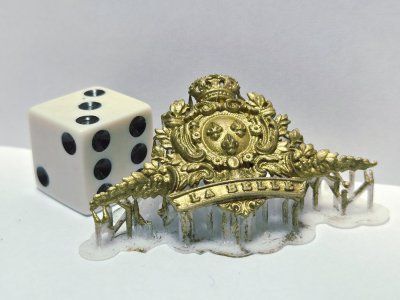
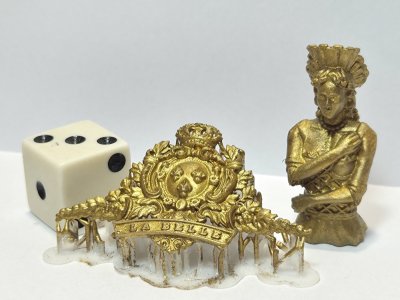
Figure is 38mm tall in 1/36 scale. It will be sized once i add a bowsprit. I'm trying to dissolve shellac to the correct color, both on wood and decorative elements.Nice prints. Are you going to show shellac ones too? Could you tell how long it took to print them and the height of figurehead
I'll show the whole thing as i build it. Printing time, depending on the number of supports or base, is from 1:40 to 2 hours.
These are only technical, test prints.

Waldemar, I won’t pretend that I fully understand all that you describe in your numerous reconstructions, but I am always learning, and I would like to express how much I appreciate what you bring to this forum.
Kuba, I am very interested to see what you do with La Belle - a vessel that I also consider a strong candidate for transitioning my skills from plastic to wood. I know what it’s like to have your enthusiasm for a project wax and wane, but I sincerely hope you will continue.
Kuba, I am very interested to see what you do with La Belle - a vessel that I also consider a strong candidate for transitioning my skills from plastic to wood. I know what it’s like to have your enthusiasm for a project wax and wane, but I sincerely hope you will continue.

.
Waldemar, I won’t pretend that I fully understand all that you describe in your numerous reconstructions, but I am always learning, and I would like to express how much I appreciate what you bring to this forum.
Thanks, Marc
 . I realize that all these conceptual issues can be quite burdensome for many, which is why I have been trying to be as concise as possible lately, and not to overload the presentations with too many details.
Kuba, I am very interested to see what you do with La Belle - a vessel that I also consider a strong candidate for transitioning my skills from plastic to wood. I know what it’s like to have your enthusiasm for a project wax and wane, but I sincerely hope you will continue.
I'm very curious to see what your next choice will be.
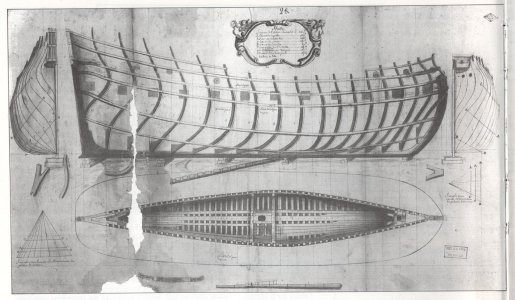
Are you really going to switch to wood? In that case, the focus of the model's difficulty will inevitably shift or expand into completely different areas. To balance this out somehow, perhaps something much simpler in terms of decoration than your amazing floating palace, for example, a modest tender serving it, such as the French fluit from that period shown below? However, this is only a basic plan without many details, and it still requires interpretation of what is already on it. Therefore, it would probably be more rational to use a complete monograph so as not to run into any unwanted trouble. Just saying... And I also hope that Kuba will not lose his enthusiasm for this historically and archaeologically important ship.
I could believe that Le Griffon might have been similar to one of these vessels.
Roger, as for French barques from the very period you are interested in, they are really very well, comprehensively covered by Jean Boudriot in his Le Navire Marchand. Ancien Régime. Etude historique et Monographie. As it turns out, this is a very broad category covering quite diverse ships in terms of size, from the smallest single-masted specimens to the large ship-rigged vessels. And, as it happens, this monograph has recently been translated into English.
Draught of a French fluit from the last decades of the 17th cent., companion proposal for Marc's Soleil Royal
:
.
Thank you. This project is being created because i believe it's worth doing something on my own. Even if it's a POB, with a little effort and more time, you can create a model significantly better than the kit at a lower cost.Waldemar, I won’t pretend that I fully understand all that you describe in your numerous reconstructions, but I am always learning, and I would like to express how much I appreciate what you bring to this forum.
Kuba, I am very interested to see what you do with La Belle - a vessel that I also consider a strong candidate for transitioning my skills from plastic to wood. I know what it’s like to have your enthusiasm for a project wax and wane, but I sincerely hope you will continue.
Kits are boring to me now, there's no model that excites me, and when a new one does come out, it's simply historically flawed and uncorrect, so i know, i can do it better, and i don't care what they give me, i only care now what i want to build.
Regards.
Thank you, Waldemar. And, yes, I absolutely will transition to wood. I have always been inspired by this particularly brilliant execution of La Belle by Olivier Gatine:
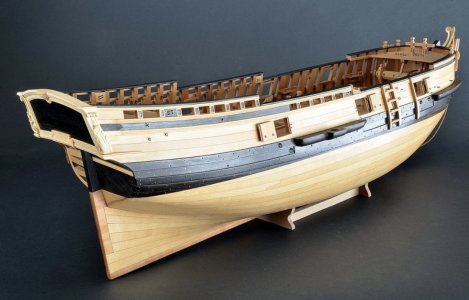
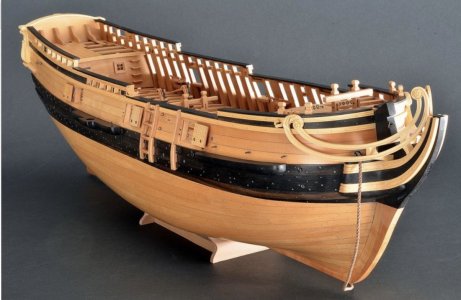
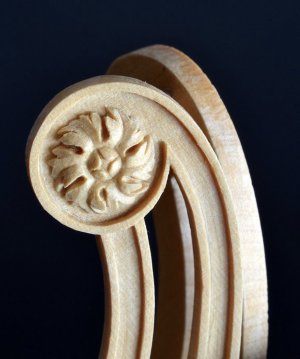
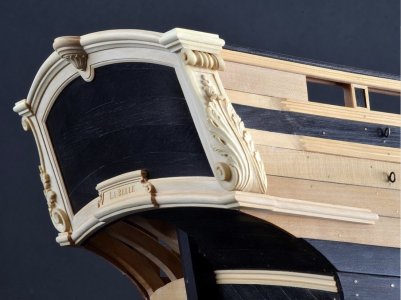
In my opinion, this is the pinnacle of the miniaturist ship carver’s art. The lines of this little ship are also very pleasing.
In my opinion, this is the pinnacle of the miniaturist ship carver’s art. The lines of this little ship are also very pleasing.
.
In my opinion, this is the pinnacle of the miniaturist ship carver’s art. The lines of this little ship are also very pleasing.
Well, yes, I absolutely agree with you about the appeal of this particular model, since it just so happens that this very style perfectly matches my personal preferences too. Sterile workmanship in the best sense of the term, including the decorations. An ideal model, one may say.
As for the hull lines themselves, Lemineur has indeed achieved a result quite similar to the original, so there is really no need to split a hair, but now I know that it could also have been done in a completely correct manner.
.
Agree. Ship is small, and it seems like a simple plan. In reality, however, it will require considerable commitment to build.Thank you, Waldemar. And, yes, I absolutely will transition to wood. I have always been inspired by this particularly brilliant execution of La Belle by Olivier Gatine:
View attachment 576654
View attachment 576655
View attachment 576657
View attachment 576656
In my opinion, this is the pinnacle of the miniaturist ship carver’s art. The lines of this little ship are also very pleasing.
For my first ship of scratch, plan type, it's quite a challenge.
I doubt i'll match shipbuilding skill of the most accomplished ships. I'll try to do it as a hobby, but with considerable dedication.
After a few considerations and adjustments, it will be possible.
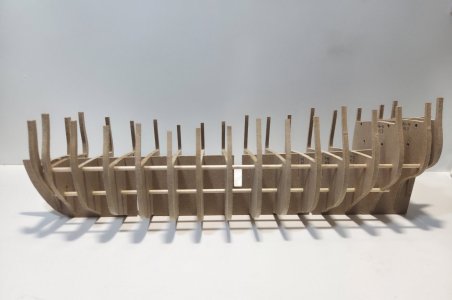
I'm currently waiting for the featherboard to arrive so i can start preparing wood for keel, bow. My fingers are too close to the saw, so I don't want to risk health.
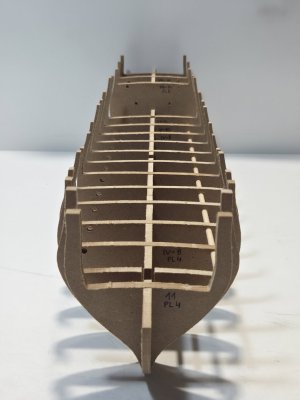

- Joined
- Jul 12, 2021
- Messages
- 147
- Points
- 143

All of the publications dealing with La Belle present difficulties of various kinds, so I feel sympathy for anyone trying to make a model. I reviewed some of the text of the archaeological publication in advance, and published a review of the finished text. One of my chief criticisms of the archaeological report, before even considering the analysis of the design method, is that it does not fulfill one of the fundamental requirements of an archaeological report, in that there is no comprehensive and consistent description of the hull remains themselves, so that we could have some idea of what questions could be answered. It makes it difficult to know what data survives, which affects not only the analysis of the design, but other equally important questions.
The editors also chose to include two separate chapters on the construction of the hull by different authors, who each chose to focus on the design question to the exclusion of virtually all other aspects, and came to wildly differing conclusions. Rather than choose between these two or attempt to reconcile them, the editors chose to publish both without commentary. The reader is left with the uncomfortable problem of trying to decide which conclusion, if any, to trust, without the necessary descriptive data to evaluate either case. As Waldemar notes, there is no proper lines drawing, or even an accurate representation of the surviving hull as found, since neither author fulfilled the brief, instead they decided to get into an argument with each other and the editors chose not to intervene. One of the authors (Pevny) had been deeply involved in the documentation of the hull remains, and is a careful observer, so had a good grasp of the shapes of the timbers, the assembly markings and touchmarks still visible on them, and the fastening pattern, which are all key details for understanding the construction process, even if the data themselves are not always present in the report. Waldemar may disagree with his conclusions, but it should be noted that he places the design process in the same context as Waldemar proposes; he is not a complete idiot. I think it could be productive for Waldemar and Pevny to have an informed discussion about this hull, where both can work from the full dataset. The timbers were recorded with sufficient accuracy to allow a comprehensive investigation of the design method, at least for the middle of the hull.
The other author went astray with a faulty interpretation of the dendrochronological evidence, which led her to believe that the ship was built from reused timbers from older ships going back over a century to the late 1500s. She had to construct an entirely fabricated historical narrative and identity for the ship in order to make this work, which invalidated virtually all of her conclusions.
As a final note, I would like to stand up for my colleagues a little bit. I read in these fora fairly often dismissive and contemptuous criticisms of archaeological ship reports and ship archaeologists by people who are very knowledgeable about ship architecture and the details of scientific/mathematical ship design processes. I would ask you to remember a few things the next time you are about to press the snark key:
1. Maritime archaeology is concerned with a very wide range of research questions, of which the history of ship design is just one. It may be your passion and area of highly comprehensive and detailed knowledge, so I can understand your frustration with reports that do not contain the specific information you want or seem uninformed, but maritime archaeologists have to cover a wide range of knowledge and few have the time or background to dive as deeply into the arcana of whole moulding. The ship is part of a larger context, including the cargo, armament, the crew and their possessions, etc. In the grand scheme of archaeological research and the limited resources that support it, there may be other questions that need more attention.
2. Archaeological hull remains show the hull as actually built, repaired, modified and worn out. This means that the theoretical design, however mathematically perfect it may have been, is only imperfectly represented in the remains. I can tell you from the process of building wooden ships (as a professional shipwright) that no matter how carefully the frame timbers are laid out, some amount of fairing of the frame surfaces is necessary to allow the planking to fit; this process can sometimes remove a surprising amount of timber, especially towards the ends of the hull, and especially if the hull was allowed to stand in frame for a year to season before being faired and planked. This is before timbers distort as the ship ages, are replaced in repairs, and lose original surface due to abrasion in use and erosions under water. So what we find in the ground needs some sensitivity to its post-design history to recover the original design thinking. Vasa is a good case in point, as its timbers were rough-shaped according to an original design, then adjusted and repositioned during assembly to widen the hull over 10% beyond its design breadth, which led to odd shapes in places (there is a long thread and discussion of this elsewhere on the forum). So the interpretation of archaeological remains requires more than a deep knowledge of design geometries, it also requires equally deep knowledge of the physical processes that affect ship timbers during construction, the working life, and the post-sinking decay of a vessel.
3. Most of us who work in this field enjoy discussing what can be learned from hull remains, especially with people who have more background in specific areas of knowledge than we might. It is how we learn. Most of us, and certainly the people I trained, are happy to share our data. As readers of this forum should remember, I have been as generous as I can with data about Vasa and other wrecks I have worked on, and my work has benefitted from things discussed in this forum and others. But no one likes to be treated like an idiot. I have an enormous respect for people who have developed their knowledge on their own or through non-academic paths, because that knowledge has often been won the hard way and has a depth of practical experience behind it that makes its real-world relevance significant. I try never to talk down to such people, partly because I started my own career as a shipwright, not an academic. In return, I would like to be treated with equal respect.
Fred
The editors also chose to include two separate chapters on the construction of the hull by different authors, who each chose to focus on the design question to the exclusion of virtually all other aspects, and came to wildly differing conclusions. Rather than choose between these two or attempt to reconcile them, the editors chose to publish both without commentary. The reader is left with the uncomfortable problem of trying to decide which conclusion, if any, to trust, without the necessary descriptive data to evaluate either case. As Waldemar notes, there is no proper lines drawing, or even an accurate representation of the surviving hull as found, since neither author fulfilled the brief, instead they decided to get into an argument with each other and the editors chose not to intervene. One of the authors (Pevny) had been deeply involved in the documentation of the hull remains, and is a careful observer, so had a good grasp of the shapes of the timbers, the assembly markings and touchmarks still visible on them, and the fastening pattern, which are all key details for understanding the construction process, even if the data themselves are not always present in the report. Waldemar may disagree with his conclusions, but it should be noted that he places the design process in the same context as Waldemar proposes; he is not a complete idiot. I think it could be productive for Waldemar and Pevny to have an informed discussion about this hull, where both can work from the full dataset. The timbers were recorded with sufficient accuracy to allow a comprehensive investigation of the design method, at least for the middle of the hull.
The other author went astray with a faulty interpretation of the dendrochronological evidence, which led her to believe that the ship was built from reused timbers from older ships going back over a century to the late 1500s. She had to construct an entirely fabricated historical narrative and identity for the ship in order to make this work, which invalidated virtually all of her conclusions.
As a final note, I would like to stand up for my colleagues a little bit. I read in these fora fairly often dismissive and contemptuous criticisms of archaeological ship reports and ship archaeologists by people who are very knowledgeable about ship architecture and the details of scientific/mathematical ship design processes. I would ask you to remember a few things the next time you are about to press the snark key:
1. Maritime archaeology is concerned with a very wide range of research questions, of which the history of ship design is just one. It may be your passion and area of highly comprehensive and detailed knowledge, so I can understand your frustration with reports that do not contain the specific information you want or seem uninformed, but maritime archaeologists have to cover a wide range of knowledge and few have the time or background to dive as deeply into the arcana of whole moulding. The ship is part of a larger context, including the cargo, armament, the crew and their possessions, etc. In the grand scheme of archaeological research and the limited resources that support it, there may be other questions that need more attention.
2. Archaeological hull remains show the hull as actually built, repaired, modified and worn out. This means that the theoretical design, however mathematically perfect it may have been, is only imperfectly represented in the remains. I can tell you from the process of building wooden ships (as a professional shipwright) that no matter how carefully the frame timbers are laid out, some amount of fairing of the frame surfaces is necessary to allow the planking to fit; this process can sometimes remove a surprising amount of timber, especially towards the ends of the hull, and especially if the hull was allowed to stand in frame for a year to season before being faired and planked. This is before timbers distort as the ship ages, are replaced in repairs, and lose original surface due to abrasion in use and erosions under water. So what we find in the ground needs some sensitivity to its post-design history to recover the original design thinking. Vasa is a good case in point, as its timbers were rough-shaped according to an original design, then adjusted and repositioned during assembly to widen the hull over 10% beyond its design breadth, which led to odd shapes in places (there is a long thread and discussion of this elsewhere on the forum). So the interpretation of archaeological remains requires more than a deep knowledge of design geometries, it also requires equally deep knowledge of the physical processes that affect ship timbers during construction, the working life, and the post-sinking decay of a vessel.
3. Most of us who work in this field enjoy discussing what can be learned from hull remains, especially with people who have more background in specific areas of knowledge than we might. It is how we learn. Most of us, and certainly the people I trained, are happy to share our data. As readers of this forum should remember, I have been as generous as I can with data about Vasa and other wrecks I have worked on, and my work has benefitted from things discussed in this forum and others. But no one likes to be treated like an idiot. I have an enormous respect for people who have developed their knowledge on their own or through non-academic paths, because that knowledge has often been won the hard way and has a depth of practical experience behind it that makes its real-world relevance significant. I try never to talk down to such people, partly because I started my own career as a shipwright, not an academic. In return, I would like to be treated with equal respect.
Fred
.
Many thanks, Fred, for your input. As my response will not be entirely complimentary, then to be on the safe side, I even made copies of my threads beforehand, since at least on another forum, my posts, deemed by the administrators to be somehow inconvenient for people who are more friendly with them, are cynically deleted. Just one-sided censorship, just like in the days of the Inquisition .
1. Maritime archaeology is concerned with a very wide range of research questions, of which the history of ship design is just one. It may be your passion and area of highly comprehensive and detailed knowledge, so I can understand your frustration with reports that do not contain the specific information you want or seem uninformed, but maritime archaeologists have to cover a wide range of knowledge and few have the time or background to dive as deeply into the arcana of whole moulding. The ship is part of a larger context, including the cargo, armament, the crew and their possessions, etc. In the grand scheme of archaeological research and the limited resources that support it, there may be other questions that need more attention.
I'm sorry, but I see this as an attempt to relativize, because it so happens that I also have other activities in my life besides researching old design methods, and in addition, unlike me, these people receive remuneration for their “professional” activity in this field and are additionally rewarded with academic titles, and one usually has to pay to see their work.
2. Archaeological hull remains show the hull as actually built, repaired, modified and worn out. This means that the theoretical design, however mathematically perfect it may have been, is only imperfectly represented in the remains. I can tell you from the process of building wooden ships (as a professional shipwright) that no matter how carefully the frame timbers are laid out, some amount of fairing of the frame surfaces is necessary to allow the planking to fit; this process can sometimes remove a surprising amount of timber, especially towards the ends of the hull, and especially if the hull was allowed to stand in frame for a year to season before being faired and planked. This is before timbers distort as the ship ages, are replaced in repairs, and lose original surface due to abrasion in use and erosions under water. So what we find in the ground needs some sensitivity to its post-design history to recover the original design thinking. Vasa is a good case in point, as its timbers were rough-shaped according to an original design, then adjusted and repositioned during assembly to widen the hull over 10% beyond its design breadth, which led to odd shapes in places (there is a long thread and discussion of this elsewhere on the forum). So the interpretation of archaeological remains requires more than a deep knowledge of design geometries, it also requires equally deep knowledge of the physical processes that affect ship timbers during construction, the working life, and the post-sinking decay of a vessel.
Most of us, and certainly the people I trained, are happy to share our data.
These are exactly the same difficulties that hinder my own investigations, and to the same extent. What is more, in contrast to archaeologists, I do not have access to a lot of detailed archaeological data that people in the field, usually those who are personally involved in a given case, have access to. Refusals to grant access to this data are a reality, but I will not mention any specific examples at this point. You yourself once explained to me that the practice of reserving this data exclusively for archaeologists themselves and denying access to others is justified by the fact that it is an additional, special reward for their hard work in the field. Personally, I am not sure if this is a good practice, because what if they are unable to interpret the data properly on their own or do not have the time to do so, and also for possible publication?
The other author went astray with a faulty interpretation of the dendrochronological evidence, which led her to believe that the ship was built from reused timbers from older ships going back over a century to the late 1500s. She had to construct an entirely fabricated historical narrative and identity for the ship in order to make this work, which invalidated virtually all of her conclusions.
This cannot be a complete explanation, because how can one account for the fact that all these gigantic anachronisms, even by the standards of the knowledge available at the time, along with their fanciful, completely arbitrary “justifications,” found their way into the monograph at all? No one noticed them before publication until now, when I pointed them out, except Taras Pevny, the author of a competing, far less wrong interpretation? Alternatively, the editors must have consciously allowed them to be published for some reason. I do not know the answer as to what exactly happened, but I can see the harmful effects of the content of this publication, and on an overwhelming scale. It must also be said that these gigantic anachronisms are not only the result of a classic attempt to fit facts to a preconceived thesis, as you noted, but also stem from a general, profound misunderstanding of these issues, and even notoriously flawed argumentative logic. Did no one notice this before publication? It seems not, for instead, an uncritical, even enthusiastic review of this monograph was written and published by another archaeologist in a specialist journal, excerpts of which I have already quoted in another thread.
The same gigantic anachronisms, and even more, can also be found in the doctoral thesis of the same author on the same subject. One might think that here, too, the reviewers did not bother to familiarize themselves with the content of this work, or perhaps they did, but for some reason accepted it anyway.
Apart from all this, I would not personally place all the blame on this one author, if only because he was not in fact the real or at least the sole creator of his failed interpretation, since this author refers in this very matter to the opinions of the most renowned archaeologists at the top of the hierarchy in this community ( “Had the author chosen to work alone rather than seek the collaboration of highly respected experts and scholars, it is conceivable that a fundamental error in the analysis of the hull could have been made. However, because these scholars independently confirmed the use of trébuchement, the author's conclusion that this is the method of hull conception is strongly supported,” p. 117 of the monograph).
Waldemar may disagree with his conclusions [i.e. Pevny's], but it should be noted that he places the design process in the same context as Waldemar proposes; he is not a complete idiot.
Pevny's proposal is admittedly not as blatantly misguided as the above, competing interpretation created by a team of “highly respected experts and scholars” and presented in the same archaeological monograph, nevertheless, his inevitably unsuccessful attempts to assign incorrect geometric figures, and only to parts of the contours of some of the frames, together with misguiding explanations of anomalies that do not actually exist, obviously cannot be treated as a correct solution, and it is even more difficult to consider this proposal as recognition of the design method used. What is more, the conceptual essence of what is actually the most important component in this particular (Northern) shipbuilding tradition, i.e., the bottom, was not recognized by the author and, as a result, completely omitted from the explanations ("The deadrise lines/curves are shown dashed in Figure 6.47. Since the drawing procedures for these could not be completely systematized, they are not illustrated in the rest of Figure 6-47," p. 176 of the monograph). Consequently, it is even more impossible to speak of a complete, coherent, and hence correct conceptual interpretation of the whole design.
In these circumstances, I consider the claim that both proposed explanations, i.e. Pevny's and mine, are placed in the same context, to be somewhat misleading. I will protest if I encounter claims in the future that such an inaccurate and incomplete interpretation somehow explains the very essence of this particular design method.
[...] he is not a complete idiot.
I am not even going to make such assessments. Nevertheless, according to his own self-assessment, he considers himself to be “probably more intelligent” than others, and certainly more intelligent than me .
In return, I would like to be treated with equal respect.
Actually, I am quite reluctant to refer to this personal aspect, but since you have already brought it up, I have no choice but to address it.
Fred, I assure you sincerely that you personally have my utmost respect (although indeed, others do not necessarily have it, and I am sure that the feeling is mutual, although it would be more accurate to say the opposite).
Actually, I'm not even quite sure why you're bringing this up. Is it related to my discoveries and conclusions, and the resulting ultra-constructive criticism of the current state of knowledge and analytical capabilities among members of the academic community in this particular field?
Indeed, I have already realized that (substantively) criticized individuals, including those from the upper echelons of the community, can react and do actually react quite violently in such situations, but I think I have already become immune to their personal insults, as well as to that of people who consider themselves their friends or simply seek their favor in this way (to give real examples: “fool,” “primitive,” or “fraud,” albeit most often it is simply applying one's own standards to others). Ultimately, I had to conclude that this is apparently an inherent feature of this activity and in this environment, and that's just the way it is. Personally, I do not resort to this in public.
So I wholeheartedly agree with you that “no one likes to be treated like an idiot”, as well as with treating someone with all due respect, but I would also add that this must, of course, work both ways.
* * *
Finally, I would also like to say that I am not bothered by other people's mistakes per se, if only because I am aware that I make them myself. However, the fundamental difference seems to be that I do not fall into self-admiration and the resulting stagnation, I honestly admit to any mistakes I may have made and continue to search for the right answers.
Waldemar
.

Hi Allan.Fred and Waldemar,
This is one of the most intelligent conversations I have seen in a while. Thanks for sharing your thoughts and the respectful way in which you presented them.
Allan
I think it’s valuable when everyone can refer to their own sources. From my perspective, every topic about a ship is worth discussing, it’s based on a real wreck.
One reason for this discussion and topic is the fact of La Belle’s creation. I wrote "1680" on purpose, which is itself a debated point.
Hypothetical ships don’t face the same material or analytical challenges.
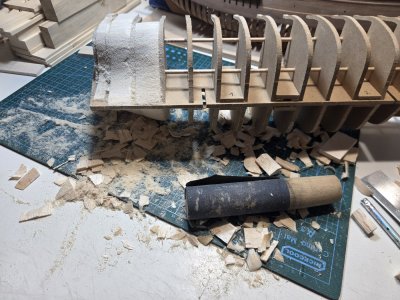
Hi, quick update.
I don't really know what i signed up for, it was supposed to be so beautiful.
It turns out that, small Proxxon saw burned up while cutting balsa... yes, balsa.
Another victim of La Belle's curse.
Why isn't this destiny.
Greetings friends.
I don't really know what i signed up for, it was supposed to be so beautiful.
It turns out that, small Proxxon saw burned up while cutting balsa... yes, balsa.
Another victim of La Belle's curse.
Why isn't this destiny.
Greetings friends.

Kuba, what a shame about the saw; perhaps you can repair it. Otherwise, there are always fret saws.
I wish you lots of fun building "La Belle." The model is worth seeing in any version! Use your obvious talent!
Best regards, Thomas
I wish you lots of fun building "La Belle." The model is worth seeing in any version! Use your obvious talent!
Best regards, Thomas
Thank you, Thomas.Kuba, what a shame about the saw; perhaps you can repair it. Otherwise, there are always fret saws.
I wish you lots of fun building "La Belle." The model is worth seeing in any version! Use your obvious talent!
Best regards, Thomas
Parts for Proxon are only available on fluidonline. I'll do a complete service.
Now, borrowed FET from a friend for temporary work. He used it for cutting aluminum, difficult subject, worn out equipment, but work.
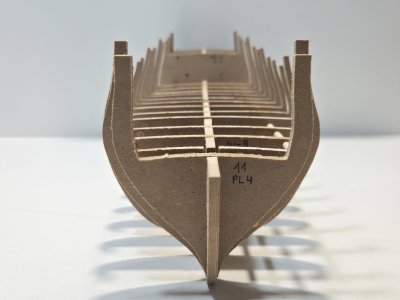
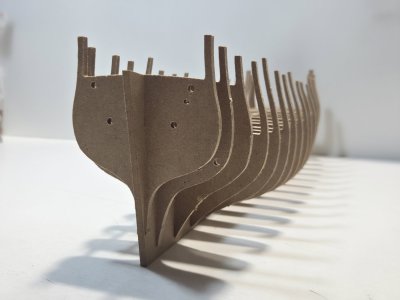
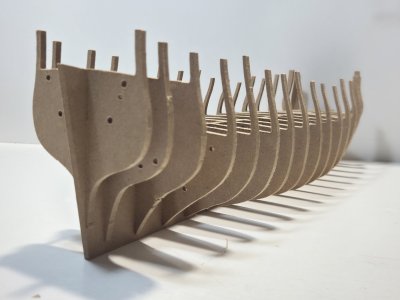
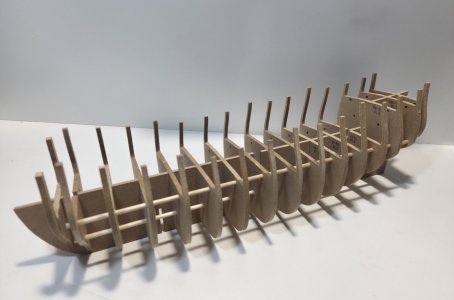
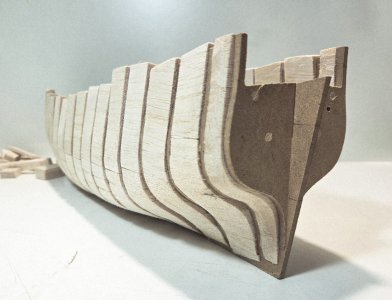
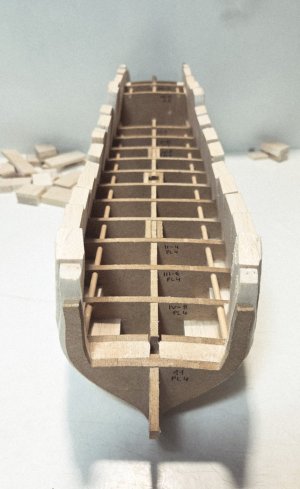
I dont give up, La Belle is gradually taking shape, and so far it's been very pleasant to work with she.
Best regards.

Kuba, I wish you a very happy birthday  . Enjoy the day.
. Enjoy the day.