• Win a Free Custom Engraved Brass Coin!!!
    As a way to introduce our brass coins to the community, we will raffle off a free coin during the month of August. Follow link ABOVE for instructions for entering.
  • SUBSCRIBE TO SHIPS IN SCALE TODAY!

    The beloved Ships in Scale Magazine is back and charting a new course for 2026!
    Discover new skills, new techniques, and new inspirations in every issue.

    NOTE THAT OUR NEXT ISSUE WILL BE MARCH/APRIL 2026

Purchased shortly ago / sthg new in your workshop -> present it here

Jaager -- Thanks for the suggestion. I found the green sharpening compound for next to nothing online and will pick up some leather bands next time at the hobby store. Is there a way for keeping serrated edge knives sharp? I've got a Japanese hacksaw that I use in my miter box that I use alot and will eventually need to re-sharpen the serrated teeth. Any suggestions on this score would be appreciated.
I would like to see a tutorial on keeping razor knives sharp, the materials needed, process, etc.
 
Is there a way for keeping serrated edge knives sharp?
I have a serrated knife that I use for slicing tomato. I keep a ~1000 grit stone and hone it - being for food the edge does not have to be able 'to split water molecules when you blow on it' sharp. Being a stone the serrated points cannot dig in as it is honed edge first. My serrated blade is coves on one side and flat on the other. I do nothing to the coves side. Just working one side still gets me a sharp edge back.
I suppose I could strop it since that is done away from the edge. But I think that the sharp points -even being dragged away on the surface of leather would really tear it up.
 
If you don’t already have them, a set of Zona razor saws is a worthwhile addition to your tool kit. These are inexpensive; look on your favorite on line tool source like Amazon. Blades are replaceable and cheap enough that I don’t bother trying to sharpen them. In addition to cutting wood, I also use them for cutting brass tubing.

The Zona saws are much better than the ones that fit into Xacto knife handles as they bolt to the handles.

Roger
 
Is there a way for keeping serrated edge knives sharp?
These work well


Rob
 
These work well


Rob
Wow. These look dangerous...my wife and our 15-18 serrated knives that need sharpening thank you!
 
If you don’t already have them, a set of Zona razor saws is a worthwhile addition to your tool kit. These are inexpensive; look on your favorite on line tool source like Amazon. Blades are replaceable and cheap enough that I don’t bother trying to sharpen them. In addition to cutting wood, I also use them for cutting brass tubing.

The Zona saws are much better than the ones that fit into Xacto knife handles as they bolt to the handles.

Roger
Roger -- I need a razor saw / miter box combination that actually are sized for each other. I've been using a 6-inch miter box that is too wide for my Japanese razor saw and I'm not getting fine cuts. Looks like Zona has a couple of razor saw & miter box combos in my budget. Thanks.
 
You have bought a solid hull kit. I would not let that router get near the hull of this model. It can destroy it in an instant! Instead buy a quality small hand plane and a spokeshave. Both of these, especially the spokeshave are used to shape solid hull models. Chisels are used too and you apparently already have some. To sharpen, buy a sharpening guide and a sharpening stone (oil or water as you prefer). There are guides on line and several good books available about sharpening edged tools. DO NOT try to sharpen edged tools on that powered grinder! Like the router it is too aggressive.

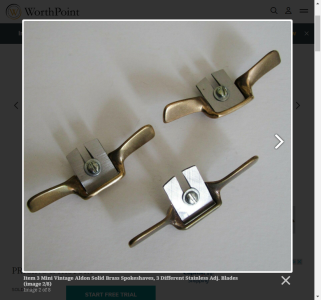
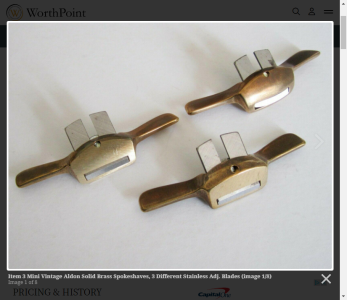
The University of Michigan operates a 450 ft long “towing tank” for testing models of ship hull to determine resistance. As a student there in the 1960’s, I watched professional model makers sculpt highly accurate models to be towed in the tank from clear white pine. Although the laminations to build these models were sawed on a bandsaw, shaping was done by hand. I still have and use a set of three miniature spoke shaves bought back then for a student project.

Power tools have their uses building models but first develop skill with hand tools.

Roger.

I still have and use a set of three miniature spoke shaves bought back then for a student project.

I'll bet they look just like these. :D ThumbsupThumbsupThumbsup Good luck finding Aldon model maker's spoke shaves anywhere today. They do occasionally turn up on eBay now and again. That's where I found mine... new old stock! Long ago, though.


1775688204891.png


1775688284851.png

Instead buy a quality small hand plane and a spokeshave.

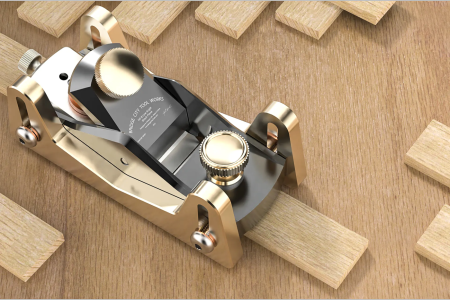
I highly recommend this modelmaker's plane. It has guides on each side which can be adjusted so it can be used as a thickness plane. Without the side "runners," it's a very high quality "No. 100" size plane. Cast iron Stanley "100's" can be found used on eBay or new Stanley and Buck sheet metal and Kunz cast-iron "No. 100" knock-offs can be bought new for a lot less, but for around a hundred bucks and closer to seventy-fivie bucks on one of their frequent sales, the Bridge City modelmaker's plane is really a piece of "jewelry" worth treating yourself to. All the features of a full-sized plane (e.g. adjustable mouth) in a modelmaker's plane. Top of the line stuff. Not to be left around where it might find its way into somebody else's pocket! ;)

See: https://bridgecitytools.com/collections/planes


1775688979995.png

Ignatius, as Roger indicated, that big Bosch plunge router you have, while a great tool, is not really good for much for ship modeling. Apparently, you were contemplating fitting small cutters on it and "free handing" carving a hull. I also noticed that you misunderstood the use of a portable bandsaw, confusing it with a stationary bandsaw. These and other comments in this thread cause me to think that you may not be as familiar with the use of power tools as one should be to use them safely. Routers, for example, are all about jigs and guides and under-table mounts. They really aren't safe to use without something that holds them fixed in position, or against and edge guide. They can be wickedly dangerous if one "gets loose" while running. Before buying any power tools, I would urge you to take a "shop course" at a local community college or high school, which often offer them in the evenings, or "apprentice" yourself to a woodworking friend, and learn how to use all of the power tools you have any interest in acquiring. An ounce of prevention is worth a pound of cure! Additionally, if you are fortunate enough to find a course that also teaches how to use hand tools, you'll probably come to realize that there's lots of money to be saved in not buying power tools that aren't really all that useful. In this day and age, we have what's known as the "Norm Abrams Syndrome." (He's the guy who used to host that PBS series on woodworking, The New Yankee Workshop. Delta power tool company was the sponsor of the show and, entertaining as it was, Norm never used a hand tool where a Delta power tool would also do the job, thus creating a generation of wood butchers who thought they had to buy a shop full of power tools to build a bookshelf! Often, a well-sharpened, quality hand tool will get a job done in less time than it takes to plug a power tool into the wall outlet and make a better job of it, too. My old well-sharpened and -set Diston "garage sale special" hand saws certainly do a quicker job of shortening a two-by-four than hooking up my $250 Skil "side-winder" for just one cut. ;)
 
Last edited:
Roger -- I need a razor saw / miter box combination that actually are sized for each other. I've been using a 6-inch miter box that is too wide for my Japanese razor saw and I'm not getting fine cuts. Looks like Zona has a couple of razor saw & miter box combos in my budget. Thanks.
I have the zona saw and miter box, and they are great.
 
Bob, yes, same spokeshave.

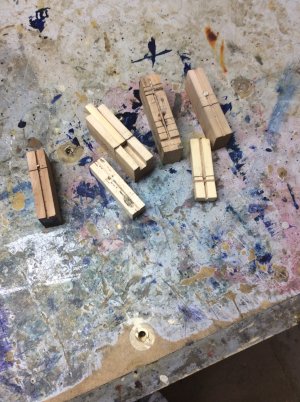
Ignatius, I wouldn’t waste my money on a miter box. With your router and el cheapo table saw you can make better ones. See photo below. I make miter boxes for specific applications. I consider them to be somewhat disposable. Mine are made with a Sherline mill and Byrnes saw but your tools should work too.

Roger

IMG_3069.jpeg
 
I still have and use a set of three miniature spoke shaves bought back then for a student project.

I'll bet they look just like these. :D ThumbsupThumbsupThumbsup Good luck finding Aldon model maker's spoke shaves anywhere today. They do occasionally turn up on eBay now and again. That's where I found mine... new old stock! Long ago, though.


View attachment 590805


View attachment 590807

Instead buy a quality small hand plane and a spokeshave.

I highly recommend this modelmaker's plane. It has guides on each side which can be adjusted so it can be used as a thickness plane. Without the side "runners," it's a very high quality "No. 100" size plane. Cast iron Stanley "100's" can be found used on eBay or new Stanley and Buck sheet metal and Kunz cast-iron "No. 100" knock-offs can be bought new for a lot less, but for around a hundred bucks and closer to seventy-fivie bucks on one of their frequent sales, the Bridge City modelmaker's plane is really a piece of "jewelry" worth treating yourself to. All the features of a full-sized plane (e.g. adjustable mouth) in a modelmaker's plane. Top of the line stuff. Not to be left around where it might find its way into somebody else's pocket! ;)

See: https://bridgecitytools.com/collections/planes


View attachment 590824

Ignatius, as Roger indicated, that big Bosch plunge router you have, while a great tool, is not really good for much for ship modeling. Apparently, you were contemplating fitting small cutters on it and "free handing" carving a hull. I also noticed that you misunderstood the use of a portable bandsaw, confusing it with a stationary bandsaw. These and other comments in this thread cause me to think that you may not be as familiar with the use of power tools as one should be to use them safely. Routers, for example, are all about jigs and guides and under-table mounts. They really aren't safe to use without something that holds them fixed in position, or against and edge guide. They can be wickedly dangerous if one "gets loose" while running. Before buying any power tools, I would urge you to take a "shop course" at a local community college or high school, which often offer them in the evenings, or "apprentice" yourself to a woodworking friend, and learn how to use all of the power tools you have any interest in acquiring. An ounce of prevention is worth a pound of cure! Additionally, if you are fortunate enough to find a course that also teaches how to use hand tools, you'll probably come to realize that there's lots of money to be saved in not buying power tools that aren't really all that useful. In this day and age, we have what's known as the "Norm Abrams Syndrome." (He's the guy who used to host that PBS series on woodworking, The New Yankee Workshop. Delta power tool company was the sponsor of the show and, entertaining as it was, Norm never used a hand tool where a Delta power tool would also do the job, thus creating a generation of wood butchers who thought they had to buy a shop full of power tools to build a bookshelf! Often, a well-sharpened, quality hand tool will get a job done in less time than it takes to plug a power tool into the wall outlet and make a better job of it, too. My old well-sharpened and -set Diston "garage sale special" hand saws certainly do a quicker job of shortening a two-by-four than hooking up my $250 Skil "side-winder" for just one cut. ;)
 
Guilty as charged! I know nothing about power tools! LOL.

For those wondering if I am going to saw off a finger or two, you should know that I have just registered for three 1-hour webinars on "Introduction to Hand Tools," "Introduction to Power Tools," and "Sanding Basics" at Home Depot. Waiting to see if I have time to add the 12-minute webinar on "Tape Measure Basics." May pick up more advanced tutorials as I go along. I am also lucky to have a local contractor in my model club who is going to help me build my router table.

I guess people missed my post where I said that these new tools are helping me move into light woodworking projects like building Adirondack chairs, planter boxes, decorative cutting boards, etc. This will involve learning new skills and techniques on a somewhat larger scale. I did not get all these tools just for boat modeling.

FWIW, this site is great for lighthearted advice from people who have years of experience building model boats to people who are just getting started in this great hobby. It becomes less useful when people start judging beginners for what they do not know (yet) and what they have not done (yet).

My career for the first 61 years of my life did not involve using hand tools or power tools. I did not grow up learning lessons at the knee of a father who was a master woodworker (that would have been gross since my father was a cancer surgeon). I have been building wooden model boats for just 9 months. I don't think it is a moral failing or character flaw if I am now in my 60s learning to use hand tools and power tools for the first time, but sometimes the comments and responses come across that way. No skin off my back. I am going to learn and to build boats at my own pace, as I start my glidepath towards retirement, and hopefully a long career at the workbench.
 
Last edited:
I did not grow up learning lessons at the knee of a father who was a master woodworker (that would have been gross since my father was a cancer surgeon). I have been building wooden model boats for just 9 months. I don't think it is a moral failing or character flaw if I am now in my 60s learning to use hand tools and power tools for the first time, but sometimes the comments and responses come across that way.

I disagree. The lack of a working familiarity with the related manual arts isn't a "moral failing or character flaw." It just means you're less of a man. It's an easily curable defect, but don't expect a lot of respect from the "big dogs" until you do. Ship modeling is an exercise in life-long self-education. :D

Truth be told, your father would have been a much better equipped and skilled scale ship modeler that the average full-sized "master woodworker." I've learned a lot more about ship modeling techniques from watching medical school YouTube videos about instrument suturing and micro-surgical technique than from DIY woodworking videos! Surgeons make great scale modelers. Dentists may even make better ones. Dental and surgical tools and skill in their use are almost all useful in some way for ship modeling.

There was a time when boys were just expected to learn the manual arts as a rite of passage. Before "Do It Yourself" as a hobby was ever a "thing," I grew up with a father who was an accountant, but one of his mottos was, "If you don't know how to fix it, you don't deserve to own it." I can't say he always enjoyed fixing it, but he instilled in me an interest in how things were done, and I suppose I'd have to admit to being a "jack of all trades and master of none" because of that. Time was what a man knew how to do was a measure of the man.

Times change. At our ages, we grew up in a post-War world of radical change that occurred faster than society could wrap its head around it. Some of us never had the opportunity to take "shop" classes in high school. Our children grew up in a "disposable" world where a lot of things weren't made to be repairable anymore, where, for example, it was no longer possible to tune up your own car without thousands of dollars of computerized diagnostic equipment. I'll be lucky if I'll even be able to teach my grandkids "righty, tighty, lefty, loosey." My fifteen-year-old grandson has no interest whatsoever in tools and what they can do. Reading ship modeling forums, a lot of old timers are amazed at the level of ignorance of basic mechanical arts knowledge many novice modelers exhibit. Sometimes it seems some of them think paying a couple of grand for a Victory kit confers all the knowledge that is required to "build" a "museum quality" model. I'm sorry if somebody's feelings get hurt. They shouldn't be. It's not their fault. It's the fault of an entire societal mindset, but when old guys who got their first pocketknife at around age seven and mastered keeping it razor sharp by eight read a post from an adult asking how to sharpen an Xacto knife and we roll our eyes in amazement... well, I'm sure you get the drift.


FWIW, this site is great for lighthearted advice from people who have years of experience building model boats to people who are just getting started in this great hobby. It becomes less useful when people start judging beginners for what they do not know (yet) and what they have not done (yet).

As thin-skinned as many novice modelers seem to be, it's commendable that so many of the experienced modelers still manage to muster the grace to provide answers without bringing more of them to tears.:D Make no mistake, there are many deadly serious scale modelers who consider "lighthearted advice" about scale ship modeling to be an oxymoron! Quality scale ship modeling is all about precision and accuracy. ;) The relationships of "teacher and student," "master and apprentice," "mentor and mentee," and the like, are necessarily relationships between "superiors and inferiors." Traditionally, which is to say, "before the internet," it was expected that an apprentice would watch, listen, and study, before asking his "master" a question. There was a certain respectful protocol which ensured that the "apprentice" had made an effort on their own to find the answer before troubling the "master" with it (and perhaps betraying the apprentice's ignorance!) Early in my legal career, I asked my wise and experienced mentor a "quick question" about how to do a particular procedure. I was sure he knew the answer off the top of his head, preuming it was nothing for him to just tell me how to do it. Much to my chagrin, he said, "Grasshopper, all of the answers to procedural questions are in the procedural manuals in the library. Have you had a problem finding them?" Of course, I knew that in the first place and had just been too lazy to look it up myself. It was easier for me to expect him to spoon-feed me the answer. I looked it up in the book and never forgot it.

Whenever we ask a question, we necessarily admit what we don't know and when a question is asked presumptuously, we don't just admit it, we proclaim our ignorance. In such fashion, the quality of the question identifies the quality of the person asking it. Thus, all of us, not only beginners, are always judged by those we ask upon the basis of what we ask, i.e., what we do not know (yet) and what we have not done (yet,) whenever we ask somebody how to do something. When a novice who is too lazy to look up the answer asks a question of a modeler who has spent decades totally immersed in the craft, (which happens a lot on social media platforms,) I seriously wonder for how much longer the really good modelers are going to bother to spend their modeling "time budget" sharing what they know at all. Knowledgeable and experienced scale ship modelers are a valuable resource that should not be squandered. They aren't "flesh and blood search engines." A lot of bandwidth could be saved if people just used the forum search engine to see if their question has been answered before. As it stands now, a large majority of highly skilled modelers have drifted away from ship modeling social media, and the greater part of the currently available content online is just the blind being led by the blind who think they can see.

Let me suggest a different approach for novices. Instead of posting questions that sound like, "I'm building the XYZ Models kit of the Widget and I think I should do ABC, is this a smart move?" ask, "I'm building the XYZ Models kit of the Widget and I've searched for an answer. Chat GPT says I should do ABC. Is this a smart move." This will save you reading a lot of meaningless congratulatory drivel about how great your model looks and "monkey see - monkey do" advice based on something somebody else read online. Instead, you'll get answers like, "Chat GPT has its head up where the sun don't shine." That way, novices can avoid the embarrassment having to disclose that it was their idea, not Chat GPT's.

Since I'm not addressing the original poster specifically, but to the general class of novice ship modelers, I have to say that you will avoid nearly any bruised feelings entirely if you build a library of good ship modeling books. All it takes is the commitment to buy one good book a month. It doesn't have to cost more than fifty bucks and most cost less if you buy them used. Select books that are about basic ship modeling techniques and books that are relevant to your area of interest. The most important tool a ship modeler can have is a good research library. Good scale ship modeling is very much an academic exercise. The more you read, the better you'll model.

Finally, if you feel like you're getting hazed because you're a "freshman, "suck it up" and remember, when you've got some experience of your own under your belt, you'll become an "upperclassman" in the ship modeling fraternity and you'll get to haze the "pledges" in your turn. :D
 
Everything depends on the attitude of the newbie builder. If you are willing to learn, this forum is pure gold, because the members will take time to pour out their knowledge to you, If you're only looking for validation, and take offense when someone presents constructive criticism and historical facts for you to use to improve your work, then all you may do is piss everyone off for taking the time to try to help. Heck, I have trouble ENCOURAGING fellow members to make comments aimed at improving my model work, and am thrilled when someone makes a correction or a suggestion. This is because I'm not afraid to take a saw and cut out a section of the ship just to redo it better. In fact, some members have cringed when they saw me chop away all the internal hull structure with a oscillating saw and rebuild it from scratch. The end result turned out okay.

It's important as a newbie to ask specific questions. Few people have the time to write a book telling you all they know about how to plank a hull, and would rather direct them to a book purchase instead.

 
Everything depends on the attitude of the newbie builder. If you are willing to learn, this forum is pure gold, because the members will take time to pour out their knowledge to you, If you're only looking for validation, and take offense when someone presents constructive criticism and historical facts for you to use to improve your work, then all you may do is piss everyone off for taking the time to try to help. Heck, I have trouble ENCOURAGING fellow members to make comments aimed at improving my model work, and am thrilled when someone makes a correction or a suggestion. This is because I'm not afraid to take a saw and cut out a section of the ship just to redo it better. In fact, some members have cringed when they saw me chop away all the internal hull structure with a oscillating saw and rebuild it from scratch. The end result turned out okay.

It's important as a newbie to ask specific questions. Few people have the time to write a book telling you all they know about how to plank a hull, and would rather direct them to a book purchase instead.

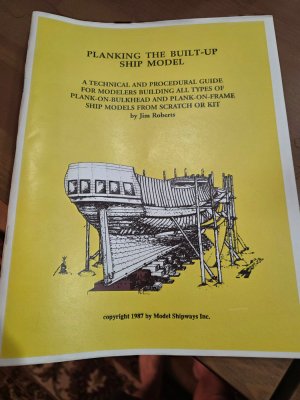
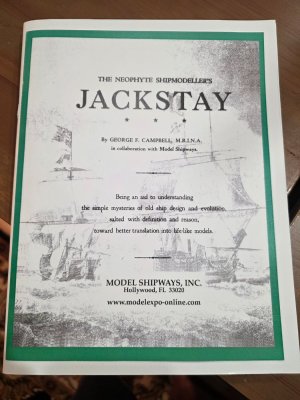
Darivs - By some funny coincidence these arrived in the mail today. I've been building my trove of boat building books for some time now. Mostly trying to understand how to read design drawings so I can make scratch hulls. Waiting for SeaWatch to deliver my book from Ab & Emiel Hoving about building 17th century Dutch ships out of paper. Will likely build a Dutch pinnace like the Duyfken or the Papegojan for my next build after the Mayflower 1620 kit from Corel.

1775794617832.jpeg


20260410_000647.jpg

20260410_000624.jpg
 
Last edited:
I disagree. The lack of a working familiarity with the related manual arts isn't a "moral failing or character flaw." It just means you're less of a man. It's an easily curable defect, but don't expect a lot of respect from the "big dogs" until you do. Ship modeling is an exercise in life-long self-education. :D

Truth be told, your father would have been a much better equipped and skilled scale ship modeler that the average full-sized "master woodworker." I've learned a lot more about ship modeling techniques from watching medical school YouTube videos about instrument suturing and micro-surgical technique than from DIY woodworking videos! Surgeons make great scale modelers. Dentists may even make better ones. Dental and surgical tools and skill in their use are almost all useful in some way for ship modeling.

There was a time when boys were just expected to learn the manual arts as a rite of passage. Before "Do It Yourself" as a hobby was ever a "thing," I grew up with a father who was an accountant, but one of his mottos was, "If you don't know how to fix it, you don't deserve to own it." I can't say he always enjoyed fixing it, but he instilled in me an interest in how things were done, and I suppose I'd have to admit to being a "jack of all trades and master of none" because of that. Time was what a man knew how to do was a measure of the man.

Times change. At our ages, we grew up in a post-War world of radical change that occurred faster than society could wrap its head around it. Some of us never had the opportunity to take "shop" classes in high school. Our children grew up in a "disposable" world where a lot of things weren't made to be repairable anymore, where, for example, it was no longer possible to tune up your own car without thousands of dollars of computerized diagnostic equipment. I'll be lucky if I'll even be able to teach my grandkids "righty, tighty, lefty, loosey." My fifteen-year-old grandson has no interest whatsoever in tools and what they can do. Reading ship modeling forums, a lot of old timers are amazed at the level of ignorance of basic mechanical arts knowledge many novice modelers exhibit. Sometimes it seems some of them think paying a couple of grand for a Victory kit confers all the knowledge that is required to "build" a "museum quality" model. I'm sorry if somebody's feelings get hurt. They shouldn't be. It's not their fault. It's the fault of an entire societal mindset, but when old guys who got their first pocketknife at around age seven and mastered keeping it razor sharp by eight read a post from an adult asking how to sharpen an Xacto knife and we roll our eyes in amazement... well, I'm sure you get the drift.


As thin-skinned as many novice modelers seem to be, it's commendable that so many of the experienced modelers still manage to muster the grace to provide answers without bringing more of them to tears.:D Make no mistake, there are many deadly serious scale modelers who consider "lighthearted advice" about scale ship modeling to be an oxymoron! Quality scale ship modeling is all about precision and accuracy. ;) The relationships of "teacher and student," "master and apprentice," "mentor and mentee," and the like, are necessarily relationships between "superiors and inferiors." Traditionally, which is to say, "before the internet," it was expected that an apprentice would watch, listen, and study, before asking his "master" a question. There was a certain respectful protocol which ensured that the "apprentice" had made an effort on their own to find the answer before troubling the "master" with it (and perhaps betraying the apprentice's ignorance!) Early in my legal career, I asked my wise and experienced mentor a "quick question" about how to do a particular procedure. I was sure he knew the answer off the top of his head, preuming it was nothing for him to just tell me how to do it. Much to my chagrin, he said, "Grasshopper, all of the answers to procedural questions are in the procedural manuals in the library. Have you had a problem finding them?" Of course, I knew that in the first place and had just been too lazy to look it up myself. It was easier for me to expect him to spoon-feed me the answer. I looked it up in the book and never forgot it.

Whenever we ask a question, we necessarily admit what we don't know and when a question is asked presumptuously, we don't just admit it, we proclaim our ignorance. In such fashion, the quality of the question identifies the quality of the person asking it. Thus, all of us, not only beginners, are always judged by those we ask upon the basis of what we ask, i.e., what we do not know (yet) and what we have not done (yet,) whenever we ask somebody how to do something. When a novice who is too lazy to look up the answer asks a question of a modeler who has spent decades totally immersed in the craft, (which happens a lot on social media platforms,) I seriously wonder for how much longer the really good modelers are going to bother to spend their modeling "time budget" sharing what they know at all. Knowledgeable and experienced scale ship modelers are a valuable resource that should not be squandered. They aren't "flesh and blood search engines." A lot of bandwidth could be saved if people just used the forum search engine to see if their question has been answered before. As it stands now, a large majority of highly skilled modelers have drifted away from ship modeling social media, and the greater part of the currently available content online is just the blind being led by the blind who think they can see.

Let me suggest a different approach for novices. Instead of posting questions that sound like, "I'm building the XYZ Models kit of the Widget and I think I should do ABC, is this a smart move?" ask, "I'm building the XYZ Models kit of the Widget and I've searched for an answer. Chat GPT says I should do ABC. Is this a smart move." This will save you reading a lot of meaningless congratulatory drivel about how great your model looks and "monkey see - monkey do" advice based on something somebody else read online. Instead, you'll get answers like, "Chat GPT has its head up where the sun don't shine." That way, novices can avoid the embarrassment having to disclose that it was their idea, not Chat GPT's.

Since I'm not addressing the original poster specifically, but to the general class of novice ship modelers, I have to say that you will avoid nearly any bruised feelings entirely if you build a library of good ship modeling books. All it takes is the commitment to buy one good book a month. It doesn't have to cost more than fifty bucks and most cost less if you buy them used. Select books that are about basic ship modeling techniques and books that are relevant to your area of interest. The most important tool a ship modeler can have is a good research library. Good scale ship modeling is very much an academic exercise. The more you read, the better you'll model.

Finally, if you feel like you're getting hazed because you're a "freshman, "suck it up" and remember, when you've got some experience of your own under your belt, you'll become an "upperclassman" in the ship modeling fraternity and you'll get to haze the "pledges" in your turn. :D
This is hilarious! I am also a lawyer, so that explains why I felt compelled to lock horns with you! I passed the bar in 1991, so I've been practicing for almost 35 years now. I haven't had much time for hobbies until now since I've started thinking about retirement.

I must say I agree with just about everything you said, except for the manhood part, but I sense you would not disagree that there are some great lady model builders out there. Ohla Batchvarov comes to mind. Also, I never use AI or ChatGPT...still an oldtimer when it comes to tech.

I do agree that some of this master/pupil stuff feels like fraternity rush all over again. If you have interest, you may want to check one of my build logs on SOS to let me know how far I need to go!
 
Last edited:
Darivs - By some funny coincidence these arrived in the mail today. I've been building my trove of boat building books for some time now. Mostly trying to understand how to read design drawings so I can make scratch hulls. Waiting for SeaWatch to deliver my book from Ab & Emiel Hoving about building 17th century Dutch ships out of paper. Will likely build a Dutch pinnace like the Duyfken or the Papegojan for my next build after the Mayflower 1620 kit from Corel.

View attachment 591109


View attachment 591107

View attachment 591108
Very nice books! I think I'll stay with wood because I don't want to re-tool and learn a new medium right now, and have plenty of models to build.
 
Very nice books! I think I'll stay with wood because I don't want to re-tool and learn a new medium right now, and have plenty of models to build.
I've posted before that I tried my hand at paper boat modeling last year for about 3 months before I got into wooden boat modeling. It was a disaster. I started and could not finish 3 boats, the tugboat Cyclon, tugboat Centaur II, and the armed freighter Graf Goetzen. I found that one error can mess up the whole build without chances of recovering. I think Ab Hoving's scratch paper model approach looks like a great improvement over the way most Eastern European paper model kits are designed.
 
Back
Top