
• Win a Free Custom Engraved Brass Coin!!!
    As a way to introduce our brass coins to the community, we will raffle off a free coin during the month of August. Follow link ABOVE for instructions for entering.
  • SUBSCRIBE TO SHIPS IN SCALE TODAY!

    The beloved Ships in Scale Magazine is back and charting a new course for 2026!
    Discover new skills, new techniques, and new inspirations in every issue.

    NOTE THAT OUR NEXT ISSUE WILL BE MARCH/APRIL 2026

"The Duyfken" (1595 Dutch Pinnace) as "The Kalmar Nyckel" (1625 Dutch Pinnace) -- Possible or Impossible?

Something I see every day on TV newscasts and more are people broadcasting "facts" that are obviously wrong, created by a person who probably knew the correct values but wrote them wrong, and the broadcaster reading them with no knowledge of what he/she is reading. I'm referring to mixing up mph and kph and every other metric/english conversion, light years, speed of light, figures off by a factor of 10, or 1000, etc. As an engineer, and probably you as well, hearing those quoted figures you just know they're wrong.

What I'm saying here is that it isn't so hard to imagine that the smaller ship's 2,902 square meters could actually have been 2,902 square feet. That someone just wrote it down in feet, and another assumed it was meters, something like that. Which sounds about right given the ship sizes.
Signet - I think you hit the treenail right on the head. The information about the Duyfken having a sail area of 2902 meters actually comes from the Australian National Maritime Museum, where a replica of the Duyfken (first European ship to reach Australia over a century before James Cook) is on display. Here is the link to the Duyfken's Ship Specifications that states that the sail area is 2902 meters, not feet. You have to scroll down past the section "What is the Duyfken?" to get to the Ship Specifications chart.

 
I don't know if you can come much closer to the Kalmar than with this one:
 
Last edited:
Not only is Ab a talented modeler, he is also very gracious in helping his fellow modelers, no matter what their skill level may be. He and Fred Hocker of the Vasa Museet are invaluable resources. I will have to look for that YT video of Ab.

I haven’t tried my hand at card modeling, but Ab’s build logs are perfectly illustrative of the speed and relative ease with which a card model can be made, using his particular substrate techniques.

I will add that one of my favorite museum ships is The Star of India, which I saw on a trip to San Diego. The ship was lovingly restored and maintained.
 
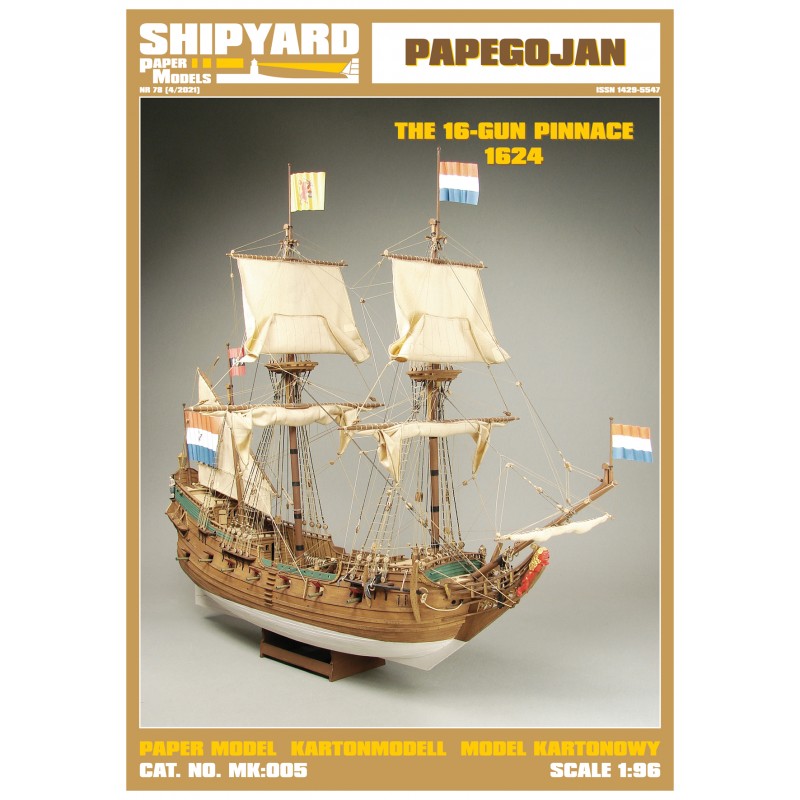
Thanks Pepite! It seems like the Papegojan 1624 was also built by the Dutch under contract to the Swedish Navy, just like the Kalmar Nyckel which was built about a year or two later, perhaps by the same Dutch shipyard. So there's a deep connection with the Kalmar Nyckel, which was built in 1625. After seeing and hearing about Ab Hoving's book on 17th Century Dutch vessel paper models, I may just try building this paper kit from Model Shipyard. I appreciate the link.
 
Thanks Pepite! It seems like the Papegojan 1624 was also built by the Dutch under contract to the Swedish Navy, just like the Kalmar Nyckel which was built about a year or two later, perhaps by the same Dutch shipyard. So there's a deep connection with the Kalmar Nyckel, which was built in 1625. After seeing and hearing about Ab Hoving's book on 17th Century Dutch vessel paper models, I may just try building this paper kit from Model Shipyard. I appreciate the link.
You're welcome.
 
Define your objective. Which ship are you interested in building, the Kalmar Nyckel, or the replica of the Kalmar Nyckel? Understand that they are not the same. Although there are no drawings of the vessel that sailed from Sweden to the New World there is probably enough information for a skilled model maker to build a model of a Dutch Pinas of 1638. This is NOT a project for a beginner.

Then there’s the Replica. Although it may look like a Dutch Pinas, the similarity is superficial. Replicas must be designed to meet safety requirements unheard of in the 1600’s. This is especially true of the issue of stability. Capsizes are catastrophic usually leading to high loss of life. The ability for shipwrights to predict the resistance of a hull to heeling forces was over 200 years in the future when the original Kalmar Nyckel was built. Stability is greatly influenced by hull shape. The naval architect who designed the replica would have had to shape a hull different from that of the original to meet modern stability requirements.

Why not build a waterline model? This avoids most of the hull shape issue.

Roger
 
Thanks Roger! I would be interested in possibly building the Kalmar Nyckel as a waterline model, as I've heard some say that the hull of the KN is "unique," as well as your suggestion that the Replica would not have the same hull design as the original. I have a few resources that discuss how a waterline model can be fabricated using the Lift Method or the Built-up Method (waterline laminate) in "Ship Modeling from Stem to Stern" by Roth and "Ship Modeling from Scratch" by Leaf. There are also several threads on this site where waterline modeling issues are discussed. I guess I just have to jump right in and start building hulls so I can gain some proficiency at it, rather than just reading books and posts about it. My wife is getting me my first scroll saw for our wedding anniversary next month, and I told her I wanted a scroll saw specifically to start learning how to craft wooden hulls using the Lift Method and the Built-up Method, as well as to start carving solid block hulls. I'll check back in after I spend some time getting acquainted with the new scroll saw.

Would you recommend any other power tools that I might need? I have a Chinese-brand mini-table saw and a DeWalt-clone cordless jigsaw. I was thinking that a router might also be worthwhile, but getting a router is not in the budget right now. Until then, I'm going do a deep dive into reading the customary 3 plans (body plan, sheer plan, and half-breadth plan) and learning how to render them into 3 dimensions. I still have a long way to go!
 
Thanks Roger! I would be interested in possibly building the Kalmar Nyckel as a waterline model, as I've heard some say that the hull of the KN is "unique," as well as your suggestion that the Replica would not have the same hull design as the original. I have a few resources that discuss how a waterline model can be fabricated using the Lift Method or the Built-up Method (waterline laminate) in "Ship Modeling from Stem to Stern" by Roth and "Ship Modeling from Scratch" by Leaf. There are also several threads on this site where waterline modeling issues are discussed. I guess I just have to jump right in and start building hulls so I can gain some proficiency at it, rather than just reading books and posts about it. My wife is getting me my first scroll saw for our wedding anniversary next month, and I told her I wanted a scroll saw specifically to start learning how to craft wooden hulls using the Lift Method and the Built-up Method, as well as to start carving solid block hulls. I'll check back in after I spend some time getting acquainted with the new scroll saw.

Would you recommend any other power tools that I might need? I have a Chinese-brand mini-table saw and a DeWalt-clone cordless jigsaw. I was thinking that a router might also be worthwhile, but getting a router is not in the budget right now. Until then, I'm going do a deep dive into reading the customary 3 plans (body plan, sheer plan, and half-breadth plan) and learning how to render them into 3 dimensions. I still have a long way to go!
 
Last edited:
The first stationary power tool that I bought when I began to equip my shop shop 50+ years ago was a bench top drill press. It is still going strong and remains my most commonly used power tool.

If you have a hand held jig saw, that should be sufficient to cut out lifts for a waterline model. A good scroll saw can be quite expensive.

Roger
 
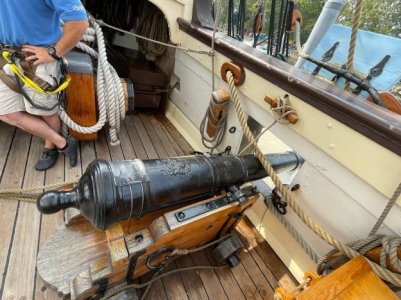
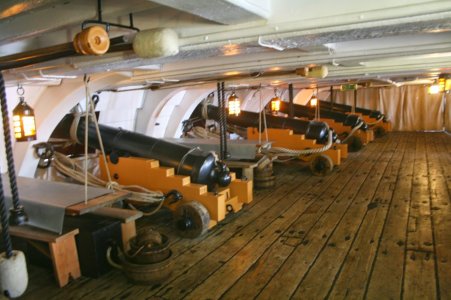
Would the Kalmar Nyckle have been originally equipped with cannon as merchant vessel?
Paulpk -- Funny you asked! According to the Kalmar Nyckel Foundation, she was outfitted with cannons to protect Dutch fishing interests off the north coast of Scotland in the early 1640's. Later, when she was returned to Sweden, she joined the naval fleet and ended her life in a naval battle.

"2.7 Swedish Warship - Kalmar Nyckel
Upon her safe return to Sweden in 1644, the Kalmar Nyckel was commissioned immediately to serve in the Swedish‐Danish War (1643‐45), one in a series of conflicts between the rival kingdoms for seizure of territory and control of the Baltic Sea.

Outfitted for naval warfare by May of 1645, the Kalmar Nyckel took part in a number of engagements and saw bloody action. With her reputation as a swift and seaworthy vessel, the Kalmar Nyckel was used primarily as a scout ship by Admiral Ancharheim, commander of the Swedish western fleet based in Gothenberg.


The vessel was eventually sunk by the English in a North Sea battle during the First Anglo‐Dutch War (1652‐54)."

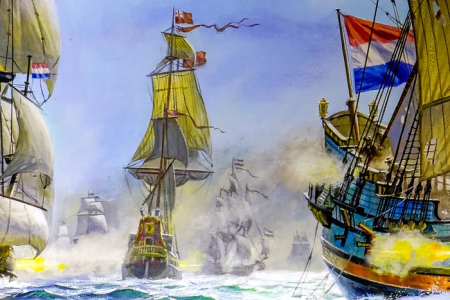
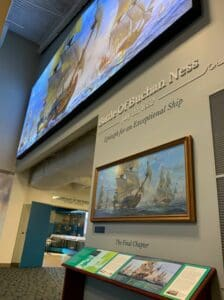
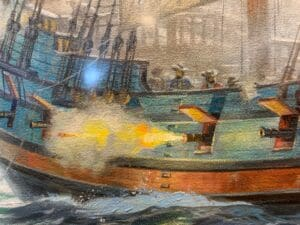
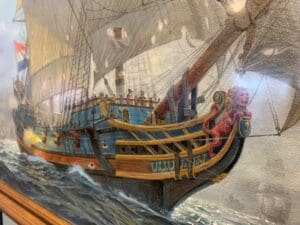
The Kalmar Nyckel Foundation also commissioned a dramatic 10' x 24' painting called "The Battle of Buchan Ness: Epitaph for an Exceptional Ship,” by marine artist Patrick O'Brien (below) which depicts the Kalmar Nyckel engaging with her 12 tiny 3-pound cannons, before she was torn to bits by British ships of the line and their decks of dozens of 32-pound, 24-pound, and 12-pound cannons. Rule Brittania!

1774141683937.png
1774141643963.png
1774141472981.png

1774141481791.png
 
Last edited:
Paulpk -- Funny you asked! According to the Kalmar Nyckel Foundation, she was outfitted with cannons to protect Dutch fishing interests off the north coast of Scotland in the early 1640's. Later, when she was returned to Sweden, she joined the naval fleet and ended her life in a naval battle.

"2.7 Swedish Warship - Kalmar Nyckel
Upon her safe return to Sweden in 1644, the Kalmar Nyckel was commissioned immediately to serve in the Swedish‐Danish War (1643‐45), one in a series of conflicts between the rival kingdoms for seizure of territory and control of the Baltic Sea.

Outfitted for naval warfare by May of 1645, the Kalmar Nyckel took part in a number of engagements and saw bloody action. With her reputation as a swift and seaworthy vessel, the Kalmar Nyckel was used primarily as a scout ship by Admiral Ancharheim, commander of the Swedish western fleet based in Gothenberg.


The vessel was eventually sunk by the English in a North Sea battle during the First Anglo‐Dutch War (1652‐54)."

The Kalmar Nyckel Foundation also commissioned a dramatic 10' x 24' painting called "The Battle of Buchan Ness: Epitaph for an Exceptional Ship,” by marine artist Patrick O'Brien (below) which depicts the Kalmar Nyckel engaging with her 12 tiny 3-pound cannons, before she was torn to bits by British ships of the line and their decks of dozens of 32-pound, 24-pound, and 12-pound cannons. Rule Brittania!

View attachment 585826
View attachment 585825
View attachment 585822

View attachment 585823
Funny, that English ship flying the red ensign ...
 
Funny, that English ship flying the red ensign ...
Pepite - The history of the Kalmar Nyckel is like a gift that keeps on giving! Here's a link to the history of the Red Ensign, as well as the Blue Ensign and the White Ensign, all likely used during the Battle of Buchan Ness, where the KN ended her relatively short career as a Swedish warship. Before embarking on this fascinating journey around the Kalmar Nyckel I had never even heard of the "Red Ensign." Thanks for pointing that out.

I did some research and learned that in the 1600's different colored ensigns were used by different groupings of British warships entering battle to designate different battle squadrons (not sure if that is the correct naval term). Later, the Red Ensign continued to be used as a designation for certain British registered merchant ships and ships from crown colonies.

Heres a description of the Red Ensign from a U.K. flag company:

"What is the Red Ensign?

The Red Ensign is the official civil ensign of the United Kingdom and is primarily used by British merchant and passenger ships. Featuring a red field with the Union Jack in the upper left corner, the flag serves as a distinctive marker of British civil ships on international waters. The flag’s design has evolved over the centuries but has remained a steadfast symbol of Britain’s maritime heritage."

 
Pepite - The history of the Kalmar Nyckel is like a gift that keeps on giving! Here's a link to the history of the Red Ensign, as well as the Blue Ensign and the White Ensign, all likely used during the Battle of Buchan Ness, where the KN ended her relatively short career as a Swedish warship. Before embarking on this fascinating journey around the Kalmar Nyckel I had never even heard of the "Red Ensign." Thanks for pointing that out.

I did some research and learned that in the 1600's different colored ensigns were used by different groupings of British warships entering battle to designate different battle squadrons (not sure if that is the correct naval term). Later, the Red Ensign continued to be used as a designation for certain British registered merchant ships and ships from crown colonies.

Heres a description of the Red Ensign from a U.K. flag company:

"What is the Red Ensign?

The Red Ensign is the official civil ensign of the United Kingdom and is primarily used by British merchant and passenger ships. Featuring a red field with the Union Jack in the upper left corner, the flag serves as a distinctive marker of British civil ships on international waters. The flag’s design has evolved over the centuries but has remained a steadfast symbol of Britain’s maritime heritage."

Well, I had a better look at the flag I mistook to be the red duster. It only has a red cross on white ground in his upper left corner, not the Union. So me bad, as (almost) usual :) :oops:ROTF.
 
Back
Top