• Win a Free Custom Engraved Brass Coin!!!
    As a way to introduce our brass coins to the community, we will raffle off a free coin during the month of August. Follow link ABOVE for instructions for entering.
  • PRE-ORDER SHIPS IN SCALE TODAY!

    The beloved Ships in Scale Magazine is back and charting a new course for 2026!
    Discover new skills, new techniques, and new inspirations in every issue.

    NOTE THAT OUR FIRST ISSUE WILL BE JAN/FEB 2026

The Mighty Panokseon (Plank Board Ship)

And don’t forget. When you build a model from a kit, someone, the kit designer, has already figured out much of the “how” of building the model. When you build from scratch figuring out things is up to you. Sometimes it takes several trials before things work. Hence more time to complete the project!

Roger
 
On the other hand, fewer mistakes to fix since you only have your own; not all the ones included with the kit. So it should go quicker, right? ;)
 
@Namabiiru Yeah, I'm finding that. Part of me wants to finish this so I can get my desk back or, even worse, get started on the next build. Reading so many others logs has given me too many ideas.

@Jim Fortnam Thank you for the kind words and advice. I'm no expert (barely a novice) on staining, but I was of the understanding that any finer than 180 would make it more difficult for the wood to absorb the stain, resulting in splotchiness. I did plan to sand further after staining, going to either 320 or 400. Do you suggest I get it down to 320 first, the stain?

@Roger Pellett good point on the models, but part of me enjoys torturing myself with overly ambitious tasks.
 
was of the understanding that any finer than 180 would make it more difficult for the wood to absorb the stain, resulting in splotchiness. I did plan to sand further after staining, going to either 320 or 400. Do you suggest I get it down to 320 first, the stain?

Ah, now, the thing is, you need to know what the end result is before you begin. A bit like your scratchbuilding.

‘We’ have been finishing wood (that is -applying a finish to wood) since wood was invented. Even if that finish is just the polish on a well used axe handle brought about by the burnishing and sweat.

The timber you show has some character brought about by what could be a knot on an adjacent plank we can’t see. If you apply a stain to end grain more soaks in and it looks darker than the same stain on long grain. Uneven absorption is what you describe as ‘blotchy’ it can happen anywhere the grain is rising or falling from the surface, if you saw out a plank rather than using riven straight grain timber then stain will be blotchy. What can we do?
No stain.
Apply paint (or another surface film)
Seal the timber?

From here, I can’t possibly give good advice. If I had this problem, then I would apply a sealing coat of shellac, then use a water based colouring agent (I try to stay with van dyke crystals) you want a colour that is transparent to allow the grain to show.
The clever bit here is that if the colour goes wrong, you can wipe it off, as shellac is a spirit base, and it prevented the stain from staining the wood.
An alternative, depending on what colour you are chasing, is to use a darker shade of shellac - but be sure and do the seal coat in case it has to come off with alcohol.

Incidentally, if you spray a mist of clear alcohol onto unfinished wood it will, for a couple of moments, look approximately like the polished item, or varnished if you are thinking of varnish or lacquer.

Now to the preparation of the substrate. How do you want the surface? Smooth to touch? Glasslike to touch and see your face In the reflection?

Your comment about 180 grit being ‘enough’ is correct.
Correct for an oil or varnish finish, or any other film really. If you are heading for a glass like finish though, then go finer. The thickness of the final layer will be a few thousandth of an inch, so the ‘scratch marks’ left by the last grade of abrasive will telegraph to the surface and continue to show. Your top layer needs to fill those marks in. A lacquer would go on and do the filling whilst thickening the top coat, then you need to abrade the high spots to get an overall flat surface. In essence, you coat the work with a thick film, then rub/cut it back until it is even and glasslike.
Shellac redissolves with alcohol, and the ‘French polishing’ process both applies more to the hollows whilst removing the high spots. You are in control, whereas an acid catalysed lacquer will set permanently, and you are obliged to use abrasives, and polish out the surface, making dust and such.
For myself, if the substrate is a hardwood capable of being polished down to fine grits, I go that way, and apply a transparent film (shellac for me!, though I like oils, though they need many, many coats.)

Conclusion: we’re all right, (correct). and we observers could be all wrong because we are not able to see and feel your timber, and exchange ideas back and forth over a tea, coffee, or around here we might all go to the pub and enjoy a pint and a reet good natter.

As I said up top, first decide what the end should look like and feel like. And make some test pieces to give yourself knowledge of what will happen when you apply stuff to the actual subject. Practice is the key to happiness!


J

 
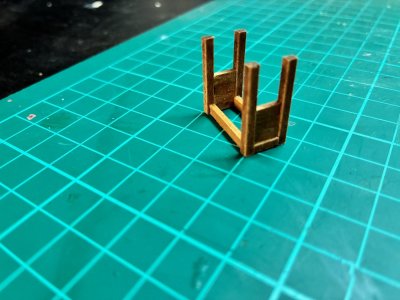
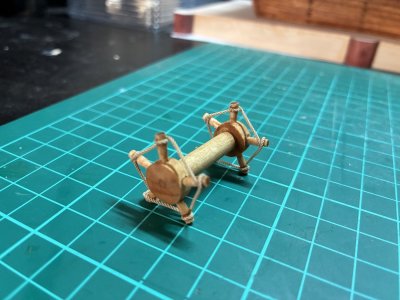
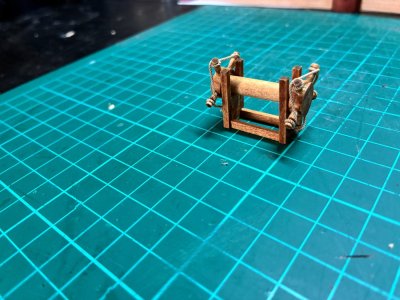
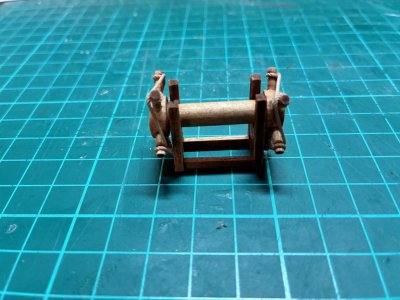
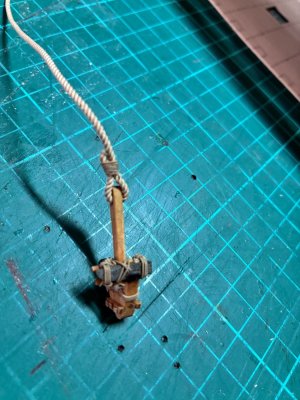
I decided to take a brief break from the base and decided to get to work on the capstan for the anchor.
IMG_6784.jpgIMG_6785.jpgIMG_6782.jpgIMG_6783.jpg

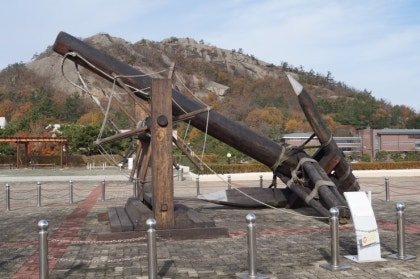
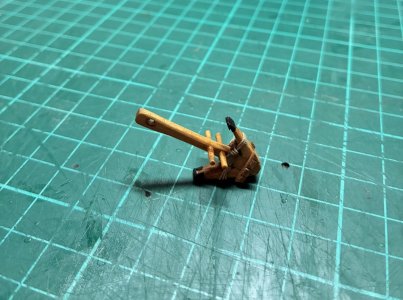
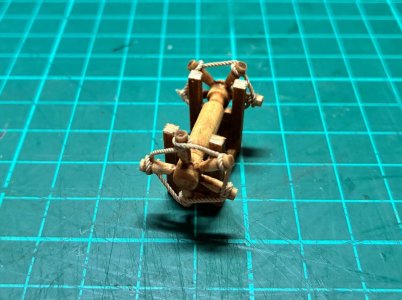
Traditional korean capstans are hard to find information on as they weren't well documented, but some traditional fishing vessels still make use of them. Unlike western capstans, anchor ropes are coiled around a horizontal axel that sits on some form of rack. The bars/levers were all fitted with a continous rope that joined them at the end (though I'm unsure the reason why).
DSC00210.jpgdownload.jpgScreenshot 2026-01-05 093707.png
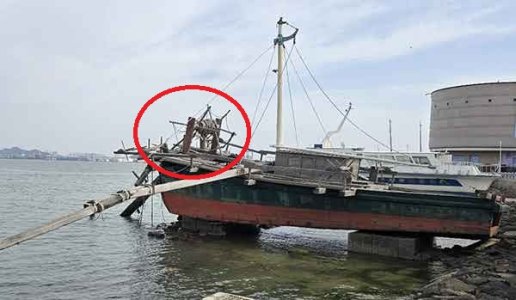
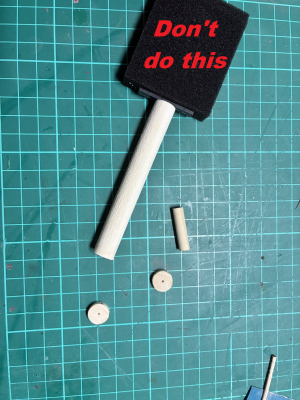
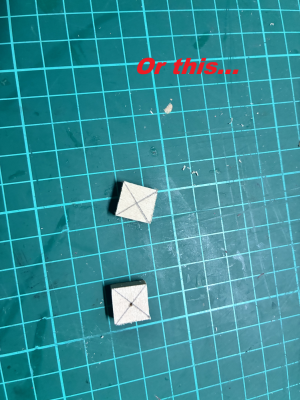
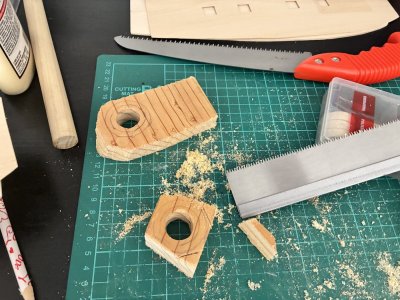
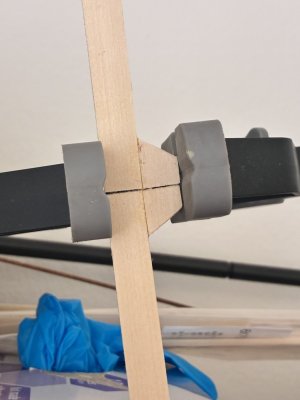
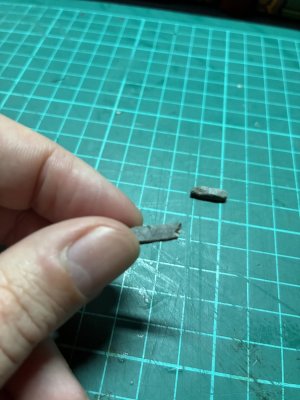
Yes, some anchors and capstans were very massive! The only reference to how this may have looked on a warship was from a video of someone assembling a model of a Korean turtle ship, pictured to the right. Below are a few pictures of my fumbles to get this one, if anyone is interested.
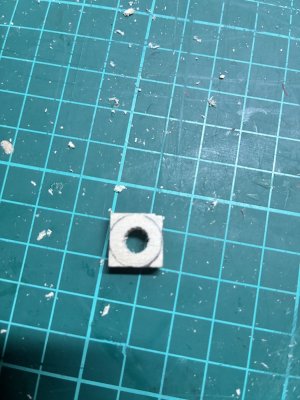
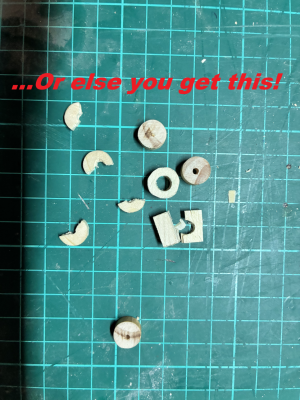
IMG_6776.pngIMG_6778.pngIMG_6779.jpgIMG_6781.png
Lessons learned: Use hardwoods for making very small, instricate pieces, and if needing to have round pieces, avoid trying to round them off by hand.
 
Last edited:
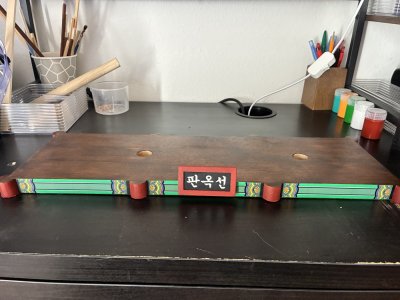
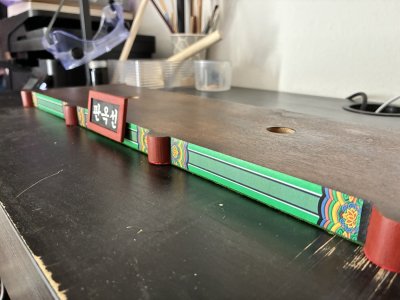
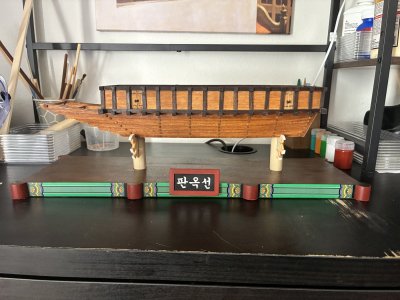
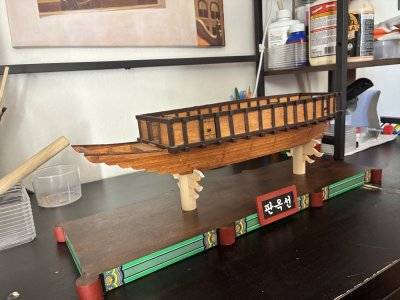
I know it's been a while, but I get the feeling that constant updates of my never ending screw ups isn't the most appealing for all. So I decide to wait until I had some real progress to update. After a lot of trial and error, mistakes and fixes, I finally finished the base of my ship stand.
IMG_6806.jpgIMG_6807.jpg

It took me a few failures with the staining before I threw my hands up and went out for gel stain. For the designs, I had attempted hand painting, but it became very apparent that I don't have the skill for that. So I used my (albiet amaturish) digital design skills to create decals that I could print onto adhesive vinyl sheets. The sign is painted using a stencil I made for the lettering on the sign which is "Panokseon" written in Korean letters. I also used green and red adhesive felt on the bottom to reduce scratches. It's not all 100% done, as I still need to do the pillars for holding the ship. But I'm pleased with how it's come out so far.
IMG_6808.jpgIMG_6809.jpg
 
Last edited:
I decided to take a brief break from the base and decided to get to work on the capstan for the anchor.
View attachment 568555View attachment 568556View attachment 568557View attachment 568558

Traditional korean capstans are hard to find information on as they weren't well documented, but some traditional fishing vessels still make use of them. Unlike western capstans, anchor ropes are coiled around a horizontal axel that sits on some form of rack. The bars/levers were all fitted with a continous rope that joined them at the end (though I'm unsure the reason why).
View attachment 568552View attachment 568553View attachment 568554
Yes, some anchors and capstans were very massive! The only reference to how this may have looked on a warship was from a video of someone assembling a model of a Korean turtle ship, pictured to the right. Below are a few pictures of my fumbles to get this one, if anyone is interested.
View attachment 568559View attachment 568560View attachment 568561View attachment 568562
Lessons learned: Use hardwoods for making very small, instricate pieces, and if needing to have round pieces, avoid trying to round them off by hand.
Hi Danang Apprentice, I am in the stages of making my capstans for the Bounty build. However, before I start to make them ( 2off) of completely different styles,
1 forward of the ship, mainly for the anchors, and aft a standing capstan, typical of the period, first up, I have to build myself a Dividing Head of such dimesions and style that will be totally different to what an actual metal machinist would use, simply because there is no such small enough Dividing Head out there that will be of the correct height I can use on my old lathe. I want to have a crack at making tapered hexagons on wood. I will document on YouTube how I make most of the parts for it, nothing special, but it has to be correct on the centreline. I have purchased, yet to arrive, chucks I can use to hold the wood that one could call small enough, and also a tailstock arrangement, which hopefully will do the trick.
BTW, interestingly, for the Vertical Capstan shape, nothing has changed in shape, except that it has been converted to a hydraulic drive in modern-day European / American Capstan.
BTW, what would you call hardwoods?
 
Last edited:
I decided to take a brief break from the base and decided to get to work on the capstan for the anchor.
View attachment 568555View attachment 568556View attachment 568557View attachment 568558

Traditional korean capstans are hard to find information on as they weren't well documented, but some traditional fishing vessels still make use of them. Unlike western capstans, anchor ropes are coiled around a horizontal axel that sits on some form of rack. The bars/levers were all fitted with a continous rope that joined them at the end (though I'm unsure the reason why).
View attachment 568552View attachment 568553View attachment 568554
Yes, some anchors and capstans were very massive! The only reference to how this may have looked on a warship was from a video of someone assembling a model of a Korean turtle ship, pictured to the right. Below are a few pictures of my fumbles to get this one, if anyone is interested.
View attachment 568559View attachment 568560View attachment 568561View attachment 568562
Lessons learned: Use hardwoods for making very small, instricate pieces, and if needing to have round pieces, avoid trying to round them off by hand.
I'll speculate that the ropes running to each of the levers / arms is to distribute force so when one arm is pulled at least some of the force goes to the next arm(s) as well. It would also help keep the arms fully seated in the drum.
 
Hi Danang Apprentice, I am in the stages of making my capstans for the Bounty build. However, before I start to make them ( 2off) of completely different styles,
1 forward of the ship, mainly for the anchors, and aft a standing capstan, typical of the period, first up, I have to build myself a Dividing Head of such dimesions and style that will be totally different to what an actual metal machinist would use, simply because there is no such small enough Dividing Head out there that will be of the correct height I can use on my old lathe. I want to have a crack at making tapered hexagons on wood. I will document on YouTube how I make most of the parts for it, nothing special, but it has to be correct on the centreline. I have purchased, yet to arrive, chucks I can use to hold the wood that one could call small enough, and also a tailstock arrangement, which hopefully will do the trick.
BTW, interestingly, for the Vertical Capstan shape, nothing has changed in shape, except that it has been converted to a hydraulic drive in modern-day European / American Capstan.
BTW, what would you call hardwoods?
Sounds very interesting, if not more complex than anything I've had to do so far.
Regarding the wood, in my case, it's birch. Nothing fancy, but it was cheap, and readily available. I just said hardwood to contrast it from the softer basswood and balsa woods I had been primarily using. I birch was strong enough to be cut and drilled into the fine shapes and pieces I needed without completely blowing apart on me. I can show you what I mean in a few days when I eventually load up pictures of what I've been doing for the anchor.
 
Last edited:
I'll speculate that the ropes running to each of the levers / arms is to distribute force so when one arm is pulled at least some of the force goes to the next arm(s) as well. It would also help keep the arms fully seated in the drum.
I hadn't thought of that, though it does make sense. My assumptions leaned towards adding more areas to grip. Maybe I'll find the definitive answer some day.
 
Anchors away!


IMG_6818.jpg
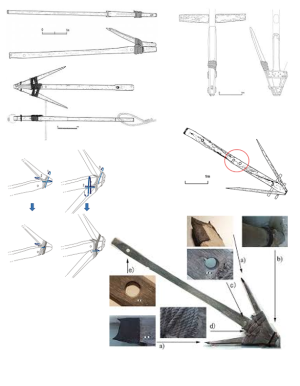
With the capstan done, the next step was obviously the anchor. I knew that Koreans continued to use wooden anchors up to the late 19th century, but it took me a bit of digging to understand the exact design and construction of them. The International Journal of Nautical Archaeology actually had a good article on wooden anchor designs, so that became the core of my research.
Screenshot 2026-02-15 095436.png3935_11238_3715.jpg

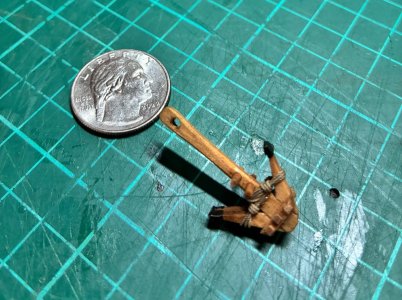
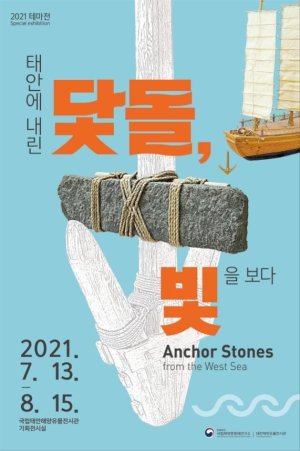
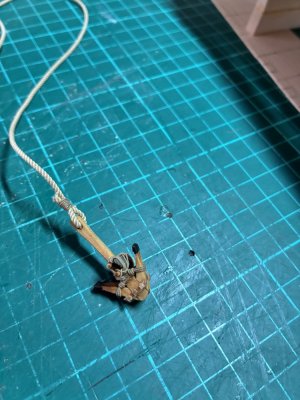
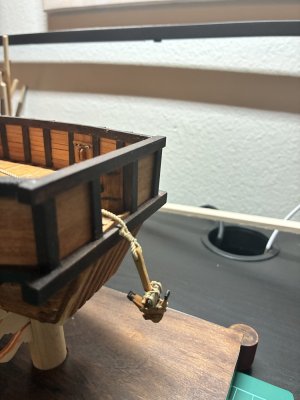
From what I was able to piece together, the arms were secured with a combination of wooden pegs and hemp ropes. Sometimes, iron bands and nails were used, but Korean construction methods likely would not have used them as it would corrode the wood, while the rope and pegs would saturate in the water, making their bindings more tight. The ends of the flukes may also include iron ends, to help dig into the sea floor and protect them. I noticed that some of the anchor shanks had too holes bored just above the anchor head, apparently for 2 stocks that run perpenducular to the arms. Initially, I wasn't sure for the exact reason for this design, but I eventually found a clue by reviewing a book generously gifted to me by @Roger Pellett a year ago. Anchors that were on the smaller side had their weight supplemented with anchor stones, which would be lashed along these stocks.

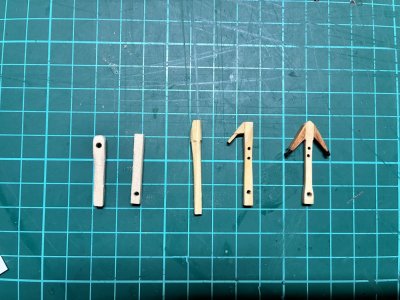
So, once I figured that out, I determined the dimensions (a Panokseon likely could not have an anchor any larger than 4 meters in order to be stored in the lower deck), I got to work. Initially tests shows that basswood was too soft for this work, so I change up my wood game to birch.IMG_6799.jpg
My progression to test pieces, with what would become the final product on the right.

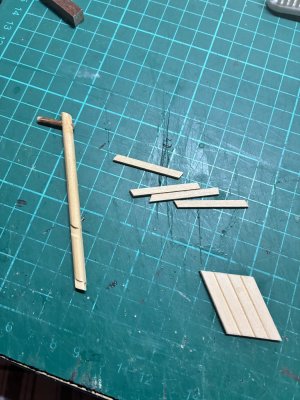
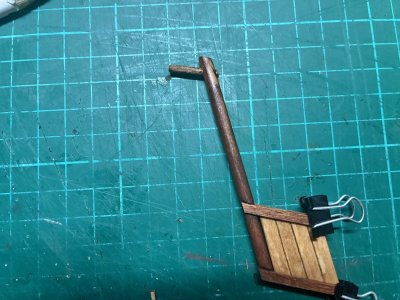
The lashings took a bit of time to figure out, but I think I got them just about right (at least enough to look convincing, even on close inspection). While I was at at it, I also redid the capstan. I found the first one I made was far too large and wouldn't even fit on the deck once I closed it in. So a made one better to scale, this time by turning the main beam to shape.
IMG_6817.jpgIMG_6819.jpg

While the anchor system is about 95% done, I still need to make/find a proper anchor stone. Most likely I'll just make something out of epoxy sculpt, but I need to find where I stored it first!!!
 
Last edited:
"While the anchor system is about 95% done, I still need to make/find a proper anchor stone. Most likely I'll just make something out of epoxy sculpt, but I need to find where I stored it first!!!"
Look in the freezer, as the epoxy should be stored in the freezer. LOL, I think I have some in a freezer as well!:oops:
Anyway looks like you are doing a grand job. Tying those ropes around the anchor as you have done looks really tidy.
Good job, mate.:)
 
Back
Top