• SUBSCRIBE TO SHIPS IN SCALE TODAY!

    The beloved Ships in Scale Magazine is back and charting a new course for 2026!
    Discover new skills, new techniques, and new inspirations in every issue.

    NOTE THAT OUR NEXT ISSUE WILL BE MARCH/APRIL 2026
  • Win a Free Custom Engraved Brass Coin!!!
    As a way to introduce our brass coins to the community, we will raffle off a free coin during the month of August. Follow link ABOVE for instructions for entering.

USS Constitution - Model Shipway’s 5/32” = 1 ft. (1:76.8) Kit No.: MS2040

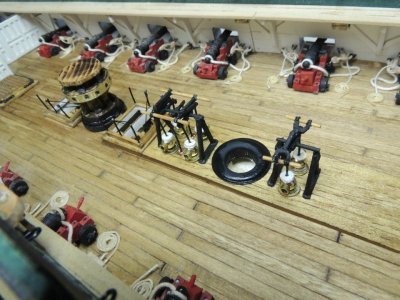
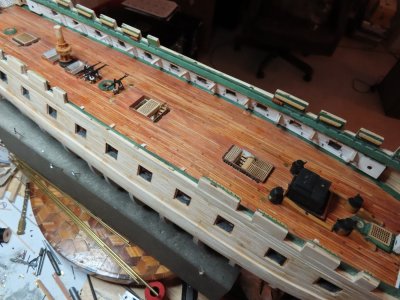
I tried looking at other builders to see what they did, but the only builder I could find that decided to show the interior of the gun deck as I had planned was SawdustDave (at ModelShipWorld). Unfortunately for me, he made his model at a larger scale of 1:60 and he did not provide a lot of detail to the actual construction process of his bilge pumps. He did, however, have some excellent photos. I hope to do as well but at the smaller scale of 1: 76.8.

DSCN2297.JPG

DSCN2301.JPG
 
My first thought was to create the A-Frames and rocker arm assemblies from 1/32” and 1/64” spruce plywood; that or boxwood. But cutting such small delicate pieces with precision daunted me. My next material option was for the most part, brass bar and brass rod. If I make the frames right, they should be sturdy enough.

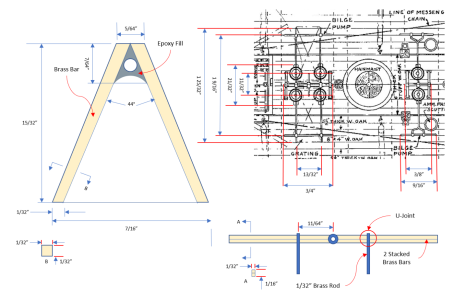
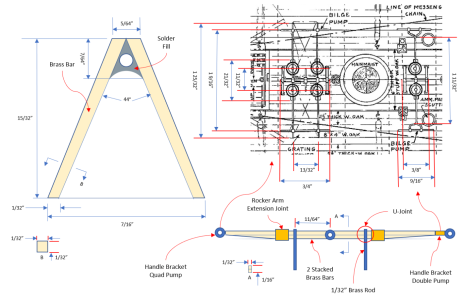
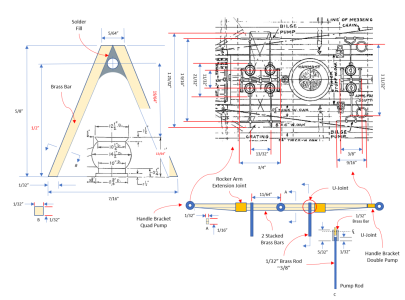
This brought up the next question, what method should I use to fasten the brass pieces together, specifically at the apex of the A-Frame? I thought of a few choices that I could use. Epoxy, glazing putty that I use as wood filler on the hull, or silver solder. The “glue” would also have to act as the A-frame apex filler from which an axial hole could be drilled. The preliminary plans are shown below. The rest will be developed as I go along.

Pump Plan.png
 
My first attempt using the epoxy method was a failure...not due to my concept but seemingly due to the epoxy. I made a very simple jig which was laid on a piece of wax paper. The wax paper prevented the epoxy from sticking to my work bench surface and it would easily peel off the fastened joint. After the epoxy set after six minutes as indicated by the epoxy instructions, I had expected the epoxy to be rigid. Instead, it was like a slightly flexible hard rubber. The epoxy did not adhere well to the brass pieces. The brass legs were easy to pull apart from the epoxy. Even after four hours, which the instructions stated were needed to cure, the epoxy remained flexible. Maybe I had the wrong type of epoxy.

My second attempt was with the glazing putty. This actually work somewhat. However, the putty shrinks as it sets up after about a half hour, so that the web in the A-frame apex had a concave surface and thus additional putty would be required. On the plus side, trimming the excess dry putty was easy and quick.

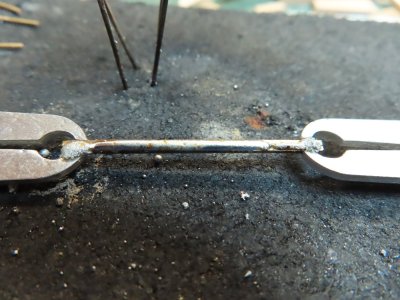
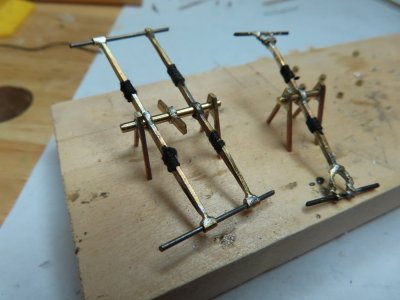
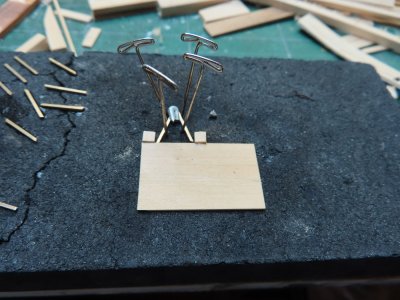
My last attempt was with the silver solder. It worked. I had to condition the bras pieces with acid to clean the surfaces and work off a heat-resistant surface. Trimming the excess solder with a hand file was a bit more tedious. As a bonus, the solder apex web appears to be strong enough to have a hole bored through it for the axial, which I not sure the glazing version could do.

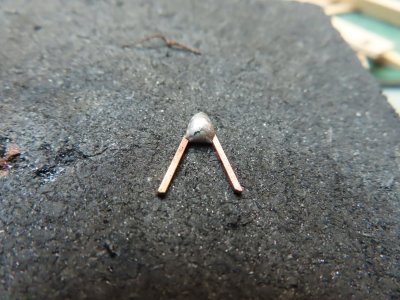
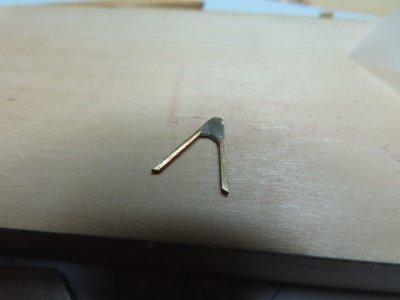
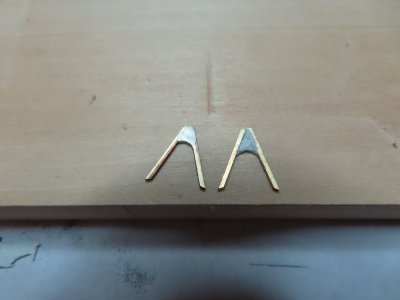
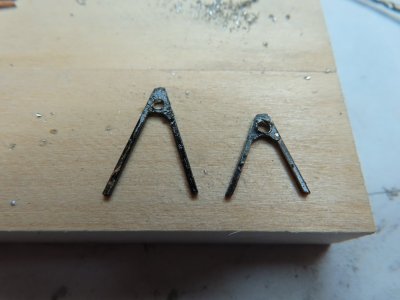
In the photos below, is the set up for the solder process. The wooden jig is removed of course before I hit it with the torch. The last photo shows the comparison between the soldered version and the glazing version after I trimmed off the excess materials. I’ll redo the glazing version with solder. One down, 11 more to do.
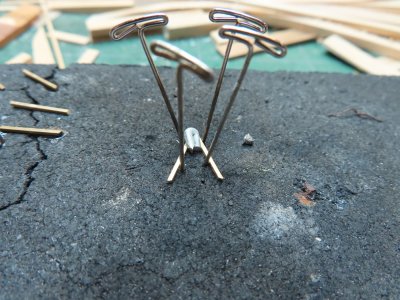
IMG_1726.JPG

IMG_1727.JPG

IMG_1728.JPG

IMG_1723.JPG

IMG_1729.JPG
 
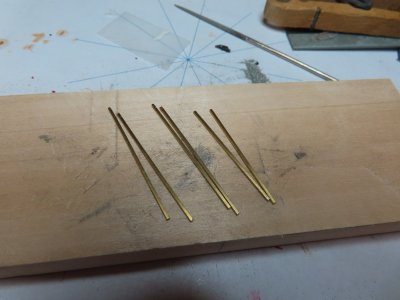
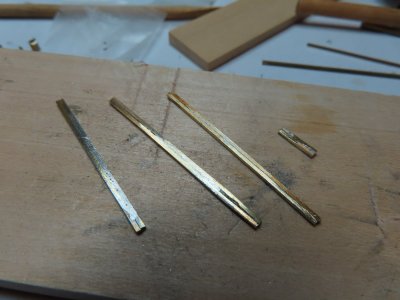
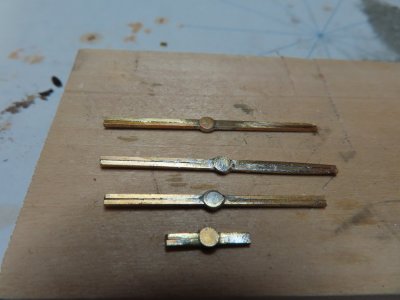
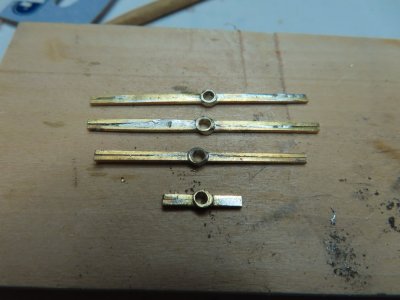
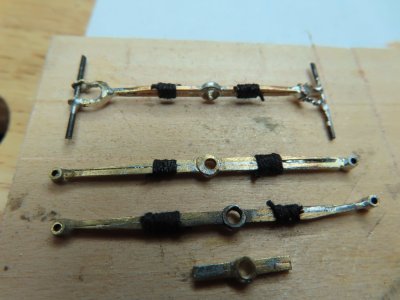
This next part of the bilge pump part deals with the two longest rocker arms and the one short one from the quad pump, and the one slightly shorter long arm from the double pump. At first glance I thought this would be relatively simple. It wasn’t. Instead of making the rocker arms from 1/32” plywood, I decided that the arms would be durable if they were made of brass bars. Because I didn’t have rectangular cross-section bars, I made the rocker arms using two, 1/32” brass bars stacked upon each other.

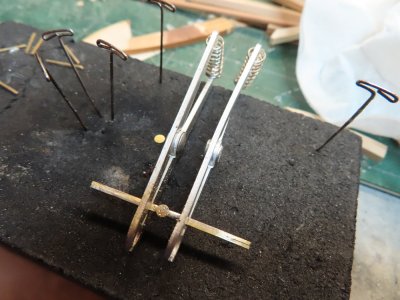
The two bars were clamped together with two aluminum pinching clamps. A bead of silver solder paste was applied along the junction of the two pieces. This, by the way, was my first time using solder paste. The advantage of paste is that no addition flux is required. Using a small Butane torch, the solder melts into the seam in a matter of seconds. The excess solder was then filed away.

IMG_1730.JPG

IMG_1731.JPG

IMG_1732.JPG

IMG_1734.JPG
 
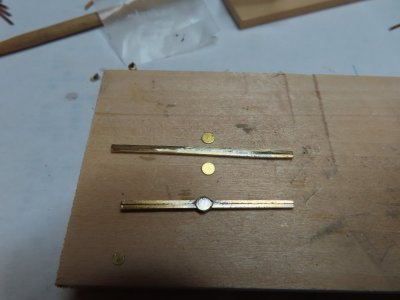
A hole at the center is required for the pump axial to pass through. My best guesstimate for the axial diameter worked out to be a 1/16”. You can see the problem here, If I drill a 1/16” hole through the 1/16” x 1/32” bar, it will cut the bar into two. The actual pump rocker arm has re-enforcing at this juncture, and I had to come up with something like that.

Using a 3mm punch, I made eight brass discs from 0.005” brass plate. This is the same brass plate I used to make the “bolt heads” on the bulwarks. The discs are wider than the rocker assembly. The trick here was to solder a disc dead center on either side of the rocker arm’s 1/16” face. Solder paste was placed on one side of a disc and positioned into place using solder paste like glue. On either side of the solder area the aluminum clamps were attached to act as a heat sink to prevent the bars from heating up, melting the previous solder and thus come apart. The flame was focused on the disc and as soon as the solder melted, the heat was cut. Then the assembly was flipped over, and the other disc was positioned opposite the first one. The gap between the two discs which extended over the bar was to fill with solder when the second disc was soldered. Again, the excess solder was filed away. This worked well enough for this scale.

IMG_1735.JPG

IMG_1736.JPG

IMG_1737.JPG
 
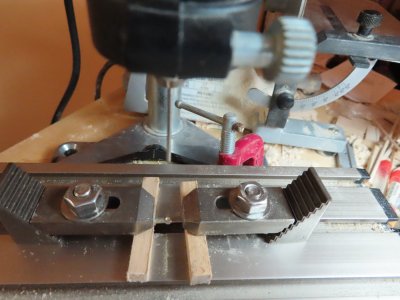
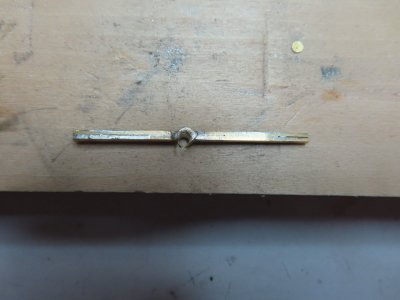
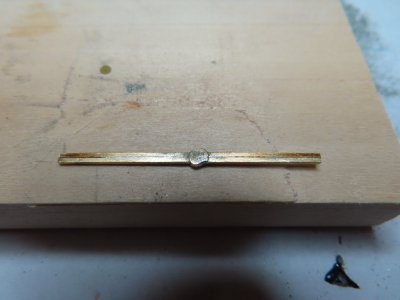
Using a metal cutting #53 drill bit and my old Dremel drill stand as a drill press, I attempted to drill the 1/16” hole into the rocker arms where the re-enforcing discs were located. The #53 bit is just a tad smaller than 1/16” which give me a bit of a cushion when making the final hole adjustment. The precision of the stand leaves a little bit to be desired. My first attempt on the first bar worked in so far as making a hole. The problem was the hole was off just enough (about 3/128”) that it cut through the edge. This was repaired with more solder. The results are not polished products yet as there is still much to do.
IMG_1741.JPG

IMG_1739.JPG

IMG_1740.JPG

IMG_1745.JPG
 
The bilge pump rocker arms have arm extensions so that the ship’s crew can consolidate the pumps for more working space when not in use. The photos of the actual ship show the bilge pumps in their stowed configuration with the rocker arms extensions removed and lashed to the pumps.

I plan to have the arms fully extended so the typical viewer can understand their function better. There are two kinds of rocker arm handles. The double pump has a “Y” branch to a double bracket for the handle while the quad pumps have a single bracket and a long handle connecting two pumps. To top it all off, the rocker arms are tapered to the handles from the extension joint. These details required me to further refine my bilge pump plan.

Pump Plan - Modified - 1.png
 
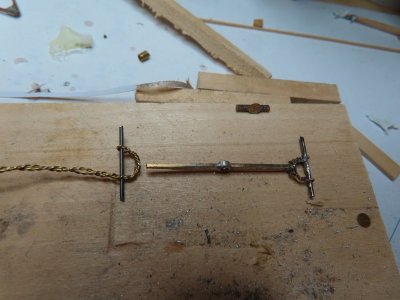
First, I tapered the rocker arms, then I created the handle brackets out of 1/16” brass tube. The problem that presented itself and which drove me crazy was that there was extraordinarily little surface area to bond the bracket to the arm. I threw away my two-part epoxy and bought fresh. The bond failed again. Once more the cured epoxy was more like a hard rubber. I could peel the epoxy off the brass with a dull knife. So, it was back to solder. Before every attempt, I cleaned all the surfaces with mild acid. It took nearly three tries per bracket till I finally got a solid bond.

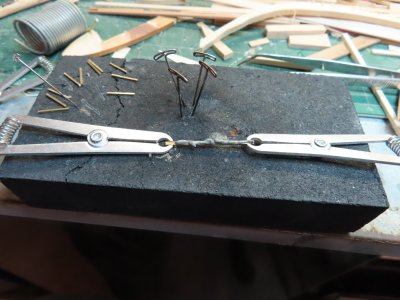
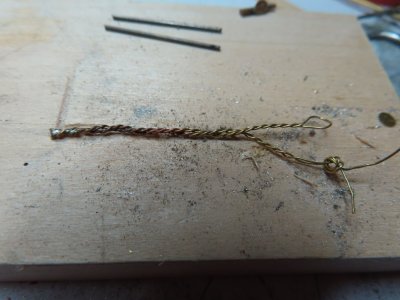
Almost as frustrating, was the Y-branch bracket – how to make it and keep it strong? How do I create a 3-part joint and then connect it to the rocker arm? I came up with a solution but there is probably a better solution out there. I just didn’t think of it. My solution was to double twist two brass wires and create a kind of brass rope. I could then open the braided strands to insert the rocker arm and handle. Once I had that, I lathered the brass rope with solder flux and solder paste and fired up the torch. The idea was that the solder would fill in the voids in the rope making a solid piece. This too took numerous attempts. The excess solder was then filed off. I had to be careful here because I didn’t want to remove too much solder and weaken the bond…again.

I almost forgot, the handle material is music wire, very stiff. Wood would have broken, burned, and it didn’t solder very well.

IMG_1749.JPG

IMG_1748.JPG
 
The last bit to complete the rocker arms were the extension joints. This is where the extension arm slides into a short pocket to create the extension. I thought about gluing 1/16” piece of wood to simulate the “box” bracket, but in the end. I just wrapped some thread around the arm with a dab of CA glue to create the illusion of a boxy bump on the arms. Most of imperfections will disappear under black paint and low light viewing conditions.

IMG_1750.JPG
 
I put the bilge pump pieces I’ve made up to this point together (dry fit) to see how everything is fitting. This close up shows there still is a bit of polishing the surfaces and fine tuning to do, but overall, so far, so good. On to the pump rods and copper spheres.

IMG_1751.JPG
 
All the pump rods pass through the copper spheres which have a discharge pipe except for two which are mounted on the short rocker arm. They passed through the deck directly.

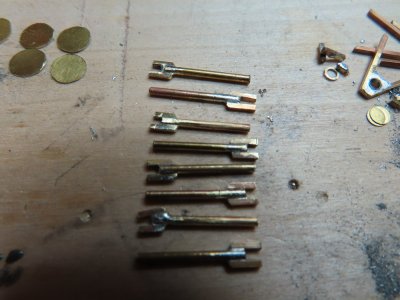
The pump rods were made from two short pieces of 1/32” bar and one longer piece of 1/32” rod. These were solder together.

IMG_1756.JPG
 
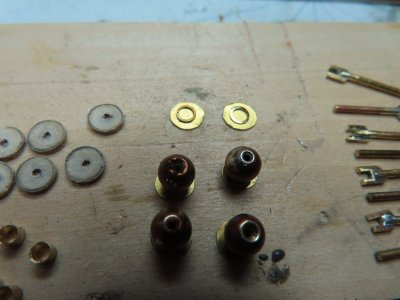
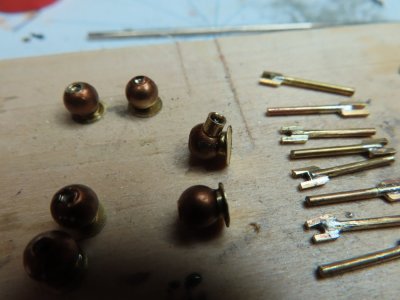
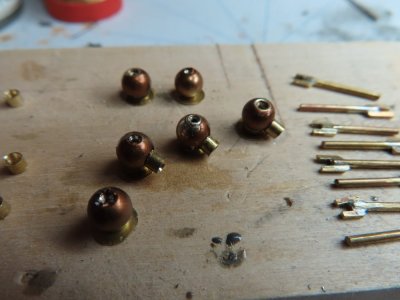
Starting the fabrication of the brass sphere assemblies, not having a punch of the right size, brass discs were hand cut from a 005” thick brass sheet, the same sheet I used to make the bulwark “boltheads.” Next, 1/32” thick slices of 3/64” dia. brass tube for the quad pumps and 1/64” slices for the double pump, were then CA glued onto the brass discs.

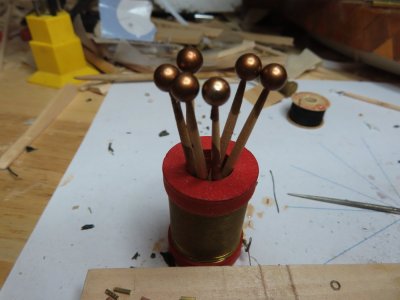
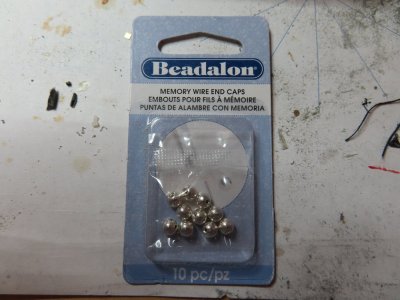
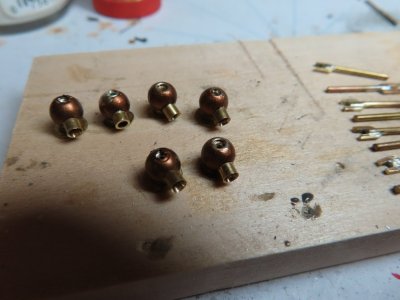
I bought some 5 mm “memory wire end caps” (don’t know exactly what their original intended purpose was) in the DIY jewelry section of Hobby Lobby. I would have been just as happy with plain spherical beads but couldn’t find any of the right size and surface smoothness. These “caps” had one opening which did not pass through to the other side. I stuck them on the ends of toothpicks and painted them with copper enamel.

The spheres were then CA glued onto 1/32” slices of brass 3/64” dia. brass tube for the quad pumps and 1/64” slices for the double pump. The discharge tubes were added angled slightly down for the quad pumps and horizontal for the double pumps. Why the pumps were designed this way, I don’t know.

IMG_1752.JPG

IMG_1754.JPG

IMG_1757.JPG

IMG_1758.JPG

IMG_1759.JPG

IMG_1760.JPG
 
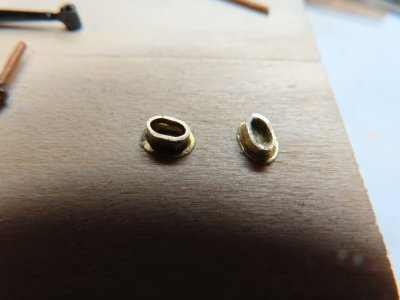
The last two pump rods attached to the short rocker arm in between the two longer rocker arms on the quad pump go directly through an elongated brass guided opening in the deck. These guides were fabricated by squeezing a brass tube flat to the proper shape and slicing them off. They were capped off on one end by a piece of the brass sheet. Of course, in reality, the opening is not blocked like the model.

IMG_1762.JPG
 
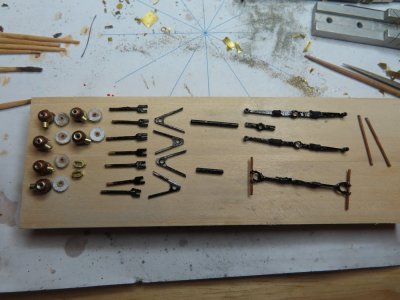
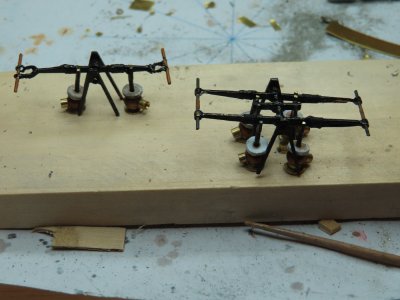
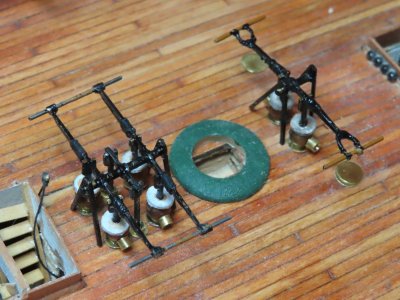
On top of the brass spheres there are what appear to be white discs. They are in fact protective canvas coverings over the top openings. These were made from 1/32” plywood. The top surface was beveled slightly inward with a Dremel tool. They were painted white with a small brown center. The pump rods will pass through the openings into the spheres. The remainder of the pieces that needed to be painted were painted gloss black. (Note the paint job may look a bit splotchy, but that’s just the weird reflections in the photo.)

I just did not realize how many parts there were to the bilge pump when I started. As it turned out, the fabrication required 67 separate pieces of wood and brass rods, bars, tubes, and sheets. This does not include all the rejected parts made during the course of fabrication. Assembly is next.

IMG_1761.JPG
 
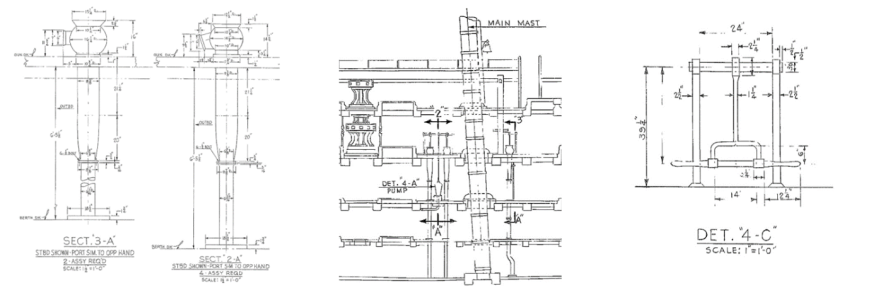
I started to assemble the pumps, but when I got to the spheres and pump rods, things went awry. The pump rods were way too long. I deliberately made them a bit longer so I could make fine adjustments when installing the pumps onto the deck, but this was way off. I checked the dimensions of the spheres, the and the A-frames. On their own they appeared correct. When I designed the parts, I used US Navy plan No. 50976, “Fittings, Pump & Pipe Fittings Over Galley, Sketches of Fire Pump-Berth Dk Water Pump-Berth Dk.” which shows the dimension of the spheres among other things and plan No. 24423, “Gun Deck General Arrangement Taken from Work Navy Yard – Boston”. I couldn’t find a drawing of the A-frame nor the pump rods, so they were designed from photos. Upon re-examining plan No. 50976, I discovered there was a partial sketch of the A-frame. I was pretty close to the actual dimensions for the A-frame but the upshot of this was, I made my A-frame about 1/8” too short in height. That’s about 9 5/8” in actual height. The cap size I bought for the spheres was close enough, but the tube slices I used to build the sphere assemblies had cumulative tolerance errors making the assembly a bit too tall. The Navy plan has the assembly as 13/64” scale vs ¼” as built. All in all, I lost up to ¼” space for the rods. That’s 40%. At 76.8:1 scale, the tolerances are very tight. As a result, I will remake the A-fames to gain some height. The spheres assemblies are locked tight with CA glue so those will remain.
Below is a photo of the miss-matched pump rod, the pump plan revised again (red dimensions), plus the applicable sections of the US Navy plan No, 50976.

IMG_1764.JPG

Pump Plan - Modified - 3.png

Bilge Pump US Navy Plan Sections.png
 
Remaking the A-frames to make them about ¼” taller was much easier this time as I knew what had to be done. The results were successful.

IMG_1765.JPG
 
After re-drilling the holes in the spheres, a bit wider and deeper, shortening the pump rods to their proper lengths, and with some trial and error, I think I got it. Here is an early dry fit test. The pieces must now be glued together, and paint added to worn areas during the adjustment and constant re-assembly process.

IMG_1766.JPG
 
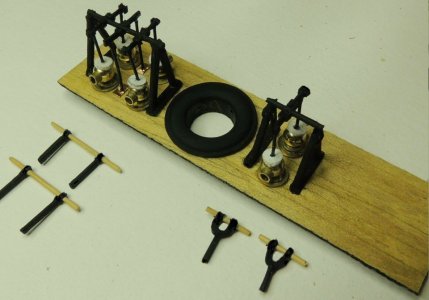
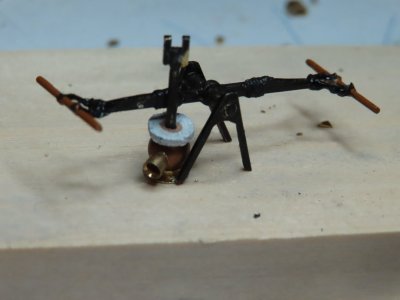
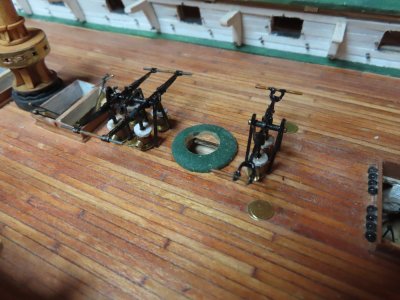
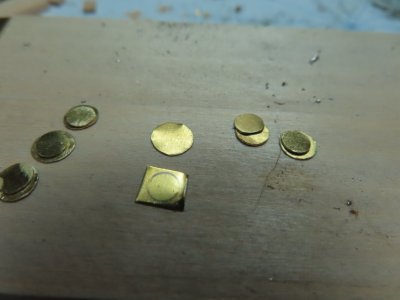
Finally, the bilge pump pieces are glued together without any more major mishaps! Before I even added the touch-up paint, I had to see what they looked like on the deck, I also fabricated and placed some brass discs on the deck to represent the ammo scuttles. Nothing however is glued down to the deck, and I don’t plan to until I finish creating all the deck furnishings including the guns and gun rigging.

IMG_1769.JPG

IMG_1767.JPG

IMG_1768.JPG
 
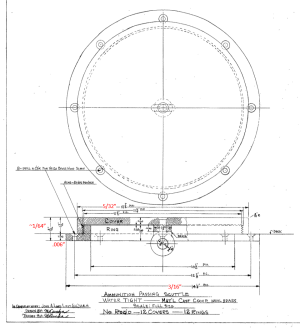
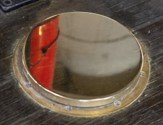
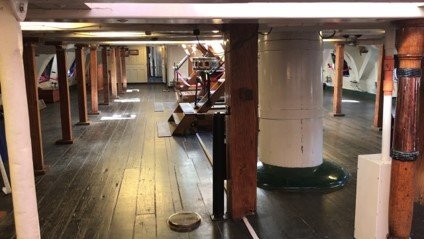
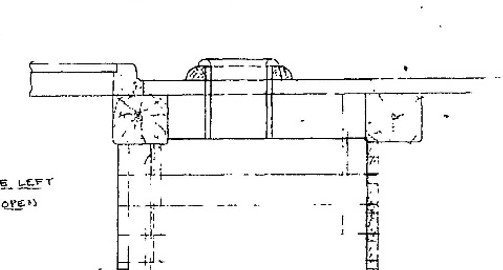
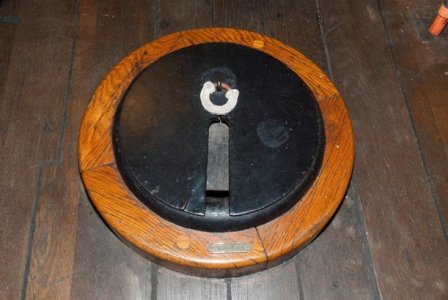
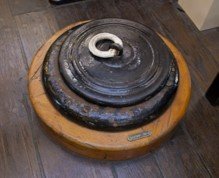
In my last post I mentioned that I made some brass discs to represent the gun ammo scuttle. Here is what I based that on. Below is the US Navy plan for the scuttle with my scale dimensions in red as well as the actual scuttle images. In the end I glued them into place.

Ammo Scuttle Plan.png

Ammo Scuttle.jpg

Ammo Scuttle Gun Deck.jpg

IMG_1770.JPG
 
Chain and Rope Pots (Pipes)

There wasn’t much that I could find in the US Navy plans about these chain pots or pipes. This is where the anchor chains and ropes are funneled through the gun deck to their storage areas. The arrangement plans call them “pots” but the labels on the actual item on the ship call them “pipes”. I did find a rudimentary drawing which I believe is for the forward chain pot (labeled Hawse Pipe on the ship). The scale dimensions were determined by actual dimensions on other parts of the drawing (not shown). They appear to be the same size as the aft pots which is to be used for the anchor hemp rope, but don’t have the extra shoulder.

Chain Pot Plan.jpg

Chain Pipe.jpg

Chain Pot (Hawse Pipe).jpg
 
Back
Top