Follow along with the video below to see how to install our site as a web app on your home screen.
Note: This feature may not be available in some browsers.
Ships of Scale has incorportated an extra level of security when you log In. Please follow
on-screen prompts to acknowledge that you are not a robot via a "Check Box" or a "Pictorial Check Box Puzzle". This is needed due
to higher level of AI Activity Security.
The beloved Ships in Scale Magazine is back and charting a new course for 2026!
Discover new skills, new techniques, and new inspirations in every issue.
NOTE THAT OUR NEXT ISSUE WILL BE July/August 2026
Win a Free Custom Engraved Brass Coin!!!
As a way to introduce our brass coins to the community, we will raffle off a free coin during the month
of August. Follow link ABOVE for instructions for entering.
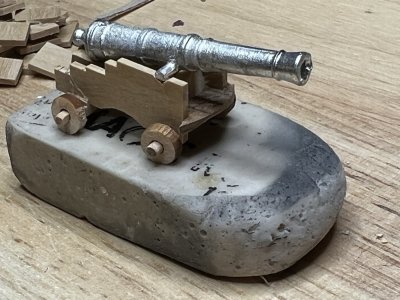
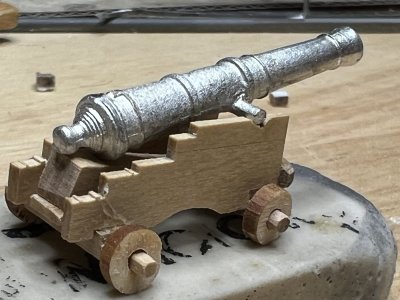
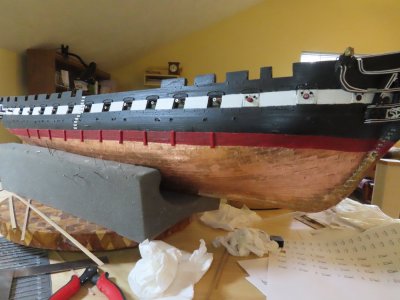
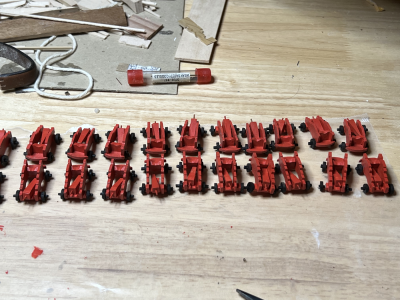
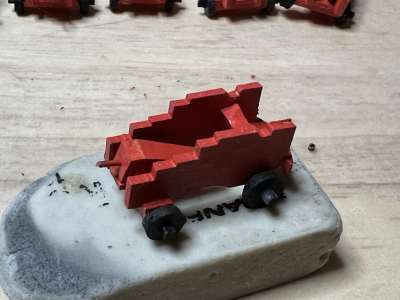
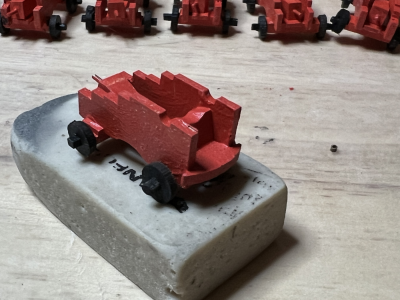
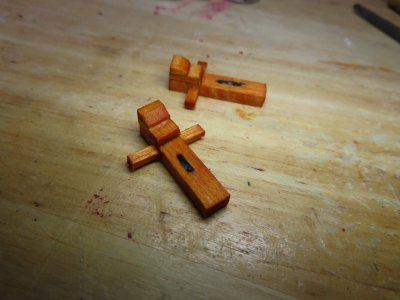
Well, I’ve finally completed fabricating the gun carriages and glued together all the wooden parts save for the quoins. BTW, the quoins shown in the photos below did not have their handles installed at the time of the photo shoot. They were made from 0.032” brass rod.
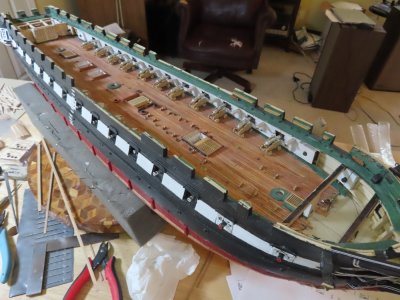
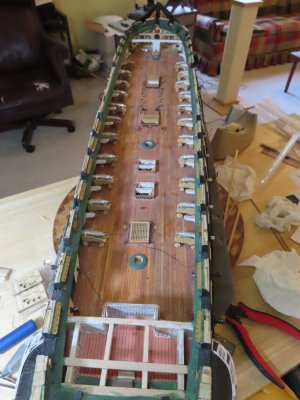
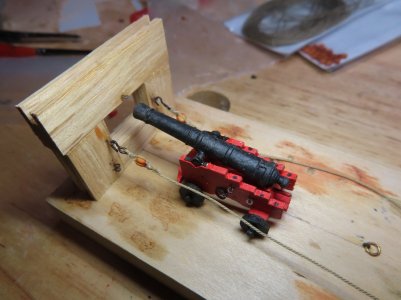
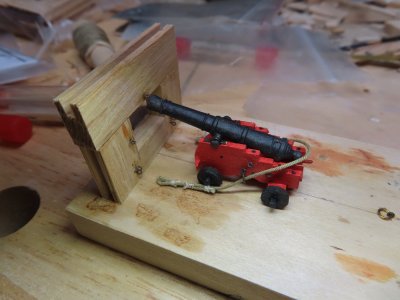
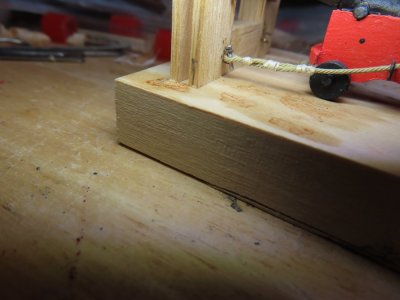
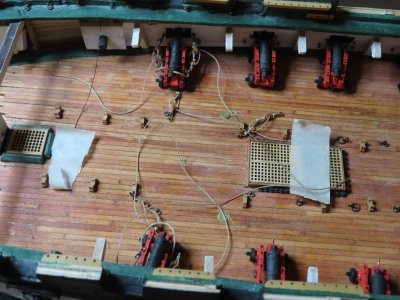
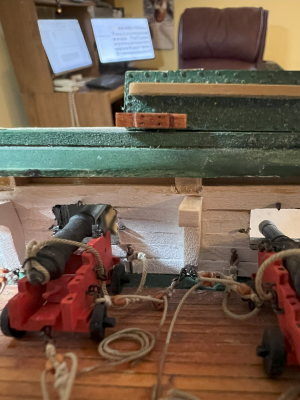
I’ll glue those down for the final adjustment of the gun barrels, after the carriages are completed. Next up, is painting the carriage bodies red and the axials and wheels black. Still to come are the addition of the metal hardware and rigging. To give myself a preview, I’ve temporarily placed the gun assemblies in their positions on the gun deck.
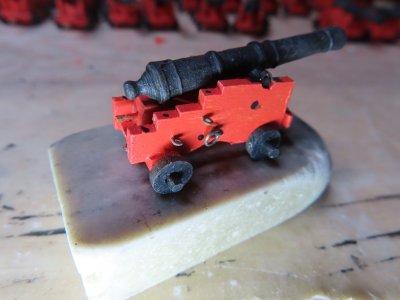
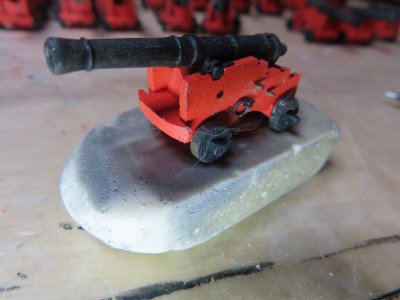
Gun carriages have several eyebolts and rings to facilitate the movement of the gun assembly during firing and positioning. In numerous builds I’ve seen posted, it appeared to me that the eyebolts used on their gun carriage were way out of scale – much too large. Relative to those, mine may appear too small to many viewers.
Using the US Navy plans for the 24” pdr. gun carriage as my guide, it shows for each carriage side, three horizontal eyebolts at approximate 1½” ID or (0.02”) 1/64” at scale. Making that size eyebolt is nearly impossible (for me) and not practical, so I’m using 1/32” eyebolts. These I have purchased from Model Expo and used over the years. One of the eyebolts has a 2½” ID or (0.036”) 1/32” at scale ring attached. To maintain the illusion of size difference, I used a 3/64” ring. The eyebolts on the forward and aft axials are 1¾” or (0.023) 1/32” at scale. Again, to maintain the illusion of size difference, I used a 3/64” eyebolt. In lieu of black paint, the hardware was blackened.
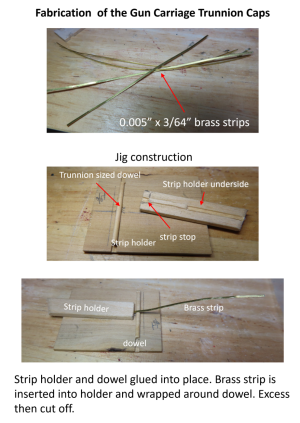
The trunnion caps although simple in construction, were a little trickier to handle and form due to their size. I made mine 3/64” wide by approximately ¼” raw length. It shortens up when shaped around the trunnions. To facilitate its fabrication, 0.005” thick brass plate was cut into 3/64” strips using the Byrnes saw. These strips were fitted into a simple jig to form their cap shape. The jig basically held down one end of the strip at fixed length, while the remainder was pressed over an equivalent trunnion diameter dowel. Then the opposite end of the cap snipped off the remaining length of the strip.
When I tried to blacken the caps, I realized that the last of my Blacken-it solution had lost its potency. It seems that the company that makes the stuff is no longer in business. So, I must wait until my order of Jax Black arrives. I’ve never used this product, so we’ll see how it goes. In the meantime, I’ll be adding all of the eyebolts and rings to the remaining 21 gun carriages. In the image below, the cap is dry fitted and unblacken.
Jax Black arrived and seemed to work just like Blacken-It, so all the trunnon caps were blackened. They were fastened to the carriage with CA very carefully so that the barrel could still rotate for final adjustment when the guns are placed in their final positions. Due to their function, the quoins are not glued in place awaiting that final placement. In addition, black dots were painted on the carriages to represent the black bolts. At this scale and final viewing location, that’s all that is needed. When I looked back at the practicum for the spar deck, that is exactly what Mr. Hunt did for the cannonades’ bolts.
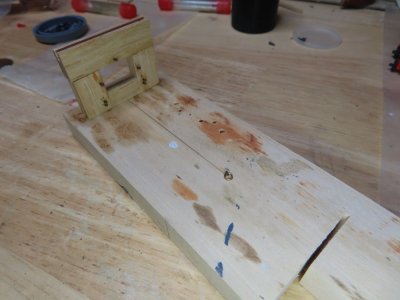
In preparation for the fabrication of the guns’ train tackle and breeching lines, a jig was made to facilitate the fabrication of those lines off-ship. Because the kit obviously does not have any supplies for the gun-deck guns’ rigging, 3/32” single blocks, 1/8” double blocks, 0.018” and 0.030” scale rope purchased from Syren Ship Model Co.
Things are going to get crowded on the gun deck. To install the guns, the anchor ropes and chain might need to be installed first, as the guns’ tackle will lie on top of the anchor cables. Also, the structural elements such as the diagonal knees, stanchions, and spar deck beams and braces all need to be installed in concert as I move down the length of the gun deck. Additionally, all the gun deck furniture that was fabricated earlier needs to be installed as well.
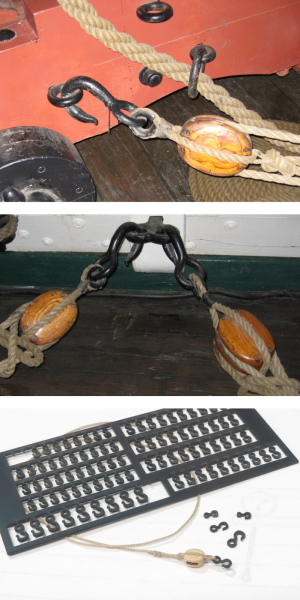
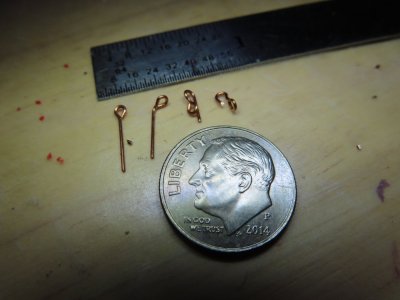
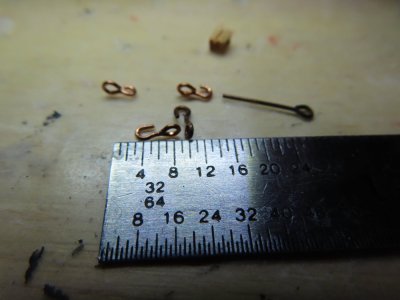
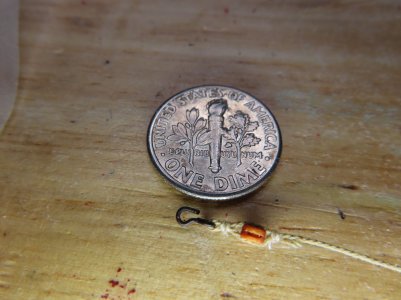
So, to start off simply, gun rigging also requires six hooks per gun which need to be either fabricated or purchased. Syren offers plastic hooks but unfortunately, there is a problem. The problem exists not only with Syren’s product, but with other manufactures as well, be it plastic or photo etched. The eye of the hooks is parallel with the hook itself. In the picture below, you can see the actual hooks have the eye turned at a right angle to the hook. It appears I will have to fabricate at least 132 1/8” hooks just for the gun deck. I haven’t checked out what the kit has supplied for the spar deck. If anyone knows a cheap supply of properly formed hooks, I would be very interested.
The blocks were stained with Minwax Gunstock 231, then the hooks were attached to blocks. Because of the small scale, wrapping the miniature rope around the block and seizing it was slow.
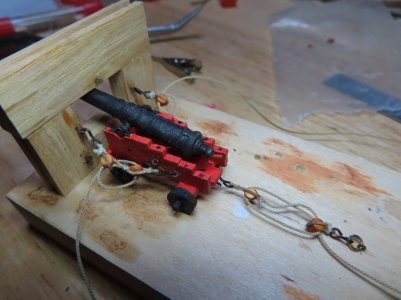
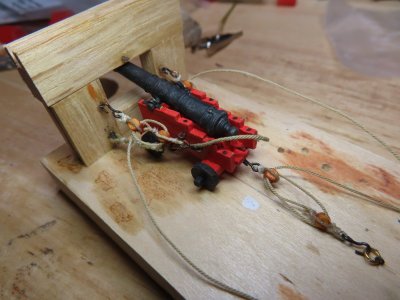
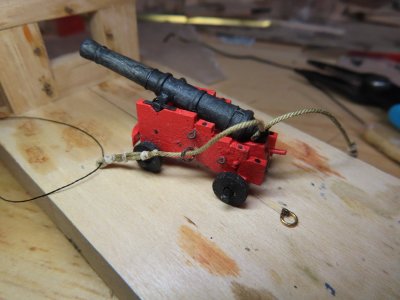
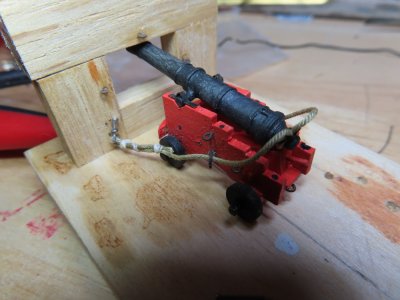
Initially I had difficulty threading the rope through the block sheaves. I’m pretty certain that the holes that were originally drilled into the Syren blocks were of the correct size for the scale, but the scale rope was definitely not going to fit. I first re-drilled the holes to match the size of the rope diameter. Then I applied CA glue to the tip of the rope to hardenite it into a needle point. I eventually got one rope through the single block sheave, but it took a lot of time, patience, and tenacity. So, I increased the sheave holes size twice more before I got a reasonable result. The holes may not be to scale, but no one will notice. In the first picture below, the 3/32 single blocks were for illustration purposes hooked to the bulwarks but eventually were attached to the carriage and the double blocks to the bulwark in the second image
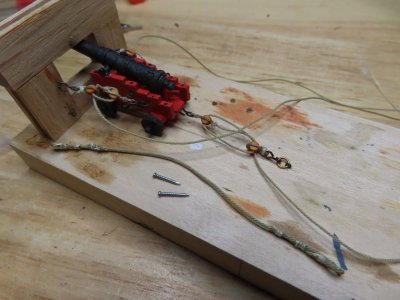
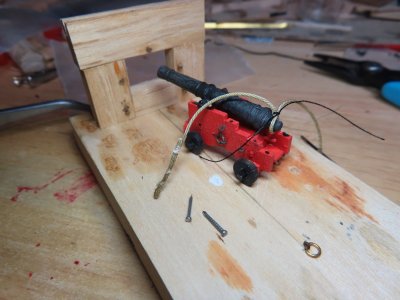
When I tried to thread the recoil rope through the vertical rings on the carriage, it wasn’t as easy as it seemed. The triple seized looped ends of the rope didn’t fit through the vertical ring. Note, in the image below, the initial recoil rope was made too long and was subsequently trimmed down.
All the tackles were removed because I found it much easier to thread the recoil rope first when I could hold on to the flopping vertical ring for threading the recoil rope. After a little trial and error, I passed a piece of thread through the ring then through the rope end loop and back through the ring again. After a little coaxing, I was able to pull the loop through the ring with the thread. Rope just does not want to be pushed. Then the tackle lines were rebooked on.
The triple seized looped ends of the recoil rope were attached to bulwark with pins that drop through two eyebolts attached to the bulwarks with the rope loop in between. The pins were created by shortening nails (typically used for nailing planking to bulkheads, seen in the above image). Nails were used because of their nail heads. A piece of rod would just fall through the eyebolts. Those nails had to be filed just a bit narrower for them to fit through the bulwark’s eyebolts. All of this work was done on the protype in the jig.
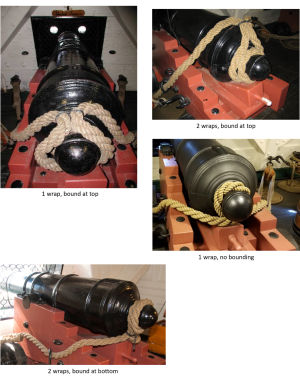
The recoil rope is wrapped around the spherical nob or button at the back of the gun, but there does not seem to be a consistent method used on the Constitution (see first image below). Once more I removed all the tackles because I should have done this before I threaded the rope through to gun’s rings. I chose the simplest method to attach the recoil rope on the gun button as seen below. This ensures I could make each side of the rope equal length. Once more, the rope was threaded through the vertical ring and pinned to the bulwark. With the recoil rope now installed properly, the remainder of the tackle re-hooked once again. The gun jig proved its worth. I would have hated having learned the sequence while trying to do this on the model. Now I’ve got two guns rigged and sitting on the model. The rope positions are not finalized nor is anything glued into their final position. I want these loose until I build the beams supporting the spar deck with its stations, not to mention the furniture I’ve already fabricated. There are a lot of moving parts that must fit, and I want the flexibility to adjust them if needed. Only 20 more to rig. Working out the proper assembly sequence is also a good reason to make this jig.
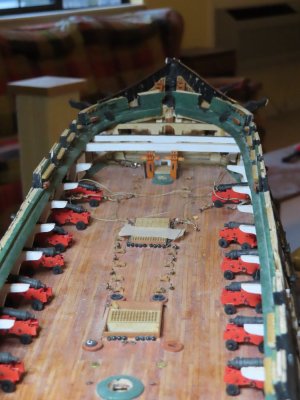
As I started rigging the third gun and thought, I’m going to go nuts rigging the remaining 20 guns all at once. Not only that, where am I going to store them prior to installation as I will have a bunch of other items (as I’ve mentioned before) that will need to be fabricated and installed as well? So, I decided to put that aside and fabricate the forward gun deck bitts and work my way aft installing all the bits and pieces as I progress one gun port at a time. This way, there will be less loose pieces and it won’t get monotonous.
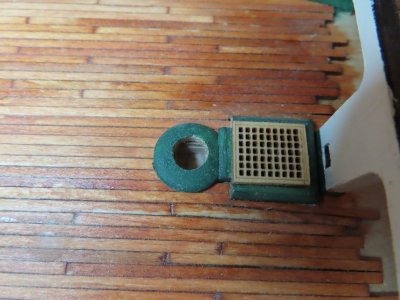
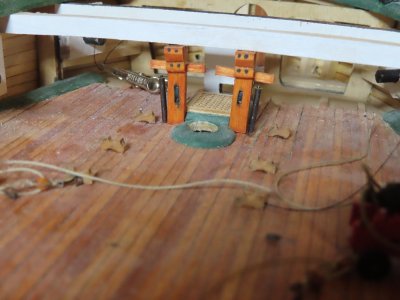
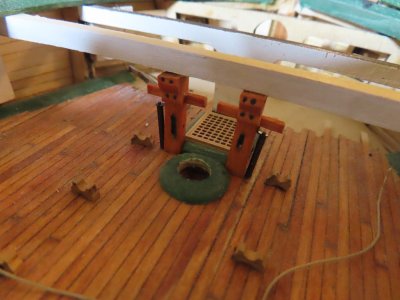
First, I fabricated the ceiling beam between bulkhead C and D. When creating the gun deck so long ago, the spar deck beams, that were previously cut off the hull forming bulkheads, were saved. (These will be used later as the spar deck is fabricated.) Using the bulkhead C beam, a new beam shape between B and C was extrapolated, fabricated, and positioned directly over the aft end of the most forward grating. This grating was previously fabricated with aft notches for the bitts going from the gun deck to the ceiling beam.
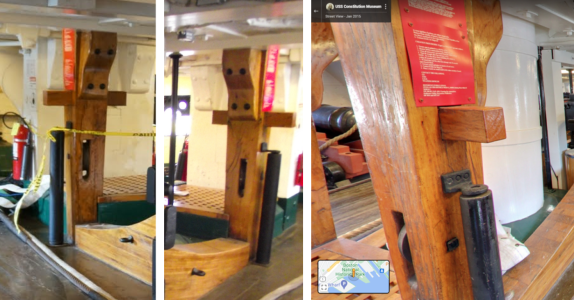
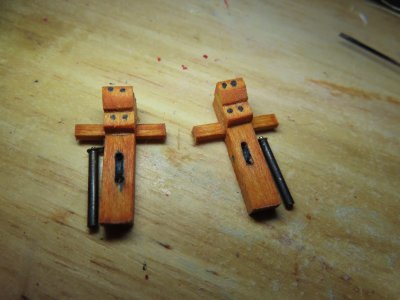
These bitts have a vertical sheave and a horizontal beam which passes through the vertical structural element. Based on the US Navy arrangement drawing, I determined the scale size of the vertical post as 3/16” width x 1/8” depth but did not find any other plans for these bitts. I had to use just my library of images to guesstimate the remainder of the dimensions. The height was easy, the space between the beam and deck. The braces were totally guesstimated.
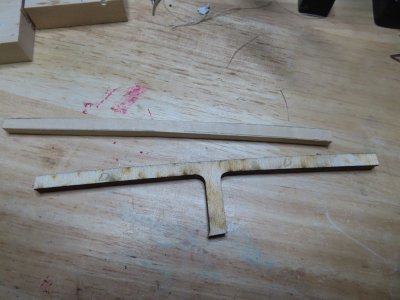
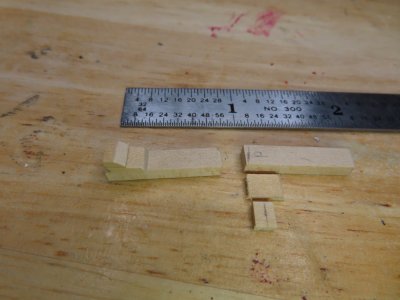
Each bitt was made from three pieces for ease of construction; two for the brace and one for the vertical post.
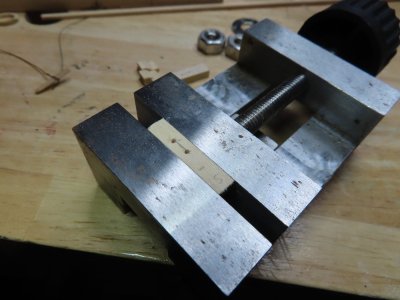
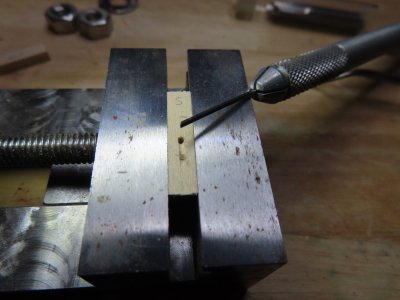
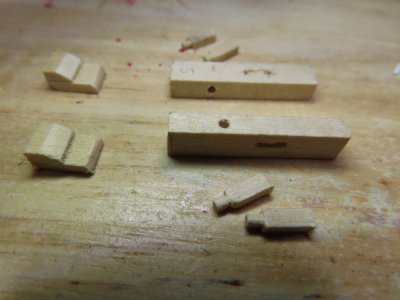
The post sheeves were carved after two holes were drilled into each of the vertical posts. The two brace parts were shaped and glued together before being glued to the posts. The horizontal beam was made in two parts. Instead of trying to insert square cross section beams through square holes cut into the posts which would have been quite difficult, the beams were made as plugs that fit into a drilled round hole which passed through the post. Once assembled, the bitts were stained with Minwax Gunstock 231 and the sheeves painted black.
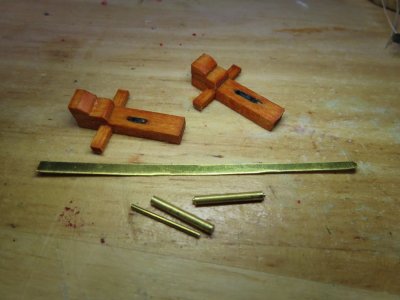
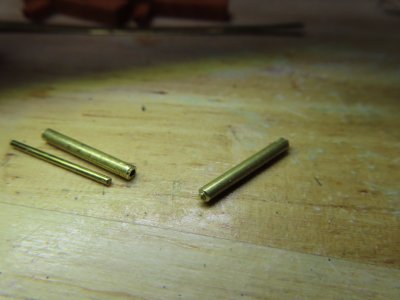
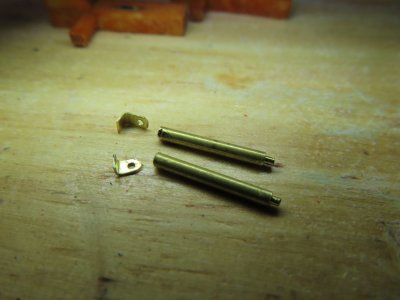
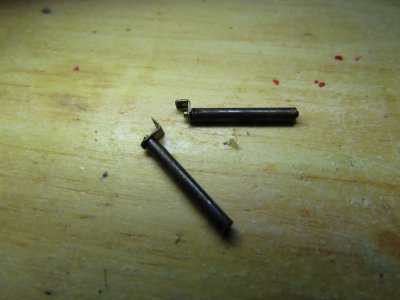
The side attached vertical roller bearings were made from 1/16” brass tube, 1/32” brass rod, and 0.010” brass sheet. After I eyeballed the roller’s length and width, the brass tube was cut to length. The brass rod, which fits inside the tube perfectly, was cut just a bit longer so it protruded. Brackets were fabricated with a hole drilled to accept the rod. In real life, there is a bracket at the bottom as well so the roller bearing can spin, not so for the model. Finally, the brass parts were blackened. and black dots painted as pseudo bolts on the braces.
The bits will eventually end up tucked into the bow and will be barely seen once parts of the spar deck are constructed. However, should ever an observer be curious enough to look, there will be the bitts and bearings in all their glory.
Moving aft, the gun rigs and recoil lines for three sets of guns after the dummy guns had to be fabricated. The three gun sets of fully rigged guns were glued into position with their recoil ropes secured to the bulwark with a small nail through two eyebolts. I initially planned to trim the nails so that they would be shorter and have a blunt end to more closely resemble the actual pin. This proved to be very difficult to use when attempting to thread them through the eyebolts and looped recoil rope. I just used the plain nail utilizing the pointed end to facilitate the installation to the bulwark. You would need a sharp eye to notice any difference.