



• SUBSCRIBE TO SHIPS IN SCALE TODAY!

    The beloved Ships in Scale Magazine is back and charting a new course for 2026!
    Discover new skills, new techniques, and new inspirations in every issue.

    NOTE THAT OUR NEXT ISSUE WILL BE MARCH/APRIL 2026
  • Win a Free Custom Engraved Brass Coin!!!
    As a way to introduce our brass coins to the community, we will raffle off a free coin during the month of August. Follow link ABOVE for instructions for entering.

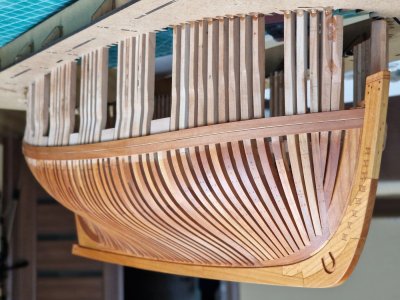
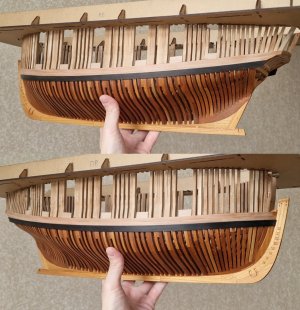
HMS Alert [1777] 1:48 POF by serikoff. (Two hulls: skeleton and fully rigged)

*I know you love this kind of thing, so here's a little update. And then comes the complicated process with wales.

Carvel planking. 1st hull.

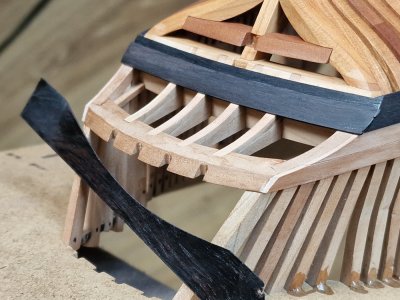
I already had the plank from the second hull (only there it was used below the waterline). It was polished and coated with Tung oil for the trim. After fixing it, I'll give it a final polish and recoat it as usual.

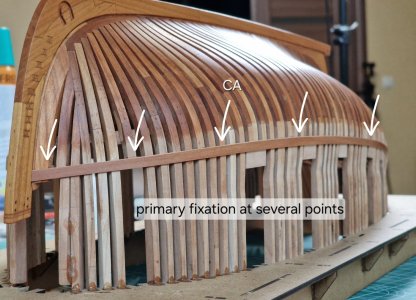
I spot-glued it to the SA, following the marking line (the bottom one!! Which I did the second time).
Alert 2435.jpg

Then I checked the symmetry and smoothness of the arc. If necessary, you can carefully tear off the strip where it needs to be moved; this is only possible while the glue is still in a few spots.
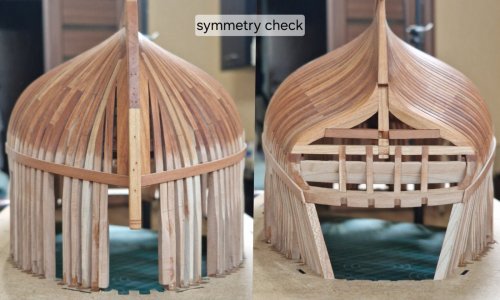
Alert 2436.jpg

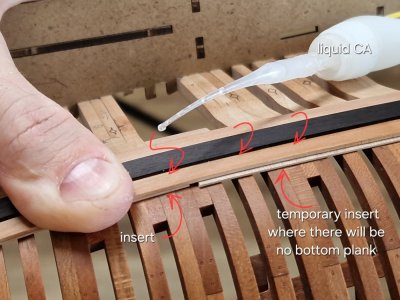
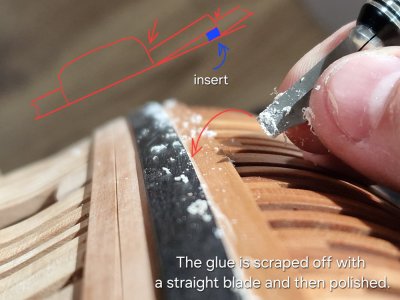
Once everything was checked, I applied glue from the inside to the joints using the capillary method. You don't need a lot of glue—there'll be a lot of spills to clean up later.
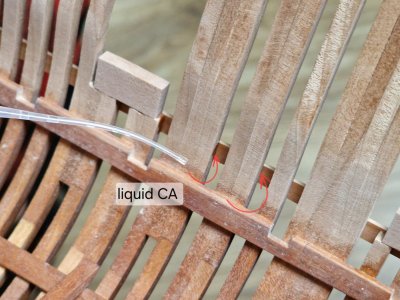
Alert 2437.jpg

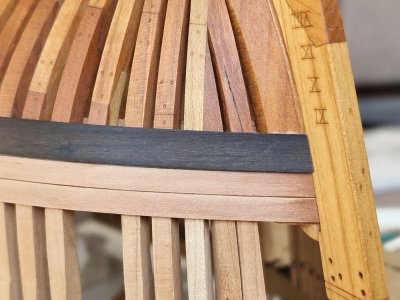
Then the second belt did the same. But before that, I made a slight chamfer on the two slats where they met, so that there would be a gap between them halfway down the contact line.
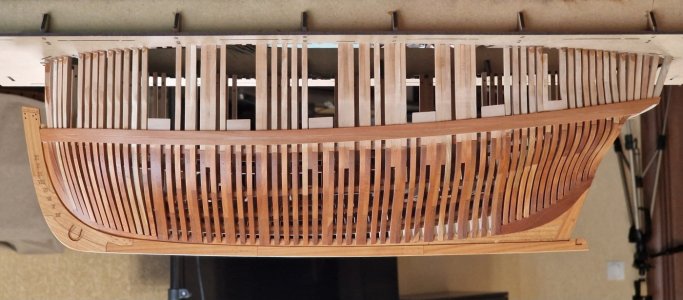
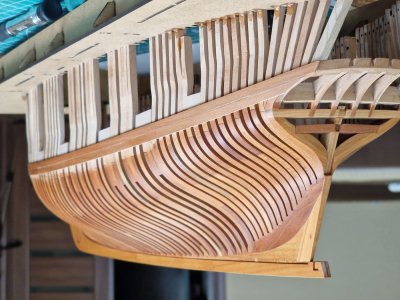
Alert 2438.jpg

Alert 2439.jpg

Alert 2440.jpg
 
Ich weiß, du liebst sowas, deshalb hier ein kleines Update. Und dann kommt der komplizierte Prozess mit Wales.

Klinkerbeplankung. 1. Rumpf.

Ich hatte das Brett vom zweiten Rumpf bereits (dort wurde es nur unterhalb der Wasserlinie verwendet). Es war poliert und mit Tungöl für die Zierleiste behandelt. Nach der Montage werde ich es noch einmal polieren und wie üblich neu beschichten.

Ich habe es entlang der Markierungslinie (der unteren!! Was ich beim zweiten Mal gemacht habe) mit Punktkleber auf die SA geklebt.

View attachment 601113

Anschließend überprüfte ich die Symmetrie und die Gleichmäßigkeit des Bogens. Falls nötig, kann man den Streifen an der Stelle, an der er versetzt werden muss, vorsichtig abreißen; dies ist jedoch nur möglich, solange der Kleber noch an einigen Stellen haftet.

View attachment 601114

Nachdem alles überprüft war, habe ich die Klebestellen von innen mit der Kapillarmethode verklebt. Man braucht nicht viel Kleber – es gibt später noch einiges aufzuwischen.

View attachment 601115

Dann wurde der zweite Riemen genauso verarbeitet. Zuvor hatte ich jedoch die beiden Lamellen an der Kontaktstelle leicht abgeschrägt, sodass auf halber Höhe der Kontaktlinie ein Spalt zwischen ihnen entstand.

View attachment 601116

View attachment 601117

View attachment 601118
Wunderschön, ausgearbeitete Rumpfform. Fantastische Oberfläche der Spanten.
 
Wale. Stern.

Since I've already shown how I made these parts on the second hull, I won't repeat myself; everyone is here. I'll only go into more detail on things I didn't mention in previous parts, or anything new.

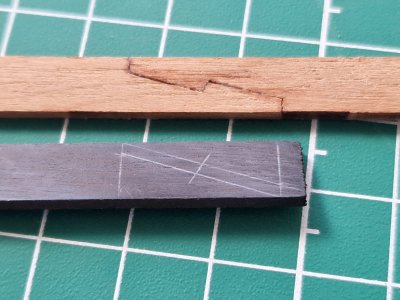
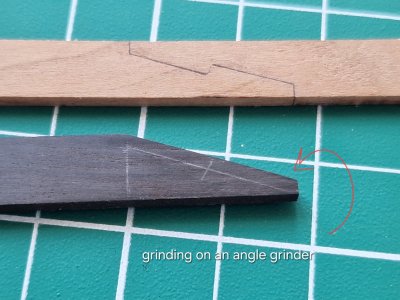
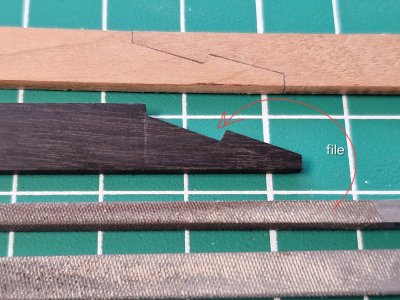
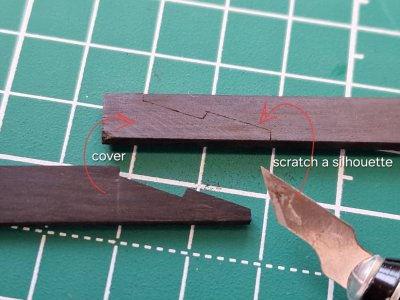
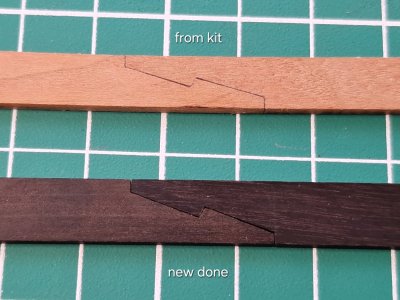
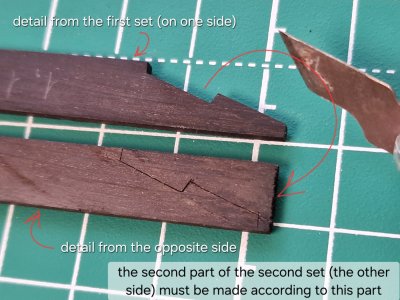
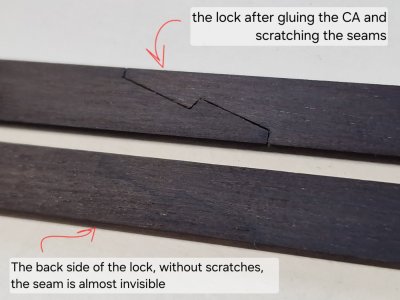
This is because I didn't have a long blank for the entire board (I had to join two with a lock). If you have a long blank, I recommend using the boards the entire length and then simulating the joint. I've done this before, but I didn't show the process of creating the lock itself...

Alert 2441.jpg

Alert 2442.jpg

Alert 2443.jpg

Alert 2444.jpg

Alert 2445.jpg

Alert 2446.jpg

Alert 2447.jpg

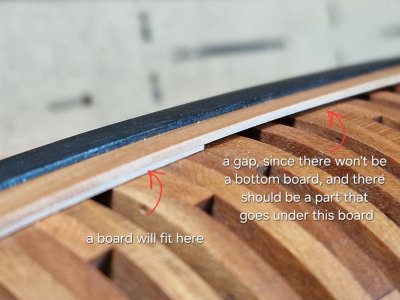
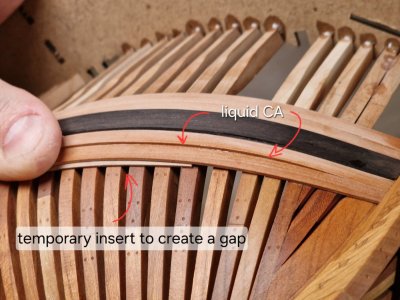
I really like black hornbeam, not only for its color, but also because if you fill it with CA and sand it, you'll practically see no gaps, which is sometimes very useful... but not when you need to show that the parts are different, so I intentionally create a gap, as in the photo above.

By the way, black hornbeam bends quite well...

Alert 2448.jpg

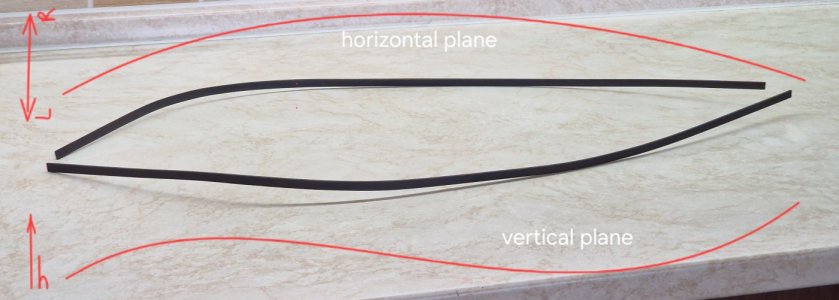
To ensure the wale lays flat, it's best to bend it in two planes first. I used a simple method: I pour a puddle of water onto an electric stove (it could be regular glass, too) and soak the board in it. After a minute, I press a hot iron directly into the puddle and bend it in the desired direction. It's quick and very simple.

Alert 2449.jpg

Alert 2450.jpg

I made the stern planks in exactly the same way as on the second hull, except here I'll only use the upper and lower ones to show the internal frame structure. The hardest part was making these half-arches. I had to make them twice, since there are two hulls...

Alert 2451.jpg

Alert 2452.jpg

Alert 2453.jpg

Alert 2454.jpg
 
Clinker planking. 1/2

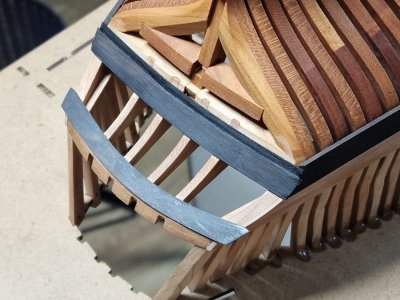
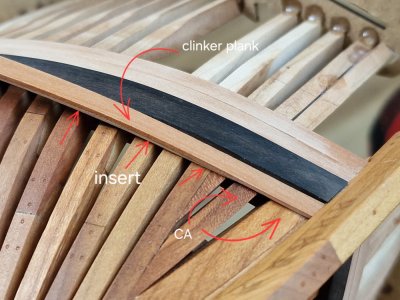
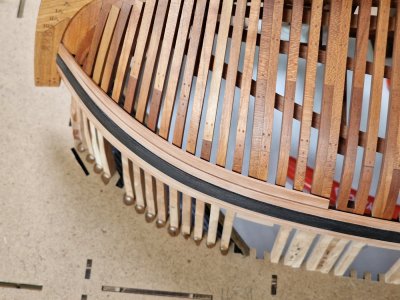
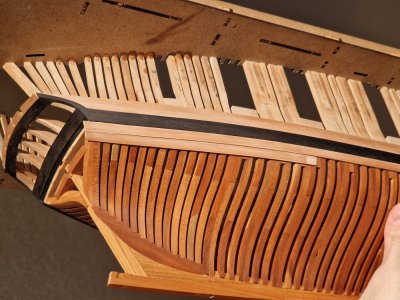
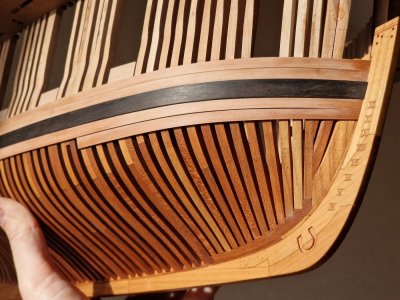
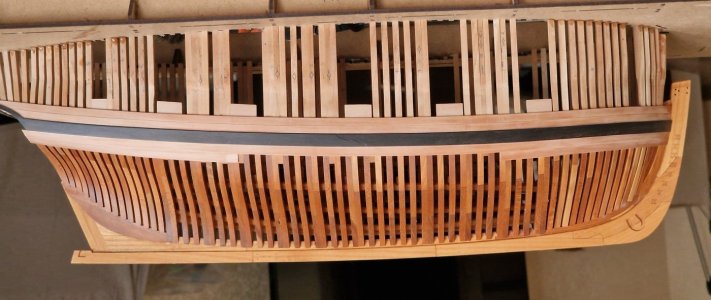
On the first hull, I won't be doing the entire planking, just the top chord, part of the second chord, and a few planks of the bottom chords. While I'll be doing the bottom planks using the real method (that'll be in the next post), I'll be doing the top planks with imitation clinker (as on the entire second hull).

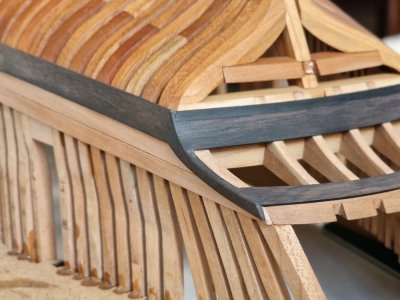
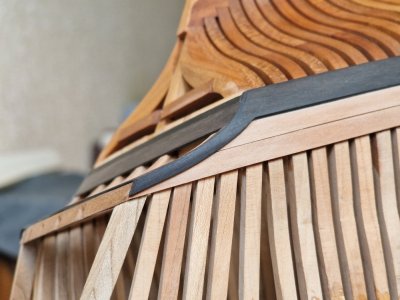
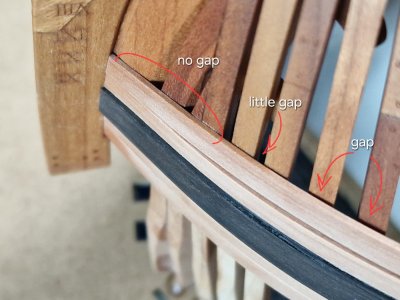
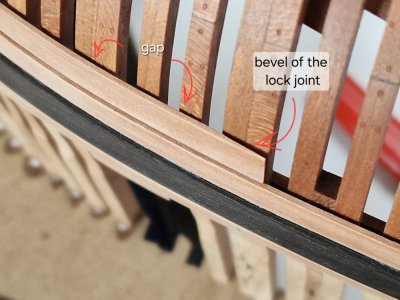
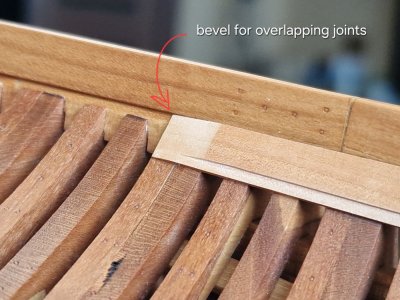
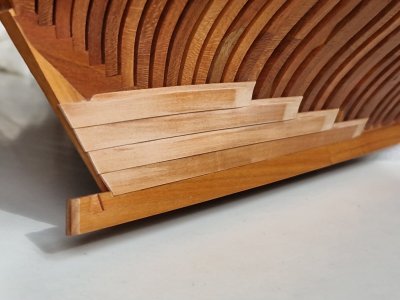
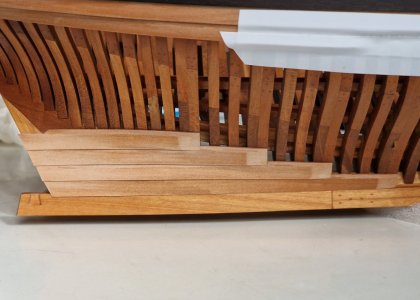
Since this is a demonstration version of clinker planking (the boards were actually installed one at a time, from bottom to top, overlapping the top planks), we can't actually see the gaps under the planks, as there are other boards underneath them. But since this is a demonstration, we need to create these gaps. The photo below will show you what I mean.

I won't repeat the details of the locks and structure of clinker planking; I've already discussed that. I previously wrote about clinker here.

Alert 2455.jpg

Alert 2456.jpg

Alert 2457.jpg

Alert 2458.jpg

Alert 2459.jpg

Alert 2460.jpg

Alert 2461.jpg

Alert 2462.jpg

Alert 2463.jpg

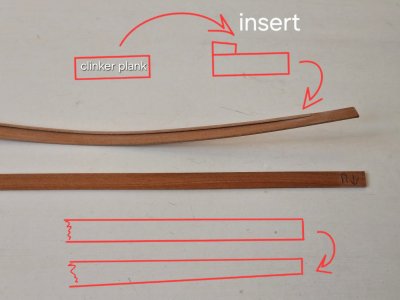
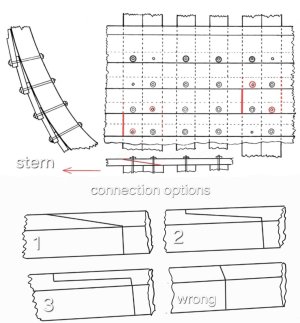
Let me remind you of the structure of clinker planking.

Alert 2463a.jpg

Alert 2464.jpg

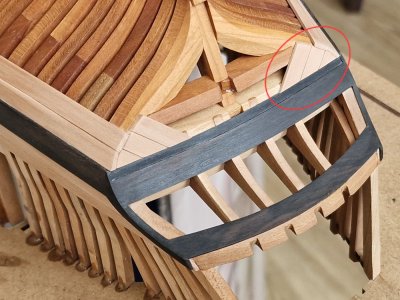
On the second belt (it is made of three boards, but there will be no middle one) I show the structure of the castle, or rather both of its parts.

Alert 2465.jpg

Alert 2466.jpg

Alert 2467.jpg

Alert 2468.jpg

Alert 2469.jpg

Below I will make a few more boards, but using the real method (not imitation), to show the structure of the upper part of the clinker planking board.
 
Last edited:
Klinkerplanken . 1/2

Beim ersten Rumpf werde ich nicht die gesamte Beplankung vornehmen, sondern nur den Obergurt, einen Teil des Mittelgurts und einige Planken des Untergurts. Während ich die Untergurtplanken nach der traditionellen Methode beplanke (dazu mehr im nächsten Beitrag), verwende ich für die Obergurtplanken eine Klinkerimitation (wie beim gesamten zweiten Rumpf).

Da es sich hier um eine Demonstrationsversion der Klinkerbauweise handelt (die Bretter wurden tatsächlich einzeln von unten nach oben verlegt und überlappten sich dabei), sind die Fugen unter den Brettern nicht sichtbar, da sich darunter weitere Bretter befinden. Da es sich aber um eine Demonstration handelt, müssen wir diese Fugen erzeugen. Das Foto unten dargestellt stirbt.

Die Details der Verriegelungen und der Konstruktion der Klinkerplanken werde ich nicht wiederholen; Das habe ich bereits erklärt. Ich habe hier schon einmal über Klinker geschrieben.

View attachment 603165

View attachment 603166

View attachment 603167

View attachment 603168

View attachment 603169

View attachment 603170

View attachment 603171

View attachment 603172

View attachment 603173

Lassen Sie mich Sie an den Aufbau von Klinkerplanken erinnern.

View attachment 603174

View attachment 603175

Auf dem zweiten Band (es besteht aus drei Brettern, aber es wird kein mittleres geben) zeige ich die Struktur der Burg, oder besser gesagt, beide Teile davon.

View attachment 603176

View attachment 603177

View attachment 603178

View attachment 603179

View attachment 603180

Im Folgenden werde ich noch einige weitere Bretter herstellen, allerdings nach der realen Methode (nicht nach einer Imitation), um den Aufbau des oberen Teils der Klinkerplankenplatte zu verstehen.
Das wird ein Modell auf höchstem Niveau. Jeder Bauabschnitt ist ein „Studiengang“. Wunderbar hergestellt und erklärt. Man sieht die Leidenschaft beim Bau. Die handwerkliche Vorgehensweise und Umsetzung ist einzigartig. Danke fürs Zeigen.
 
These continue to be an amazing build of beauty and craftsmanship !
Das wird ein Modell auf höchstem Niveau. Jeder Bauabschnitt ist ein „Studiengang“. Wunderbar hergestellt und erklärt. Man sieht die Leidenschaft beim Bau. Die handwerkliche Vorgehensweise und Umsetzung ist einzigartig. Danke fürs Zeigen.
Friends, thank you for your kind words. I can't believe that soon both hulls will be at the same stage and the exterior will be practically finished. Now everything will proceed in parallel and simultaneously. The most challenging part for me is still to come – coating with oil and bitumen; this is a very important step.
 
Clinker planking. 1/2

On the first hull, I won't be doing the entire planking, just the top chord, part of the second chord, and a few planks of the bottom chords. While I'll be doing the bottom planks using the real method (that'll be in the next post), I'll be doing the top planks with imitation clinker (as on the entire second hull).

Since this is a demonstration version of clinker planking (the boards were actually installed one at a time, from bottom to top, overlapping the top planks), we can't actually see the gaps under the planks, as there are other boards underneath them. But since this is a demonstration, we need to create these gaps. The photo below will show you what I mean.

I won't repeat the details of the locks and structure of clinker planking; I've already discussed that. I previously wrote about clinker here.

View attachment 603165

View attachment 603166

View attachment 603167

View attachment 603168

View attachment 603169

View attachment 603170

View attachment 603171

View attachment 603172

View attachment 603173

Let me remind you of the structure of clinker planking.

View attachment 603174

View attachment 603175

On the second belt (it is made of three boards, but there will be no middle one) I show the structure of the castle, or rather both of its parts.

View attachment 603176

View attachment 603177

View attachment 603178

View attachment 603179

View attachment 603180

Below I will make a few more boards, but using the real method (not imitation), to show the structure of the upper part of the clinker planking board.
Every nice and secure planking, Sergey. A lot of fitting and bending.
Regards, Peter
 
Good morning Sergey. I think you have an AI robotic modelling program installed somewhere- it just perfect. I refer to your wonderful informative logs regularly however I never get the results you do ROTF . Us South Africans never give up though so I will keep trying. Thanks for sharing this build with us. Cheers Grant
 
Every nice and secure planking, Sergey. A lot of fitting and bending.
Regards, Peter
Thank you. This method is quite simple, so I use it. It produces good results without a lot of adjustments. Below, I'll be making real clinker cladding using another method, so we'll see the difference.

Good morning Sergey. I think you have an AI robotic modelling program installed somewhere- it just perfect. I refer to your wonderful informative logs regularly however I never get the results you do ROTF . Us South Africans never give up though so I will keep trying. Thanks for sharing this build with us. Cheers Grant
Thank you. Hahahaha, I wish it were like that, it wouldn't hurt. You have very good results too, I'm interested in watching you too. Thanks for the praise, although there's always room for improvement, it's nice to hear praise.
 
Clinker planking. 2/2

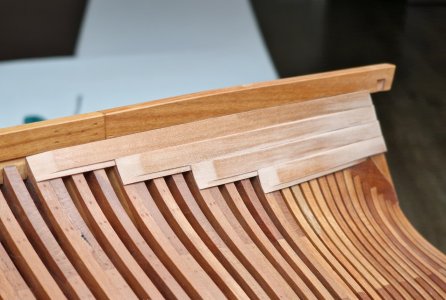
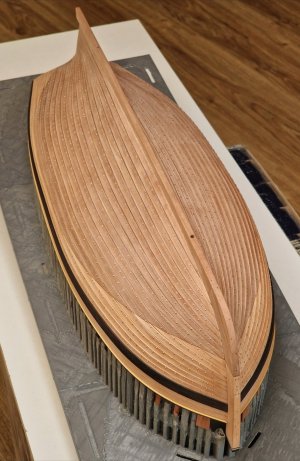
First, I finished the entire upper section. I've already shown how I did the stern section on the second hull, so I won't repeat myself.
These are the two Adidas badges that came out. ROTF

Alert 2470.jpg

All that remains is the lower rear part of the (real) clinker planking.

Alert 2471.jpg

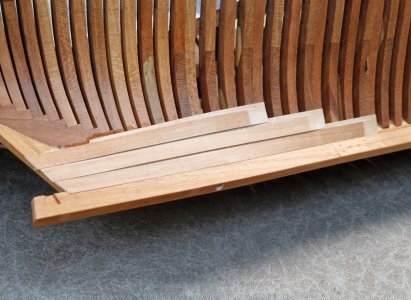
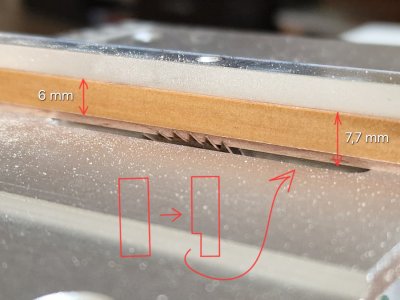
I made the blanks on a saw, cutting off a third of the board's thickness to create a groove. As a result, when joined together, the board will visually be 6 mm thick, just like the top.

Alert 2472.jpg

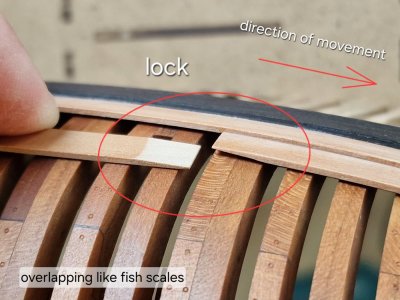
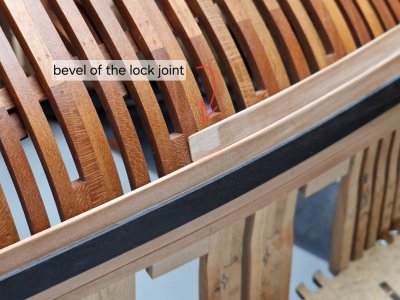
I beveled the end of the board to allow for overlapping. Since this is the back board (and, incidentally, the first board to be sheathed), the bevel was precisely shaped so that the front board would overlap it, allowing water to flow around the joint like fish scales.

Alert 2473.jpg

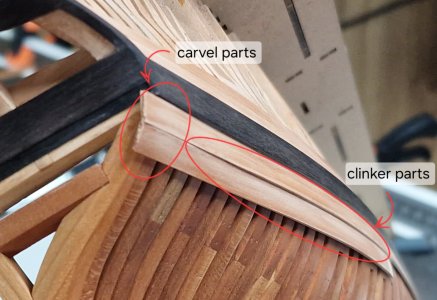
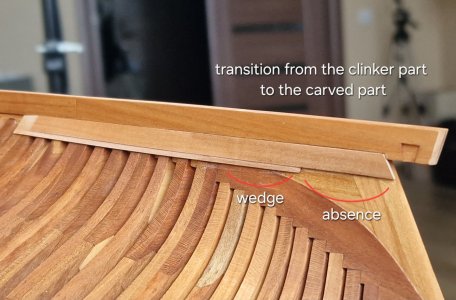
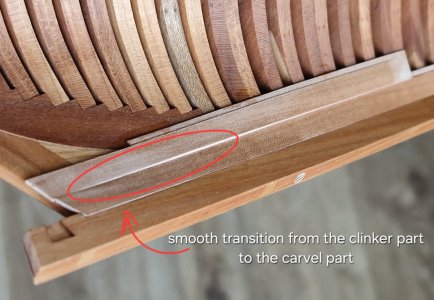
At the front and back (as in this case), the part of the board with the groove goes to zero and then disappears completely... this is necessary in order to create a smooth transition from the clinker part (when the boards overlap) to the carvel part (when the boards are butted).

Alert 2474.jpg

Alert 2475.jpg

Alert 2476.jpg

Alert 2477.jpg

Alert 2478.jpg

When I'm done with the other side, I can sand everything down and drill holes for the dowels and bolts, then install them.

By the way, I ended up using all these boards to cover up the areas I didn't like. These were either defects, kit flaws, or my own mistakes. And now they're all buried under the boards... and that's a good thing.
 
Klinkerbeplankung. 2/2

Zuerst habe ich den gesamten oberen Bereich fertiggestellt. Wie ich den Heckbereich des zweiten Rumpfes gebaut habe, habe ich bereits gezeigt, daher werde ich mich nicht wiederholen.
Dies sind die beiden Adidas-Logos, die herausgebracht wurden. ROTF

View attachment 603618

Übrig geblieben ist lediglich der untere hintere Teil der (echten) Klinkerbeplankung.

View attachment 603619

Ich habe die Rohlinge mit einer Säge zugeschnitten und ein Drittel der Brettstärke abgeschnitten, um eine Nut zu erzeugen. Dadurch ist das Brett, wenn es zusammengefügt ist, optisch 6 mm dick, genau wie die Oberseite.

View attachment 603620

Ich habe das Ende des Brettes abgeschrägt, um eine Überlappung zu ermöglichen. Da es sich um das Rückbrett handelt (und es übrigens auch als erstes verkleidet wird), wurde die Abschrägung präzise geformt, sodass das Vorderbrett sie überlappt und das Wasser wie Fischschuppen um die Fuge fließen kann.

View attachment 603621

An der Vorder- und Rückseite (wie in diesem Fall) geht der Teil des Brettes mit der Nut auf Null und verschwindet dann vollständig... dies ist notwendig, um einen sanften Übergang vom Klinkerteil (wenn sich die Bretter überlappen) zum Karvelteil (wenn die Bretter aneinanderstoßen) zu schaffen.

View attachment 603622

View attachment 603623

View attachment 603624

View attachment 603625

View attachment 603626

Wenn ich mit der anderen Seite fertig bin, kann ich alles abschleifen und Löcher für die Dübel und Schrauben bohren und diese dann montieren.

Übrigens habe ich all diese Platten letztendlich verwendet, um die Stellen zu verdecken, die mir nicht gefielen. Das waren entweder Defekte, Mängel am Bausatz oder meine eigenen Fehler. Und jetzt sind sie alle unter den Platten begraben … und das ist gut so.
Fantastisch! Einfach fantastisch!
 
This build log is a treasure trove of knowledge and techniques. I'm always amazed at what can be achieved with your skills!
Thank you very much. I understand that there are craftsmen far better than me, but considering that everything you see was practically done "on the fly," I'll accept that compliment with pride. ROTF ROTF

I'm intrigued by your new project. If I ever finish this project, I'll definitely return to Victory and do a lot of plastic work there too. A lot has already been done, but it's not shown or fixed to the hull. Maybe when I take a break from rigging this project, I'll do a little work on Victory.

Fantastisch! Einfach fantastisch!
Thanks a lot!
 
Think on the planking scheme. You should use a three of four butts shift system.
That's all there will be on this hull. The planking is minimal, just enough to show the general principle and the connection points. Planking was completed in full on the 2nd hull.

Screenshot_20260517_203736_Gallery.jpg
 
Last edited:
Thank you very much. I understand that there are craftsmen far better than me, but considering that everything you see was practically done "on the fly," I'll accept that compliment with pride. ROTF ROTF
Of course, there will always be a bigger fish out there, but I get the impression that we’re mainly looking at work of a very high standard and assuming that this is the default benchmark—one that can only be surpassed by a master-class model. But the truth is, it’s just a handful of people, surpassed only by an even smaller handful—the ones we aspire to. Setting that aside, having the skills and the ability to pass on knowledge are two separate matters, and you clearly possess both. That’s far rarer than the opportunity to watch master-class model.
 
Natürlich gibt es immer jemanden, der noch besser ist, aber ich habe den Eindruck, dass wir uns hauptsächlich auf Arbeiten von sehr hohem Standard konzentrieren und annehmen, dass dies der Standardmaßstab ist – ein Maßstab, der nur von einem absoluten Vorbild übertroffen werden kann. Doch in Wahrheit gibt es nur eine Handvoll Menschen, die nur von einer noch kleineren Handvoll übertroffen werden – von denen, zu denen wir aufschauen. Davon abgesehen sind die Fähigkeiten und die Fähigkeit, Wissen weiterzugeben, zwei verschiedene Dinge, und Sie besitzen beides ganz offensichtlich. Das ist weitaus seltener, als die Gelegenheit zu haben, einem absoluten Vorbild zuzusehen.
Besser geht immer. Aber das handwerkliche Niveau muss man erst einmal in der Praxis errreichen und umsetzen können. Es ist fantastisch, was hier umgesetzt und gezeigt wird. Auch die Art und Weise
, wie jeder Bauschritt und wie jede Vorgehensweise erklärt und begründet wird. Einfach klasse.
 
Of course, there will always be a bigger fish out there, but I get the impression that we’re mainly looking at work of a very high standard and assuming that this is the default benchmark—one that can only be surpassed by a master-class model. But the truth is, it’s just a handful of people, surpassed only by an even smaller handful—the ones we aspire to. Setting that aside, having the skills and the ability to pass on knowledge are two separate matters, and you clearly possess both. That’s far rarer than the opportunity to watch master-class model.
Besser geht immer. Aber das handwerkliche Niveau muss man erst einmal in der Praxis errreichen und umsetzen können. Es ist fantastisch, was hier umgesetzt und gezeigt wird. Auch die Art und Weise
, wie jeder Bauschritt und wie jede Vorgehensweise erklärt und begründet wird. Einfach klasse.
Thank you very much, friends. I agree with you that showing results, no matter how perfect, is not quite the same as showing the process and what needs to be done to achieve them. I do what I can and what I know, and I'm happy to share my knowledge until I have the time and inclination to do so. Many years ago, I encountered people who also shared everything they knew, and I realized that this is much more important than simply staring at an ideal and having no idea how to replicate it. But still, thank you for the praise. For those who think I consider myself a professional, I'm not. I'm simply sharing what I know and hope it helps someone, while at the same time I strive to be better every day than I was yesterday. Thank you, friends!
 
Back
Top