• Win a Free Custom Engraved Brass Coin!!!
    As a way to introduce our brass coins to the community, we will raffle off a free coin during the month of August. Follow link ABOVE for instructions for entering.

BALDER, Vlaardingen Herring Lugger from 1912, scratch build scale 1:50 Plate-On-Frame

You are a true master Peter. What a pleasure to follow your build log. The combination of the historical photos with your model really adds to the experience.
You also thanks very much for these nice words en compliments, Herman. The old picture’s are a big plus. Not only to look at the details but also to set everything in a historical context of the hard live on board.
Regards, Peter
 
Last edited:
Hi Paul. You adjectives so true and are just in time:
wet, cold, slimy, disgusting, exhausting, and miserable
Yesterday evening I found a old movie of the ‘Northsee Fishery’. It’s from the Dutch ‘Polygoon’:
From 00:00 till 05:24 is for the ‘vleet’ herring fishery. After 05:24 is for the ‘beug’ line-fishery and trawler fishery.
Although the movie is from 1924 with a steam-vessel, the work and the equipment is still the same as on the Balder.
At the end on 10:36 you can see a herring lugger at roughly see with the mast backwards in fishing position.
Regards, Peter
 
Last edited:
Hi Paul. You adjectives so true and are just in time:

Yesterday evening I found a old movie of the ‘Northsee Fishery’. It’s from the Dutch ‘Polygoon’:
From 00:00 till 05:24 is for the ‘vleet’ herring fishery. After 05:24 is for the ‘beug’ line-fishery and trawler fishery.
Although the movie is from 1924 with a steam-vessel, the work and the equipment is still the same as on the Balder.
At the end on 10:36 you can see a herring lugger at roughly see with the mast backwards in fishing position.
Regards, Peter

What a great video! I only wish I could understand the narration. Anyone know the reason for flipping the fish back and forth over his shoulder?
 
What a great video! I only wish I could understand the narration. Anyone know the reason for flipping the fish back and forth over his shoulder?
If you mean the cod in de 2nd part? It's the "venting" of the swim bladder to prevent the cod floating in the well.
Sorry that the movie is only in Dutch.
Regards, Peter
 
Last edited:
If you mean the cod in de 2nd part? It's the "venting" of the swim bladder to prevent the vod floating in the well.
Sorry that the movie is only in Dutch.
Regards, Peter
Thank you - yes, the venting makes sense. No need for apologies - despite what some may think, English-speakers are not the only people in this world.

As I watch them hoisting barrels in and out of the holds, I realize that there must be someone down in the hold. And then when I look at your cut-away model, I wonder ... how? There seems to be just barely enough room for the barrels!
 
As I watch them hoisting barrels in and out of the holds, I realize that there must be someone down in the hold. And then when I look at your cut-away model, I wonder ... how? There seems to be just barely enough room for the barrels!
From the book I found a few months ago:
Among the 14-member crew were also five "boys" aged 12 or 13. Those with the most experience were called "elders." These inexperienced boys had to perform the tedious and dirty tasks. They learned the life on board, learning the tricks of the trade from the rest of the crew.
One such boy would enter a hold and climb down the beams between the port and starboard holds, where he would put the barrels in place. He would also climb between the beams from one hold to the other. Fortunately, and presumably, these boys weren't (yet) claustrophobic.
PS: I still haven't figured out how they could secure the second hatch.
Regards, Peter
 
A small update on some small parts.
Two parts were added to the casing of the kosssing.
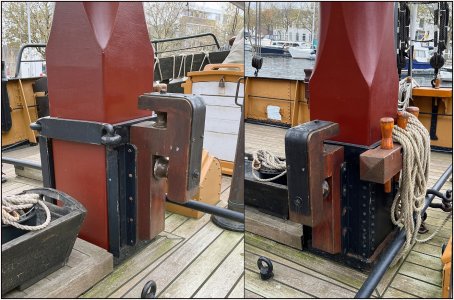
These are a nailing bench and the 'reep' guide block:
0898 Reepgeleideblok.jpg
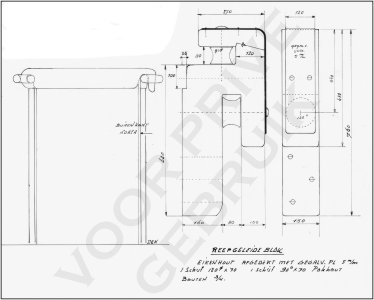
The drawings from the Amsterdam archives also included a drawing of the guide block:
0899 Reepgeleideblok.jpg
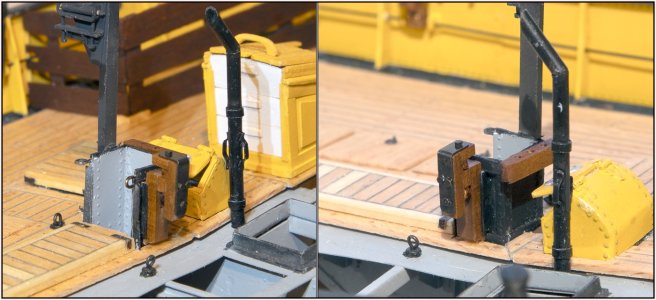
After some sawing, sanding, and filing, this was the result:
0900 Reepgeleideblok.jpg
Here are also some M0.6 mm bolts as axles for the two rollers and the attachment to the casing.
Regards, Peter
 
Wow it's been 3 months since I last looked in on your build, not sure how this happens but am so glade to be back on board the Balder. The one area that caught my eye was the realism you captured in the short section of railing above the crib area. Great metal work.
 
Wow it's been 3 months since I last looked in on your build, not sure how this happens but am so glade to be back on board the Balder. The one area that caught my eye was the realism you captured in the short section of railing above the crib area. Great metal work.
Thanks, Daniel. It was a very long time ago that I was soldering brass and copper. With a much-too-large soldering gun. But the combination of the fine tip soldering pen and the gas flame gives me many more possibilities. I really enjoy it.
Regards, Peter
 
To continue working from front to back, it was now time to tackle the traveler for the jib sheet.

I've had plenty of time to think about this, as it's secured to both the port and starboard sides.
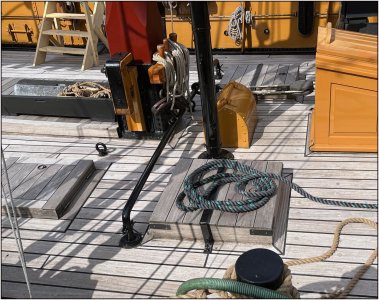
0901 Overloop Fok.jpg
Both ends pass through the deck and are secured to the watertight bulkhead below.
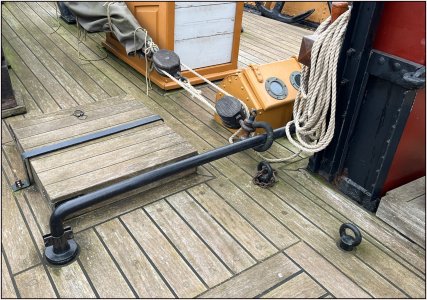
0902 Overloop Fok.jpg
The jib sheet is attached to this. It can't move completely freely when tacking. The sheet then has to be guided over the lantern and the entrance to the forepeak.

If I were to secure this in the usual way, I wouldn't be able to separate the two parts. So I decided to make it from a tube, saw it in half, and attach a pin as a connection between the two.
The traveler is 50 mm thick, so to scale, I had to work with a 1 mm tube. I found one with an inside diameter of 0.5 mm. With 0.5 mm wire. With the wire inside the tube I was also able to bend the tube without deforming it in the bends.
This is the result:
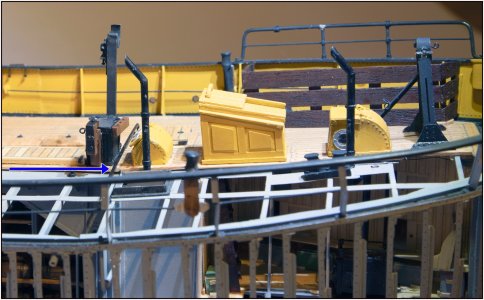
0903 Overloop Fok.jpg
The blue arrow points to the traveler that runs between the mast tube and the lantern.
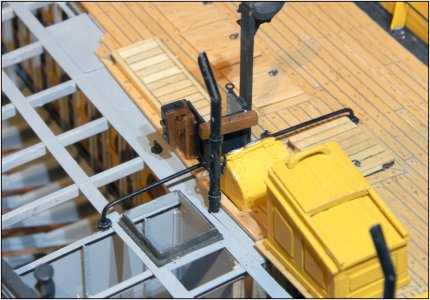
0904 Overloop Fok.jpg
Halfway behind the mast tube, I made the connection.

Here are the two parts separated:
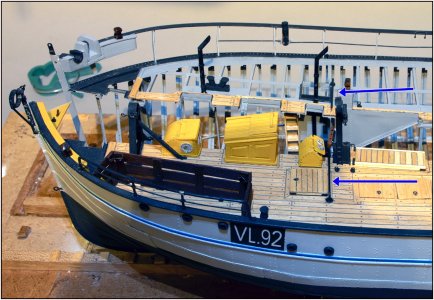
0905 Overloop Fok.jpg
The blue arrows point to the two parts of the traveler.
It's almost insignificant, so a few "unforgivable macros" are necessary.

The two parts with the pin in the port side:
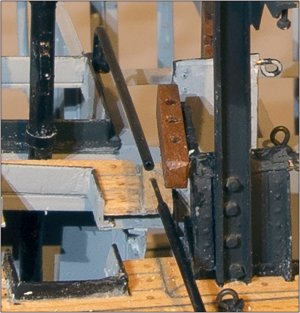
0906 Overloop Fok.jpg
So, the tube is 1.0 mm and the pin is 0.5 mm.
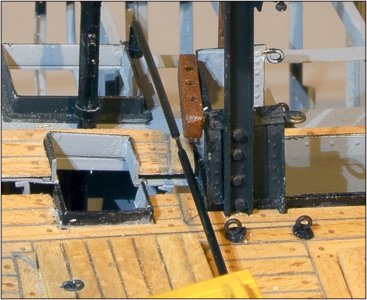
0907 Overloop Fok.jpg
With some trial and error, the pin was slid into the other part. And I can now slide everything together more evenly.

That's another trigger point solved.
There's also a traveler for the mainsail sheet. It's partially attached to the bulwark, near the mizzen mast's chainplates. I need to add a piece of hull plating to the open section of the frame, otherwise, it won't be secured there.
Regards, Peter

 
Last edited:
What an ingenious solution to the problem of separating the hull halves Peter! Putting them back together, however, is becoming more difficult with each step. ;)

Then there's the actual operation of the sheet. The full scale photo shows the jib lowered and the sheet parallel with the deck. I assume the angle to the deck becomes greater once the jib is hoisted, but I still can't imagine how difficult it must be to get that sheet past everything - especially that tall vent pipe - when gybing in a stiff wind. Those sailors must have had cat-like reflexes to move that traveler, since you only have a few seconds while the jib is booming across before it snaps into place. Wow! I'd love to see how it is done.
 
Last edited:
What an ingenious solution to the problem of separating the hull halves Peter! Putting them back together, however, is becoming more difficult with each step. ;)

Then there's the actual operation of the sheet. The full scale photo shows the jib lowered and the sheet parallel with the deck. I assume the angle to the deck becomes greater once the jib is hoisted, but I still can't imagine how difficult it must be to get that sheet past everything - especially that tall vent pipe - when gybing in a stiff wind. Those sailors must have had cat-like reflexes to move that traveler, since you only have a few seconds while the jib is booming across before it snaps into place. Wow! I'd love to see how it is done.
I had almost 2 years to figure out how to split the traveler ....... ;) but theory and practice must come together.
When the jib is hoisted it reaches over the most.
Afbeelding 1.jpeg
So, what I wrote above is not completely correct. Only when starting with wind from the wrong direction they have to lift it.
And they can take the vent pipes off.
Here you can also see the high positioned traveler on the back.
Regards, Peter
 
Back
Top