



• SUBSCRIBE TO SHIPS IN SCALE TODAY!

    The beloved Ships in Scale Magazine is back and charting a new course for 2026!
    Discover new skills, new techniques, and new inspirations in every issue.

    NOTE THAT OUR NEXT ISSUE WILL BE MARCH/APRIL 2026
  • Win a Free Custom Engraved Brass Coin!!!
    As a way to introduce our brass coins to the community, we will raffle off a free coin during the month of August. Follow link ABOVE for instructions for entering.

Bluenose I - YuanQuin 1:72 - Loracs (in progress)

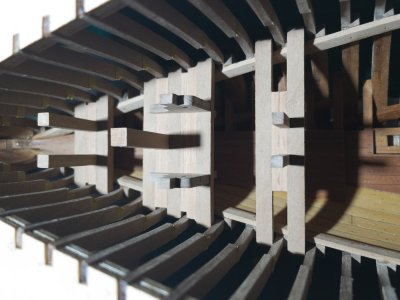
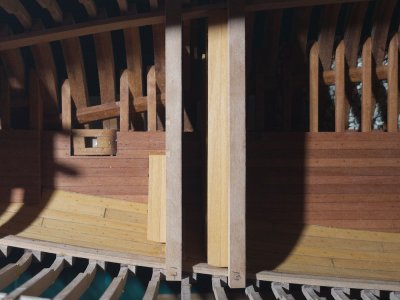
Support deck: I have been thinking for a while about a way to present, make more visible, the internal structure of the bluenose. I have seen numerous approaches here... each quite good. The most radical and courageous is obviously the split bluenose of
Peter. Here what I'm thinking, still experimental but viable: a semi-transparent upper deck.

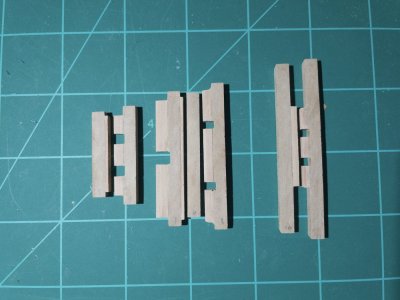
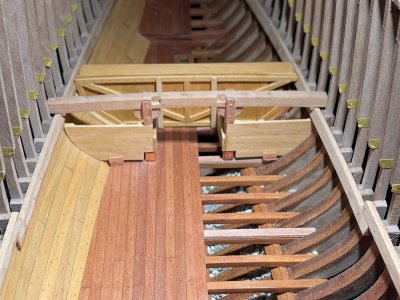
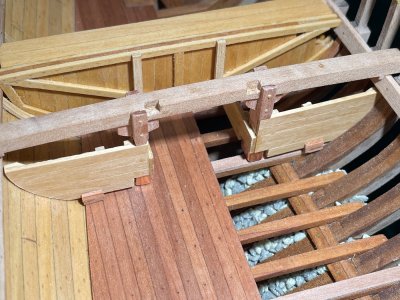
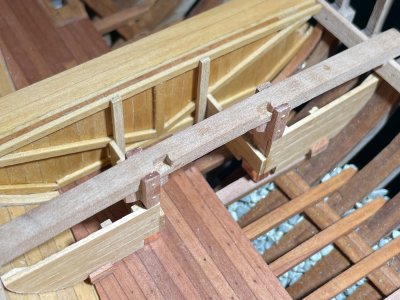
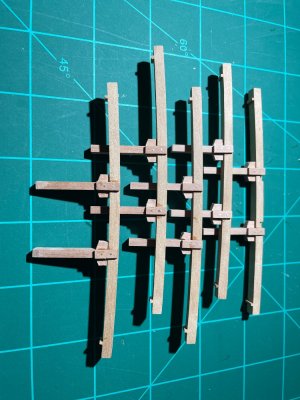
I still like wood, so this will be applied in selected area to keep thing simple. I'm still planning to use the kit beams for the complex area that requires addition of transversal beams but elsewhere... transparent acrylic square rods, cut and shape as replacement. Here what it looks like as a first prototype.

a. cut to length using a small Japanese saw.
b: shape using the current beam as template using heat gun.
c. dry test: as you can see in the last picture the transparency is quite good.

View attachment 607729

View attachment 607730

View attachment 607731

View attachment 607732
Transparent beam: The kit deck beams are 4mm wide by 3mm depth. However, you can only purchase square acrylic rods. Now, decision... should I use 3mm (smaller in width than the wood beams but require no adjustment in depth) or go with 4mm rods and shave 1mm in a small area in contact with the side support (look easier to shave the wood side support). I'm edging toward the later, even if more work. The reason is that the ship will be seen primary from the top and, thus it may look slightly better.

Will be doing more testing with an area of 3-4 consecutive acrylic beams, both at 3mm and shaved 4mm. Dry testing should help make the final call.
The frames and beams in the YQ kit are (a bit:rolleyes:)oversized. I considered adjusting them, but that would have meant adjusting 'everything'. I don't think the narrower acrylics beams will be a problem. They already look different from the wooden ones anyway. If they are beams with crossbeams resting in them, you could consider a laminate. You do have to make sure the seam is completely sealed so that it is as invisible as possible. I have had good experiences gluing with chloroform; it is water-thin and soaks completely into the seam due to capillary action. However, it is sometimes a problem to get hold of that stuff. The pharmacist in my town believed my model-building story. Looking forward to your next results.
Regards, Peter
 
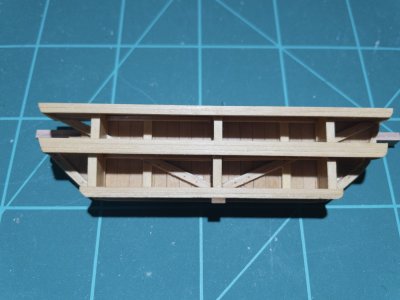
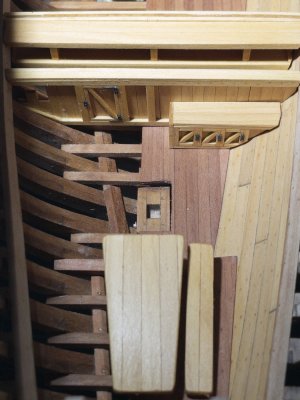
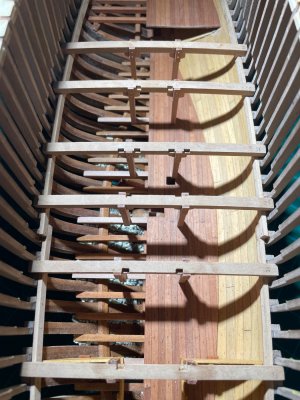
Upper Deck - Bow: Since I altered the design in this area, I have to account for the addition of the deck elements. I did the spacer from scratch to have them at the same thickness than the deck beam, which is far more stable. The first three beams will go down to the deck underneath to illustrate the required structural strength, while both only winch anchor to the upper deck beams - which is still close to a foot deep at scale. It should be stable enough.

IMG_3994.jpeg

IMG_3998.jpeg
 
Last edited:
Storage room: I was testing the walls of the storage room when it occurs to me that there would be a rack in this area. Well, here one now. It is a thigh space with 2 feet shelves and 2 feet in front (real space). The shelves have "lips" so that things remain in place.

It is not likely that this will be seen well once complete... but HEY! we all have a front seat here to see thing from unique perspective.

IMG_4004.jpeg

IMG_4024.jpeg

IMG_4018.jpeg
 
Last edited:
Storage room: I was testing the walls of the storage room when it occurs to me that there would be a rack in this area. Well, here one now. It is a thigh space with 2 feet shelves and 2 feet in front. The shelves have "lips" so that things remain in place.

It is not likely that this will be seen well once complete... but HEY! we all have a front seat here to see thing from unique perspective.

View attachment 609393

View attachment 609394

View attachment 609395
Even if nobody ever sees it after completed, you will know it was done, and we have proof of your work.
 
Linseed Oil - Side note: We often WANT to highlight the definition or seam between planks, either for esthetic purposes or to simulate caulking. If you look at the last picture above, you will see two methods:

a) caulking on the ceiling planks was done using a method very often described here: by adding a little carbon to the side of the plank using pencil #2. You will note the very slight "greyish" coloration and not quite uniform (intensity wise).

b) the second method was use for the table (and the wall panel in the back): I just discovered it completely by accident. I guess this is how you gain knowledge. With the table I did NOTHING. The planks are simply hold together by a cross-plank underneath. How does doing nothing still outlined the junction between planks so neatly? The secret is simply by using linseed oil. Linseed oil stain grains and side-cuts darker, thus creating a nice hairline effect of darker color, uniform and not greyish at all. I don't know if you are like me... I like it a lot!
 
Last edited:
Hide glue - Side note #2: If you go back to the beginning of the log, I mentioned that I switched to "hide glue" for this build. I like its properties and plan on continuing using it. However, there is a side effect I did not anticipate at all - it shrinks and become rock hard while curing. Why does it matter? well... here why.

Sometimes I like building elements such as decks, walls, etc. on the table to be fit later on the ship. Sometimes, it is more accurate and/or more convenient.

HOWEVER, remember my first attempt at the wall gluing planks at the edge only or using a long back cross-plank? The shrinking of hide glue place tension at the junction, which ultimately lead to "curving" of the entire wall. Changing to standard glue solved this for me, and/or (as mentioned here) using an opposite cross-plank on both sides to counterbalance.

This can be an advantage though: the small table and back wall is an example. It worked well with hide glue using a short crossbeam (simply because it is smaller) or counter cross-plank (wall). The advantage is that as the glue shrink and harden it "squeeze the planks together for a nice no-gap fit.
 
Last edited:
The secret is simply by using linseed oil. Linseed oil stain grains and side-cuts darker, thus creating a nice hairline effect of darker color, uniform and not greyish at all. I don't know if you are like me... I like it a lot!
For sure! That’s why I like linseed oil and use only that for my models.
Regards, Peter
 
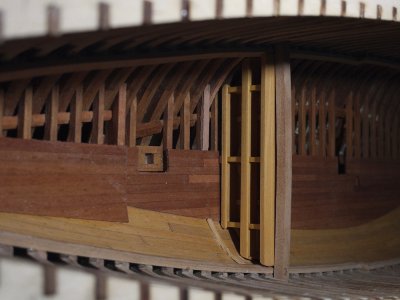
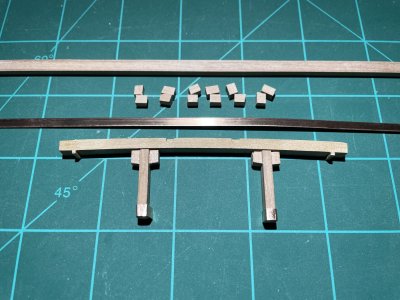
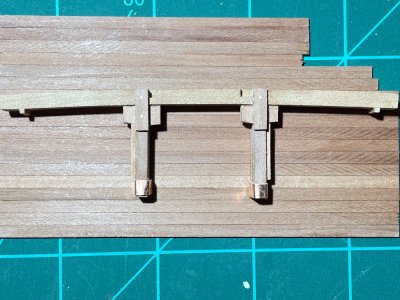
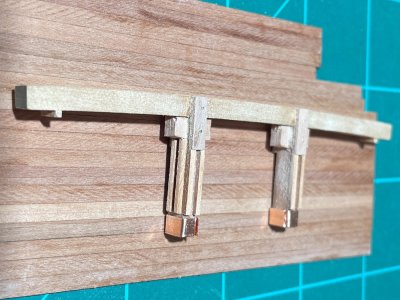
Prototype Cargo support beam: Time to move to the cargo area. After some consideration, I decided to keep this area quite open with only few sub-divisions. However, the support beams should all be in place, which will allow for customization by the crew. I will set the spacing to between 30 or 40 mm apart, which translate to 7-8 feet at scale. Support beams were likely crude and frequently change as they get damaged and/or rot set in - this was likely a messy area. So, I try not to work the parts to perfection, so they appear a little crude

Lastly, I will be using copper bands at the base. This is relatively thick copper (not the tape) formed using small plier. The idea is that it should help with maintenance, strengthen the base and limit rotting. However, I have to reveal a little secret (just between you and me - don't tell anyone): The copper band at the base will act as a sleeve, i.e. not glue to the beam. That way they can slide down to hide any tiny gap with the deck underneath. This way I won't have to drill thru the deck but just leave the beam sit on it.

On a side note: the upper deck beams are cut a tad short. They keep falling during test fit, which annoy me. To help I glued small "stopper" underneath. The picture below is a test fit; nothing really glue together.

IMG_4071.jpeg
 
Last edited:
Back
Top