



• Win a Free Custom Engraved Brass Coin!!!
    As a way to introduce our brass coins to the community, we will raffle off a free coin during the month of August. Follow link ABOVE for instructions for entering.
  • SUBSCRIBE TO SHIPS IN SCALE TODAY!

    The beloved Ships in Scale Magazine is back and charting a new course for 2026!
    Discover new skills, new techniques, and new inspirations in every issue.

    NOTE THAT OUR NEXT ISSUE WILL BE MARCH/APRIL 2026

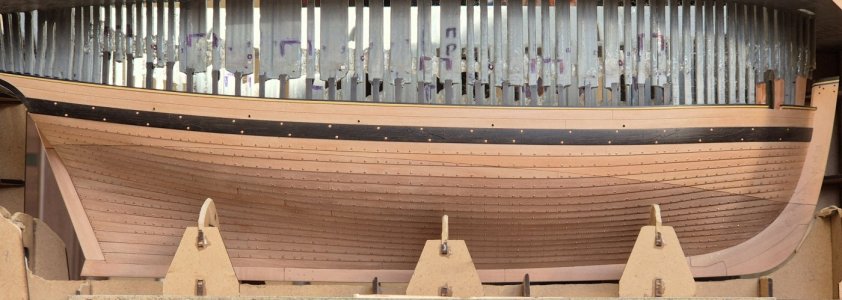
HMS Alert [1777] 1:48 POF by serikoff. (Two hulls: skeleton and fully rigged)

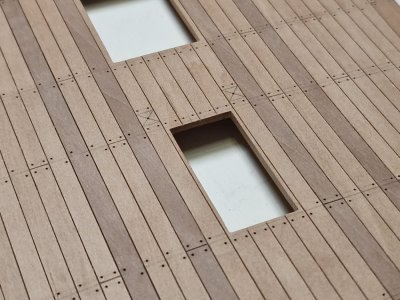
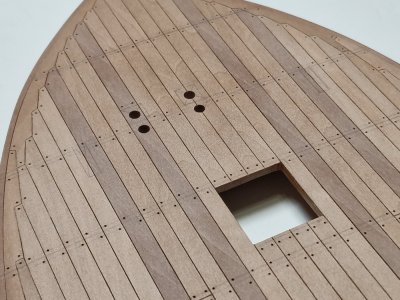
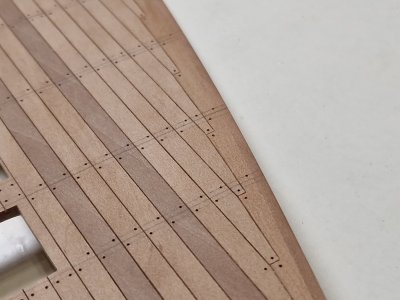
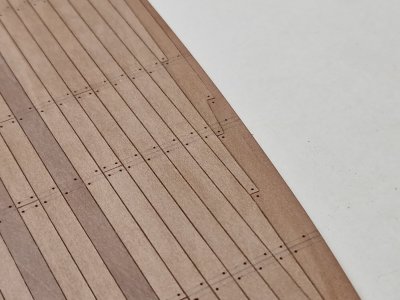
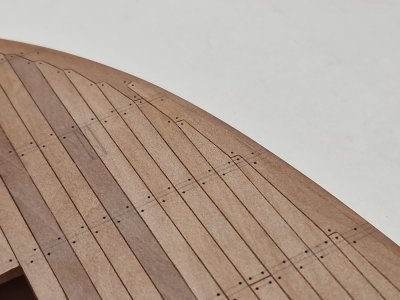
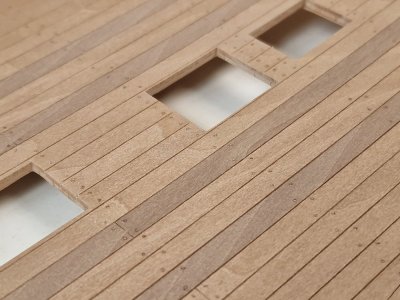
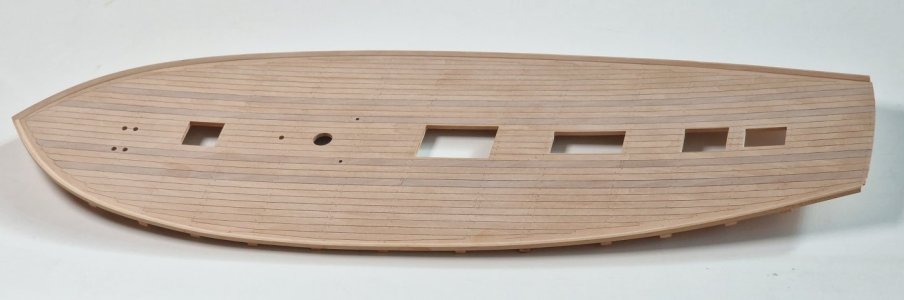
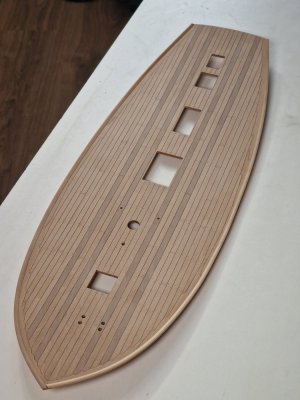
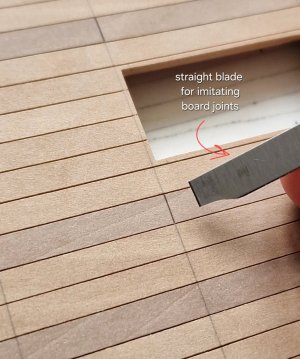
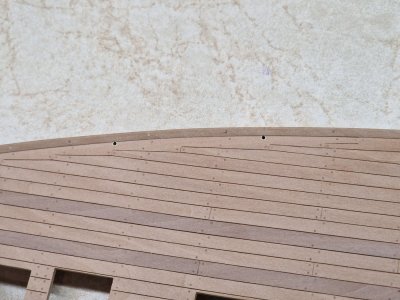
Deck. Nailing (imitation of plugs).
Alert 2343.jpg

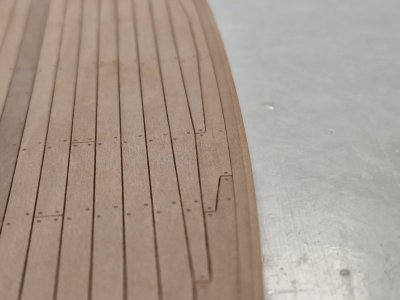
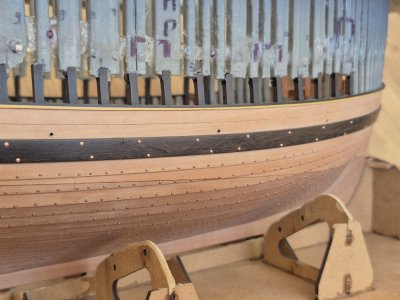
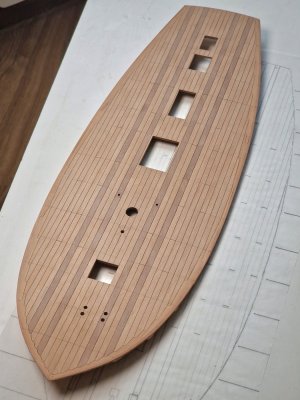
First, I made the joints on the boards with a straight blade. But since the power boards (which are a different color) were in short supply, I had to make real joints on them and then lay out the planks from there. Unfortunately, I made a small mistake, but in the end, I moved it to the place where the guns are... and it won't be visible. Although I blamed myself for it all day...
Alert 2344.jpg

The only good thing is that everything looks good visually: there are no unnecessary joints, no irregularities, or violations of the rule of one joint every three solid boards, and that's truly pleasing.

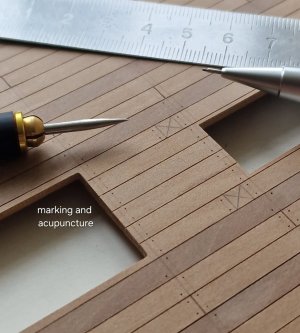
Next comes the marking and the needling.
Alert 2345.jpg

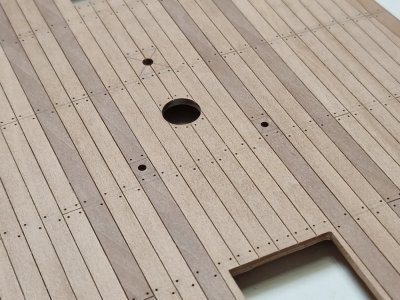
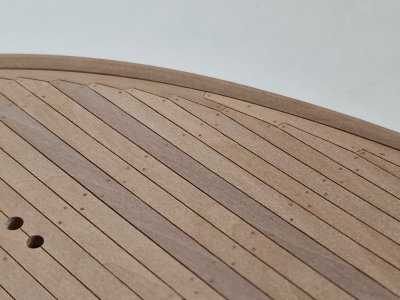
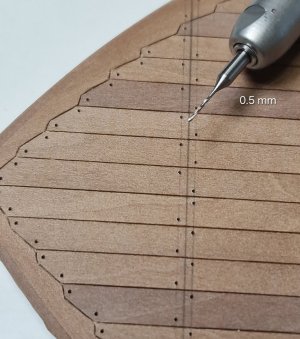
I start by making very small (barely noticeable) punctures along the entire belt. After checking for symmetry, I make the punctures deeper. If the first, weak puncture was slightly offset, I can correct this by making a second puncture, rather than making a second one, but rather by moving the hole closer to the first.

This process is the most important and painstaking... any mistake here is a visual flaw in the entire composition.

Then, carefully drill with a 0.5 mm drill bit.
Alert 2346.jpg

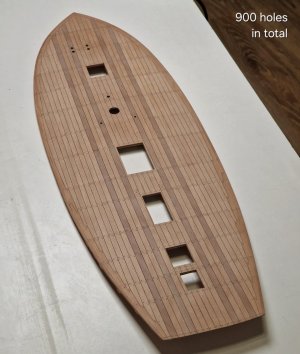
Luckily, all the holes were made in the right places...
Alert 2347.jpg

And the total number of such holes, as well as nails, will be 900.

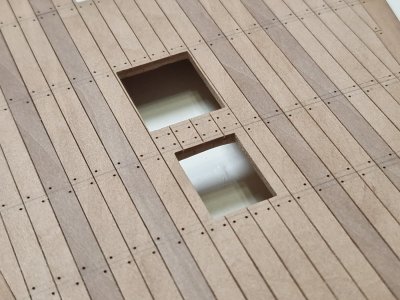
A few close-ups for those closely monitoring the construction:
Alert 2348.jpg

Alert 2349.jpg

Alert 2350.jpg

Alert 2351.jpg

Alert 2352.jpg

Alert 2353.jpg

Alert 2354.jpg

Alert 2355.jpg

Alert 2356.jpg

Alert 2357.jpg

Alert 2358.jpg

Alert 2359.jpg

Alert 2360.jpg

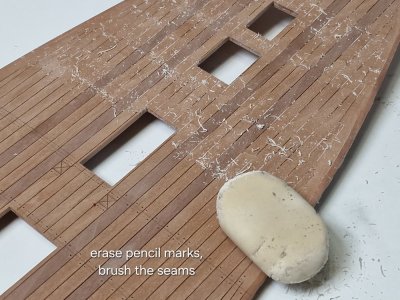
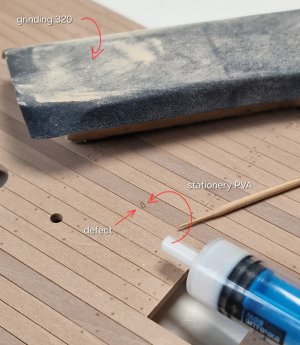
After sanding, I always check the surface for defects...
Alert 2361.jpg

...and I fill them with regular PVA. And sand them again. As a result, the crack isn't stained as much by either oil or bitumen.

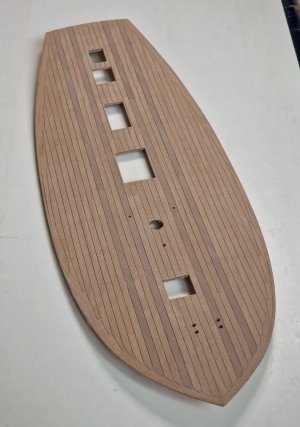
Here's the final result.
Alert 2362.jpg

Alert 2363.jpg

Without oil the nails are still hard to see, but I'm already happy with the result.
 
Deck . Nageln (Imitation von Dübeln).

View attachment 595121

Zuerst habe ich die Verbindungen der Bretter mit einem geraden Messer hergestellt. Da die Platinen für die Stromversorgung (die eine andere Farbe haben) aber knapp waren, musste ich sie mit richtigen Verbindungen versehen und die Bretter darauf auslegen. Leider ist mir ein kleiner Fehler unterlaufen, aber letztendlich habe ich die Platine an die Stelle verschoben, wo die Waffen stehen … und sie wird nicht sichtbar sein. Obwohl ich mich den ganzen Tag darüber geärgert habe …

View attachment 595122

Das einzig Gute daran ist, dass alles optisch gut aussieht: Es gibt keine unnötigen Fugen, keine Unregelmäßigkeiten oder Verstöße gegen die Regel, dass jeweils eine Fuge auf drei massive Bretter gesetzt wird, und das ist wirklich erfreulich.

Als Nächstes folgen das Markieren und das Vernadeln.

View attachment 595123

Ich fange damit an, entlang des gesamten Gürtels sehr kleine (kaum sichtbare) Löcher zu stechen. Nachdem ich die Symmetrie überprüft habe, vertiefe ich die Löcher. Fällt das erste, schwache Loch leicht versetzt war, kann ich dies korrigieren, indem ich ein zweites Loch hinzufüge, anstatt ein zweites zu stechen, sondern das Loch näher an das erste verschiebe.

Dieser Prozess ist der wichtigste und mühsamste... Jeder Fehler hier ist ein visueller Mangel in der gesamten Komposition.

Anschließend vorsichtig mit einem 0,5 mm Bohrer bohren.

View attachment 595124

Zum Glück wurden alle Löcher an den richtigen Stellen gemacht...

View attachment 595125

Die Gesamtzahl solcher Löcher sowie der Nägel beträgt 900.

Ein paar Nahaufnahmen für diejenigen, die die Bauarbeiten aufmerksam verfolgen:

View attachment 595126

View attachment 595127

View attachment 595128

View attachment 595129

View attachment 595130

View attachment 595131

View attachment 595132

View attachment 595133

View attachment 595134

View attachment 595135

View attachment 595136

View attachment 595137

View attachment 595138

Nach dem Schleifen überprüfe ich die Oberfläche immer auf Mängel...

View attachment 595139

…und ich fülle sie mit normalem PVA-Kleber. Anschließend schleife ich sie erneut. Dadurch wird der Riss weder durch Öl noch durch Bitumen so stark verfärbt.

Hier ist das Endergebnis.

View attachment 595140

View attachment 595141

Ohne Öl sind die Nägel zwar noch schwer zu erkennen, aber ich bin mit dem
Wunderbarer Eindruck deiner Technik. Sehr sauber gearbeitet. Erstklassig erklärt und visualisiert. Das Ergebnis spricht für sich. Einer der besten Bauberichte, die ich gelesen habe. Dein Baubericht und all die „ Teilberichte „ gleichen einem Studium. Eine Anleitung für weltklasse Modellbau. Danke, dass Du uns hier jeden Schritt so ausführlich zeigt und erklärst.
 
Last edited:
You should be happy that I don’t live close to you. Otherwise you would have an unexpected apprentice that you couldn’t get rid of . Beautiful work, as always!
Ahah, thank you. Technology now makes it easier to learn from others. I'm glad I can help. And I'll be happy if all my "students" one day surpass their "teacher" many times over. Ahahahaha

Wunderbarer Eindruck deiner Technik. Sehr sauber gearbeitet. Erstklassig erklärt und visualisiert. Das Ergebnis spricht für sich. Einer der besten Bauberichte, die ich gelesen habe. Dein Baubericht und all die „ Teilberichte „ gleichen einem Studium. Eine Anleitung für weltklasse Modellbau. Danke, dass Du uns hier jeden Schritt so ausführlich zeigt und erklärst.
Vielen Dank für das Lob. Und ich bin sicher, es gibt viele Modellbauer, die es viel besser machen als ich… Meine Stärke ist, dass ich versuche, meine Vorgehensweise zu erklären. Ich habe einmal Modellbauer getroffen, die ebenfalls ihre Erfahrungen teilten, und mir wurde klar, dass die Leute mehr daran interessiert sind, zu verstehen und zu sehen, wie man es nachbaut, als das schönste Ergebnis zu sehen.

(En) Thank you for the high praise. And I'm sure there are many modelers who do much better than me... My strength is that I try to share how I do everything. I once met modelers who also shared their experiences, and I realized that people are more interested in understanding and seeing how to replicate it, rather than seeing the most beautiful result.
 
Waterways. 1/2

Alert 2364.jpg

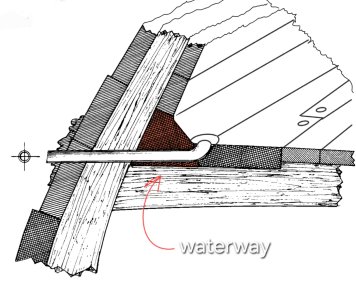
Since the anatomy drawings don't really show normal views of this unit (not to mention the lack of drainage channels), I'll use the diagram from the anatomy of the Royal Caroline 1749 as a reference.

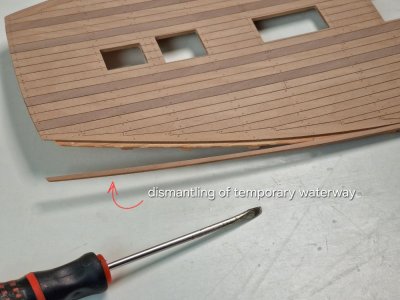
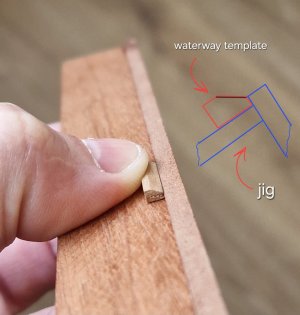
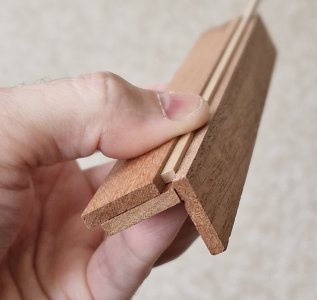
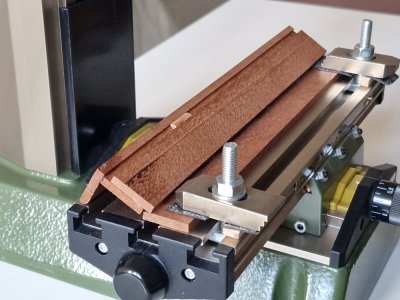
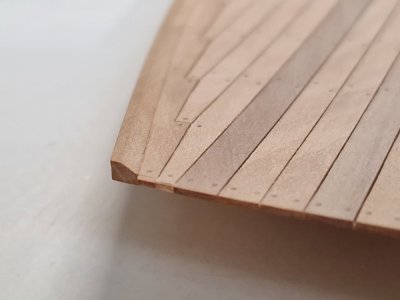
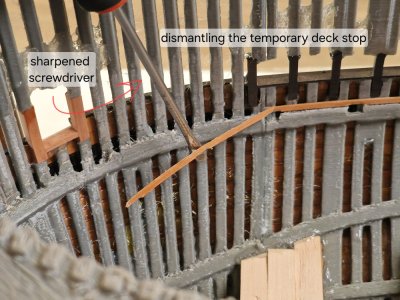
First, I dismantled the temporary waterway and made a simple jig to create a new one.

Alert 2365.jpg

Alert 2366.jpg

Alert 2367.jpg

Alert 2368.jpg

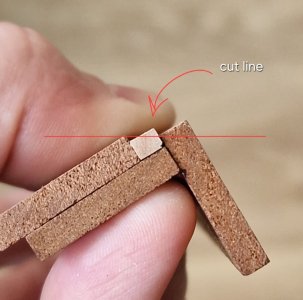
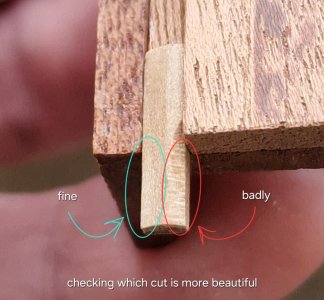
In order to understand which cut would look better, I tried it from different sides.

Alert 2369.jpg

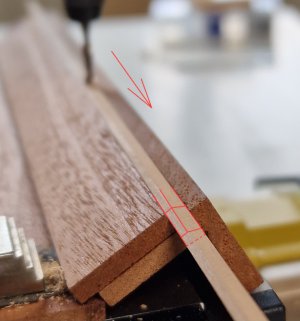
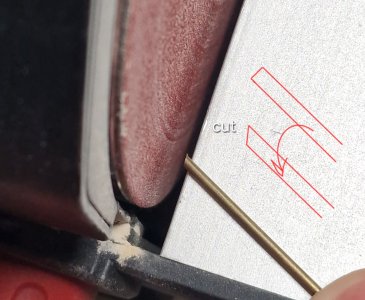
The principle of jig is simple. You need to cut a section of the workpiece diagonally. And then you just need to create a slanted surface.

Alert 2370.jpg

Alert 2371.jpg

This jig will be needed for the second set (for the first hull).

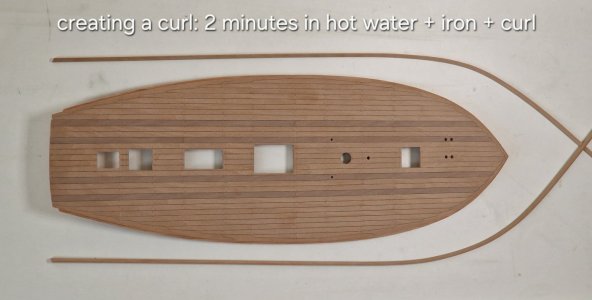
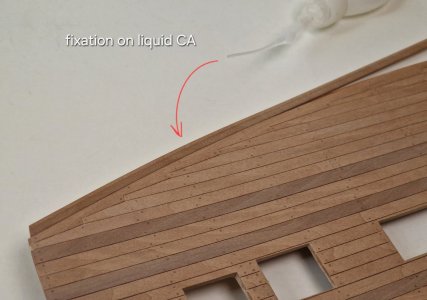
Next, I bent the blanks using a simple method. I dipped them in boiling water and then ironed them into the desired shape. I didn't try too hard, the main thing was to bend them where the radius was largest.
Alert 2372.jpg

Alert 2373.jpg

Alert 2374.jpg

Alert 2375.jpg

Alert 2376.jpg

Alert 2377.jpg

Alert 2378.jpg

Alert 2379.jpg

Alert 2380.jpg

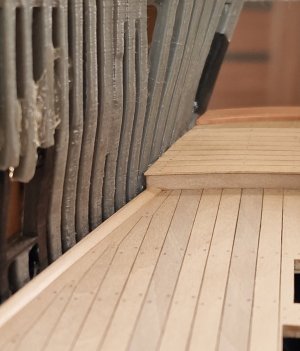
After removing the deck stop, I installed the deck inside the hull.
Alert 2381.jpg

Alert 2382.jpg

The rest is in the next part...
 
Waterways. 2/2

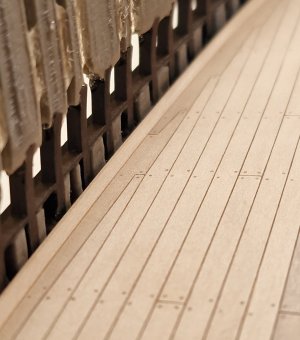
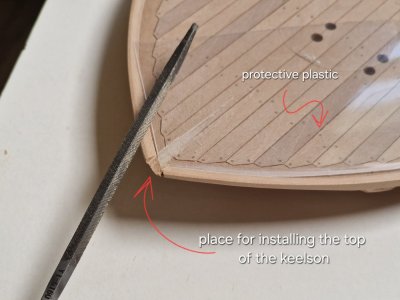
To make adjustments, I made a removable keelson top. Now I need to make room for it in the waterways.

Alert 2383.jpg

Alert 2384.jpg

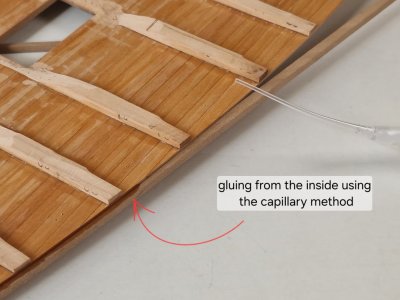
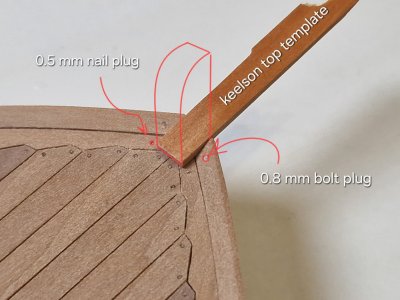
I added a couple more plugs to the outer chord of the 0.5mm planks (as usual). And two 0.8mm plugs at the ends of the waterways. These plugs are larger because they cover bolts, not nails, which secure the waterways (top to bottom) to the beams and (from inside to outside) to the frames. This creates a unified framework, as the waterways weren't merely decorative, but were crucial for achieving the hull's longitudinal and transverse strength.

Alert 2385.jpg

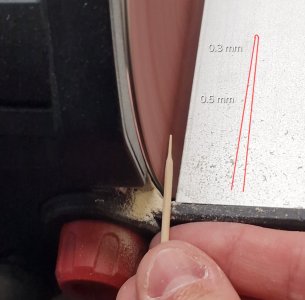
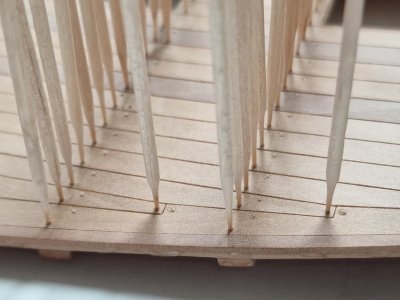
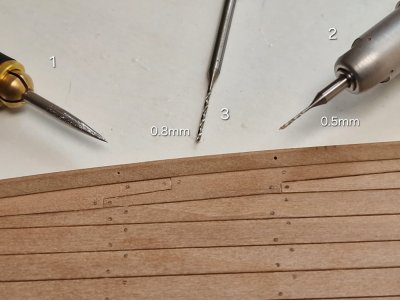
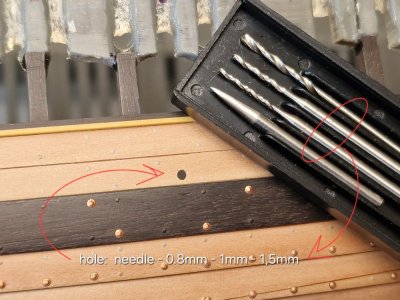
Next, everything is standard: injection, start with a drill of a smaller diameter, and finish with a drill of the required diameter (0.8 mm).

Alert 2386.jpg

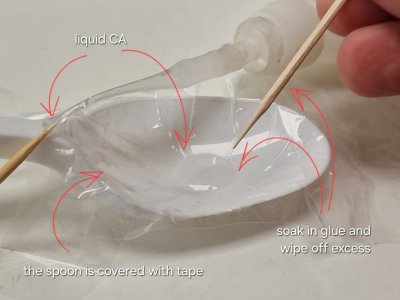
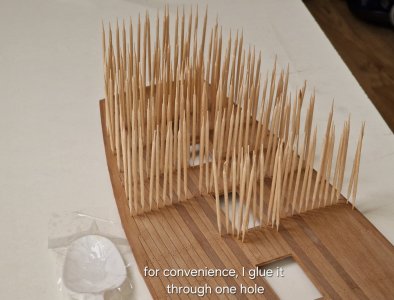
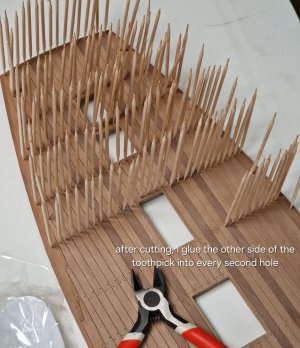
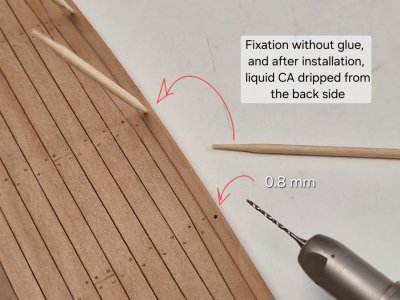
After securing the toothpick (without glue), I apply glue to the back. I bite off the toothpick and sand it down to a level surface.


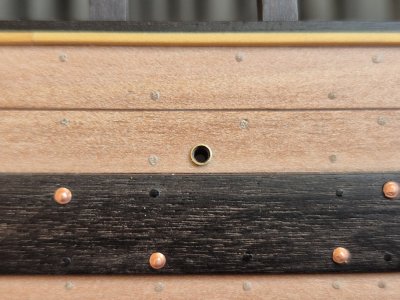
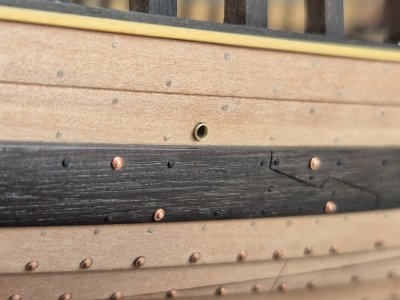
Scuppers (inner part).

Alert 2387.jpg

*A few words about the plugs on the waterways. They are located in the center of the beam, as the bolt passed through both parts. We can't see the bolts that connect the waterway and the frames, as they are covered by deck planks.

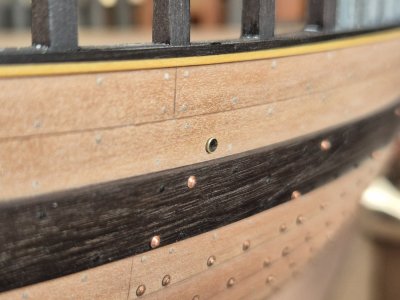
So, what are scuppers? They are lead pipes through which water that entered the ship's side exited. Since the Alert had a very low side, this detail was very important. Ships of this class could have 4-5 pairs of scuppers.

Alert 2388.jpg

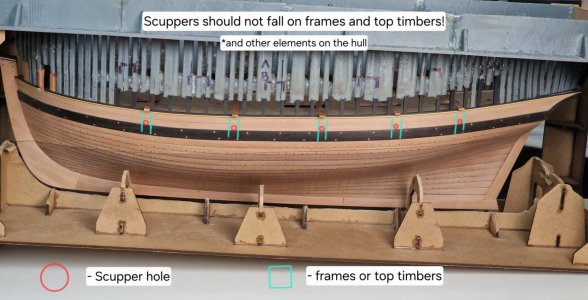
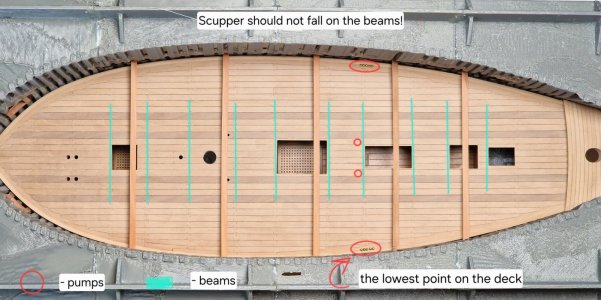
The scuppers were not supposed to hit the beams or top timbers, frames, gun ports, or other hull elements.

In the photo below, I've indicated the positions of the pumps and the lowest points on the deck (I used balls, and they found these points). These points were located under the gun ports, where scuppers couldn't be located. Therefore, I didn't move the second-to-last scuppers aft (to reduce their number to four pairs), but rather placed them as close as possible to these points. However, this left a large area aft (especially considering the low frame of the rear grille). Therefore, I had to add a fifth pair (the rear one). But given the small diameter of the scuppers (to avoid brittleness of the planks they pass through) and the low sides (which didn't provide protection from waves at high heels), five pairs is quite realistic. Let me remind you that these details are essentially absent from the anatomy, so all planning is a reconstruction based on a similar situation of similar ships.

Alert 2389.jpg

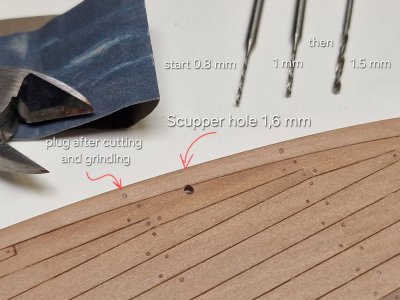
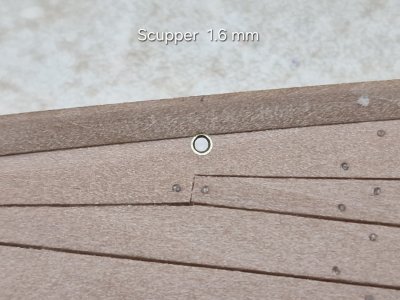
So, there's a 1.6 mm hole. It's angled, not tied to any specific value, since the scuppers will be composite: internal (on the deck) and external (on the hull). Today, we'll be talking about the internal ones.

Alert 2390.jpg

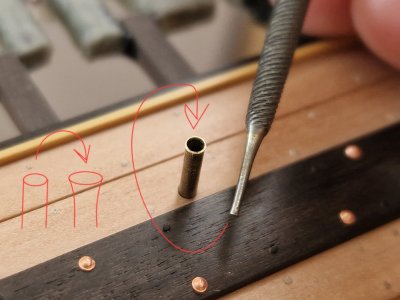
I used 1.6mm brass tube.

Alert 2391.jpg

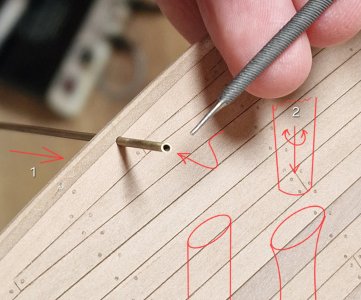
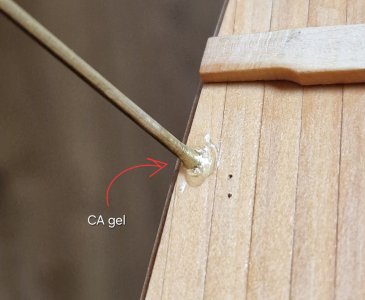
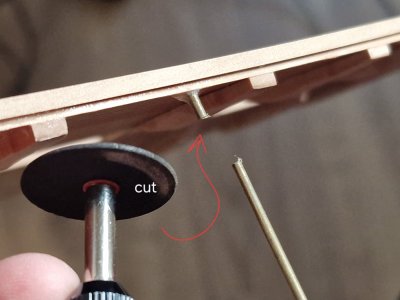
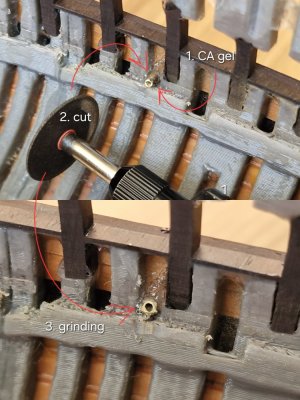
After I'd angled it correctly, I'd push it through the hole and use a sharpened file to slightly increase the diameter by stretching it. This made the tube fit more snugly. I held it so the cut surface was flush with the deck surface and glued it to the back with CA gel.

Alert 2392.jpg

Alert 2393.jpg

Alert 2394.jpg

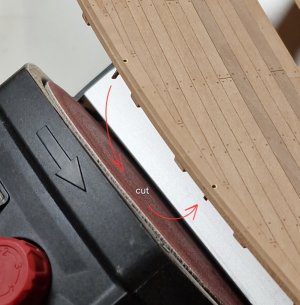
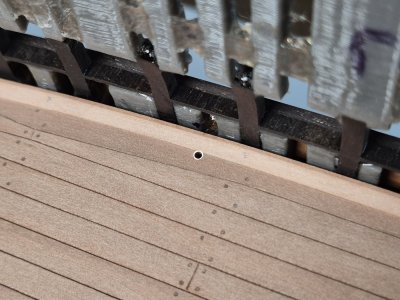
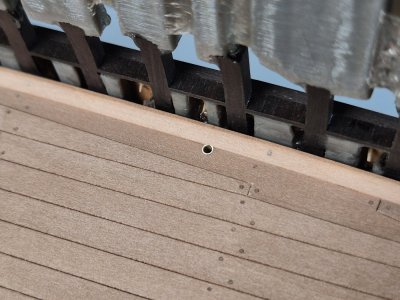
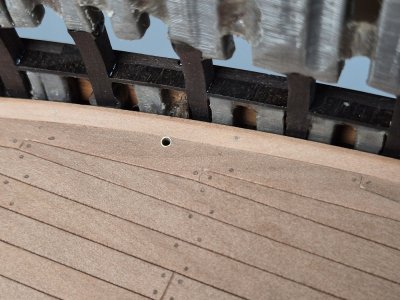
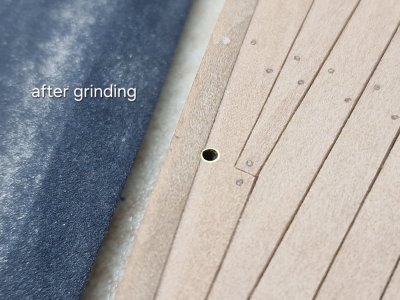
After trimming off the excess, I polished the surface. I recommend leveling the surface right away so you don't have to sand too much, otherwise you'll leave marks on the polished deck.

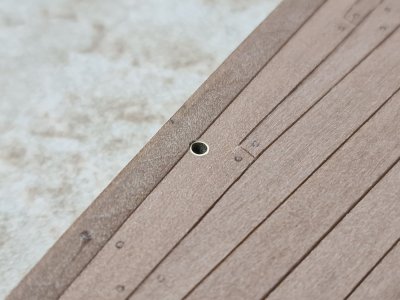
And here's the result:

Alert 2395.jpg

Alert 2396.jpg

Alert 2397.jpg

Alert 2398.jpg

It's not a given that these elements will be very visible, as there will be cannonball holders above them. That's why I didn't bother with the funnel shape, flaring the metal... this shape is more than sufficient at this scale.

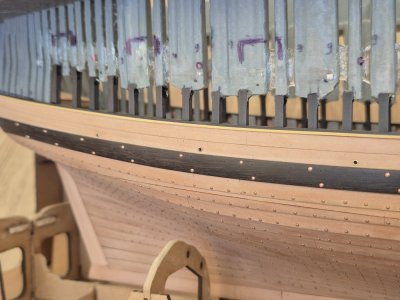
Next comes the remaining 8 pieces... and creating the outer parts that will be fixed to the hull. This is also a consideration. Scuppers, especially on low-sided ships, had check valves. These are rectangular pieces of leather that covered the openings. They dangled freely and easily let water pass from the inside out, but when a wave hit from the outside, they sealed the pipe tightly, preventing water from spurting out. So the question is... how to implement this. Should I make this valve... then it would cover the opening and all the work on the scupper... Or should I ignore the valve and show the design of this element. The downside of the valve is that it's difficult to show it well, especially at this scale... so I'm more inclined to go without the valve. Considering that many models don't always have scuppers. ;) Speechless
 
Waterways. 2/2

To make adjustments, I made a removable keelson top. Now I need to make room for it in the waterways.

View attachment 595819

View attachment 595820

I added a couple more plugs to the outer chord of the 0.5mm planks (as usual). And two 0.8mm plugs at the ends of the waterways. These plugs are larger because they cover bolts, not nails, which secure the waterways (top to bottom) to the beams and (from inside to outside) to the frames. This creates a unified framework, as the waterways weren't merely decorative, but were crucial for achieving the hull's longitudinal and transverse strength.

View attachment 595821

Next, everything is standard: injection, start with a drill of a smaller diameter, and finish with a drill of the required diameter (0.8 mm).

View attachment 595822

After securing the toothpick (without glue), I apply glue to the back. I bite off the toothpick and sand it down to a level surface.


Scuppers (inner part).

View attachment 595823

*A few words about the plugs on the waterways. They are located in the center of the beam, as the bolt passed through both parts. We can't see the bolts that connect the waterway and the frames, as they are covered by deck planks.

So, what are scuppers? They are lead pipes through which water that entered the ship's side exited. Since the Alert had a very low side, this detail was very important. Ships of this class could have 4-5 pairs of scuppers.

View attachment 595824

The scuppers were not supposed to hit the beams or top timbers, frames, gun ports, or other hull elements.

In the photo below, I've indicated the positions of the pumps and the lowest points on the deck (I used balls, and they found these points). These points were located under the gun ports, where scuppers couldn't be located. Therefore, I didn't move the second-to-last scuppers aft (to reduce their number to four pairs), but rather placed them as close as possible to these points. However, this left a large area aft (especially considering the low frame of the rear grille). Therefore, I had to add a fifth pair (the rear one). But given the small diameter of the scuppers (to avoid brittleness of the planks they pass through) and the low sides (which didn't provide protection from waves at high heels), five pairs is quite realistic. Let me remind you that these details are essentially absent from the anatomy, so all planning is a reconstruction based on a similar situation of similar ships.

View attachment 595829

So, there's a 1.6 mm hole. It's angled, not tied to any specific value, since the scuppers will be composite: internal (on the deck) and external (on the hull). Today, we'll be talking about the internal ones.

View attachment 595830

I used 1.6mm brass tube.

View attachment 595831

After I'd angled it correctly, I'd push it through the hole and use a sharpened file to slightly increase the diameter by stretching it. This made the tube fit more snugly. I held it so the cut surface was flush with the deck surface and glued it to the back with CA gel.

View attachment 595832

View attachment 595833

View attachment 595834

After trimming off the excess, I polished the surface. I recommend leveling the surface right away so you don't have to sand too much, otherwise you'll leave marks on the polished deck.

And here's the result:

View attachment 595835

View attachment 595836

View attachment 595837

View attachment 595838

It's not a given that these elements will be very visible, as there will be cannonball holders above them. That's why I didn't bother with the funnel shape, flaring the metal... this shape is more than sufficient at this scale.

Next comes the remaining 8 pieces... and creating the outer parts that will be fixed to the hull. This is also a consideration. Scuppers, especially on low-sided ships, had check valves. These are rectangular pieces of leather that covered the openings. They dangled freely and easily let water pass from the inside out, but when a wave hit from the outside, they sealed the pipe tightly, preventing water from spurting out. So the question is... how to implement this. Should I make this valve... then it would cover the opening and all the work on the scupper... Or should I ignore the valve and show the design of this element. The downside of the valve is that it's difficult to show it well, especially at this scale... so I'm more inclined to go without the valve. Considering that many models don't always have scuppers. ;) Speechless
So, you will have one model to show what the insides look like and the other that will be fully planked I believe is what you said you were going to do with these. What about putting the valve on the one that is planked and leaving it off of the one that is not? As for modeling the leather valve, what about a piece of silk fabric might lay down like it needs to. You might have to dye it to get the color you want, if it will work.
 
So, you will have one model to show what the insides look like and the other that will be fully planked I believe is what you said you were going to do with these. What about putting the valve on the one that is planked and leaving it off of the one that is not? As for modeling the leather valve, what about a piece of silk fabric might lay down like it needs to. You might have to dye it to get the color you want, if it will work.
It's a good idea... but I need to think about it some more... and, of course, experiment. Whichever option I like best, I'll keep.
 
Back
Top