

- Joined
- Apr 20, 2020
- Messages
- 6,562
- Points
- 738

merry Christmas and Happy new year my friend

 |
The beloved Ships in Scale Magazine is back and charting a new course for 2026! Discover new skills, new techniques, and new inspirations in every issue. NOTE THAT OUR NEXT ISSUE WILL BE July/August 2026 |
|
 |
As a way to introduce our brass coins to the community, we will raffle off a free coin during the month of August. Follow link ABOVE for instructions for entering. |
|
merry Christmas and Happy new year my friend






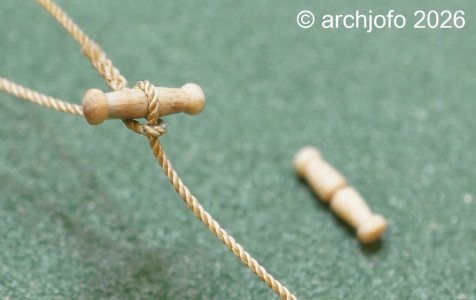
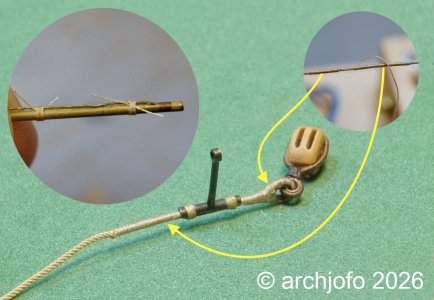
This is a very impressive detail,The final close-up shows the toggle together with a rope that has been fitted with a fully scale‑accurate, real spliced eye
THANK YOU. Just downloaded it and will play around with it over the next few days. Don't be surprised if you get a DM from me though with questions.I do this with Paint.NET, using the free version.
Continuation: Fore Yard Boulins – Boulines de la vergue de misaine
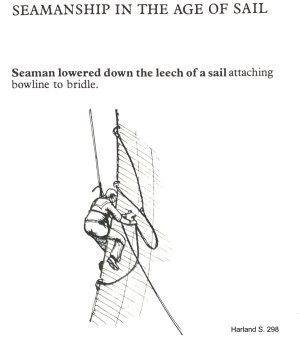
After further research, I moved away from securing the boulins with the sails taken off in the way I had originally shown on the model. That earlier version followed English practice more closely:
View attachment 572951
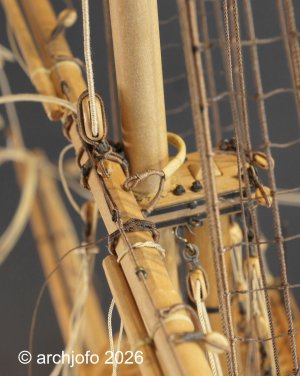
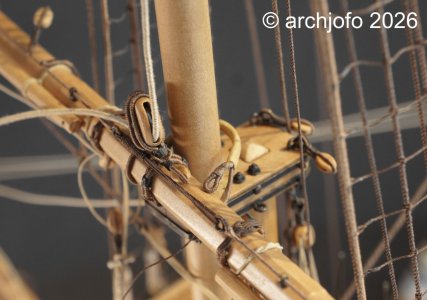
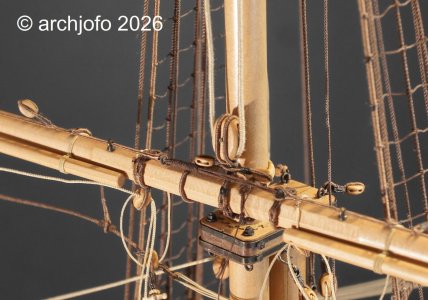
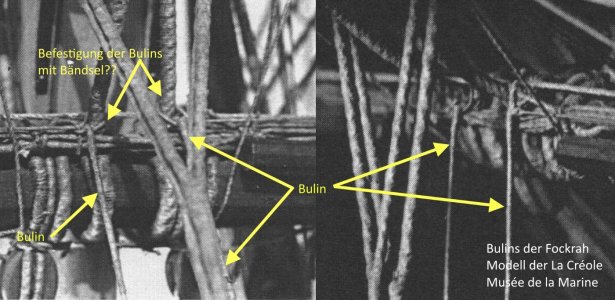
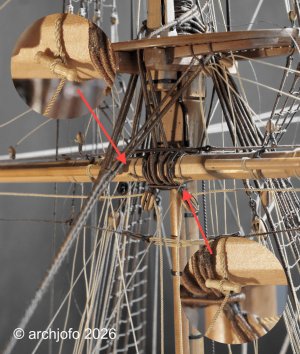
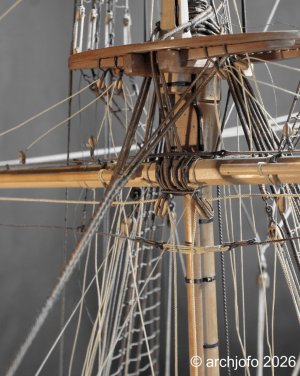
In the meantime, I have settled on the variant now implemented on the model, as it corresponds much more closely to French practice and is therefore historically more accurate. The following photos show the current arrangement on the fore yard in detail.
View attachment 572954
View attachment 572955
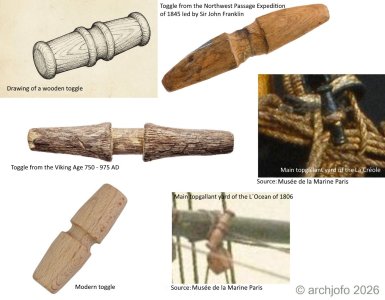
Beforehand, during additional research, I systematically examined the shape and construction of the toggles.
The compilation of different toggles illustrates the wide range of forms and manufacturing techniques — from simple wooden toggles of the Viking era to turned pieces from the 19th century.
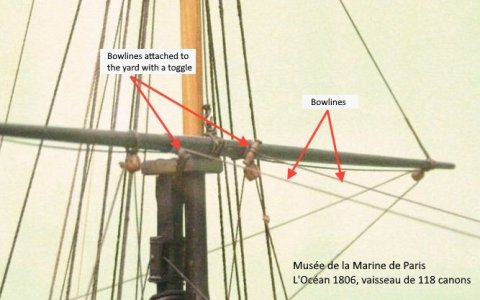
For the model of La Créole, however, the toggles documented on the models of L’Océan (1806) and La Créole in the Musée de la Marine are the most relevant. Both display a characteristic French design.
View attachment 572956
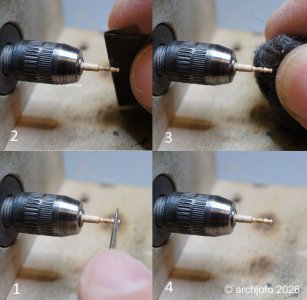
The following images show how the toggles were made from dogwood. The wood is extremely hard and fine‑grained, making it ideal for these tiny pieces.
View attachment 572953
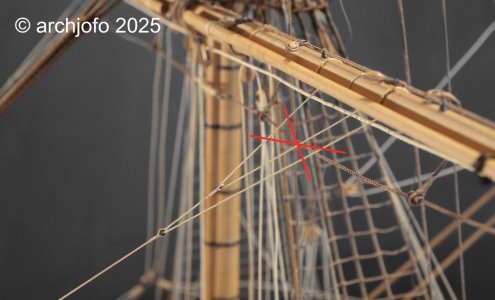
The final close-up shows the toggle together with a rope that has been fitted with a fully scale‑accurate, real spliced eye — exactly as shown on the model. The splice ensures:
View attachment 572952
- clean load transfer without the bulk of a knot
- a scale‑appropriate appearance, since knots often look oversized on a model
- a historically correct connection, as can also be seen on the Paris museum models
To be continued…


Excellence personified.Continuation: Fore Yard Boulins – Boulines de la vergue de misaine
After further research, I moved away from securing the boulins with the sails taken off in the way I had originally shown on the model. That earlier version followed English practice more closely:
View attachment 572951
In the meantime, I have settled on the variant now implemented on the model, as it corresponds much more closely to French practice and is therefore historically more accurate. The following photos show the current arrangement on the fore yard in detail.
View attachment 572954
View attachment 572955
Beforehand, during additional research, I systematically examined the shape and construction of the toggles.
The compilation of different toggles illustrates the wide range of forms and manufacturing techniques — from simple wooden toggles of the Viking era to turned pieces from the 19th century.
For the model of La Créole, however, the toggles documented on the models of L’Océan (1806) and La Créole in the Musée de la Marine are the most relevant. Both display a characteristic French design.
View attachment 572956
The following images show how the toggles were made from dogwood. The wood is extremely hard and fine‑grained, making it ideal for these tiny pieces.
View attachment 572953
The final close-up shows the toggle together with a rope that has been fitted with a fully scale‑accurate, real spliced eye — exactly as shown on the model. The splice ensures:
View attachment 572952
- clean load transfer without the bulk of a knot
- a scale‑appropriate appearance, since knots often look oversized on a model
- a historically correct connection, as can also be seen on the Paris museum models
To be continued…

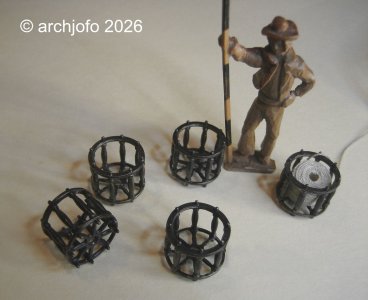
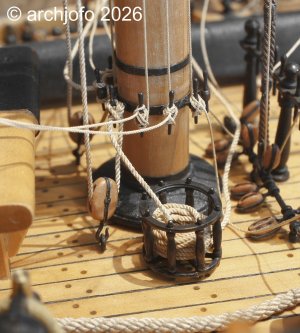


Great detailed parts, Johann. Even on those macro-pictures! And the metal work on the blocks ....... I don't even come close .......@AllanKP69
@shota70
@GrantTyler
Thank you so much for your kind comment,
and thank you to everyone else for the likes.
Rope tubs for halyards and sheets - Baille à drisse
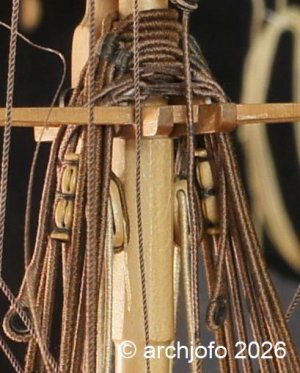
I am currently securing the running rigging of the foreyard at the appropriate points. In this context, the loose ends of the foreyard sheets also need to be stowed.
On French ships of the first half of the 19th century, this was done in so-called bailles à drisse – roughly translated as rope tubs, in which the lines lay neatly coiled and ready.
In Dr. Eduard Bobrik's "Allgemeinen nautischen Wörterbuch" of 1858, they are mentioned as follows:
View attachment 574239
View attachment 574243
Contemporary handbooks clearly describe the function of these containers.
In the Manuel du Gabier (1827), it states:
"Les drisses doivent être lovées proprement et déposées dans la baille, afin qu’elle puissent filer sans embarras." (“The lines must be neatly coiled and placed in the container so they can run without snagging.”)
The Manuel du Matelot (1811) adds:
“ Les cordages de manœuvre sont rangés dans des bailles pour les préserver de l’humidité et du désordre. ”
(“The maneuvering lines are stored in containers to protect them from moisture and disorder.”)
This clearly defines their function: order, dryness, and free-running lines without dragging on the deck or becoming tangled.
The Manuel du gréement – frégate de 44 canons (1828) describes, by way of example, how these containers were moved as needed when a free run had to be ensured when a rope was being let out. This prevented loops from forming or the rope from snagging on the deck. This source proves that the baille à drisse was an active piece of equipment, its position adjusted depending on the maneuver situation—not merely a static storage location.
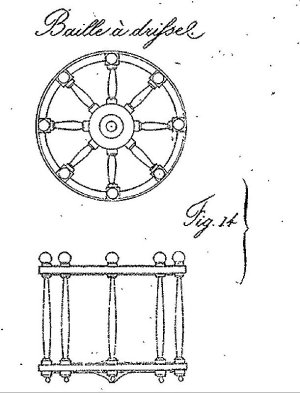
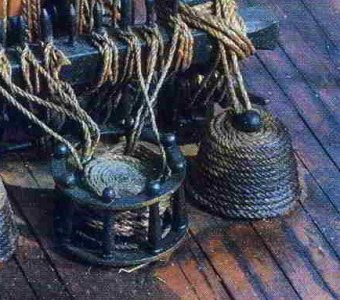
The shape of these containers is not described in detail in the texts, but the Atlas du Génie Maritime and several shipyard models in the Musée de la Marine (e.g., La Belle Poule) clearly show cylindrical, open baskets with vertical struts.
View attachment 574238
Source: Atlas du Génie Maritime
View attachment 574240
Source: Musée national de la Marine
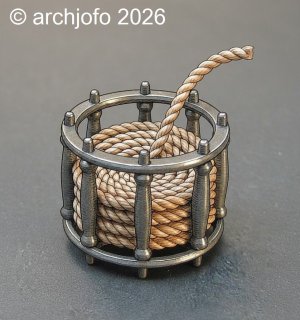
Some time ago, I made such baille baskets for my 1:48 scale La Créole and presented them in the construction report.
For the construction of my baskets, I used a corresponding drawing from the Atlas du Génie Maritime as a guide. As with the historical shipyard model, I will install a total of five: two at the foremast, two at the mainmast, and one at the mizzenmast.
View attachment 574242
In the French Navy of the early 19th century, bailles à drisses were mobile wooden containers used for both the organized storage and dry keeping of running rope, particularly halyards and sheets.
1. Safe, dry storage of rope
Between maneuvers, the lines were neatly coiled and stored in these containers. This protected them from:
• Dampness on the deck
• Dirt
• Tangles
• Damage from chafing
The containers were therefore located in close proximity to the respective rigging, usually at the base of the mast or where the lines led onto the deck.
2. Organized handling during maneuvers
During sailing maneuvers, the containers served to neatly gather the running or hauled-in rope. They prevented:
• lines from dragging across the deck
• lines from wrapping around fittings or blocks
• loops from forming
• crew members from being hindered in their work
3. Situational Repositioning During Maneuvers
The Manuel du gréement (1828) describes a specific case on page 234 in which the officer has the containers briefly moved aside to prevent loops from forming and snagging when a halyard runs out.
This example demonstrates:
• The containers are not permanently mounted
• They are positioned according to the maneuver situation
• They are an active tool, not just a storage location
The described case is a practical example, but it confirms the fundamental function of these containers.
View attachment 574241
The initial temporary placement of a rope tub on the foremast shows the direction things are headed. The design with small feet lifts the container slightly off the deck, thus reflecting the practical logic also mentioned in the Manuel du gréement of 1828. The final placement of all five rope tubs will only take place after the rigging of the running rigging is complete and the belaying points have been cleaned up. These will later receive their coils, so the overall appearance will only be complete once the final setup is finished.
Until next time…