


My best wishes for your birthday, Johann! I hope you have a great day celebrating with family and friends!

 |
The beloved Ships in Scale Magazine is back and charting a new course for 2026! Discover new skills, new techniques, and new inspirations in every issue. NOTE THAT OUR NEXT ISSUE WILL BE July/August 2026 |
|
 |
As a way to introduce our brass coins to the community, we will raffle off a free coin during the month of August. Follow link ABOVE for instructions for entering. |
|


 .
.


Good morning Johann. There are not enough superlatives to describe your work. I missed your birthday so a very belated Happy Birthday. Cheers GrantAttaching the Fore Topgallant Yard
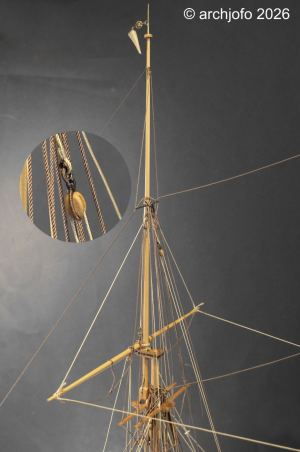
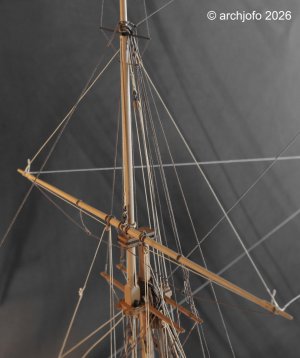
As announced, work on the foremast has now moved up a level to the fore topgallant yard. Following the theoretical planning, the practical implementation on the model is now underway.
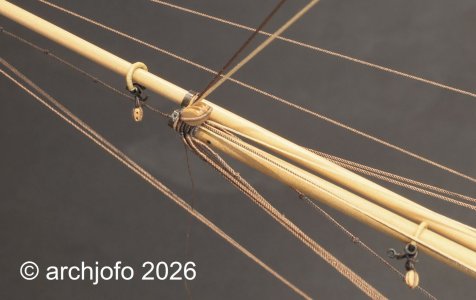
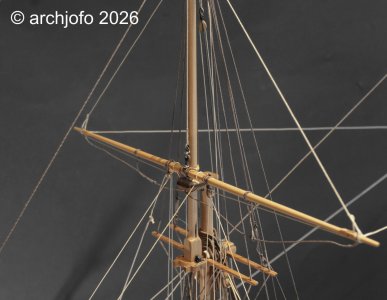
Particular attention was paid to tying the halyard block to the rigging: Authentic flat seizings were used here to create a stable and historically accurate connection. The remaining running rigging of the topgallant yard – lifts, braces, and clewlines – has already been provisionally attached. The final challenge now is to guide these lines past the standing rigging to their respective belaying points without any collisions.
Attached are a few pictures showing the progress of the fore topgallant yard rigging:
View attachment 586846
View attachment 586847
View attachment 586848
To be continued...
Bob, you should watch your language a bit. I translated “cuntlines” into Dutch and German—shame on you.


My respect for your original splice in the 3,5 mm thread, Johann. And as always very instructive pictures of your work.Continued: Fore topgallant yard – Fore topgallant halyard – Drisse de petit perroquet
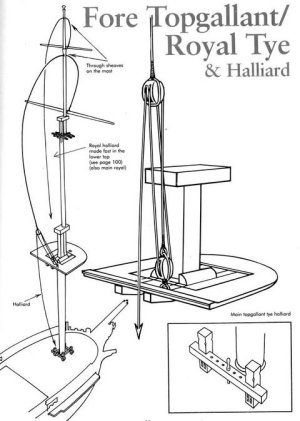
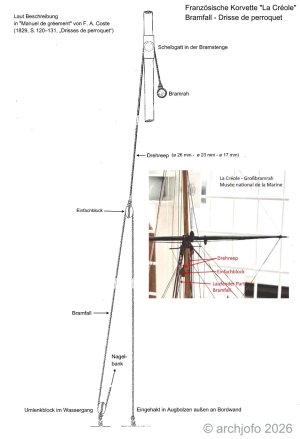
In previous posts, I reported on my research into the topgallant halyards. In connection with the installation of the fore topgallant halyard, it was still necessary to clarify how the upright part was attached to the outer hull.
On the original model of the La Créole in the Paris Museum, the contemporary model maker knotted the standing parts of the topgallant halyards (Drisse de vergue perroquet) to the backstay fittings – a solution I consider a simplification.
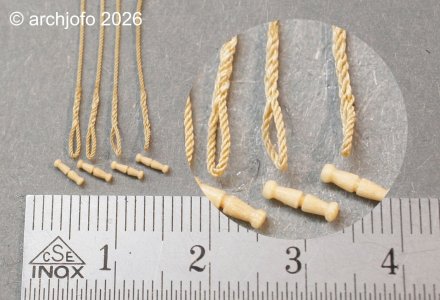
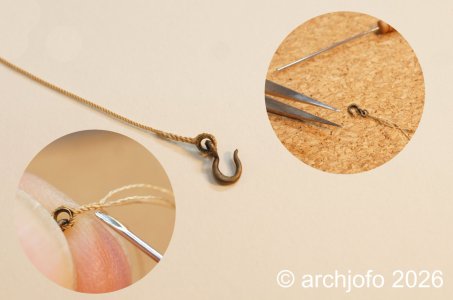
Since no clear information on how these standing parts were attached can be found in contemporary technical literature or in the usual sources, I opted for a spliced hook. This method is technically plausible, practical, and documented for comparable applications of the time. A similar principle can also be found in the replica of the French cutter La Renard 1812.
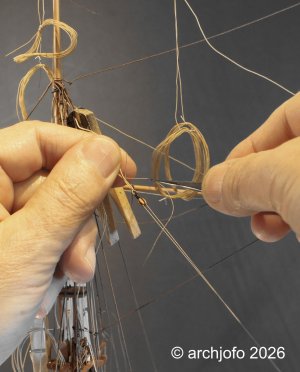
For the practical implementation on the model, I once again tried my hand at splicing a 0.35mm diameter rope.
After some initial practice, it worked reliably again – the old saying "practice makes perfect" proved true once more.
The following image shows the spliced hook in detail.
View attachment 589023
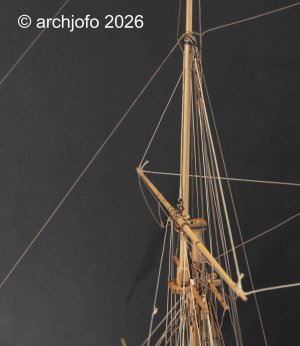
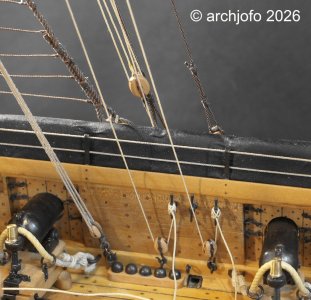
The next image shows how the running end of the fore topgallant halyard leads over the right turning block to the belaying point on the bulwark.
View attachment 589024
The standing end was hooked into an eyebolt behind the fore topmast backstay.
View attachment 589025
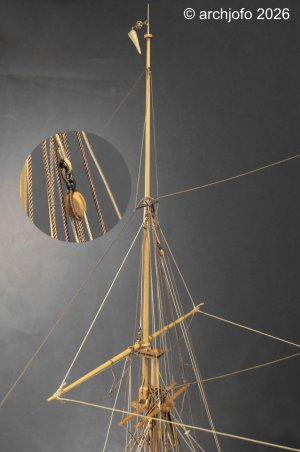
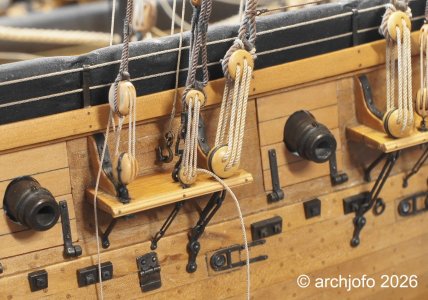
The last image finally shows the fore topgallant yard with the single block of the topgallant halyard.
View attachment 589026
After securing the sheets, halyards, and attaching the fore topgallant halyards, the next step is to set the fore royal yard.
Until next time…