Follow along with the video below to see how to install our site as a web app on your home screen.
Note: This feature may not be available in some browsers.
Win a Free Custom Engraved Brass Coin!!!
As a way to introduce our brass coins to the community, we will raffle off a free coin during the month
of August. Follow link ABOVE for instructions for entering.
The beloved Ships in Scale Magazine is back and charting a new course for 2026!
Discover new skills, new techniques, and new inspirations in every issue.
Some time ago, I thought it would be nice to build Le Coureur. She wasn’t available on the CAF website for quite a while, but one day a kit popped up so I ordered it then and there.
I started building a little while ago, but kept some pictures and notes of my progress which I will post before starting the log in earnest.
My kit arrived safely from Tom at CAF and I started with the keel:
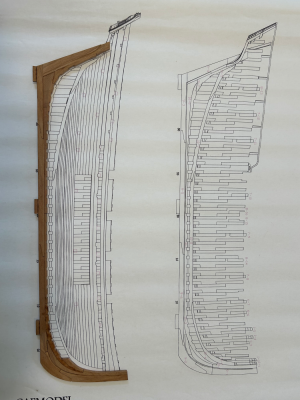
Here is the jig:
There are a few blocks of soft wood from the local hobby shop holding everything square and in place, but I think they will be straightforward to remove when the jig has to be dismantled later.
There was a little bit of guesswork in cleaning up the CNC machined parts (they were quite fuzzy on the outside), but everything seemed to fit nicely together in the end. It’s a bit of a shame it will be completely covered in the final model.
PS Sorry, but I just noticed the blue tape around the middle frame which holds everything steady in the jig.
Richard and Adi, thank you for your kind comments. I wish I had started with everyone else a few years ago, but am looking forward to it nonetheless. She’s a lovely ship and a little usual for a model ship with the clinker planking.
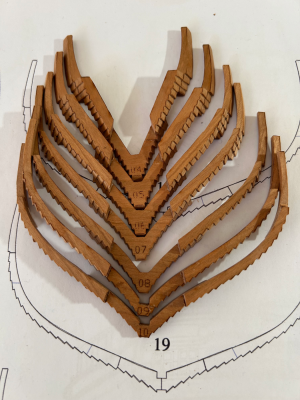
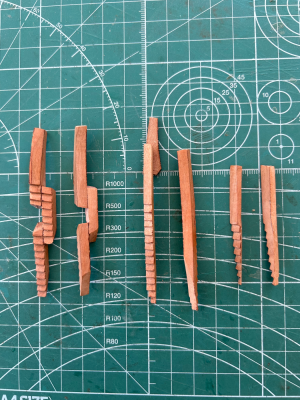
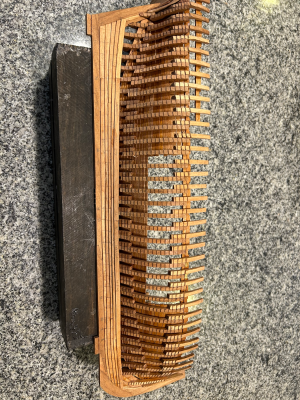
The next job is the frames. Here are some of the frames for the bow:
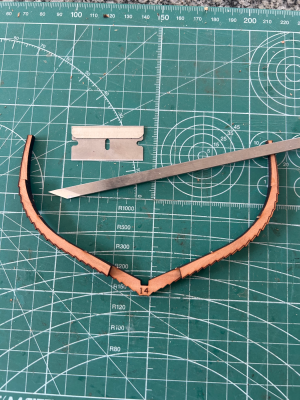
I have taken a slightly different approach to finishing the outside of the frames and have been using a knife (to remove most the of the material) and then a razor blade (to make the final adjustments to the steps).
The knife has to be very sharp to cut cleanly across end grain (quite common in the floor timbers). I also use the knife for the inside bevel, but then finish with 240 grit sandpaper and a scraper. The scraper is also useful to check the bevels are flat (fore and aft).
The frames seem to be cut very accurately, but there are some very slight differences in the laser markings for the bevels between the front and back. This is perhaps more pronounced on the reverse side of the billet, but the correct position can be marked in pencil by reference to the plans.
Thank you to all who have been following my progress to date. If you have any questions, please feel free to ask and I’ll do my best to explain why and how I have gone about things.
A few more frames completed:
Hopefully, all this effort will make the planking easier.
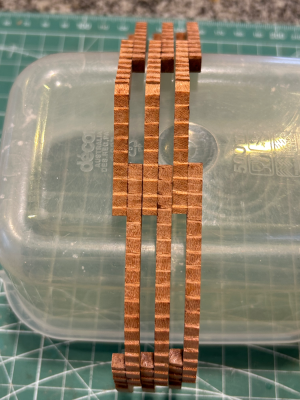
If you look closely, you can see the grain of the wood runs in different directions - across on the floor timbers and up and down on the futtocks. This makes cutting the notches more difficult where the two overlap.
Alan, thanks for your encouragement. I am determined to see this through, so there should be plenty more to read in the coming months…
Frames 1 , 2 and 3
The bottom of each frame is very fragile - the wood gets progressively thinner as the bevels which sit flush on the stem are lengthened, with the last two notches actually partially disappearing. Everything seems to fit in the jig, but I will need to do head-scratching to work out how to hold these pieces in place while the glue dries.
I am really enjoying this kit - full credit to Tom at CAF for being able to create these complicated three dimensional shapes from a sheet of timber.
The bevels have swapped sides - the outside bevel (for the clinker planking) is now on the aft face of the frame, while the inside bevel (for the ceilings) is now on the forward face of the frame.
It’s a bit of a fiddle fitting the frames where there are plywood cross pieces in the jig. As you can see, these cross pieces have steps which correspond to the steps on the frames and occasionally minor adjustments are needed to frame and jig.
Thank you to all who have been following my progress to date. I thought I might be a little hidden way in this part of Ships of Scale forum, but apparently not so…
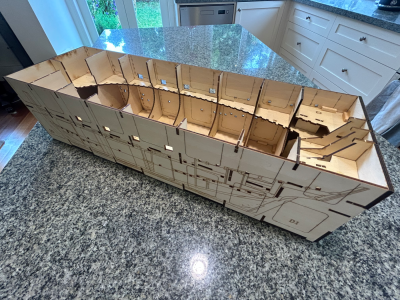
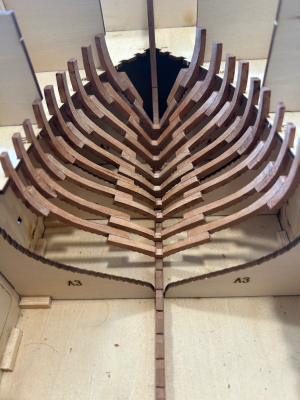
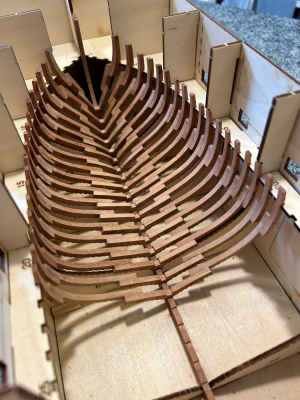
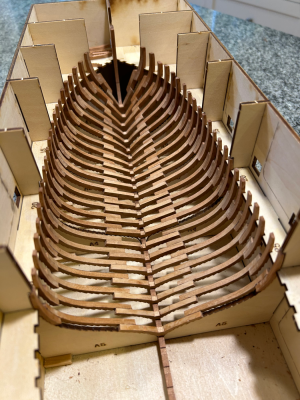
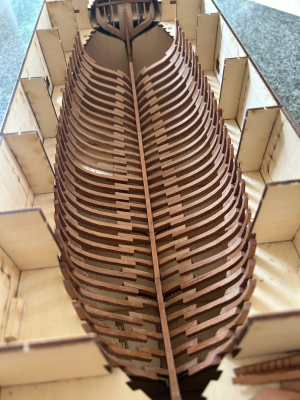
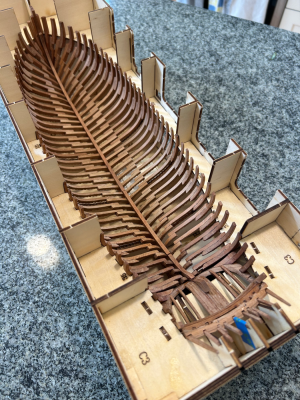
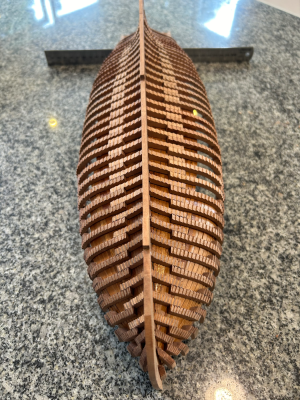
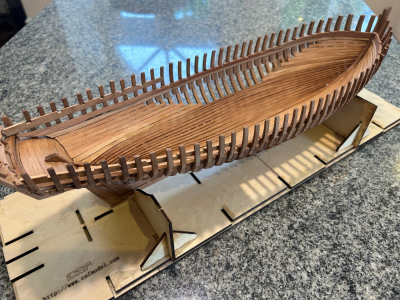
Frames 1 to 35, plus the keelson:
The frames need care to avoid breakages when bevelling as the glued area is decreasing. One or two have occurred, but they have been clean and not difficult to repair. I think overlapping sections of the frames form a satisfying pattern as the jig fills up.
Great progress Salty... this is a model I have my eye on... will consider once the tariff issue is resolved here. In the meantime, I'm enjoying your build log.
Loracs, thank you for visiting my diary. Like your Bluenose, we seem to be at similar stages in our respective projects and I will follow your progress with interest. I notice you are using hide glue and am using fish glue on this model. There’s no particular reason, other than it’s used for making musical instruments, so it seemed a perfect candidate for wooden models. It allows you a little work time to get the alignment on the frames right, but then grabs with a little finger pressure enough to allow clamping.
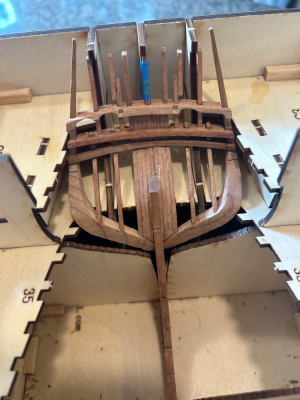
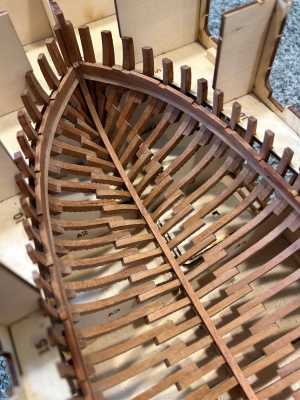
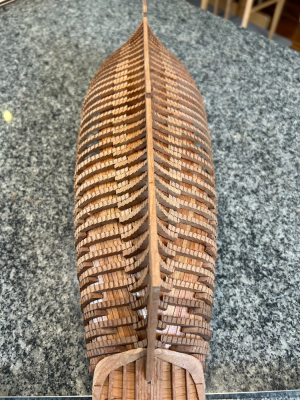
All the frames are now complete.
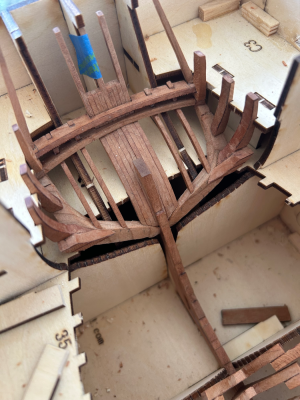
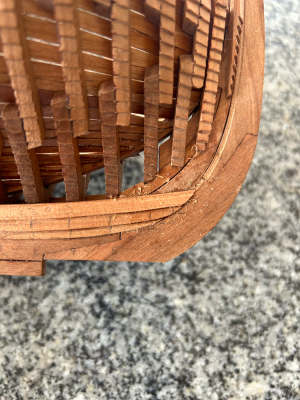
One minor change I have made (compared to some other building logs) is that I have the last frame 40 sitting on top of the lowest horizontal transom timber, rather than on the curved section immediately below it:
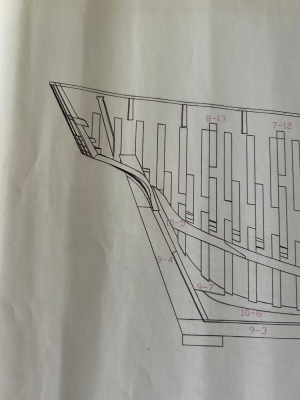
I think this is more consistent with the plan:
Of course, this is really of no consequence as everything in this area will eventually be covered with planking.
Adi, thanks for keeping an eye on my progress. I am sure you would remember the day you finished the frames on your Le Coureur. It certainly is a major milestone!
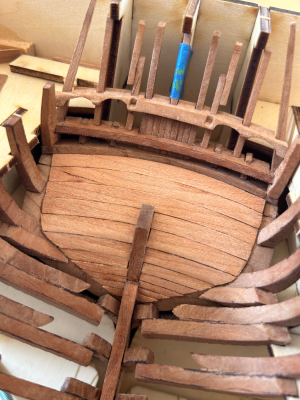
The next job was installing the internal planking on the transom
Then onto the three deck clamps - two running the full length of the hull and one for the aft section:
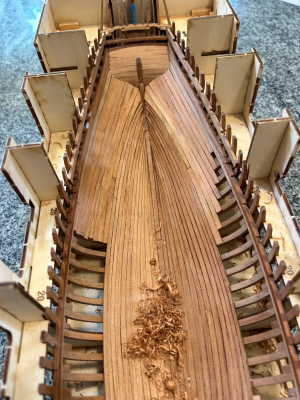
The bow and stern sections needed some bending. I used a clothes iron and dip the wood in cold water frequently to stop scorch marks. After a minute or so, you can feel the wood start to loosen and then you can start shaping before clamping in place to dry.
Overall, I am pretty happy with my Le Coureur to date. Progress hasn’t been quick, but things have fitted together reasonably well.
Paul, Adi, Norway, Jim and Brad - thanks for your likes and to everyone else who has visited.
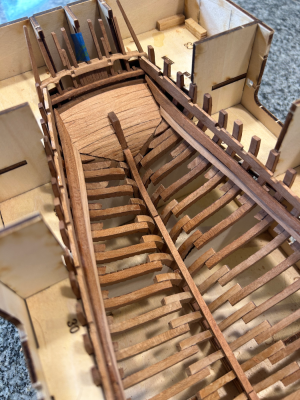
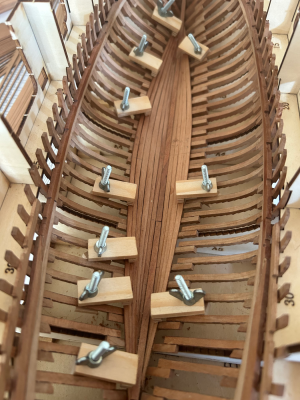
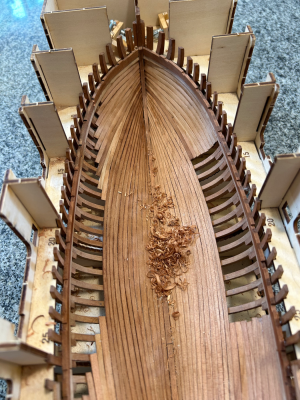
Next are the ceilings. The parts are laser cut and after a bit of consideration, I have just layed them as is. The Boudroit drawings show a limber board and some thick stuff about half way up, but I didn’t want to complicate things. I also found that the first plank sat nicely against the keelson after a little bevelling for and aft.
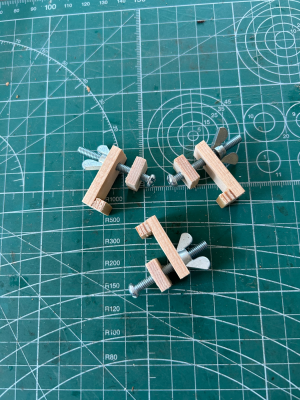
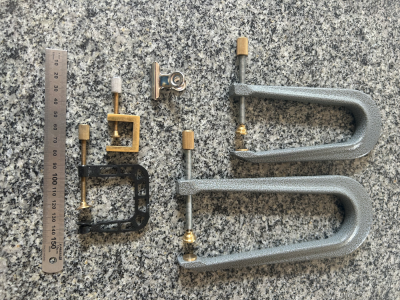
I made a few clamps for this using a pattern suggested by Bryian. They are made from spruce from the local hobby shop and I find they do a much better job on internal planking than trying to clamp from the outside over the jig.
As you can see, I have opted to make the unplanked section on the port side slightly larger than in the plans by staggering the plank length rather than have a rectangular opening. I made my own planks for the aft sections. I think every builder of Le Coureur has had some trouble with this part and I thought it was just easier to do them from scratch. Of course, none of this will be visible when the model is finished.
Loracs, thanks for your support. Your Bluenose looks very nice. These group builds are a really good way to tackle projects that might otherwise be beyond us if started on our own.
I made a start on planking the hull.
It’s not as bad as I thought it might be. At present, I am only bevelling the previous row in order to make a better fit for the plank to be laid on top. I do this after laying the plank. I am also using superglue as there’s no real way to clamp (or at least with the clamps I have). It certainly helps focus the mind as there’s really no going back once a plank is in place. I know the purists frown upon its use, so please forgive me.
I have been also been using rebates to let the planks into each other at the bow and stern rather than just trimming off the overlapping sections. This is more how dinghies are clinker planked, but I am not sure whether it was used on Le Coureur.