



• SUBSCRIBE TO SHIPS IN SCALE TODAY!

    The beloved Ships in Scale Magazine is back and charting a new course for 2026!
    Discover new skills, new techniques, and new inspirations in every issue.

    NOTE THAT OUR NEXT ISSUE WILL BE MARCH/APRIL 2026
  • Win a Free Custom Engraved Brass Coin!!!
    As a way to introduce our brass coins to the community, we will raffle off a free coin during the month of August. Follow link ABOVE for instructions for entering.

Annie Buck Chesapeake deadrise oyster / crab working boat Build Log

One thing you may want to invest in is a cutting mat. Save the surface of your tables. Legend here on SOS is that a green colored cutting mat is the only "official" one but I have seen others ;)


Rob
 
Jaager said "I may well be an outlier but I would never use Basswood - it is just not crisp. If you paint and use Acrylic water base paints, there is a real probability that the water will swell an already wants to be fuzzy surface into something that looks like a freshly plowed field when viewed under magnification."

Basswood definitely has that problem. Before I paint it, I but a few coats of shellac to act as a sanding sealer. I find the that really helps.

You have a beautiful looking ship there. I am looking forward to watching its construction!

Rob
Thanks Rob! When I stain my builds with water-based stains I usually apply 1 or 2 coats of Minwood Pre-Stain. I have made some bad decisions choosing the right primer for wood when the build calls for oil-based paints. So open to suggestions for primers. Interestingly, this build calls for using water soluble wood putty to prime the hull and superstructure followed by a couple of coats of water-based white latex paint. Never encountered that before!
 
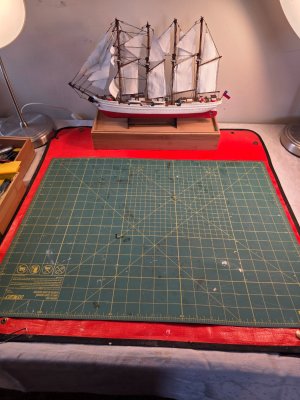
One thing you may want to invest in is a cutting mat. Save the surface of your tables. Legend here on SOS is that a green colored cutting mat is the only "official" one but I have seen others ;)


Rob
Rob - Funny you asked...I've been using a green plastic cutting mat but after 8 months of hard modeling, it got pretty cruddy. Tried to clean it off with Goo Gone to no avail. This week I got a red silicon cutting mat that will go on top of my green mat. We'll see how it works!

20260509_092216.jpg

20260509_092401.jpg

20260509_092540.jpg
 
Last edited:
Thanks Rob! When I stain my builds with water-based stains I usually apply 1 or 2 coats of Minwood Pre-Stain. I have made some bad decisions choosing the right primer for wood when the build calls for oil-based paints. So open to suggestions for primers. Interestingly, this build calls for using water soluble wood putty to prime the hull and superstructure followed by a couple of coats of water-based white latex paint. Never encountered that before!
If I stain the wood, I will definitely stain it first and let it dry well before I apply the shellac. The shellac will prevent the stain from penetrating the wood. (Which is what it does with the water based paints) So I guess you can call it a sanding sealer, or a primer. I usually use water based wood filler (Elmers) when I am doing planking etc. After it is sanded smooth I will prime it. Bryian suggest the use of an automotive sprayable primer/ filler that I will be trying. this is also apparently used extensively to smooth out 3D printed objects.


Bob Cleek, gives a wonderful explanation of finishing wood in this thread.


Rob
 
Nice progress on your build!

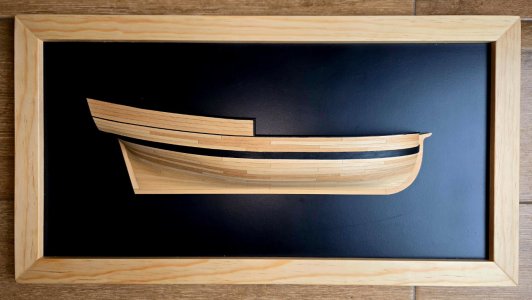
I think I'll be reposting the build log, but in the meantime, I've attached a photo of my half hull. The planking is basswood, the wale was painted, and it was finished with linseed oil.
View attachment 599963
Beautiful half-hull model! I love the black plank against the black background. What did you mount the ship on? Is that painted wood or something plastic? It's also an interesting subject...is that a sloop or caravelle? If you repost your build log from MSW I would follow with interest.
 
Beautiful half-hull model! I love the black plank against the black background. What did you mount the ship on? Is that painted wood or something plastic? It's also an interesting subject...is that a sloop or caravelle? If you repost your build log from MSW I would follow with interest.
Thanks! The frame is pine, the backing is mdf with a lot of sealer applied and sanded smooth before painting, and I used magnets to hold the hull in place. I believe the model is supposed to represent a generic merchant schooner from the mid-1700s.
 
Jaager - May I ask what types of wood you use for hull planking, frames / bulkheads, and deck.planking? Also, any recommendations for wood stock that presents well when used in making half-hull models and their mounting boards? My preference so far has been to use water-based stains on my builds. I only use oil-based paints when the build specifically calls for it, like my recent builds of the Schuylkill River Dragon Boat and the Sea Bright Dory Lifeboat.
Ig,
I have not forgotten you. I am going to think about how to answer this for a while.

About the finish part:
First off - I advise you to get a copy of Flexner:
Flexner book.jpg

Second: I think that you have probably out grown following kit advice about finishing and also out grown water base acrylic paint.
You should consider going hardcore - not just solvent based pigments, but solvent based pigments from artist's oils. Let Blick or its competitors become your friends. Bob Cleek is way better for why and how. A much better and scale appropriate finish is produced with using these tools.

Dean
 
Ig,
I have not forgotten you. I am going to think about how to answer this for a while.

About the finish part:
First off - I advise you to get a copy of Flexner:
View attachment 600589

Second: I think that you have probably out grown following kit advice about finishing and also out grown water base acrylic paint.
You should consider going hardcore - not just solvent based pigments, but solvent based pigments from artist's oils. Let Blick or its competitors become your friends. Bob Cleek is way better for why and how. A much better and scale appropriate finish is produced with using these tools.

Dean

Dean - Thanks for the heads up. I much prefer to use water-based wood stains, so upping my game to start working with oil-based stains makes sense. My next build is likely going to be a half-hull model of the Shadow (1881) racing yacht and I want to do justice for the build by choosing the right wood stock and the right stains.

Also a big fan of Bob Cleek since he gave me great advice during my last build of the Esmeralda kit from Artesiana Latina. He's one of the "good guys" on this site - giving helpful advice and encouragement for newbies like me.
 
The verb: to stain covers a lot of processes.

The noun stain as it refers to a wood finishing product has or should have a specific definition. - That it is used loosely causes much misunderstanding.

If you are paying for and using quality wood - an actual stain product should not even appear on your radar screen.
A stain is a suspension of pigment particles in a solvent along with a binding agent - something that either polymerizes or dries as a film. You know: a paint.

A dye is pigment molecules dissolved in a solvent. The solvent carries the molecules into the wood and changes the actual color. When the solvent dries the wood surface is the unchanged.

Aniline wood dyes have two solvents - water and alcohol. The writers about this extol aqueous (water) based dye. It penetrates to a deeper level and has more depth ---- on full size furniture. - At the scales that we use the difference is probably microscopic if that.
Water affects the wood fibers on the surface. We spend years air drying wood - getting it to shrink into equilibration with atmospheric humidity. Wetting it reverses that. Shellac thinner - 95% ethanol - penerates far enough - dries quickly - and does not affect the wood surface.

For wood where the purpose is actual natural wood color - Black - brown - red is all that is needed. Green, blue, yellow allow for hinting at a painted surface that will not have the model so treated looking a cheap street walker with scale inches thick pancake makeup or a garish toy.

I know.. Them's fighting words. There are whole industries paying lots of money to con you into knee jerk react to defend what they are selling. Look at what is generally done with clear eyes. Think: does this look like I am viewing an actual vessel from the distance that I would have to be to see the whole thing in my visual field?
 
Oil finishes can look very nice on builds that are going for a natural wood look--Greg Davis's build of the gundalow Fanny M is a great example, he just applied a finish to the hull and the cherry he used looks great. One thing to keep in mind for the future is that oil finishes, among other types of finishes, can impede glue adhesion, and may not soak into the wood in areas where excess glue was left on too long. Personally, I instead like shellac for a natural finish, as I find it cheap, easy to apply, and quite nice-looking, but it's really all about looking around at what people have done and seeing what you like.

I also have used stains on builds before, although only for specific parts and never for a full build. Basswood sometimes takes up stain unevenly, which can be frustrating. In furniture-making, while there are certainly garish stain jobs out there, stain can also be used more subtly to even out the natural color variation between different planks of the same type of wood. Some woodworkers may view this as sacrilege to change the natural wood tones/grain, but it is what it is, and can work well with the piece.

As for acrylics, I find that they can look quite nice if applied well. (And I'm not saying that because I own stock in Vallejo or something--I almost exclusively use cheap craft acrylics). The key really is to apply multiple thin coats, and to use fine sandpaper after the first coat or two to knock down any grain that gets raised by the water content. There are also some more advanced techniques, which I haven't used but can really add to the look of a build. There was a beautifully-painted model of the cutter Alert on MSW which sadly has disappeared, but the builder did recently post a bit about his paint techniques here. I think he used acrylics, but honestly, I'm not sure without the original build log. He's specifically showing how he painted a frieze in that post, but you can see how he also varied the tone of the blue background to provide a better sense of shadow and light. This of course wasn't how the actual ships were painted, but it does trick the eye a bit and help bring the model to life by suggesting light hitting the ship in a certain way. Anyway, something to consider, although again, I've never tried anything like that myself.
 
6. Annie Buck Build Log

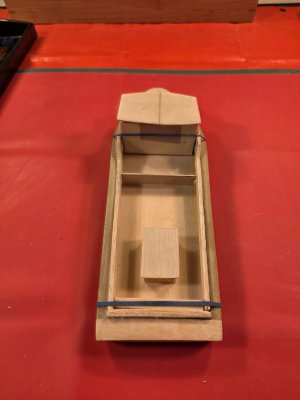
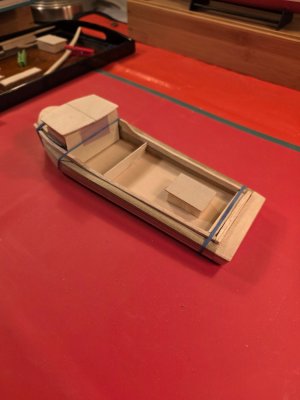
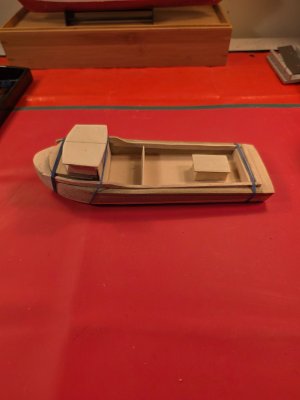
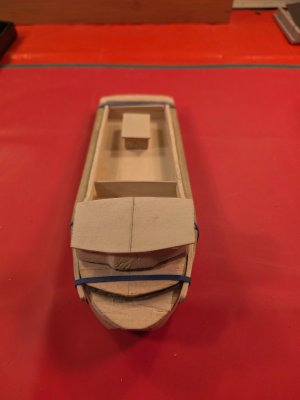
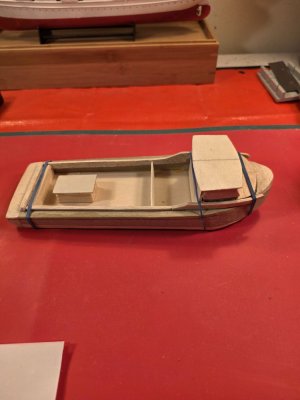
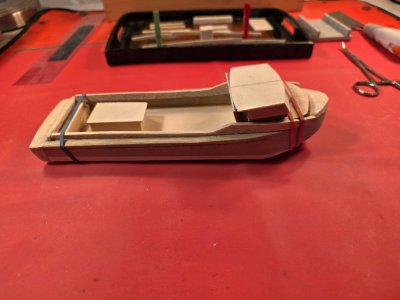
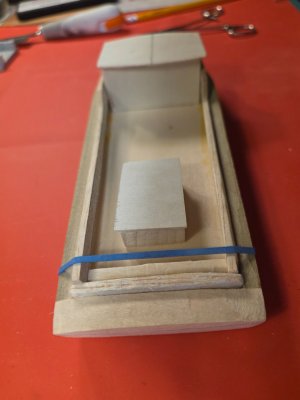
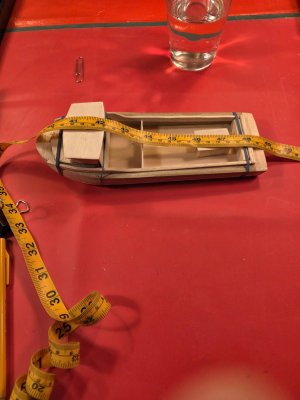
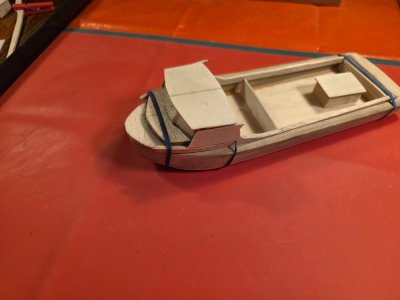
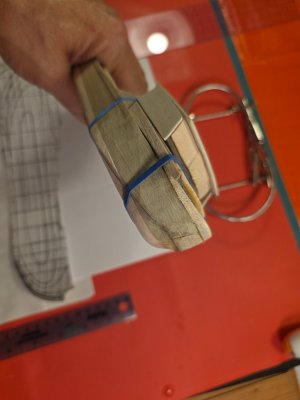
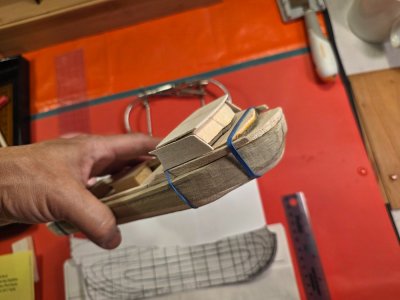
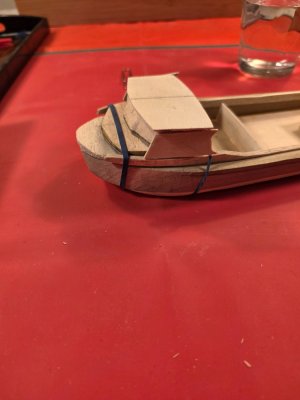
Today's labors on the Annie Buck, Chesapeake Bay deadrise oyster/crab working boat.

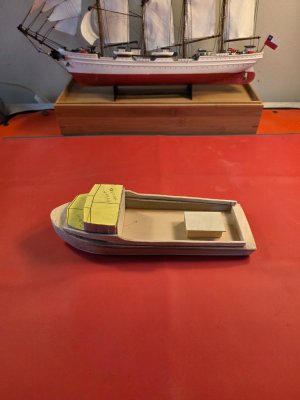
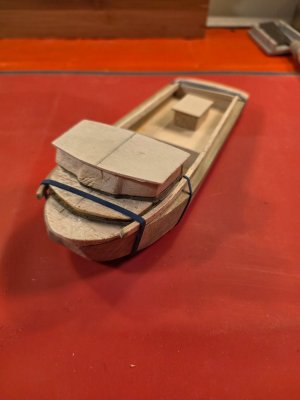
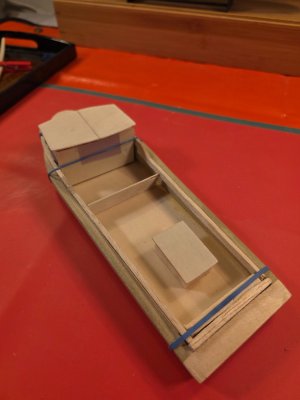
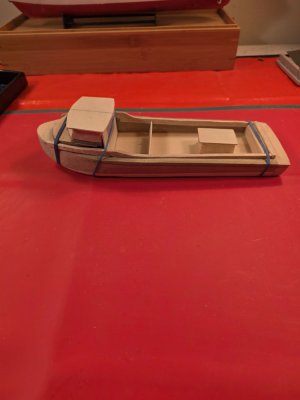
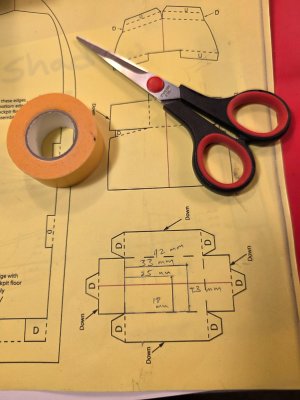
1. Did my first dry fit of all deck structures, including cabin, pilot house, engine box. Starboard and port coamings carved to fit from the transom up to the cabin side walls. Lots of sanding of the cabin to get it to fit the side coamings, which will be blended into the cabin top piece.

2. I attached the gingerbread siding for the pilot house to fit above the starboard and port coamings. Affixed the transom coamings to fit the stern pieces together with the side coamings. Carved roof for pilot house windows.

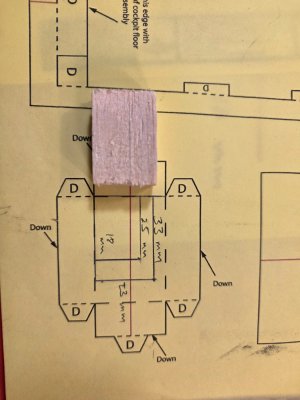
3. I decided that the dimensions of the engine box are off (too big in relation to the pilot house) and I calculated that in real life the engine box would be 7 feet long on a 38 foot boat. I reduced the original dimensions for the engine box by 20%, or what would be more realistically at about 5.5 feet in length for the engine box for a relatively small boat. The proportions of the engine box to the ship length are now somehow more appealing with the smaller engine box relative to the pilot house.

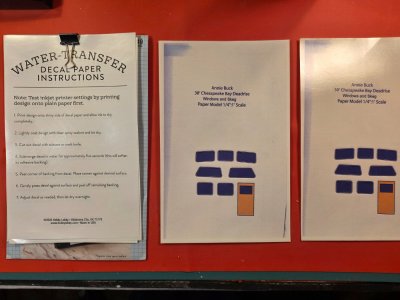
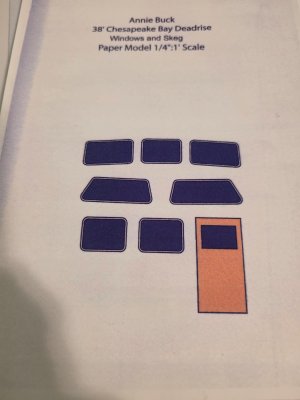
4. I printed out the windows and pilot house door on decal paper so I can just transfer the window stickers after I prime and stain the pilot house.

Up next, making up some water based wood putty to apply as a primer coat for staining. I still have alot of decisions to make, including whether I should use oil based stains for the very first time. I am leaning towards finishing the Annie Buck with water-based stains and use the oil-based stains when I make a half-hull model of the "Shadow" racing sloop from plans purchased from Model Boat Store.

Next, shave down the fore ends of the coamings so they blend with the cabin top piece.

Having fun building the Annie Buck!

20260510_213702.jpg

20260510_213619.jpg

20260510_213611.jpg

20260510_211054.jpg


20260510_211029.jpg

20260510_211001.jpg

20260510_210856.jpg

20260510_210833.jpg

20260510_210811.jpg

20260510_210306.jpg


20260510_191909.jpg

20260510_191903.jpg


20260510_191427.jpg


20260510_181652.jpg

20260510_171204.jpg

20260510_222924.jpg

20260510_222932.jpg

20260510_230532.jpg

20260510_230415.jpg

20260510_230401.jpg

20260510_223902.jpg
 
Last edited:
Ig,
Two things:
#1 before you use any stain - give this a read https://shipsofscale.com/sosforums/threads/when-is-smooth-enough-smooth-enough.18869/post-497056

shellac is your friend - it can do most anything you need and it will not leave a miles deep layer on the wood like a polymerizing oil or lacquer (nitrocellulose) - not close to polyacrylamide and nowhere as tacky or kitschy as polyurethane.

#2 decals - I would scan them before I did anything irreversible with them. Should things go south you will have the patterns, for black ink or paint on paper and PVA to be a possible replacement and that would be a stronger bond. thinking about it - used to make a stencil and paint the black directly.
 
Ig,
Two things:
#1 before you use any stain - give this a read https://shipsofscale.com/sosforums/threads/when-is-smooth-enough-smooth-enough.18869/post-497056

shellac is your friend - it can do most anything you need and it will not leave a miles deep layer on the wood like a polymerizing oil or lacquer (nitrocellulose) - not close to polyacrylamide and nowhere as tacky or kitschy as polyurethane.

#2 decals - I would scan them before I did anything irreversible with them. Should things go south you will have the patterns, for black ink or paint on paper and PVA to be a possible replacement and that would be a stronger bond. thinking about it - used to make a stencil and paint the black directly.

Dean - You're right. Why do decals when I could just trace the window template and paint the windows black. Or I could apply the decals and then paint over them in black or deep blue. Going to my arts and crafts happy place rn.
 
The verb: to stain covers a lot of processes.

The noun stain as it refers to a wood finishing product has or should have a specific definition. - That it is used loosely causes much misunderstanding.

If you are paying for and using quality wood - an actual stain product should not even appear on your radar screen.
A stain is a suspension of pigment particles in a solvent along with a binding agent - something that either polymerizes or dries as a film. You know: a paint.

A dye is pigment molecules dissolved in a solvent. The solvent carries the molecules into the wood and changes the actual color. When the solvent dries the wood surface is the unchanged.

Aniline wood dyes have two solvents - water and alcohol. The writers about this extol aqueous (water) based dye. It penetrates to a deeper level and has more depth ---- on full size furniture. - At the scales that we use the difference is probably microscopic if that.
Water affects the wood fibers on the surface. We spend years air drying wood - getting it to shrink into equilibration with atmospheric humidity. Wetting it reverses that. Shellac thinner - 95% ethanol - penerates far enough - dries quickly - and does not affect the wood surface.

For wood where the purpose is actual natural wood color - Black - brown - red is all that is needed. Green, blue, yellow allow for hinting at a painted surface that will not have the model so treated looking a cheap street walker with scale inches thick pancake makeup or a garish toy.

I know.. Them's fighting words. There are whole industries paying lots of money to con you into knee jerk react to defend what they are selling. Look at what is generally done with clear eyes. Think: does this look like I am viewing an actual vessel from the distance that I would have to be to see the whole thing in my visual field?
 
Dean - I'm going to use your method and shellac the Annie Buck with a coat or two before painting with white acrylic oil paint.

I have some tiny imperfections that I would like to fill with wood filler or putty. Should I do these small patches before I put the shellac on, or should I wait after the first shellac coat?
 
I have some tiny imperfections that I would like to fill with wood filler or putty. Should I do these small patches before I put the shellac on, or should I wait after the first shellac coat?
Patch first.
An idea = try this on scrap first -
wait a tic - do your whole proposed finish process on scrap first!
now back
I would use gold 220 grit on a disc sander - use a scrap piece of the wood being patched - make a pile of wood flour
make your own patching material - use white PVA -it dries clear
The color may be darker - wetting wood darkens too - no help for this.

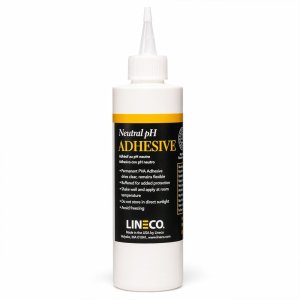
- maybe even Lineco - it is pH7 - a good idea for natural fiber rigging
- not so good for poly anything - no pores or irregular surface at microscopic - PVA is long tentacles invading and grabbing on. Lineco 8oz.jpg

Large area surfaces for a smooth paint surface are probably better with a commercial trowel it on product. For a first layer PoB with serious valleys - hand plane wood curls and PVA as wood scabs to be filed and sanded flush. Gobs of thick filler probably ain't the best way.

While on the subject of PVA glue -
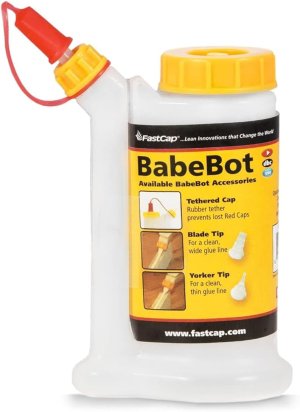
as of May 2026 - I really like this dispenser: BabeBot.jpg 4oz size

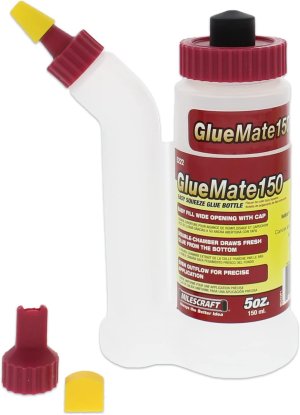
I bought a knock-off as backup. It is 5oz - less expensive - not sure there is a loss of quality - overall - it may be better to support the original?

GlueMate150.jpg

Dean
 
Patch first.
An idea = try this on scrap first -
wait a tic - do your whole proposed finish process on scrap first!
now back
I would use gold 220 grit on a disc sander - use a scrap piece of the wood being patched - make a pile of wood flour
make your own patching material - use white PVA -it dries clear
The color may be darker - wetting wood darkens too - no help for this.

- maybe even Lineco - it is pH7 - a good idea for natural fiber rigging
- not so good for poly anything - no pores or irregular surface at microscopic - PVA is long tentacles invading and grabbing on. View attachment 602418

Large area surfaces for a smooth paint surface are probably better with a commercial trowel it on product. For a first layer PoB with serious valleys - hand plane wood curls and PVA as wood scabs to be filed and sanded flush. Gobs of thick filler probably ain't the best way.

While on the subject of PVA glue -
as of May 2026 - I really like this dispenser: View attachment 602419 4oz size

I bought a knock-off as backup. It is 5oz - less expensive - not sure there is a loss of quality - overall - it may be better to support the original?

View attachment 602420

Dean
That's the ticket. I'm going to use fine sawdust and a PVA glue like Gorilla wood glue or Elmer's wood glue to make the wood filler. It's really only the open sides of the Pilot Cabin, which will be covered by the gingerbread (pilot house side walls with windows) anyway. And there is a 2-3 mm gap where the side coamings meet the transom. Thanks.
 
Back
Top