



• Win a Free Custom Engraved Brass Coin!!!
    As a way to introduce our brass coins to the community, we will raffle off a free coin during the month of August. Follow link ABOVE for instructions for entering.

DE 7 PROVINCIËN (1665) 1:50

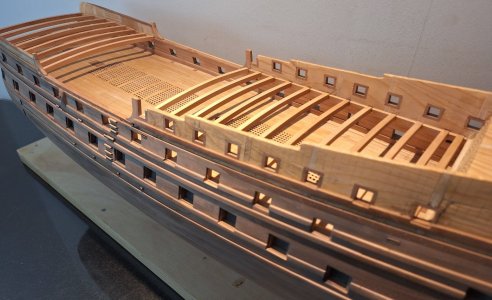
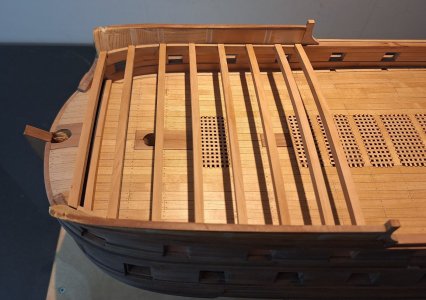
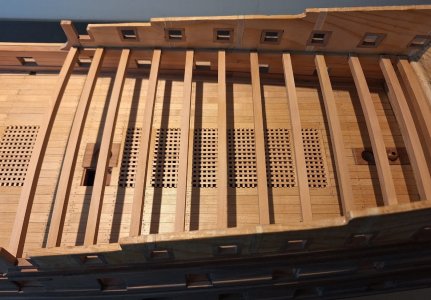
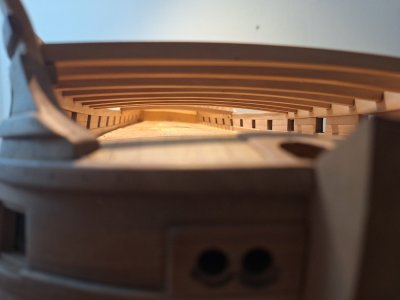
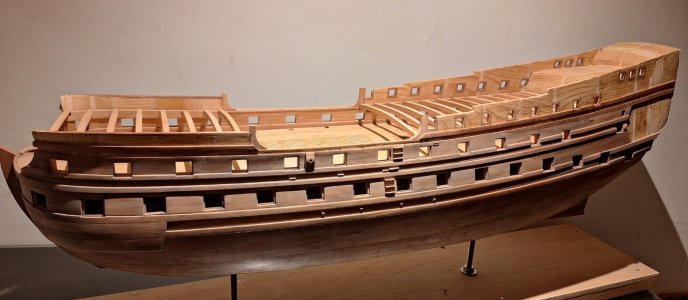
It seems like I'm jumping around a bit regarding the construction sequence, and that's probably true. I now wanted to complete the interior planking of the main deck bulwark. To do that, I wanted to install the deckclamps for the quarter deck first on the aft portion of the deck and then fill the remaining space with planking. At the same time the deckclamps for the forecastle were installed.

View attachment 562778

View attachment 562781

View attachment 562783

View attachment 562784

View attachment 562779
Again some very nice fitted parts, Herman. And taking off the sharp edges makes it complete.
Regards, Peter
 
Again some very nice fitted parts, Herman. And taking off the sharp edges makes it complete.
Regards, Peter
Thanks, Peter.
Rounding the corners of the planks around the pulleys(/sheaves?) in the hull helped me in this case to neatly resolve the existing situation where the pulleys were, in my opinion, located a bit too deep in the hull.
 
Awesome, Herman! How did you cut the matching cambers on the beams (the round-ups)?
Thanks Paul.
After planing some scrap wood to the correct thickness, I transferred the curves of the foredeck and quarterdeck from the construction drawing and roughly cut them out with the band saw.
Then I cut the beams to length so they fit in/on the deck clamps and then I shaped the convex side with the disc sander (several planks at a time).
Since I don't have a spindle sander, I have removed the outer protective cover from my disc sander so I could trim the concave side to size using the outside of the sanding disc.
I do this by eye until the curve is even with the convex side and the thickness is approximately 6.25 mm.
 
Thanks Paul.
After planing some scrap wood to the correct thickness, I transferred the curves of the foredeck and quarterdeck from the construction drawing and roughly cut them out with the band saw.
Then I cut the beams to length so they fit in/on the deck clamps and then I shaped the convex side with the disc sander (several planks at a time).
Since I don't have a spindle sander, I have removed the outer protective cover from my disc sander so I could trim the concave side to size using the outside of the sanding disc.
I do this by eye until the curve is even with the convex side and the thickness is approximately 6.25 mm.
How delightfully hands-on!

For the Kingfisher I did basically the same thing with the transfer of the curve via a template - used a disc sander for the convex surface - but then used a mill with a jig to cut the concave surface to a standard thickness.

I have quite a number of decks on the Saint Philippe and I am looking for a way to standardize beam fabrication.
 
How delightfully hands-on!

For the Kingfisher I did basically the same thing with the transfer of the curve via a template - used a disc sander for the convex surface - but then used a mill with a jig to cut the concave surface to a standard thickness.

I have quite a number of decks on the Saint Philippe and I am looking for a way to standardize beam fabrication.
Hi Paul, I think the mill/jig combination is the best option in your situation. That naturally produces the most precise and consistent thickness for the deck beams.
I considered it too, but once I got started with the disc sander, I really liked that method. The thickness isn't exactly the same everywhere, but that probably contributes to the authenticity of a ship of Dutch origin.
 
Hey Herman,

Beautifully done. Great. I wonder how long you spent working on it, and freehand too. Really great.
Ik ben een grote fan van je bouwstijl en dit prachtige schip..... :D Thumbsup
 
Hey Herman,

Beautifully done. Great. I wonder how long you spent working on it, and freehand too. Really great.
Ik ben een grote fan van je bouwstijl en dit prachtige schip..... :D Thumbsup
Thank you Guenther.
How long I spent working on it? I try to work on my model each evening about 2 hours and during the weekend as much as I am allowed ;).
So for the deckbeams roughly one evening planing some scrapwood / one evening to study the drawings and transfer the curves to the wood and saw the outlines roughly by bandsaw / one evening to sand the convex sides and one evening to make them fit in between the deckclamps.
I could work all Saturday to trim the concave side and then further trimming both sides back to about 6,5 mm and during that process keep them to the correct length to fit between the deckclamps ((the sides of the forward deck spread out, so trimming the underside of those deckbeams was no problem, then you can adjust the length of the beams; on the quarterdeck the sides converge to the top, so there I trimmed the topside of the beams, otherwise they would have become too short and fall short between the deckclamps)).
 
Thank you Guenther.
How long I spent working on it? I try to work on my model each evening about 2 hours and during the weekend as much as I am allowed ;).
So for the deckbeams roughly one evening planing some scrapwood / one evening to study the drawings and transfer the curves to the wood and saw the outlines roughly by bandsaw / one evening to sand the convex sides and one evening to make them fit in between the deckclamps.
I could work all Saturday to trim the concave side and then further trimming both sides back to about 6,5 mm and during that process keep them to the correct length to fit between the deckclamps ((the sides of the forward deck spread out, so trimming the underside of those deckbeams was no problem, then you can adjust the length of the beams; on the quarterdeck the sides converge to the top, so there I trimmed the topside of the beams, otherwise they would have become too short and fall short between the deckclamps)).
Hey Herman,

Thanks for your reply. Oh man, that's really time-consuming and involves a lot of work. But the result is excellent. Thank you! :D Thumbsup
 
I was thinking more in terms of beam locations along the length of the ship. You have to be very precise to cut the pockets ahead of time - and then install the clamps in perfect longitudinal symmetry, Again, I admire the approach.
Hi Paul,

In 17th century building let go this idea of perfect symmetry, it is just not the case. If you create perfect symmetry you create an unrealistic model.
This is not the case for 17th Dutch ships only but for all.
This means it is perfect to have it unsymmetrical 8-)
 
Hi Paul,

In 17th century building let go this idea of perfect symmetry, it is just not the case. If you create perfect symmetry you create an unrealistic model.
This is not the case for 17th Dutch ships only but for all.
This means it is perfect to have it unsymmetrical 8-)
Perhaps. But the bitts and the masts and other vertical structures still went in certain places relative to the beams...which necessarily informs beam locations. It surely wasn't just random...
 
Perhaps. But the bitts and the masts and other vertical structures still went in certain places relative to the beams...which necessarily informs beam locations. It surely wasn't just random...
Even that was done with a wet finger, I'm study at the moment how yards where Rejuvenated and even about that subject they had different meanings in the past.
 
Back
Top