
-

SUBSCRIBE TO SHIPS IN SCALE TODAY!
The beloved Ships in Scale Magazine is back and charting a new course for 2026!
Discover new skills, new techniques, and new inspirations in every issue.
NOTE THAT OUR NEXT ISSUE WILL BE July/August 2026 -

Win a Free Custom Engraved Brass Coin!!!
As a way to introduce our brass coins to the community, we will raffle off a free coin during the month of August. Follow link ABOVE for instructions for entering.


- Home
- Forums
- Ships of Scale Group Builds and Projects
- HMS Alert 1777 1:48 PoF Group Build
- HMS Alert 1777 1:48 Group Build Logs
You are using an out of date browser. It may not display this or other websites correctly.
You should upgrade or use an alternative browser.
You should upgrade or use an alternative browser.
HMS Alert [1777] 1:48 POF by serikoff. (Two hulls: skeleton and fully rigged)




You need one of these: Ring Light


Thank you. A good drill and the right speed will produce good holes. I have so many drills that it's more than enough.I think your idea for the limited planking is a wonderful idea !
I'm amazed you are able to get such clean holes from a regular twist drill !
Brad Point drill bits will give you a much cleaner hole.You might look into some.

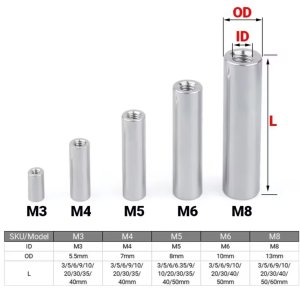
I thought about it, but my keel is 5mm and my propeller is 3mm, and there's no way to fit anything between them because the keel is physically too big. But my keel will be buried in the column, and its sides will be firmly clamped to the sides. Plus, I'll be making temporary stops for the sides during rigging to make sure nothing gets damaged. But thanks for the caution.Last time i drilled a keel, it cracked while i was making rigging. Now i use aluminum inserts M2-M3 with internal thread, which i permanently glue in place with epoxy resin. Then i add a 4 or 5mm rod inside.
View attachment 563548
Thanks, but I forgot about that.You need one of these: Ring Light
 I bought bearings and a ruler, but I forgot about the light. I'll have to think about it.
Brass columns with the side reinforcement you want to use work very well. In case of heavy frigate where i used it, there are additional copper plates that also reinforce the keel. It's also 5mm wide, drilled 4mm, and the column holds it without a problem.
In the previous model, when i drilled a 3mm hole directly onto the 5mm keel, something went wrong. Then i overtightened one of the lines, and the keel also snapped from the tension.
It had to happen once to know what to watch out for.
Now I know...
In the previous model, when i drilled a 3mm hole directly onto the 5mm keel, something went wrong. Then i overtightened one of the lines, and the keel also snapped from the tension.
It had to happen once to know what to watch out for.
Now I know...

You have skills Sergey. Once again thank you for the informative log. I don’t stop learning reading your account. Cheers Grant
Yes, when the keel is clamped laterally, the risk of breakage is minimal. I'll go into more detail when the time comes to perform these manipulations. Your mistakes always teach you the best lessons; I've often found that out.Brass columns with the side reinforcement you want to use work very well. In case of heavy frigate where i used it, there are additional copper plates that also reinforce the keel. It's also 5mm wide, drilled 4mm, and the column holds it without a problem.
In the previous model, when i drilled a 3mm hole directly onto the 5mm keel, something went wrong. Then i overtightened one of the lines, and the keel also snapped from the tension.
It had to happen once to know what to watch out for.
Now I know...

Thank you very much for the praise. I will continue in the same spirit.You have skills Sergey. Once again thank you for the informative log. I don’t stop learning reading your account. Cheers Grant

My router bearings finally arrived, but I still need to install them. In the meantime, I decided to practice nailing and drilling for bolts, and making the bolts themselves...
I've already talked about this...
Nailing is easy here:
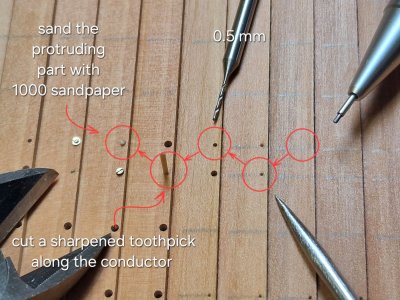
1 - Mark, 2 - Prick with a needle (along the distance guide from the edge of the board), 3 - Drill with a 5mm drill, 4 - Trim the inserted sharpened toothpick (naturally, along the length guide), 5 - Lightly round off the remaining protruding end with 1000-grit sandpaper so that the rounded edge protrudes from the surface.
But the bolts will require some fiddling...
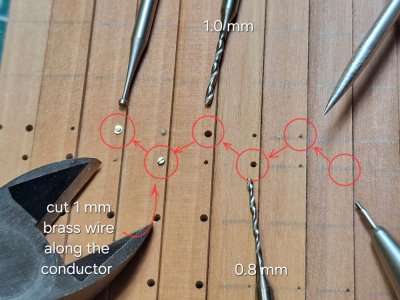
1 - same pencil markings, 2 - prick, 3 - then drill with a 0.8 mm drill to the desired depth, 4 - drill with a 1 mm drill to the thickness of the board (I'll explain why below), 5 - then trim the inserted millimeter wire (all according to the template, so that all protruding edges are the same length and needed for the next step), 6 - shape the wire into a bolt with a special cup drill (I also mentioned this earlier).
So, here's the result and the obvious mistakes:
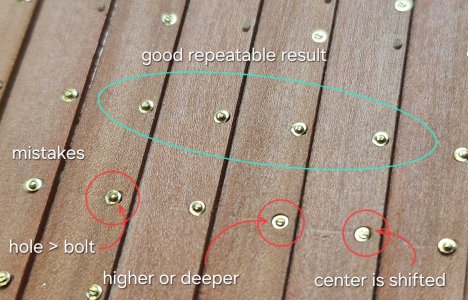
You can achieve a consistent shape, but you should avoid the following mistakes:
The center may shift laterally if the tool is positioned incorrectly during operation. It's best to place the drill cup on the wire and run the micromotor at low speed. This way, you can monitor the shift and prevent the center from shifting.
Plunging too deep, or not deep enough, is also unsightly. Or the distance from the edge of the board is not the same.
But the worst thing is when the hole is larger than the wire, as this will leave a stain when bitumen gets into the hole. I initially drilled with a 1 mm drill bit, but even at low speeds, the slightest movement of the hand and the sharp drill bit widened the hole. To prevent this, I first drill with a 0.8 mm drill bit and then, using a quick, shallow drill bit, duplicate the hole with a 1 mm drill bit. This way, the hole is the right size and the wire doesn't wobble in it.
Yes, in theory, you could find a 0.9mm drill bit and then try inserting the wire, but I tested it—the only repeatable option is: 0.8mm, then 1mm to a shallow depth with a quick motion.
Although I'll tell you a secret, from a distance, nothing is noticeable, and any defects are simply invisible... My wife teases me, "Who's going to see anything there except you?"... but in a macro photo, it's visible... so I'll do it beautifully.
I've already talked about this...
Nailing is easy here:
1 - Mark, 2 - Prick with a needle (along the distance guide from the edge of the board), 3 - Drill with a 5mm drill, 4 - Trim the inserted sharpened toothpick (naturally, along the length guide), 5 - Lightly round off the remaining protruding end with 1000-grit sandpaper so that the rounded edge protrudes from the surface.
But the bolts will require some fiddling...
1 - same pencil markings, 2 - prick, 3 - then drill with a 0.8 mm drill to the desired depth, 4 - drill with a 1 mm drill to the thickness of the board (I'll explain why below), 5 - then trim the inserted millimeter wire (all according to the template, so that all protruding edges are the same length and needed for the next step), 6 - shape the wire into a bolt with a special cup drill (I also mentioned this earlier).
So, here's the result and the obvious mistakes:
You can achieve a consistent shape, but you should avoid the following mistakes:
The center may shift laterally if the tool is positioned incorrectly during operation. It's best to place the drill cup on the wire and run the micromotor at low speed. This way, you can monitor the shift and prevent the center from shifting.
Plunging too deep, or not deep enough, is also unsightly. Or the distance from the edge of the board is not the same.
But the worst thing is when the hole is larger than the wire, as this will leave a stain when bitumen gets into the hole. I initially drilled with a 1 mm drill bit, but even at low speeds, the slightest movement of the hand and the sharp drill bit widened the hole. To prevent this, I first drill with a 0.8 mm drill bit and then, using a quick, shallow drill bit, duplicate the hole with a 1 mm drill bit. This way, the hole is the right size and the wire doesn't wobble in it.
Yes, in theory, you could find a 0.9mm drill bit and then try inserting the wire, but I tested it—the only repeatable option is: 0.8mm, then 1mm to a shallow depth with a quick motion.
Although I'll tell you a secret, from a distance, nothing is noticeable, and any defects are simply invisible... My wife teases me, "Who's going to see anything there except you?"... but in a macro photo, it's visible... so I'll do it beautifully.

.
To prevent this, I first drill with a 0.8 mm drill bit and then, using a quick, shallow drill bit, duplicate the hole with a 1 mm drill bit. This way, the hole is the right size and the wire doesn't wobble in it.
You use tricks that are employed in professional machine cutting. Pre-drilling a hole, then reaming it to size. Truly elegant work. Congratulations
..
Thank you. Glad to see you in my review. It's nice to know you're following my build..
You use tricks that are employed in professional machine cutting. Pre-drilling a hole, then reaming it to size. Truly elegant work. Congratulations
.
Yes... you'll have to make not 4,000 holes, but twice as many.
Today I gave the ship physiotherapy treatments... or more accurately, acupuncture... 2,500 times. 
But first, I did at least a quarter of it on a test piece. I made a template for it to create an intersection line for positioning the holes. The principle is simple: a pencil hole and a stop at the desired distance.
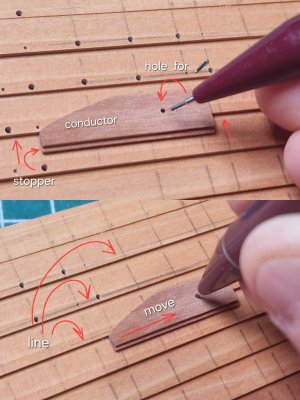
All holes were made according to the option described in the previous post.
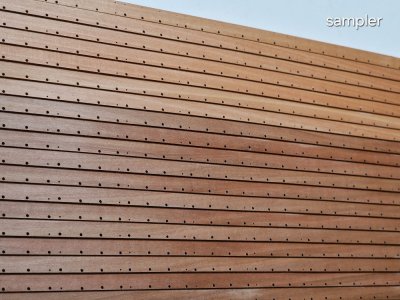
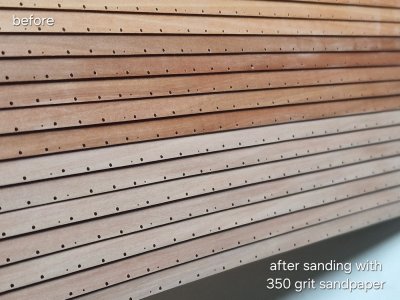
After that, I sanded the surface with 350-grit sandpaper. As a reminder, before securing the boards, I coated them with tung oil to bring out the grain and ensure the correct color match. Now, all of this needs to be removed and, after securing the bolts, re-oiled.
After checking everything, I got to work on the ship. I made a jig for it and drew lines.
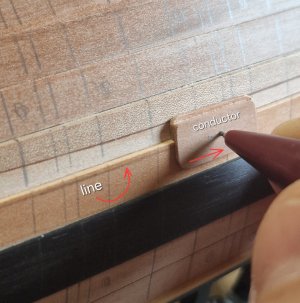
A similar jig was made for the top boards above the wave.
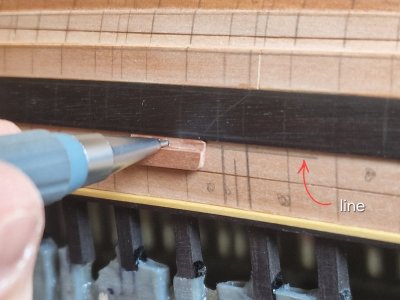
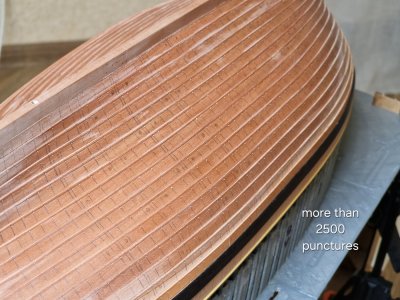
But so far I've only made punctures on the clinker cladding. As I already mentioned, I've made over 2,500 punctures.
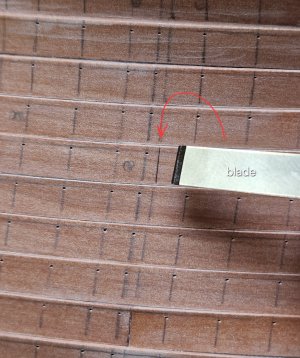
And with a straight blade I made the joints of the boards (or rather their imitation).
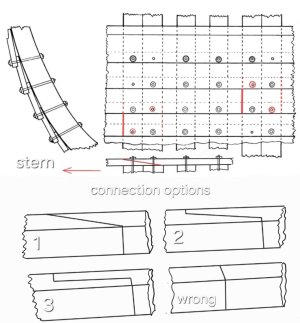
Since the boards were not butted but overlapped, we can only see the outer transition from board to board.
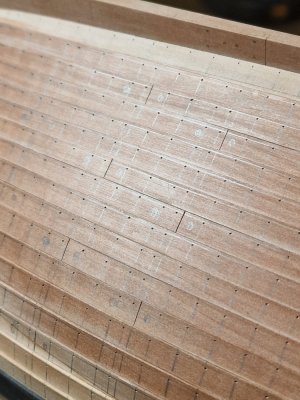
Next I have to drill 100,500 holes. Save me
But first, I did at least a quarter of it on a test piece. I made a template for it to create an intersection line for positioning the holes. The principle is simple: a pencil hole and a stop at the desired distance.
All holes were made according to the option described in the previous post.
After that, I sanded the surface with 350-grit sandpaper. As a reminder, before securing the boards, I coated them with tung oil to bring out the grain and ensure the correct color match. Now, all of this needs to be removed and, after securing the bolts, re-oiled.
After checking everything, I got to work on the ship. I made a jig for it and drew lines.
A similar jig was made for the top boards above the wave.
But so far I've only made punctures on the clinker cladding. As I already mentioned, I've made over 2,500 punctures.
And with a straight blade I made the joints of the boards (or rather their imitation).
Since the boards were not butted but overlapped, we can only see the outer transition from board to board.
Next I have to drill 100,500 holes.
Save me 

beautiful as always and I love the simple marking jig you made !

Simple jigs, but very effective. The joints look very realistic too.
Beautiful job.
Beautiful job.
beautiful as always and I love the simple marking jig you made !
Thanks, friends! Yes, often the simplest solution is the most effective. I'm already looking forward to finishing the bolts; that will be a cucumberSimple jigs, but very effective. The joints look very realistic too.
Beautiful job.
Simple and makes total sense. Another great tutorial, thank you. If you don't mind can you copy this to the Tricks of the Trade topic here at SoS so others that may be missing out on your build log will see this? Thanks again for sharing this.
Allan
Another great tutorial, thank you. If you don't mind can you copy this to the Tricks of the Trade topic here at SoS so others that may be missing out on your build log will see this? Thanks again for sharing this.Allan

Such a wealth of techniques. Amazing.
Thanks for the praiseSuch a wealth of techniques. Amazing.
Yes, I was thinking about that. I've just accumulated a few moments during the construction process that I can share in the section of the site where colleagues share their tips. When I have time, I'll try to do that.Simple and makes total sense.
Allan

Dziękuję. Nie mogę się doczekać, żeby zobaczyć, jak to wszystko będzie wyglądać pod asfaltem... To bardzo ekscytujące. Mam w głowie wizję tego, jak to będzie wyglądać, ale zobaczymy, jak to będzie w rzeczywistości.Witaj
Świetna praca i doskonały opis ,czekam na pracę bitum. Pozdrawiam Mirek
Thank you. I'm really looking forward to seeing how it will all look under the bitumen... it's very exciting. I have a picture in my head of how it will all look, but we'll see how it actually turns out.
Judging by your positive feedback, I've decided to create a separate thread on the topic of planning. It's easy to lose track of all the information in the many review pages, so I decided to create a cross-link to all the important topics related to this. I see that there are people interested (I thought there would be many more), but if I helped even a few, that means it was worth it.
Planking : Clinker | Carvel | Deck | Waterway | PoF Plank on Frame | How to calculate, mark, build. + Jig + Nail ( nailing ), Bolt | by serikoff
Thanks to the positive feedback from my colleagues, I've decided to share my experience in the topics described in the title. If you found this through a search, below is a list of what I can share. I'll be posting links to posts from my building reviews where I detail construction methods in...
shipsofscale.com
In two days I completely finished one side:
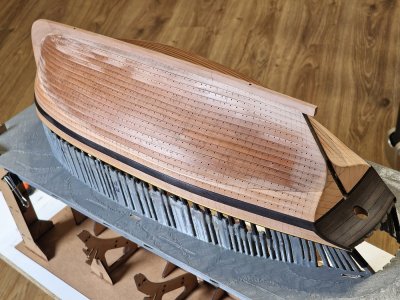
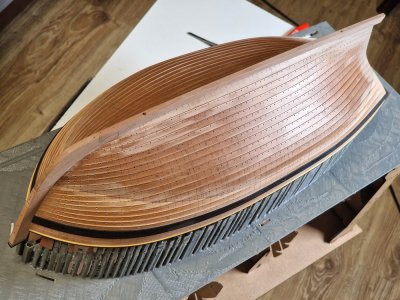
Now I'll tell you step by step where the bolts will be and where the nails will be.
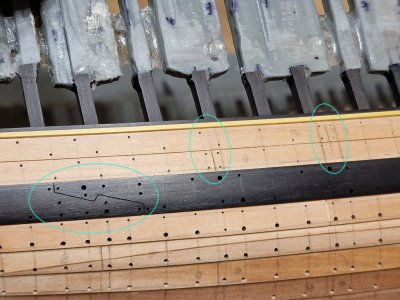
The top is Carvel planking with 0.5mm holes for nails. The holes where the boards meet are slightly closer together (not centered on the frame, as usual).
The wave planks have 0.6mm holes (I drilled them twice to slightly widen the holes from the 0.5mm drill bit). The bolt holes are 1mm, but I first drilled 0.8mm ones.
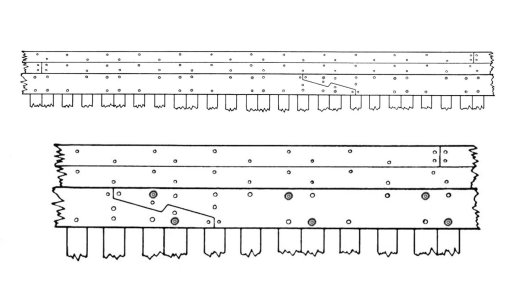
Clinker planking according to the scheme that I have shown many times.
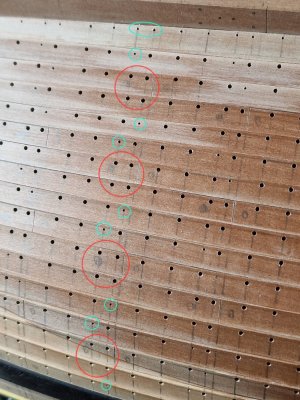
All bolt holes are 1 mm (but I initially drilled 0.8 mm holes).
The lower chord near the keel is secured with nails (0.5 mm holes). The next chord covers it, and they are both connected and bolted to the frames.
The planks are secured to the paired frames in a staggered pattern, alternating nails and bolts (turquoise circle).
But where the planks join, all four are bolts (1 mm) (red circle).
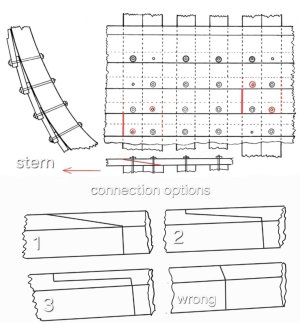
At the stern, everything is simple - 0.5 mm nails are used everywhere.
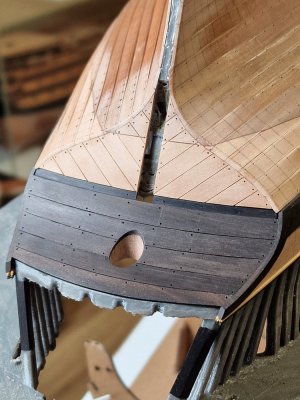
At the bow, the edges of the boards are secured with 0.5 mm nails, but another row of 0.5 mm holes is also drilled for nails, as this is where the sheathing overlaps and butts.
The top chord under the wave is also secured with nails.
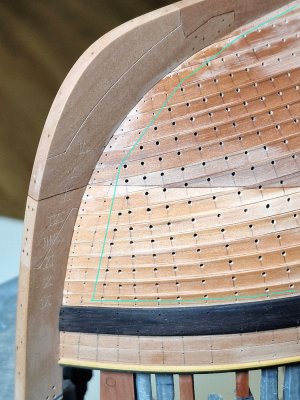
The same is true for the upper and lower chords at the rear.
All intermediate boards, reaching the sternpost, are also transitioned from overlapping to butt-jointed and also secured with nails.
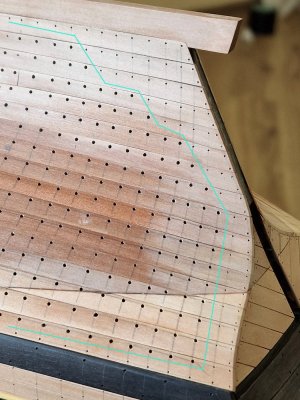
The wave section is a bit more interesting. The anatomy diagram shows the bolts running along paired webs, but it doesn't indicate the areas where there aren't paired frames.
Let's just say (even though the anatomy is full of errors and omissions), even without this, there should be logic everywhere. And it's physically impossible for there to be no bolts in the fore and aft sections. Practically speaking, two of the four wave sections were held together solely by nails, which is highly unlikely!
Therefore, I added bolts at similar intervals both fore and aft, and in the middle frame, where the span is greater than anywhere else (not two, but five separate frames).
This is not only logical, but will definitely look better, as the brass will shine slightly and it will seem as if something is missing.
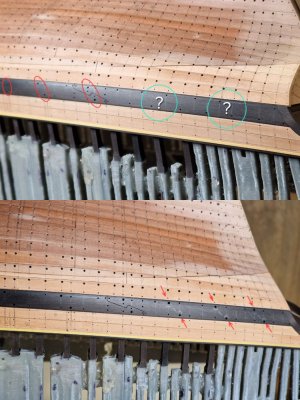
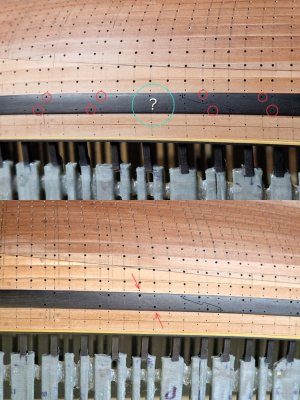
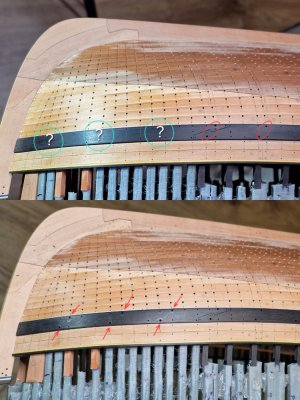
Naturally, unfortunately, there were some defects ((( Several extra holes, also several holes of a larger diameter than necessary and several damages near the hole... And it's hard to avoid when you drill more than 2000 holes (many had to be done in 2 approaches from a smaller to a larger diameter). I'll tell you the most interesting ones in words, and then I'll show the result after bitumen... So, to mask an extra hole or remove damage, I covered the holes with putty in the same color. While I had brown, I still need to buy a light one. And after sanding and coating with oil, of course, it is unrealistic to completely mask it, but the bitumen will not get there and will not paint the defect, which is much more noticeable than a small difference in color. But it's good that such defects are few and far between. But there are about a dozen more holes than necessary, and after covering with putty and after sanding, I made holes of a smaller diameter in the putty (I even installed nails on the test, and oiled (I covered it), then in this case it's practically impossible to see that anything is wrong... and that's good. Although it's still a shame that everything can't be done perfectly... eh.
Now I'll tell you step by step where the bolts will be and where the nails will be.
The top is Carvel planking with 0.5mm holes for nails. The holes where the boards meet are slightly closer together (not centered on the frame, as usual).
The wave planks have 0.6mm holes (I drilled them twice to slightly widen the holes from the 0.5mm drill bit). The bolt holes are 1mm, but I first drilled 0.8mm ones.
Clinker planking according to the scheme that I have shown many times.
All bolt holes are 1 mm (but I initially drilled 0.8 mm holes).
The lower chord near the keel is secured with nails (0.5 mm holes). The next chord covers it, and they are both connected and bolted to the frames.
The planks are secured to the paired frames in a staggered pattern, alternating nails and bolts (turquoise circle).
But where the planks join, all four are bolts (1 mm) (red circle).
At the stern, everything is simple - 0.5 mm nails are used everywhere.
At the bow, the edges of the boards are secured with 0.5 mm nails, but another row of 0.5 mm holes is also drilled for nails, as this is where the sheathing overlaps and butts.
The top chord under the wave is also secured with nails.
The same is true for the upper and lower chords at the rear.
All intermediate boards, reaching the sternpost, are also transitioned from overlapping to butt-jointed and also secured with nails.
The wave section is a bit more interesting. The anatomy diagram shows the bolts running along paired webs, but it doesn't indicate the areas where there aren't paired frames.
Let's just say (even though the anatomy is full of errors and omissions), even without this, there should be logic everywhere. And it's physically impossible for there to be no bolts in the fore and aft sections. Practically speaking, two of the four wave sections were held together solely by nails, which is highly unlikely!
Therefore, I added bolts at similar intervals both fore and aft, and in the middle frame, where the span is greater than anywhere else (not two, but five separate frames).
This is not only logical, but will definitely look better, as the brass will shine slightly and it will seem as if something is missing.
Naturally, unfortunately, there were some defects ((( Several extra holes, also several holes of a larger diameter than necessary and several damages near the hole... And it's hard to avoid when you drill more than 2000 holes (many had to be done in 2 approaches from a smaller to a larger diameter). I'll tell you the most interesting ones in words, and then I'll show the result after bitumen... So, to mask an extra hole or remove damage, I covered the holes with putty in the same color. While I had brown, I still need to buy a light one. And after sanding and coating with oil, of course, it is unrealistic to completely mask it, but the bitumen will not get there and will not paint the defect, which is much more noticeable than a small difference in color. But it's good that such defects are few and far between. But there are about a dozen more holes than necessary, and after covering with putty and after sanding, I made holes of a smaller diameter in the putty (I even installed nails on the test, and oiled (I covered it), then in this case it's practically impossible to see that anything is wrong... and that's good. Although it's still a shame that everything can't be done perfectly... eh.
Drilling continues, and I think I'll finish the other side tomorrow.
And now we can start working on the gratings.
To do this, I needed to upgrade the Proxxon MF 70, which I did today (waiting for a shipment of bearings).
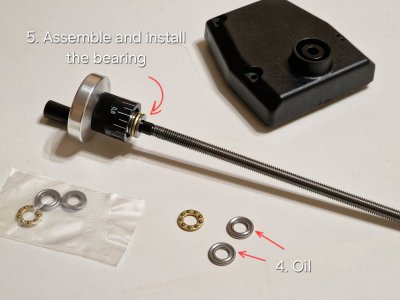
I also created a new thread where I'll explain everything I'll be doing with the milling machine. In the second post, I've posted step-by-step instructions on how to install the bearings; maybe someone will find it useful.
And now we can start working on the gratings.
To do this, I needed to upgrade the Proxxon MF 70, which I did today (waiting for a shipment of bearings).
I also created a new thread where I'll explain everything I'll be doing with the milling machine. In the second post, I've posted step-by-step instructions on how to install the bearings; maybe someone will find it useful.
Proxxon MF 70 | Upgrade Tools Jigs Workspace | Making: grating ladder stair skylight pin carriage pump windlass winch mast yard
In this thread, I'll be showing the following: 1. Machine upgrades and improvements (Z-axis bearings, electronic ruler, lighting etc.) 2. Consumables I'll be using (milling cutters, drills, burrs) and jigs I'll be creating for the job. 3. Workspace and storage (designing a box and a...
shipsofscale.com