• Win a Free Custom Engraved Brass Coin!!!
    As a way to introduce our brass coins to the community, we will raffle off a free coin during the month of August. Follow link ABOVE for instructions for entering.
  • PRE-ORDER SHIPS IN SCALE TODAY!

    The beloved Ships in Scale Magazine is back and charting a new course for 2026!
    Discover new skills, new techniques, and new inspirations in every issue.

    NOTE THAT OUR FIRST ISSUE WILL BE JAN/FEB 2026

La Créole 1827 by archjofo - Scale 1/48 - French corvette

@dockattner
@AllanKP69
@serikoff
@Peter Voogt
@Mirek

Hello colleagues,
It's always great to receive feedback. It's very motivating and makes me very happy. Thank you so much for that, and also thank you to everyone else for the many likes.

Even though the La Créole is by no means my first ship model, I've been working on its rigging for quite some time now—and yet it still feels like I'm venturing into uncharted territory.
For the first time, I'm attempting to recreate the entire rigging almost completely and with historical accuracy. My basis for this isn't just Boudriot's monograph on the La Créole. I'm also drawing on primary sources, available specialist literature, and everything the internet has to offer in terms of reliable information.

In addition, there are the tips, discussions, and suggestions from the forum, which constantly open up new perspectives. Often, the various sources lead to slightly different solutions, and in the end, the task remains to decide on a plausible, logically sound option. The more I delve into each individual piece of rope, the more I marvel at this ingenious interplay of the rigging—a finely tuned system in which each element absorbs, transmits, and balances forces.

And that, for me, is precisely the special charm of model making: the learning, the discovering, the understanding—and, of course, the joy of every successful detail. Added to that is the quiet hope of one day seeing this model finished and standing before me.

And so it continues…

Attaching the Fore Topsail Yard - Vergue de hune de misaine
Now that the fore yard has been rigged, we'll proceed with attaching the fore topsail yard, working systematically from the bottom up. For this, it's necessary to install the corresponding fore topsail tye.

The tye's components - including the topsail halyard spacers (gouvernail de drisse) and tackle - were manufactured and documented some time ago; the blocks are also already in place on the model.

During the preparation, the question arose as to the correct tarring or coloring of the tye with halyard. A recent close-up photograph of the Hermione replica shows the the rope of the tye just before the tackle block, in direct comparison to the backstay that guides the topsail halyard.

View attachment 577265
Source: Association Hermione – La Fayette, “Dico de l’Hermione”, December 9, Itague.

The image clearly shows that the topsail tye is visibly lighter in color and therefore only lightly tarred, if at all, in contrast to the heavily tarred backstay. This likely corresponds to historical practice. The fore topsail tye is part of the running rigging.

View attachment 577264

The tye in general (fore topsail yard ø 37 mm) was served in the sections where it passed through the blocks (according to F. A. Coste 1827). Therefore, to prepare for the fore topsail tye, this area had to be defined on the model. Appropriate markings were made on a temporarily installed section of rope. At each end of the tye, there was a spliced eye for attaching the halyard blocks. These sections also received appropriate serving, as can be seen in the following pictures.

I prepared the lashings for the halyard spacers in the form of rings made from thin silk yarn. I was then able to stiffen these rings with diluted white glue and pull them onto the rope, sliding them over the spacer at the appropriate points.

View attachment 577266

One side of the topsail tye with halyard could be made completely, and therefore conveniently, outside the model.
Only after the rope is threaded through the blocks can the other side (with the serving already prepared, and silk thread for the remaining serving) be finished on the model, albeit somewhat less conveniently.

Attaching the halyard spacers requires opening the seizings of the fore topsail backstays. Unfortunately, I didn't consider that something would be added there when rigging the standing rigging.

View attachment 577270

The following pictures show the fore topsail tye already installed in the block of the middle of the fore topsail yard.

View attachment 577267
View attachment 577268
View attachment 577269

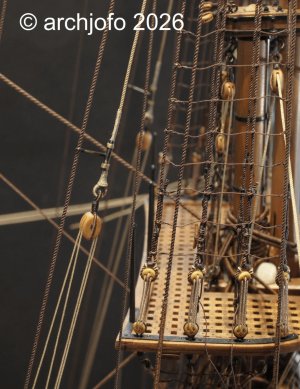
The last picture shows both tye blocks under the braiding of the shrouds with the already pulled-in tye rope.

View attachment 577271
In the next step, I will then complete the starboard side of the tye with halyard.

To be continued...

Soo Beautiful work and performance, so precise, I admire your work, my dear friend
 
@Mirek
@shota70
@Steef66
Thank you so much for your interest. It's great that my report is being followed.
And a big thank you to everyone else for the many likes.

Continued: Fore topsail yard – tye, lifts, clewline, braces, bowlines – Itague, balancines, cargue-points, bras, boulines
I have now completed the tye on the starboard side as well, including the fore topsail halyard. The double block of the fore topsail halyard tackle was tied directly to the model, and the halyard spacer was attached, as can be seen in the following pictures.

DSC02420.jpg

DSC02426.jpg
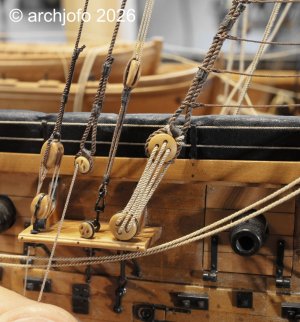
The next picture shows the single block of the halyard tackle with a long strop, which has been hooked onto the channel with a swivel hook. The released fore topmast backstay, into which the tackle had to be reattached, is also visible.

DSC02424a.jpg
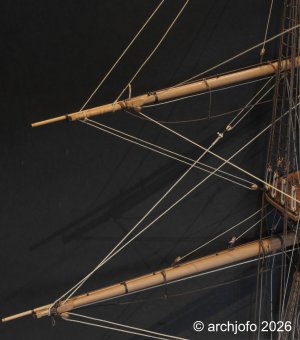
Furthermore, I was now able to connect the fore topsail sheets to the clew lines of the fore topsail using toggles. The lifts were also threaded into the topmast sister blocks and led down. I also attached the braces and bowlines. I had already pre-cut all these ropes and prepared them with the blocks.
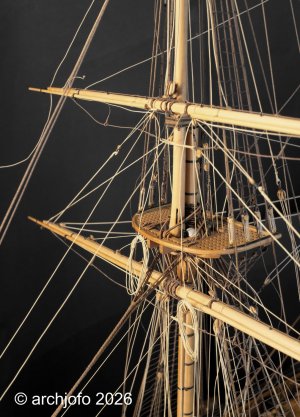
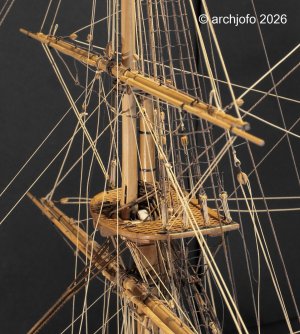
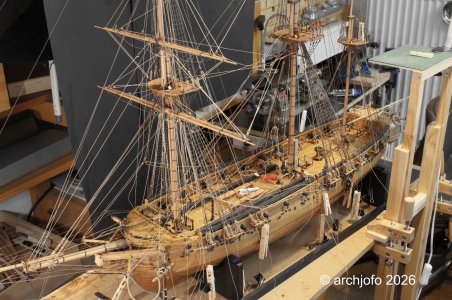
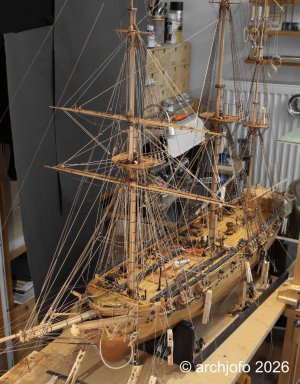
Finally, here's an impression of the current state of the rigging work on the foremast. The rigging is progressing steadily, even if it all looks a bit unsteady at the moment.

DSC02428.jpg


Until next time…
 
@Mirek
@Herman
Thanks!
I really appreciate it — especially coming from such a skilled model builders.
And thanks to everyone for the likes as well — I really appreciate your support.

Continued: Fore topsail yard – Reef tackle – Palanquin de ris
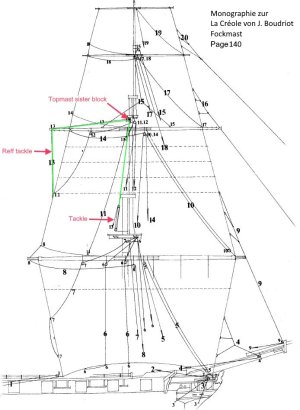
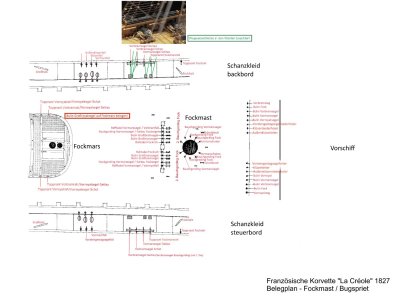
Several aspects of the reef tackles (palanquins de ris) on La Créole initially remained unclear. The monograph specifies tackles located at the top, yet neither the original Paris model of La Créole nor other contemporary models in the Musée national de la Marine show such fittings.
Refftakel_Fockmast_LaCreole_eng.jpg

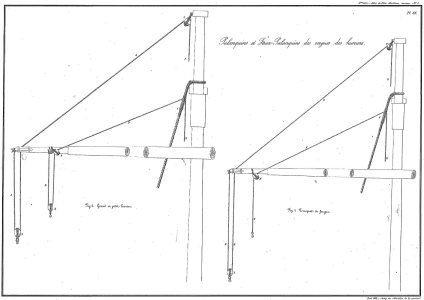
The Atlas du Génie Maritime includes illustrations of reef tackles, but likewise without tackles. This suggests that on La Créole, the reef tackles ran via the sheaves of the yardarms to the topmast, were led through the topmast sister block (poulies de baraquettes), and then—without a tackle—through the lubber’s hole, over the fairlead block, and finally to the pin rail aft of the foremast.

Atlas du Génie Maritime_Palanquin_de_ris.jpg
Source: Atlas du Génie Maritime

Contemporary technical literature, such as F.A. Coste's Manuel du gréement (1829), mentions tackles, but these refer primarily to larger ships.

Whether blocks were attached to the reef tackles of the La Créole—as depicted in the Atlas du Génie Maritime—is uncertain. On the original Paris model, the reef tackles are simply attached to the sheaves of the yardarms with knots (e.g., figure-eight knots), as the model is rigged without sails.

However, reef blocks seem particularly useful without tackles, as they significantly facilitate reefing—a practical advantage in every respect.

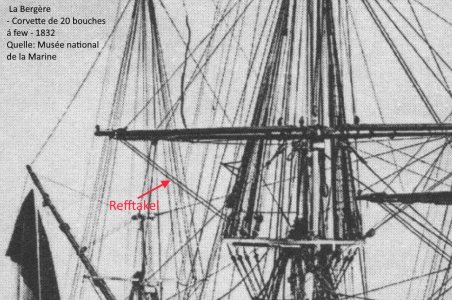
The La Bergère model (1832) features reef tackles with reef blocks. Since this model was also rigged without sails, the reef tackles was attached to the fittings of the topmast shrouds. Particularly compelling is the comparison with the La Bergère, a corvette of nearly the same size from the same era, which also features reef tackles without tackles, but with reef blocks.

LaBergere_Corvette_20_bouches_1832.jpg

Based on my research, I've come to the following conclusion for my corvette:

I will use reef tackles without tackles, but with reef blocks.

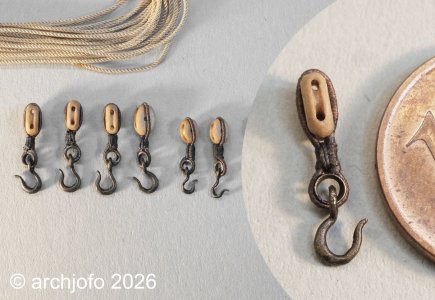
This results in six additional blocks with hooks in the size range of approximately 3.5–4.5 mm-
a consequence I can live with...:D

To be continued…
 
Atlas du Génie Maritime
This sounds like a book anyone building a model of a 19th century French ship and cares about accuracy should have. Oh my, another book on my wish list. This one would be trouble as it would keep me and the admiral (she is fluent in French) busier than usual. trouble ahead??
Allan
 
Last edited:
@marsalv
@AllanKP69
Hello,
thank you so much for your feedback! I'm always delighted by the interest in my work. I also want to thank everyone for the many likes.

Continued: Topmast Yard – Reef Tackles, Buntlines and Leechlines – Palanquin de ris, cargue‑fonds et cargue‑boulines

In the course of the work on the fore topmast yard, I recently finalised the routing and execution of the reef tackles. One detail, however, remained unresolved: how, historically, was the standing part of the reef tackle secured to the yardarm of the topmast yard?

The Atlas du Génie Maritime clearly shows the lead of the tackle, but does not reveal the precise method of fastening.

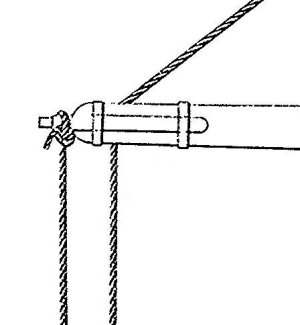
Rundtörn_mit_zwei_halbschlägen_Atlas.jpg

Quelle: – Atlas du Génie Maritime, annexe Nr. 1, Pl. 25 - Bildausschnitt

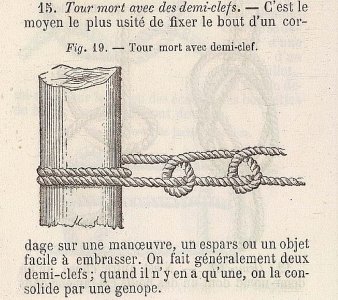
To clarify this point, I consulted additional contemporary French literature and found in the Manuel du Gabier (1875) the tour mort avec des demi‑clefs (a round turn with half‑hitches), described there as the “most commonly used” method for fastening the end of a rope to spars, yards or other easily encircled parts of the rigging.Manuel_du_Gabier_1875.jpg.f5a51cfb62684d692ef2b30d535fb1c4.jpg
Manuel_du_Gabier_1875_wett.jpg
Quelle: Manuel du Gabier, Paris 1875

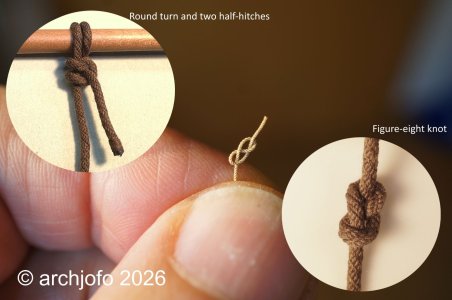
Combined with the representation in the Atlas du Génie Maritime, this results in a coherent and historically plausible solution: the standing part of the reef tackle is secured to the yardarm with a round turn and two half‑hitches.
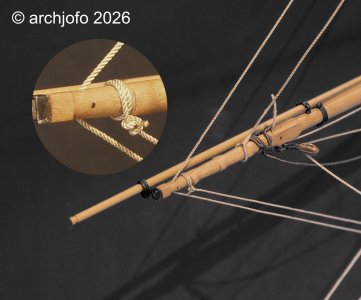
To illustrate the knots used on the fore topmast yard, I show three examples here: – on the left, a round turn with two half‑hitches for the standing part of the reef tackle, – on the right, a figure‑eight knot as a safeguard against slipping, – in the centre, a figure‑eight knot tied in 0.25 mm rope at model scale to demonstrate the actual fineness of the work.
DSC02454.jpg

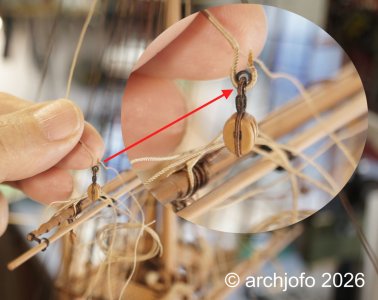
In the meantime, the blocks for the reef tackles (palanquins de ris) have also been made and fitted with their strops and hooks.

DSC02430.jpg

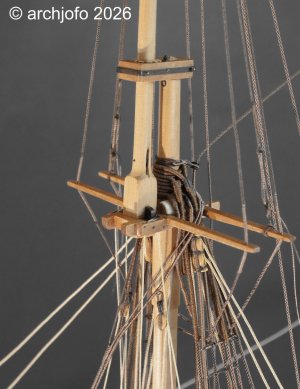
In the next image, the buntlines can be seen, running through the cheek blocks on the trestle trees, as well as the leechlines, which lead over the blocks seized to the fore topgallant stay. Also visible in this picture, on the port side, is the sister block with the reef tackle and the lift.

DSC02450.jpg

The following image shows the port reef tackle with its standing part, as it returns from the reef block towards the sheave in the yardarm, running in the direction of the topmast sister block.

DSC02459.jpg

Finally, a close‑up of the standing part of the reef tackle: round turn with two half‑hitches.

DSC02460.jpg

To be continued…
 
Back
Top