• Win a Free Custom Engraved Brass Coin!!!
    As a way to introduce our brass coins to the community, we will raffle off a free coin during the month of August. Follow link ABOVE for instructions for entering.
  • SUBSCRIBE TO SHIPS IN SCALE TODAY!

    The beloved Ships in Scale Magazine is back and charting a new course for 2026!
    Discover new skills, new techniques, and new inspirations in every issue.

    NOTE THAT OUR NEXT ISSUE WILL BE MARCH/APRIL 2026

School for Shipmodel Building School for model ship building

and now the mini lecture on model building

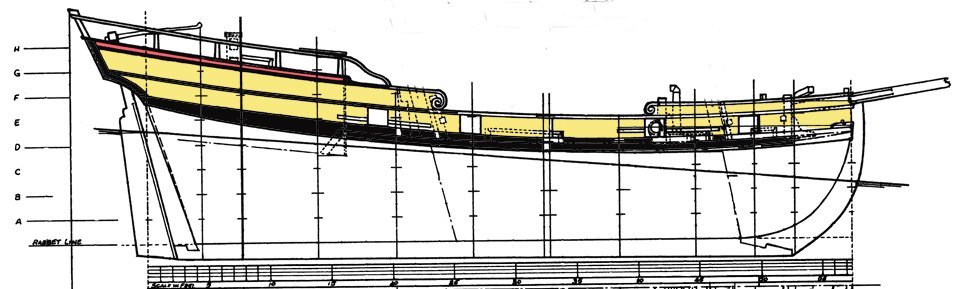
When you look closer you might notice a difference in the model as built and the drawings. Here is the drawing by Chapelle

org.jpg

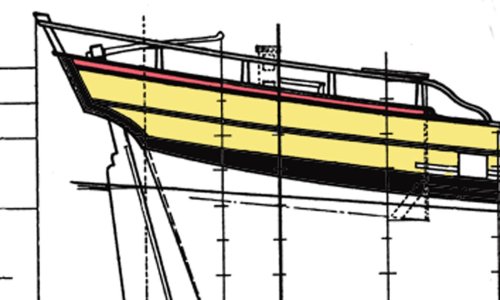
The red area is quite narrow with a slight flaring as it approaches the stern


org close.jpg

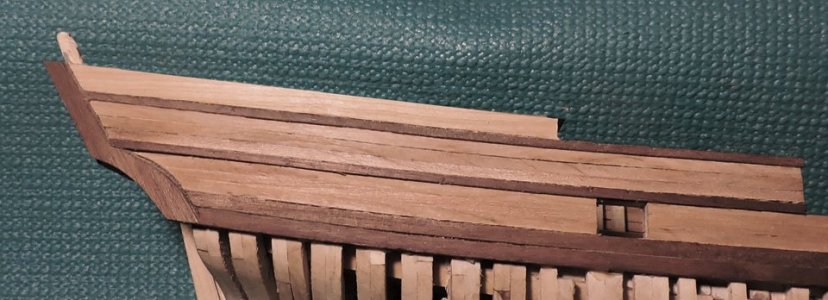
The model as built is wider and a slightly more flare toward the stern so why is that?

stern91.jpg
 
" Both models and ships are "shaped and refined during the building process." Thus, it always was and always will be. When it comes to plans, "accuracy" is a relative term. At the end of the day, it's always the craftsmanship that determines if the parts fit well enough. There used to be a saying: "A good framing carpenter works to the nearest eighth of an inch and a good finish carpenter works to the closest sixteenth of an inch, but a good a shipwright works to the closest ship."

Any professional craftsman who uses drawn plans for any purpose lives by the universal rule that "Measurements are never taken from the drawing, but rather always from the notations." In fact, many draftsmen printed a standard caveat on all their drawings saying just that. This is a rule that is widely ignored by modelers who commonly do the exact opposite

For some, the most important thing is the carpentry skills and their result, while for others it is the concept the carpenters tried to follow, with varying degrees of success in practice. Personally, I see no reason to oppose one to the other, because there is no conflict or contradiction here.


I believe that there is no such thing as true precision or false precision Rather, precision either exists or it does not, and to a varying degree.

In a nut shell what is being said plans are the concept and starting point. At some point a builder stops taking measurements from the plans and builds to the model. It is well known "the hand of man" or the "creeping thousandth" prevents a perfect model built to exactly the plans. Not saying sloppy building is acceptable what is acceptable is the model not being built to the thousandth of an inch as drawn on a set of plans.
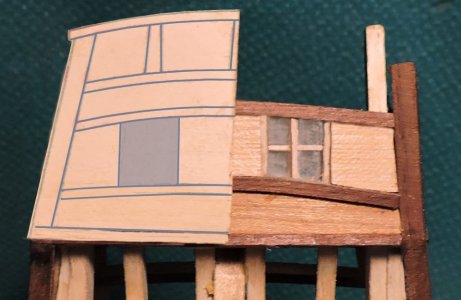
As case in point the reason the last planked section at the side is wider than drawn started with the stern construction. It started out in the correct place but as the stern was built it creeped upward when compared to the drawing. keep in mind you are looking very close the differences are in the thousandth but they do add up thus the term creeping thousandth

stern93.jpg

the stern is built on the structure and that is where it all started, placing the transom pieces slightly different from the drawing. This resulted in the deck ever so slightly higher at the stern.

stern94.jpg

does it matter is an opinion if you building for strict competition and the judge has a set of calipers and he is measuring from plan to model you may lose a point or two because the model is not exactly built to the plans. But if your building for your own personal satisfaction and it looks good and it is close enough your good to go. The general public viewing the finished model and never seeing the original drawings would have no idea what is right or wrong or close enough.
 
Last edited:
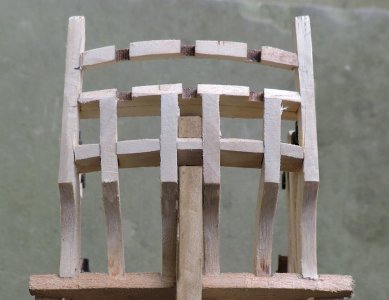
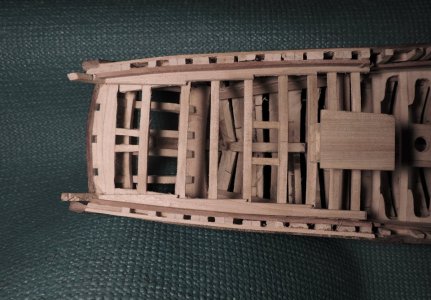
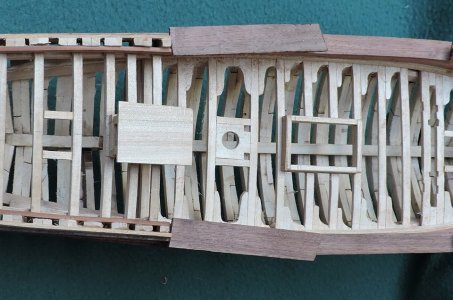
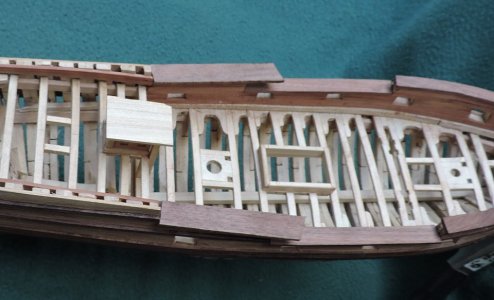
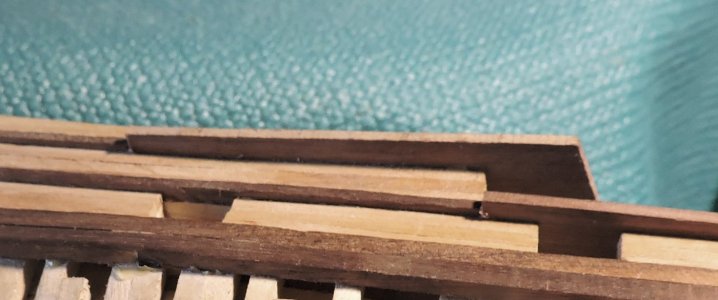
A top view shows a space between the frames and at the stern this is where the rail stanchions will go. These rail stanchions are separate from the frame top timbers because that can be replaces if broken. If they were the top timbers od a frame planking would have to be removed and the top of the frame repaired. The stanchions and railing are a delicate part of the model and will be the last thing added.
So next will be moving on to deck planking

stern92.jpg
 
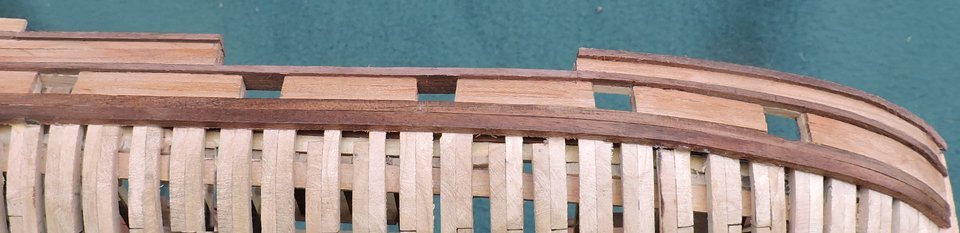
It is time to install the cap rails

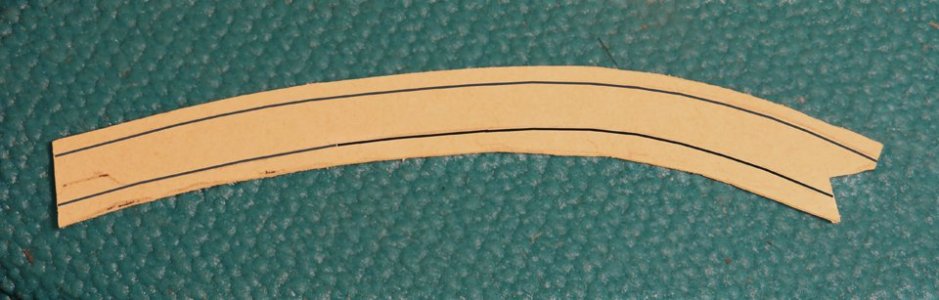
i use cardboard templates for just about all the parts before cutting wood

cap rail 1.jpg

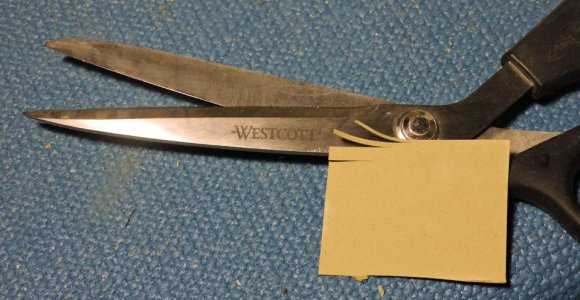
a tool you really never hear about and that is a pair of scissors, making cardboard templates requires a clean sharp edge. You have to be able to cut a very thin sliver and not rip, bend or crush the edge.


cap rail 5.jpg

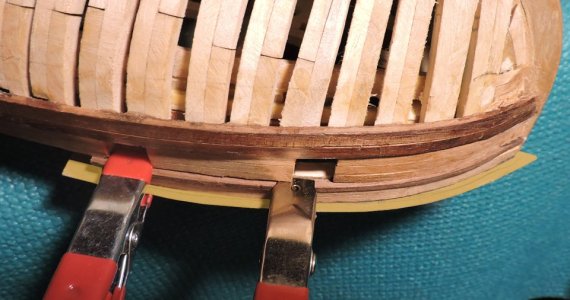
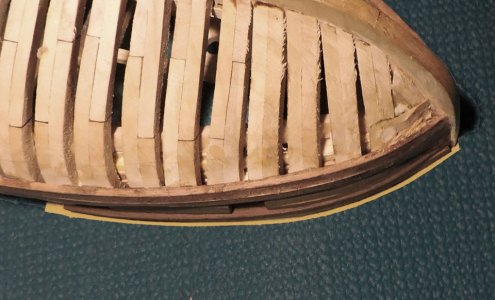
i will just do one cap rail because the procedure is the same for all the sections starting with a rough shape i will draw a pencil line along the bulkhead inside and out

cap rail 6.jpg
cap rail 4.jpg

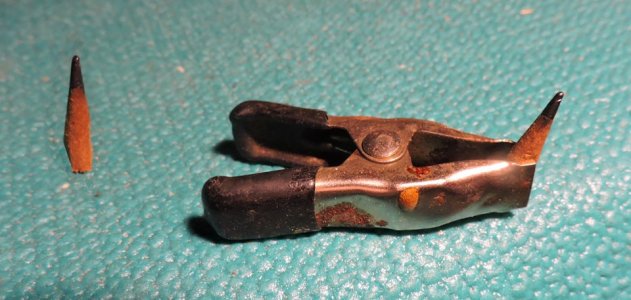
Drawing the inside line is difficult because there is little space between the cap rail and deck so i cut off the tip of a pencil and held it with a clamp.

cap rail 3.jpg
 
Last edited:
Tracing the pattern to the wood you want to draw a fat line around the cardboard template. I do this with a pencil that i sanded to a flat end. This gives me a fat wide line around the edge.

cap rail 13.jpg

The reason for the extra wood is so i can give the cap rails there final edge along the bulwarks.

cap rail 11.jpg
 
Another way to do the cap rails is to cut a rough shape

cap rail 6.jpgcap rail 8.jpgcap rail 9.jpgcap rail 10.jpg

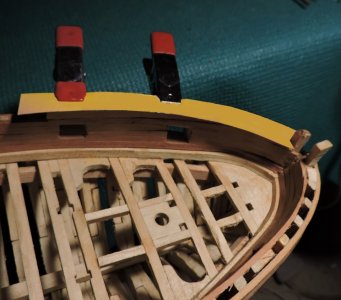
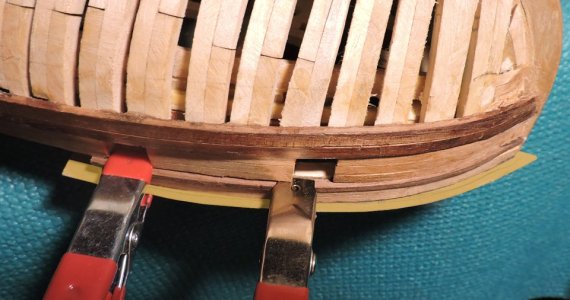
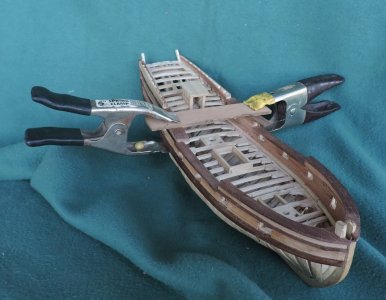
glue the rough pieces to the top of the bulwarks.

cap rail 12.jpg


Then sand the edges to a thin overhang of the bulwarks. Sanding this way is quick with a sanding disk on a Dremel tool to bring the cap rail down close then finish it by hand sanding.
The wood being used for the cap rails is Walnut which goes well with the Cherry planking
 
Last edited:
Tolerances: You are correct, real wooden ships could not be built exactly in accordance with the design drawings. Their hulls were complex three dimensional structures that had to be “sculpted.” During this building process, subtle variations would occur that could affect the finished vessel. This may account for differences in sailing performance of different ships supposedly built to the same design. And it may also be why historians have so much difficulty figuring out which of the several contemporary lines drawings show the “real” shape of the Schooner Yacht America. Lines recorded by the British in a dry dock are slightly different from drawings from other sources.

In his interesting book, Industrializing American Shipbuilding, historian William Thiesen explains the technical changes required by the transition from wood to iron ship building. Where wooden ships had been built on the building ways by artisans, iron, and later steel ships now required 1000’s of drawings to precisely show construction details. A rivet cannot be driven though two pieces of steel plate if the holes do not line up exactly.

This is not to encourage sloppy workmanship. Ship designs have what historians call “defining characteristics.” A knowledgable observer looking at a ship model should be able to immediately see the unique characteristics of whatever design its builder has chosen to build. Or as Bob Cleek has posted “a compelling impression of the real thing.”

Roger
 
Tolerances: You are correct, real wooden ships could not be built exactly in accordance with the design drawings. Their hulls were complex three dimensional structures that had to be “sculpted.” During this building process, subtle variations would occur that could affect the finished vessel. This may account for differences in sailing performance of different ships supposedly built to the same design. And it may also be why historians have so much difficulty figuring out which of the several contemporary lines drawings show the “real” shape of the Schooner Yacht America. Lines recorded by the British in a dry dock are slightly different from drawings from other sources.

In his interesting book, Industrializing American Shipbuilding, historian William Thiesen explains the technical changes required by the transition from wood to iron ship building. Where wooden ships had been built on the building ways by artisans, iron, and later steel ships now required 1000’s of drawings to precisely show construction details. A rivet cannot be driven though two pieces of steel plate if the holes do not line up exactly.

This is not to encourage sloppy workmanship. Ship designs have what historians call “defining characteristics.” A knowledgable observer looking at a ship model should be able to immediately see the unique characteristics of whatever design its builder has chosen to build. Or as Bob Cleek has posted “a compelling impression of the real thing.”

Roger

this is very true once the framing was done the plans were just a suggestion. The ship pretty much takes on a form of itself and everything is "fit to the ship" rather than patterns traced from the plans. The pattern i cut for one side around the bow section was NOT an exact fit for the other side, very close but not close enough. This is the reason i left enough width on the cap rails and once they are glued to the bulwarks they are finished to the hull.
 
Even once the framing was erect they were dubbed; sculpted with an adz to produce fair surfaces for the planking. Since this was done by hand it could result in variances from the lofted framing patterns.

Roger
 
Even once the framing was erected they were dubbed; sculpted with an adz to produce fair surfaces for the planking. Since this was done by hand it could result in variances from the lofted framing patterns.

Roger
 
The next step in the build will be the deck planking and the question is do you lean toward historical accuracy or take artistic
license ?
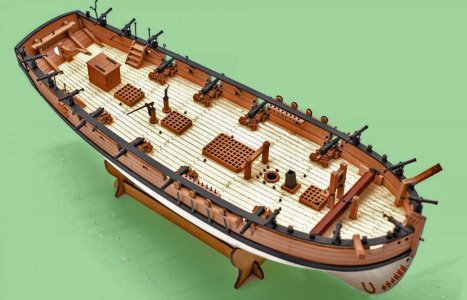
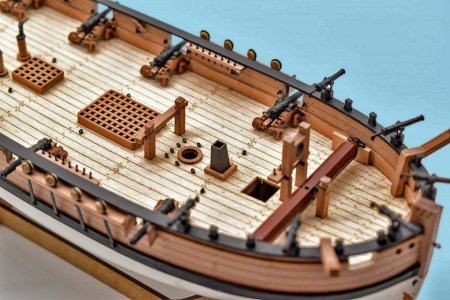
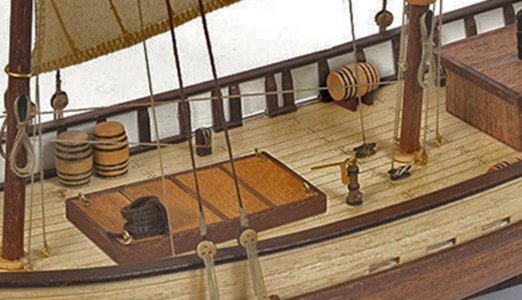
Looking at typical kits the deck planking is grossly out of scale.

VM1613.jpg

On this model the width of the deck planking is about 18 inches wide


VM169.jpg

on this model the deck planking is about 19 inches wide

-OC12007-39.jpg
 
Last edited:
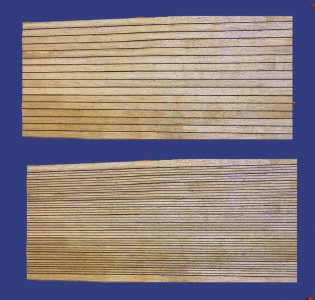
The issue is wide out of scale deck planking looks aesthetically pleasing on a model as opposed to the bottom example which is true scale plank width.

plank scale.jpg
 
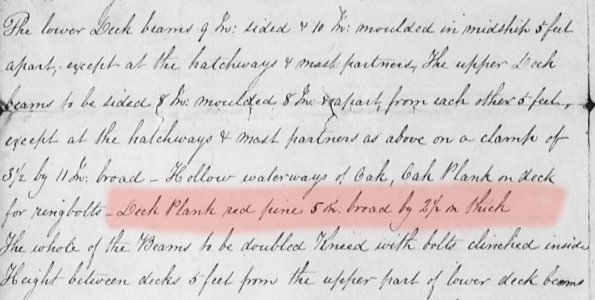
So how wide is the average deck plank? a contract for a 100 ton brig dated 1822 the high light states the deck planking to be Red Pine 5 inch wide and 2 1/2 thick.

decking.jpg

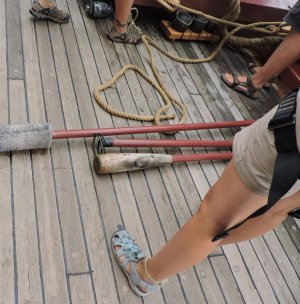
Now lets take a look at people standing on some real decks judging from their shoes the average width of a deck plank is from 4 1/2 to 6 inches wide. So why are deck planks so narrow? it is because of cupping.
Cupping occurs when one face of a board absorbs or releases moisture faster than the other. This creates a moisture gradient that drives differential expansion or contraction. In a typical flat-sawn board, the sides closer to the edge (with more tangential growth ring exposure) shrink or swell more than the pith side, pushing the edges upward and the center downward.
To call decking a plank is misleading because the decking is half the thickness of the width making them more like a beam rather than a plank.

DSCN6824.JPGDSCN6833.JPGDSCN6922.JPGDSCN6978.JPG6323955.jpg
 
A model builder is faced with a dilemma because there are some things you just cannot recreate to scale and decks are one of them. The smallest you can go when it comes to decking is 1:48 scale and that is just a little wider than a toothpick You can reproduce 5-inch-wide decking at 1:48 scale that is a fat 3/32 of an inch. Any smaller scale is not possible to reproduce to scale.
This is not to encourage sloppy workmanship. Ship designs have what historians call “defining characteristics.” A knowledgeable observer looking at a ship model should be able to immediately see the unique characteristics of whatever design its builder has chosen to build. Or as Bob Cleek has posted “a compelling impression of the real thing.”
Roger


way out of scale decking does give “a compelling impression of the real thing.” not to scale just an impression of a deck.
 
let's not fall into the pit of ALL decks have narrow planks some first-rate ships have decking as wide as 7 to 9 inch. There is a difference between a weather deck and a below deck where planking is quite wide. However, I have never come across 18 inch wide deck planking

DSCN6933.JPG
 
Back
Top