The beloved Ships in Scale Magazine is back and charting a new course for 2026!
Discover new skills, new techniques, and new inspirations in every issue.
NOTE THAT OUR NEXT ISSUE WILL BE MARCH/APRIL 2026
Win a Free Custom Engraved Brass Coin!!!
As a way to introduce our brass coins to the community, we will raffle off a free coin during the month
of August. Follow link ABOVE for instructions for entering.
Sei stato molto prudente a lasciare un margine di 500 gr. per i successivi aggiustamenti. Lavori con metodo, complimenti.
Io sono un pò esagerato avrei lasciato ancora più margine.
In realtà sono molto esagerato su questi aspetti.
Preferisco non fissare mai in maniera irrevocabile la zavorra. E' ben bloccata ma, se voglio posso toglierla e riposizionarla.
La mia è probabilmente mancanza di esperienza, si vede che tu agisci con sicurezza e sai bene tutti i passi da compiere.
A proposito di zavorra per ottenere la massima spinta raddrizzante io ho preferito sostituire la chiglia in legno (tagliandola) con una chiglia in ottone, poi ricoperta di listelli di legno. Nessuno si accorge del trucco ma in questo modo sono riuscito ad abbassare il baricentro, favorendo la spinta laterale di raddrizzamento ed evitando di mettere la pinna a bulbo.
Hi JJ Lad.
You were very careful to leave a 500g margin for subsequent adjustments.
You work methodically, congratulations.
I'm exaggerating a bit; I would have left even more margin.
In reality, I'm very exaggerated in these aspects.
I prefer never to permanently fix the ballast. It's well-secured, but if I want, I can remove it and reposition it.
I probably lack experience; you clearly operate with confidence and know all the steps to follow.
Regarding ballast, to obtain maximum righting thrust, I preferred to replace the wooden keel (by cutting it) with a brass keel, then covered it with wooden strips. No one notices the trick, but this way I managed to lower the center of gravity, favoring the lateral righting thrust and avoiding the need for a bulbous fin.
The number of yard sails in service will largely depend on the effectiveness of my current ballast arrangement.
If it turns out the ship wants to capsize, I’ll definitely have to reduce sail area or consider an external ballast attachment.
Fortunately, the masts on the AV are fairly short in relation to the hull length so the center of pressure is very low. Compare that to a modern sail boat where the center of pressure is considerably higher… hence their deep fin-ballast bulb.
Il numero di vele da cantiere in servizio dipenderà in gran parte dall'efficacia della mia attuale disposizione di zavorra.
Se si scopre che la nave vuole capovolgersi, dovrò sicuramente ridurre l'area velica o prendere in considerazione un attacco di zavorra esterna.
Fortunatamente, gli alberi dell'AV sono abbastanza corti rispetto alla lunghezza dello scafo, quindi il centro di pressione è molto basso. Confrontalo con una moderna barca a vela in cui il centro di pressione è considerevolmente più alto... da qui il loro profondo bulbo di zavorra.
La tua scelta è un'ottima idea, le vele quadre sono più difficili da manovrare e non riescono a risalire bene il vento come quelle triangolari o auriche.
Tuttavia io credo che il maggior o minore numero di vele sia determinante per la capacità di sospingere la nave e per la velocità della nave.
Tu non devi fare regate o gare perciò non è un problema.
Per quanto riguarda la stabilità laterale io farei un altro tipo di ragionamento: La nave (a differenza di quella vera) deve poter raddrizzarsi in ogni caso.
Le navi vere con forte vento riducono o tolgono le vele per evitare di raggiunegre un angolo di sbandamento elevato (oltre il quale la nave non si raddrizza più ma si ribalta).
Nel modello puoi fare in modo che questo angolo sia elevato al massimo o quasi.
Per questo puoi fare un esperimento molto semplice: porta le sommità degli alberi quasi a toccare la superfice dell'acqua, inclina la nave al massimo, quasi con la falchetta sott'acqua. Se, dopo aver mollato gli alberi, la nave torma in posizione allora hai ottenuto una buona spinta raddrizzante indipendemente dalle vele che metti (il loro peso lo considero trascurabile anche se non è così, infatti l'esperimento andrebbe ripetuto con le vele complete e bagnate).
Non so se mi sono spiegato, ti metto un link video per farmi capire meglio.
Se ho detto stupidaggini o mi sono spiegato male ti prego di dirmelo.
Share your videos with friends, family, and the world.
studio.youtube.com

Hi JJ Lad.
Your choice is an excellent idea; square sails are more difficult to maneuver and don't sail upwind as well as triangular or gaff sails.
However, I believe that the greater or lesser number of sails is crucial to the ship's ability to propel and its speed.
You don't have to compete in regattas or races, so it's not a problem.
Regarding lateral stability, I would reason differently: The ship (unlike a real one) must be able to right itself in any case.
Real ships in strong winds reduce or remove sails to avoid reaching a high heeling angle (beyond which the ship no longer rights itself but capsizes).
In the model, you can set this angle to the maximum or nearly maximum.
To do this, you can do a very simple experiment: bring the tops of the masts almost to the surface of the water, and list the ship as far as possible, almost with the gunwale underwater.
If, after releasing the masts, the ship returns to its original position, then you've achieved good righting force regardless of the sails you use (I consider their weight negligible, although that's not the case; in fact, the experiment should be repeated with the sails fully set and wet).I don't know if I made myself clear; I'll provide a video link to help you understand better.
If I've said something stupid or explained myself poorly, please let me know.
La tua scelta è un'ottima idea, le vele quadre sono più difficili da manovrare e non riescono a risalire bene il vento come quelle triangolari o auriche.
Tuttavia io credo che il maggior o minore numero di vele sia determinante per la capacità di sospingere la nave e per la velocità della nave.
Tu non devi fare regate o gare perciò non è un problema.
Per quanto riguarda la stabilità laterale io farei un altro tipo di ragionamento: La nave (a differenza di quella vera) deve poter raddrizzarsi in ogni caso.
Le navi vere con forte vento riducono o tolgono le vele per evitare di raggiunegre un angolo di sbandamento elevato (oltre il quale la nave non si raddrizza più ma si ribalta).
Nel modello puoi fare in modo che questo angolo sia elevato al massimo o quasi.
Per questo puoi fare un esperimento molto semplice: porta le sommità degli alberi quasi a toccare la superfice dell'acqua, inclina la nave al massimo, quasi con la falchetta sott'acqua. Se, dopo aver mollato gli alberi, la nave torma in posizione allora hai ottenuto una buona spinta raddrizzante indipendemente dalle vele che metti (il loro peso lo considero trascurabile anche se non è così, infatti l'esperimento andrebbe ripetuto con le vele complete e bagnate).
Non so se mi sono spiegato, ti metto un link video per farmi capire meglio.
Se ho detto stupidaggini o mi sono spiegato male ti prego di dirmelo.
Share your videos with friends, family, and the world.
studio.youtube.com

Hi JJ Lad.
Your choice is an excellent idea; square sails are more difficult to maneuver and don't sail upwind as well as triangular or gaff sails.
However, I believe that the greater or lesser number of sails is crucial to the ship's ability to propel and its speed.
You don't have to compete in regattas or races, so it's not a problem.
Regarding lateral stability, I would reason differently: The ship (unlike a real one) must be able to right itself in any case.
Real ships in strong winds reduce or remove sails to avoid reaching a high heeling angle (beyond which the ship no longer rights itself but capsizes).
In the model, you can set this angle to the maximum or nearly maximum.
To do this, you can do a very simple experiment: bring the tops of the masts almost to the surface of the water, and list the ship as far as possible, almost with the gunwale underwater.
If, after releasing the masts, the ship returns to its original position, then you've achieved good righting force regardless of the sails you use (I consider their weight negligible, although that's not the case; in fact, the experiment should be repeated with the sails fully set and wet).I don't know if I made myself clear; I'll provide a video link to help you understand better.
If I've said something stupid or explained myself poorly, please let me know.
I completely understand what you’re saying. As part of my normal sea-trials, I tip the hull over on its bulwark to ensure it self-rights. The test is repeated under various sail-area conditions.
Capisco perfettamente quello che stai dicendo. Come parte delle mie normali prove in mare, capovolgo lo scafo sulla sua murata per garantirgli i diritti personali. Il test viene ripetuto in varie condizioni di superficie velica.
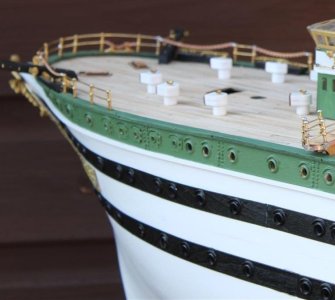
Sorry to harp back on this issue, however if I maintain schedule, I'll be installing the Air/Port holes next week.
I need to evaluate the risk of water ingress into the hull should I install these air/port holes as instructed.
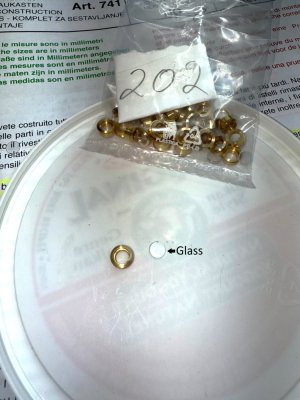
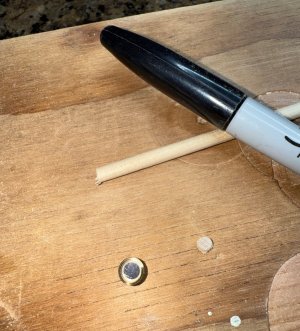
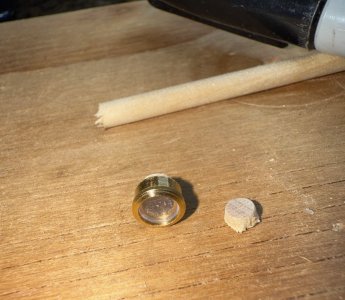
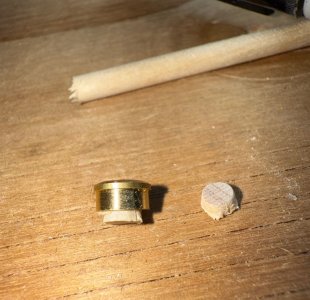
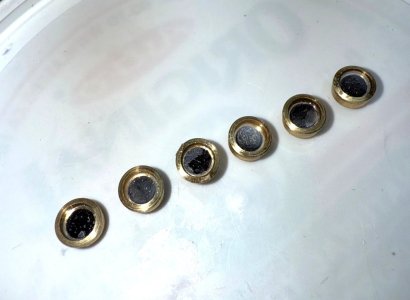
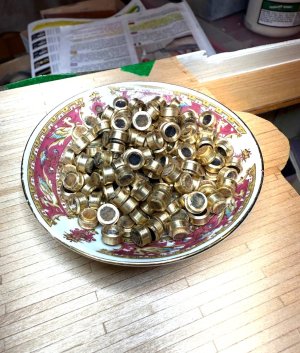
As seen below, the port holes are brass rings in various diameters, each press-fit with a 'glass' window. My fear is that should these 'glass' windows fall out, it leaves a water path into the hull.
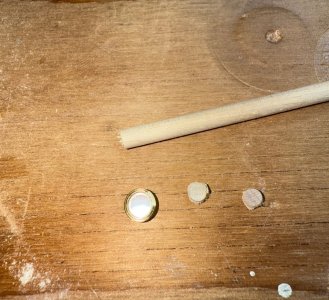
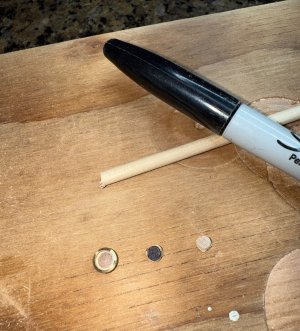
My options are to glue the windows into place using 'thin' CA glue...which will 'fog' the plexi-glass. Or, epoxy a small dowel inside the brass ring.
Of course, fitting a small dowel into the ring would be the ideal solution, however there are some 200 air/port holes that would take 2-days to modify.
Other posters who have had the opportunity to tour the Amerigo Vespucci managed to take some great photo's that are a great resource for scale model builders.
I've been looking for sources that describe the running rigging accurately that might help me understand how the mains sheets are controlled.
Unfortunately, I'm not great at remembering to take photos whenever I go places (half out of laziness, and half out of just wanting to enjoy my experience). I did dig through what few I did take, but none that really reveal much of the rigging and all are just of my wife and daughter on the ship, and I'm not keen on posting their pictures online. I hope you understand.
But thanks to AllesandroROMA, it seems to be a moot point. Regardless, the build seems to be coming along nicely! Good solution to the port holes. I know there's a lot of them to do, but I've learned to find such repetative steps to be somewhat meditative. Granted, I'm not always successful at that.
It's been a few weeks since my last update. I've been making some slow progress, largely due to some mild paralysis in my left arm. It gets better daily and I can see full mobility in a couple of weeks.
Working on the ship seems to be therapeutic.
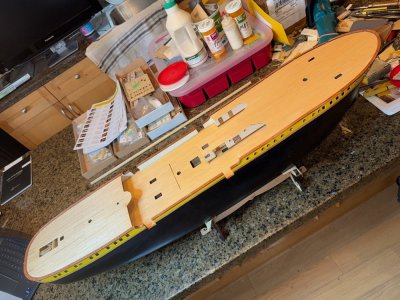
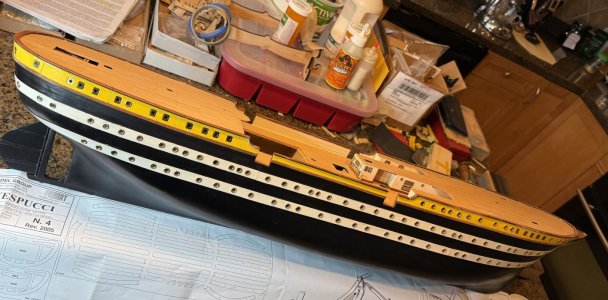
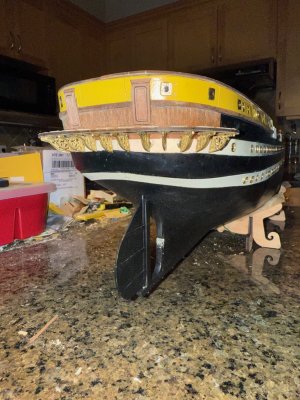
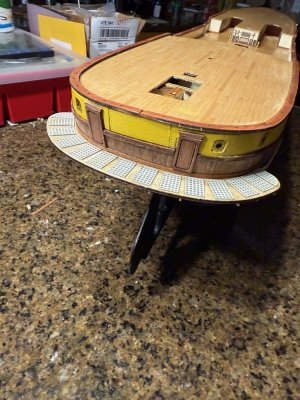
I'm pleased to report that the hull is now complete and ready for pool tests.
I'll have to fabricate a tote-wagon and get her in the water soon.
A few more details added before the hull sea trial.
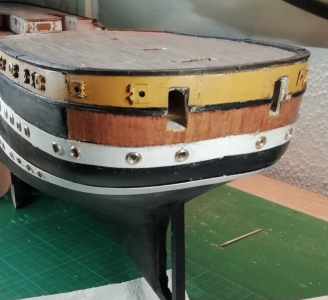
Made some adjustments to the assembly to accommodate the environment the ship will operate. Assembled the aft end using epoxy adhesives to withstand a water environment which results in longer curing time to the project.
Hull is scheduled to receive a satin varnish coating next week prior to trials.
I should note that where the model calls for door egress to be cut into the hull, I elected not to implement the penetration with the gaol of limiting any chance for water ingress.